5 pesos 1898
Market Prices
About This Note
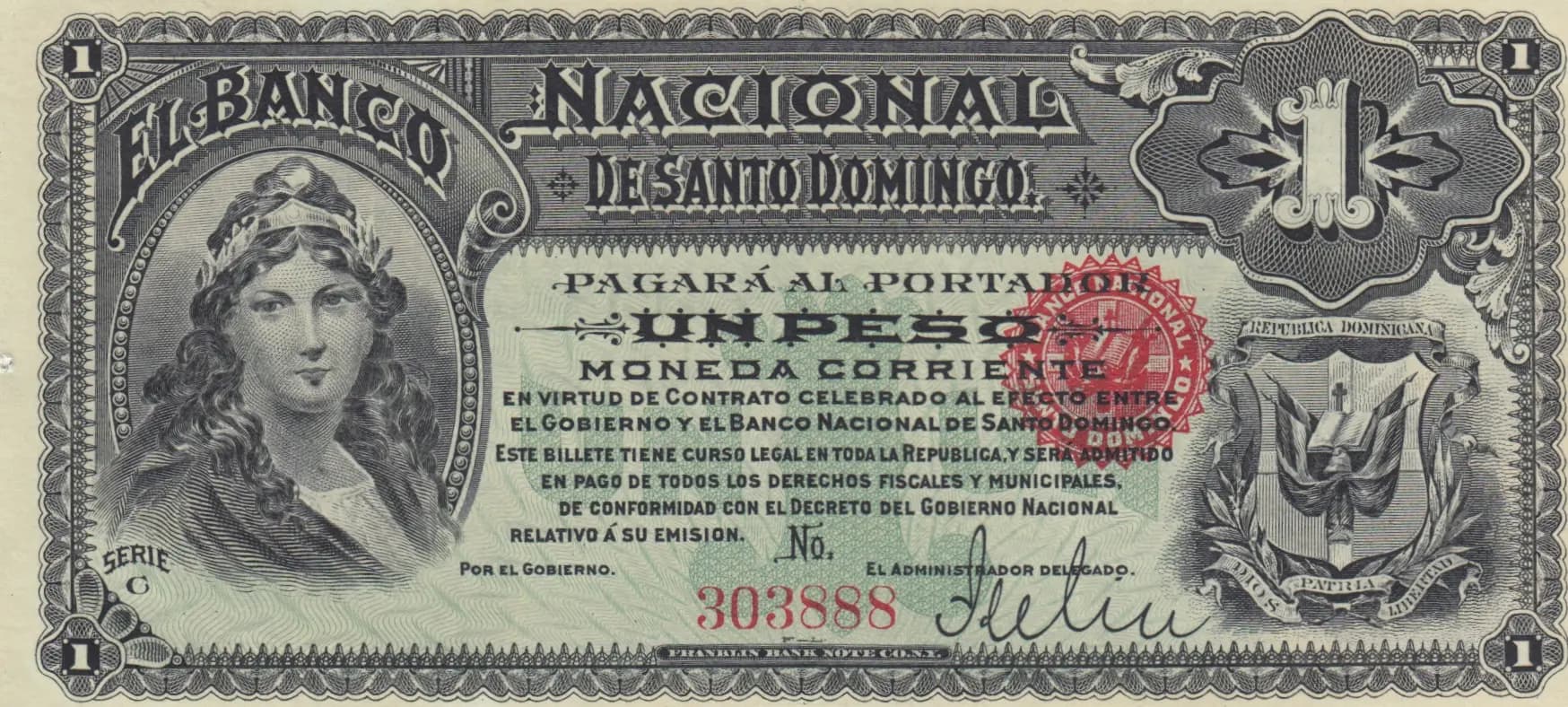
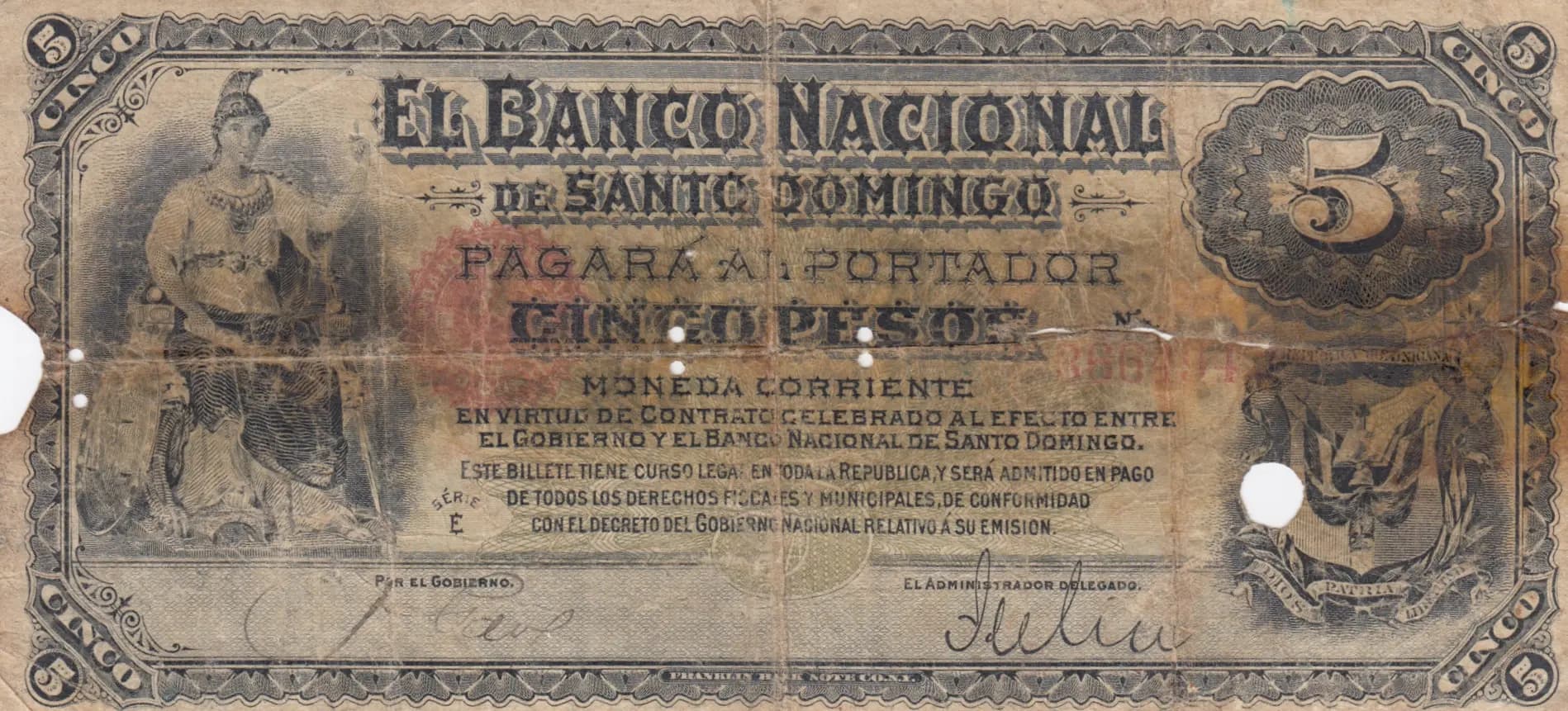
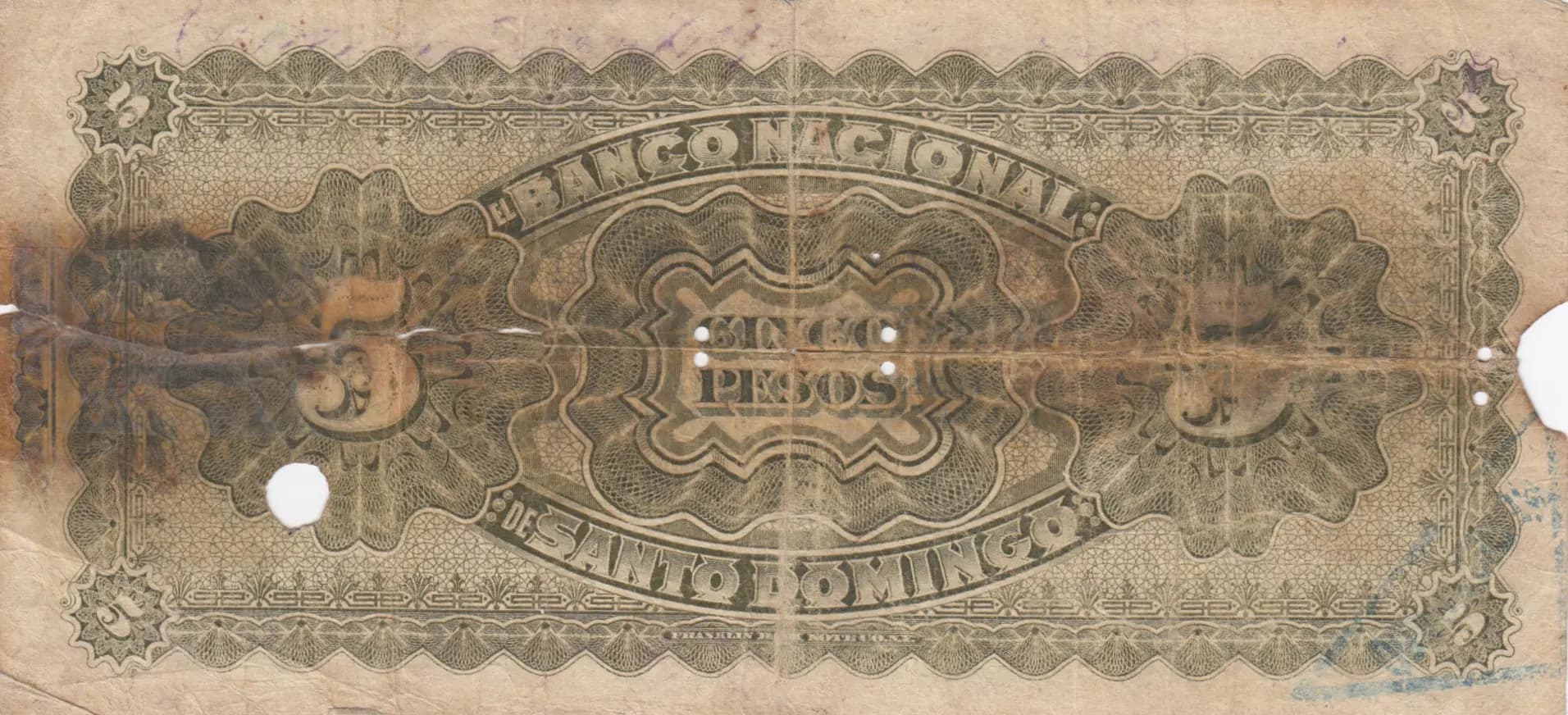
This 5 pesos banknote from El Banco Nacional de Santo Domingo represents an important early issue from the Dominican Republic's banking history. The note exhibits extensive circulation wear including creasing, foxing, brown staining, and perforations consistent with its G (Good) condition grade. The fine engraved design features a classical female portrait on the obverse and an ornate central medallion on the reverse, with the note's legal tender declarations prominently displayed across both sides.
Common. The eBay price tracking data shows significant price variation but includes multiple UNC specimens listed under $250, with several listings under $20. The presence of multiple examples in circulation and the straightforward design suggest this was a regular production issue. The G condition grade and worn state of the observed specimen, combined with the availability of higher-grade examples on the secondary market, indicates this is not a scarce or rare variety. The 1889 issue date and sustained production by El Banco Nacional de Santo Domingo further support a common classification.
Issued by El Banco Nacional de Santo Domingo in 1889 during a period of Dominican monetary modernization, this banknote represents the late 19th-century transition to a centralized banking system. The prominent Spanish inscriptions emphasizing legal tender status and government contractual backing reflect the Dominican Republic's efforts to establish monetary credibility and confidence in its nascent national banking authority during the post-independence era.
The obverse features a classical allegorical female portrait positioned on the left side, rendered in fine engraved style and adorned with elaborate jewelry and headdress, representing prosperity or commerce. The denomination '5' appears in ornamental corner designs with scalloped borders. The center displays the bank name and legal tender inscriptions in serif typeface. The reverse presents a dominant central oval medallion framed by baroque-style ornamental elements, with the denomination centrally positioned within the oval. Elaborate decorative border patterns with intricate line engraving surround the entire design, and corner ornaments feature decorative rosettes. The color palette throughout is monochromatic, utilizing brown, tan, gray, and black inks on aged paper.
FRONT: 'EL BANCO NACIONAL DE SANTO DOMINGO' (The National Bank of Santo Domingo); 'PAGARA AL PORTADOR' (Payable to Bearer); 'CINCO PESOS' (Five Pesos); 'MONEDA CORRIENTE' (Current Currency); 'EN VIRTUD DE CONTRATO CELEBRADO AL EFECTO ENTRE EL GOBIERNO Y EL BANCO NACIONAL DE SANTO DOMINGO' (By virtue of a contract made for that purpose between the Government and the National Bank of Santo Domingo); 'ESTE BILLETE TIENE CURSO LEGAL EN TODA LA REPUBLICA Y SERA ADMITIDO EN PAGO DE TODOS LOS DERECHOS FISCALES Y MUNICIPALES DE CONFORMIDAD CON EL DECRETO DEL GOBIERNO NACIONAL RELATIVO A SU EMISION' (This banknote is legal tender throughout the Republic and shall be accepted in payment of all fiscal and municipal charges in accordance with the Government's National Decree regarding its issuance); 'POR EL GOBIERNO' (By the Government); 'EL ADMINISTRADOR DELEGADO' (The Delegated Administrator); '5' (Five). BACK: 'BANCO NACIONAL DE SANTO DOMINGO' (National Bank of Santo Domingo); 'CINCO PESOS' (Five Pesos).
Intaglio engraving (steel or copper plate engraving), evidenced by the fine line work, portrait detail, and ornate decorative borders visible throughout both sides. The precision of the geometric patterns, the depth of the engraved lines, and the quality of the allegorical portrait are characteristic of bank note engraving by specialized security printers of the late 19th century. The specific printer for this Dominican Republic issue is not definitively identified from the visual evidence, but the high quality suggests work by an established continental or European security printing house.
Handwritten signatures are visible at the bottom of the obverse, indicating individual administrator and authorized officer signatures typical of the period. The specific signature varieties would require comparison with multiple examples to document. No printed serial numbers are clearly visible in the provided images, though signature position and type may constitute varieties. The note's perforations may indicate post-issue handling such as bank accounting marks or archive notation rather than manufacturing varieties. Without access to multiple examples or detailed catalog documentation of known varieties for Pick S133, specific variety attribution cannot be definitively established.