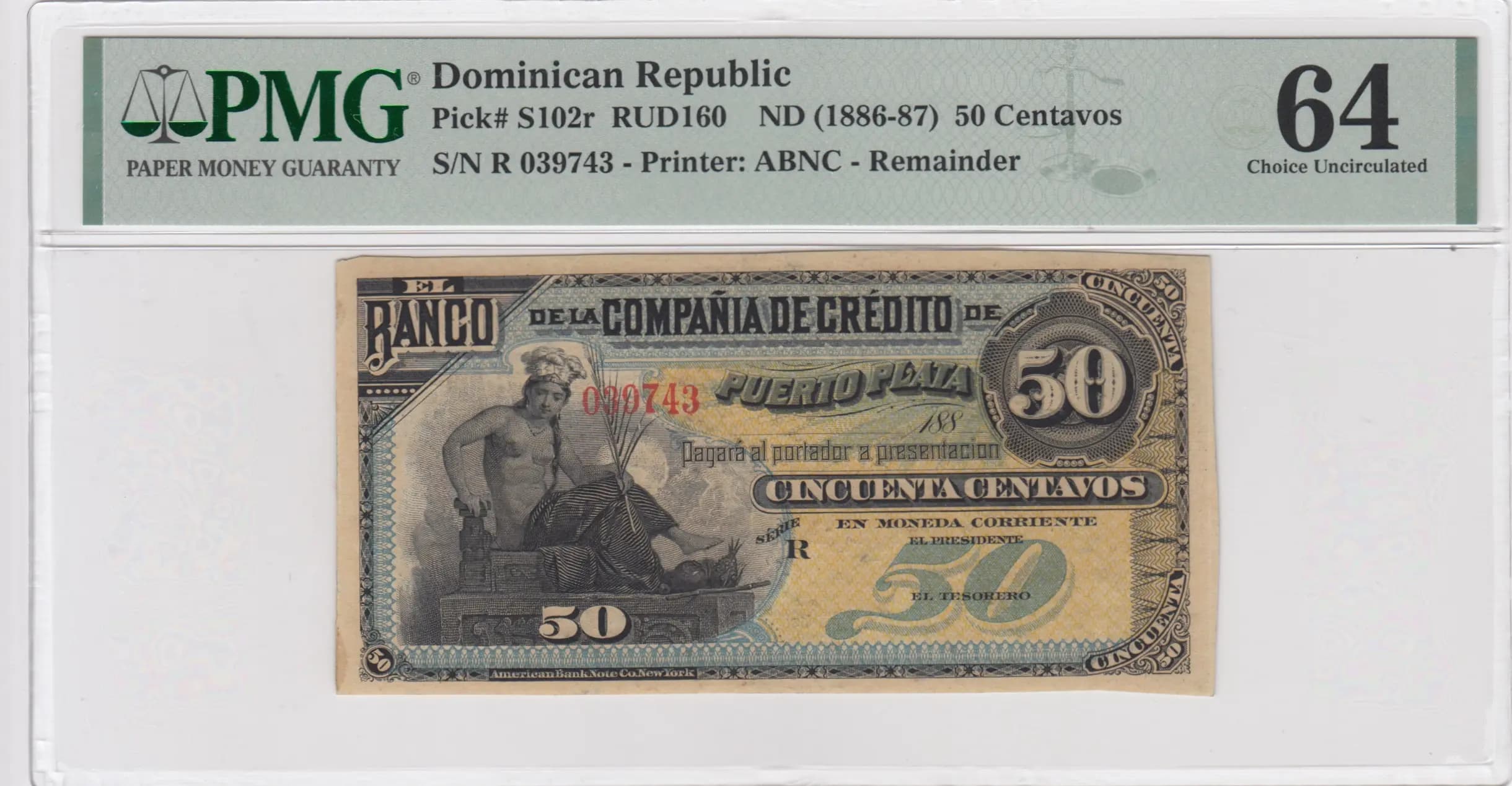
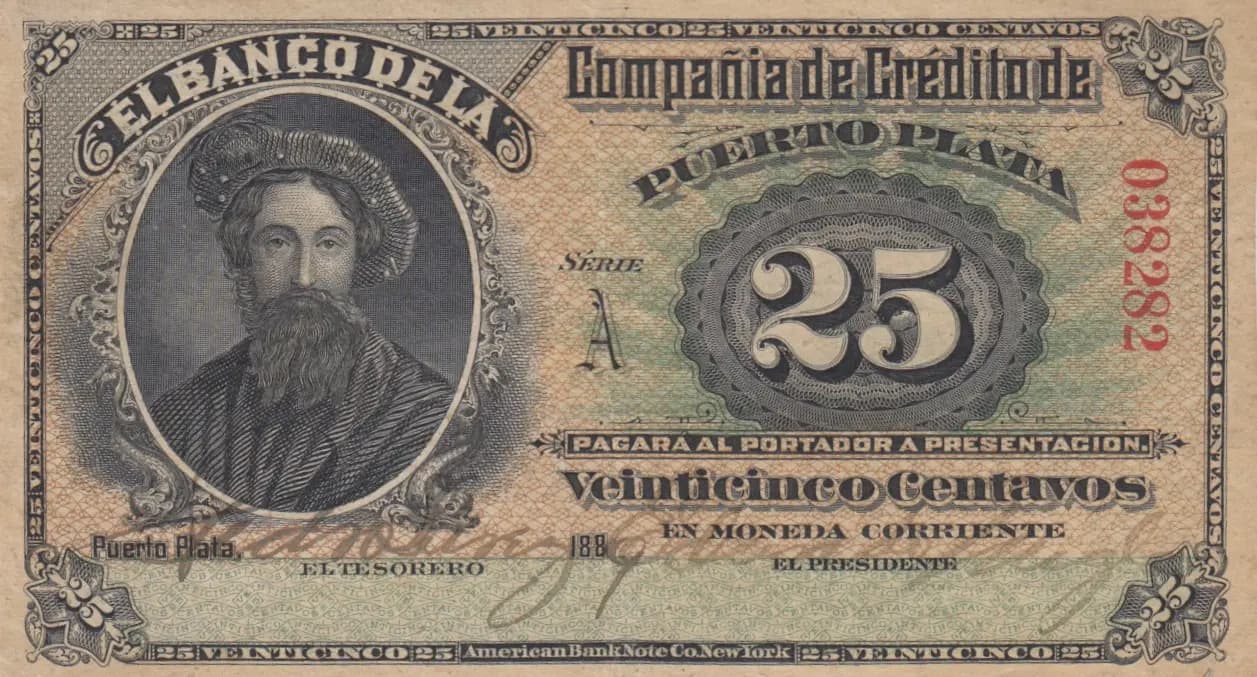
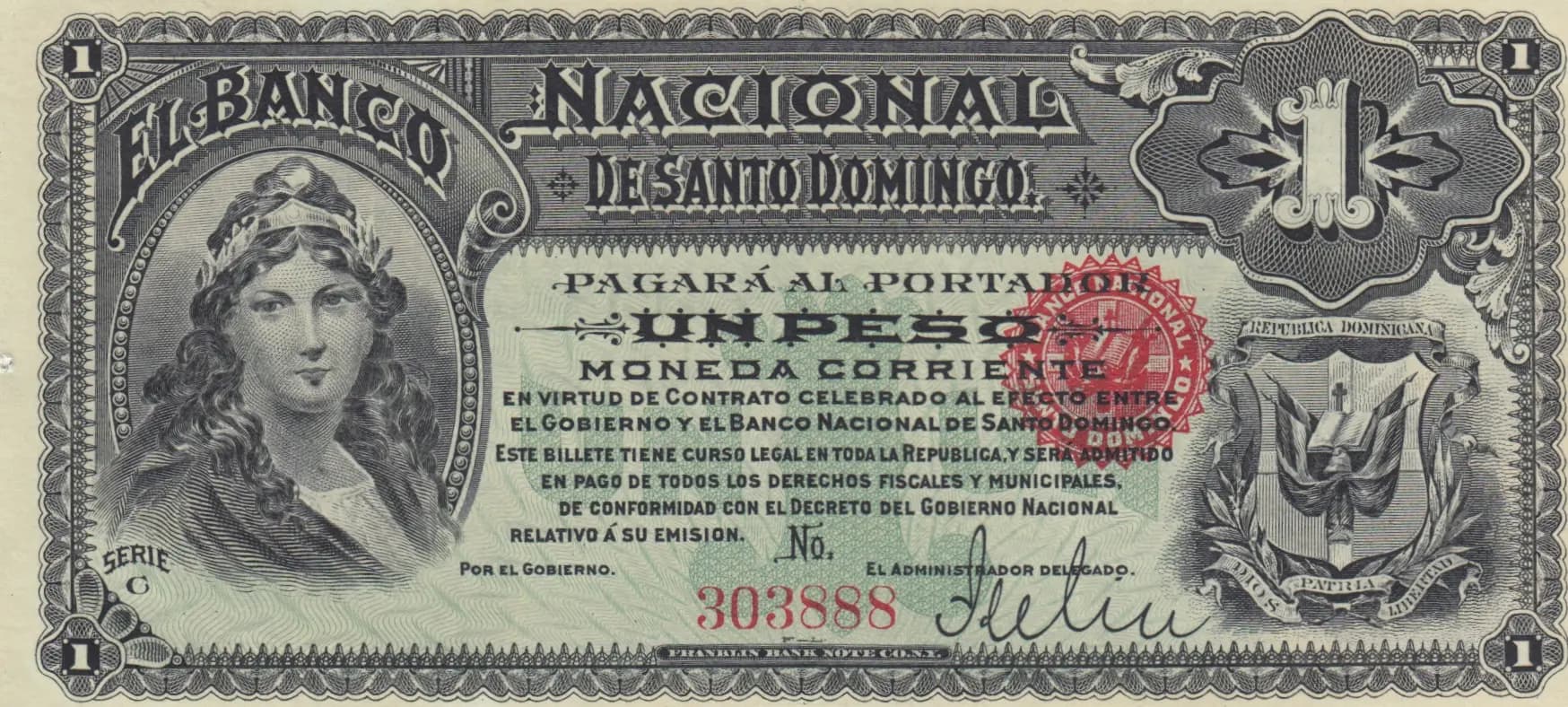
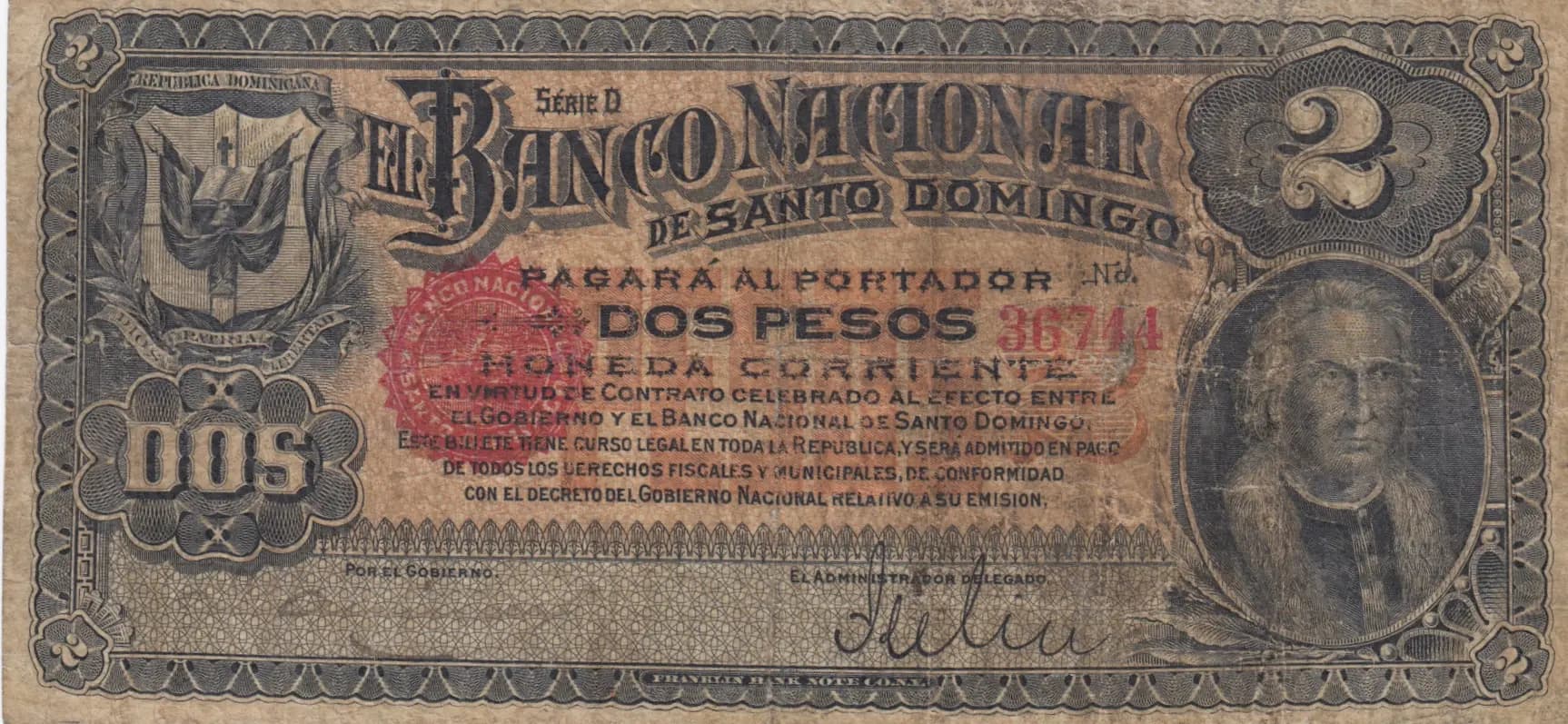
50 centavos 1886
Market Prices
1 saleAbout This Note
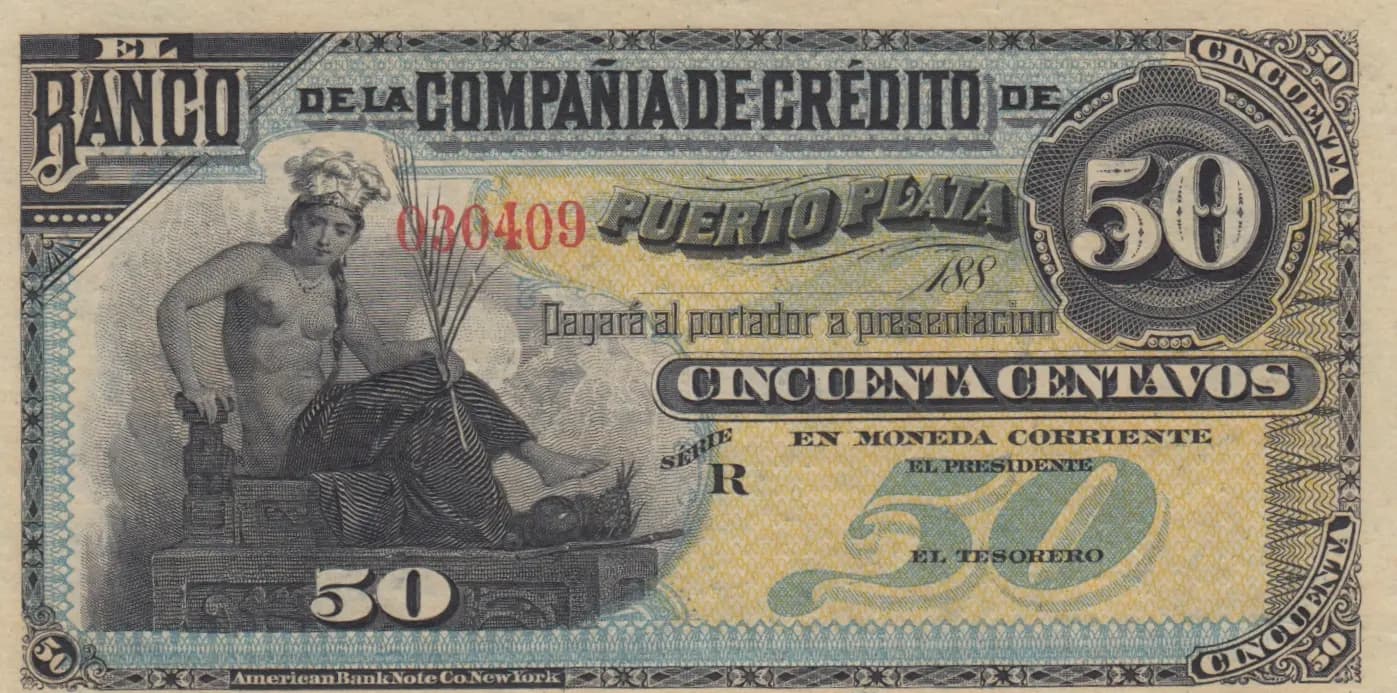
This is an exceptional 1886 50 centavos remainder note from the Banco de la Compania de Credito de Puerto Plata, featuring stunning classical allegorical imagery characteristic of ABNC's finest 19th-century work. The obverse displays a seated Indian woman ("La Hija de los Incas") in elaborate headdress holding palm fronds, rendered in intricate engraved detail on a cream background with blue and gold underprinting. Though bearing signs of age including foxing and a red manuscript serial marking (0/30409), the note retains sharp impressions of its ornate borders and security line work, making it a desirable example of Caribbean private bank currency from the 1880s.
Common. Despite being cataloged as a remainder note (unsigned/unissued), the eBay reference price of $63 for a PMG 53 specimen indicates this is a relatively accessible note in the collector market. The Banco de la Compania de Credito de Puerto Plata issued these notes in quantities typical of regional Caribbean banks, and while private bank notes from this era have limited surviving populations, this particular denomination and series does not exhibit the extreme scarcity markers (small print runs, rapid recall, short operational lifespan of the bank) that would elevate it to rare status. Its presence in eBay market circulation and the relatively modest pricing confirm common classification.
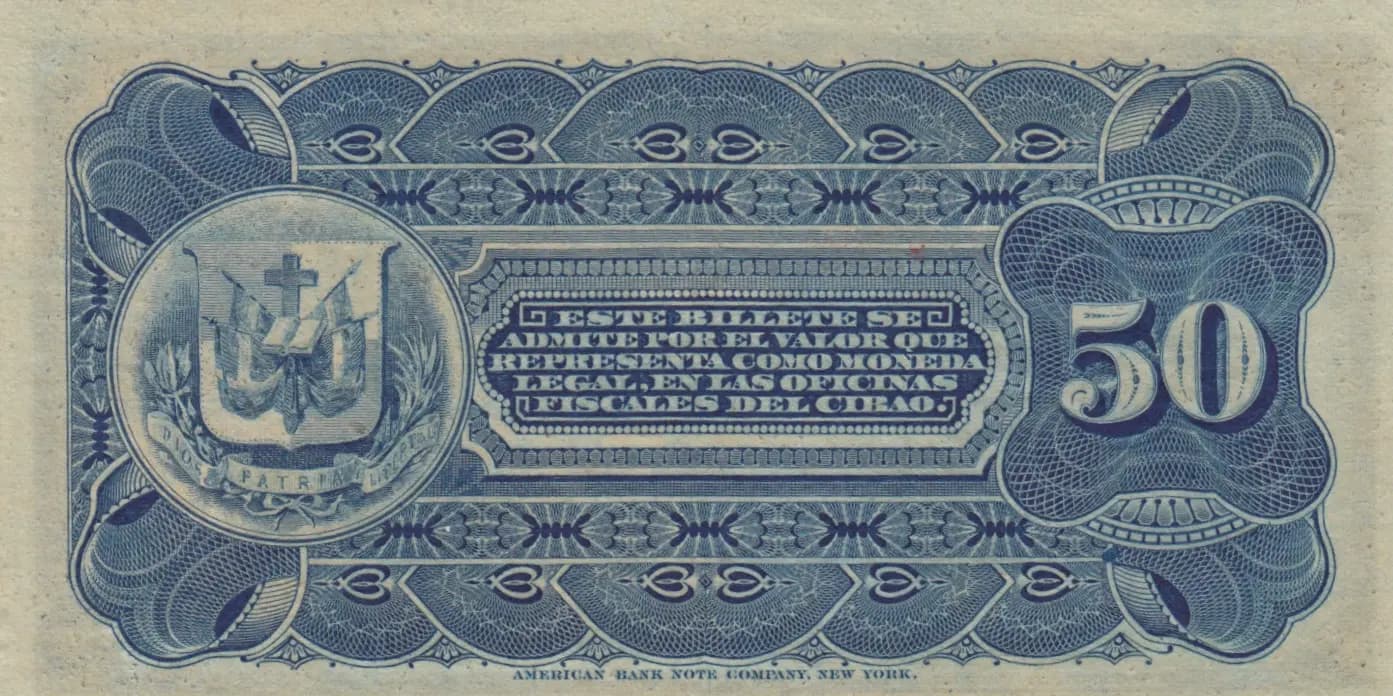
This note was issued during the height of Dominican Republic's private banking era, when regional credit institutions like the Puerto Plata bank issued their own currency backed by commercial operations. The allegorical imagery—particularly the seated Indian woman with palm fronds—reflects 19th-century artistic conventions romanticizing pre-Columbian heritage and tropical commerce, while the Dominican coat of arms featuring a cross and sailing ship on the reverse emphasizes the nation's maritime and Christian identity. As an unsigned remainder (likely produced but never placed into circulation in full form), this note provides rare documentary evidence of the sophisticated banknote design and production capabilities that ABNC maintained for even small regional issuers in the Caribbean.
The obverse features a classical allegorical seated female figure—identified as 'La Hija de los Incas' (Daughter of the Incas)—positioned on the left side, depicted wearing an elaborate feathered or beaded headdress and holding palm fronds, symbolizing fertility, commerce, and tropical wealth. The central text area identifies the issuing bank and denomination in clear typography, while a large ornamental circular frame on the right encloses the numeral '50' in decorative serif numerals. The entire design is framed by elaborate engraved borders featuring repeating floral and geometric motifs rendered in black ink on a cream background, with blue and gold underprinting visible throughout. The reverse presents the Dominican Republic coat of arms—a shield containing a cross and sailing ship symbol—within an ornamental circular frame flanked by laurel wreaths on the left, while a matching ornamental '50' appears on the right. The entire back is printed in blue monochrome, creating a formal and authoritative appearance. All lettering and decorative elements demonstrate the hallmark precision and artistic refinement of high-quality 19th-century banknote engraving.
FRONT SIDE: 'BANCO DE LA COMPAÑIA DE CRÉDITO DE PUERTO PLATA' (Bank of the Credit Company of Puerto Plata); '1886' (Year); 'Pagará al portador a presentación' (Will pay to bearer upon presentation); 'CINCUENTA CENTAVOS' (Fifty centavos); 'EN MONEDA CORRIENTE' (In current currency); 'EL PRESIDENTE' (The President); 'EL TESORERO' (The Treasurer); 'SERIE R' (Series R); '0/30409' (Serial number); 'American Bank Note Co. New York' (Printer attribution). BACK SIDE: 'ESTE BILLETE SE ADMITE POR EL VALOR QUE REPRESENTA COMO MONEDA LEGAL EN TODAS LAS TRANSACCIONES FISCALES DEL CIBAO' (This note is accepted for the value it represents as legal currency in all fiscal transactions of the Cibao); 'AMERICAN BANK NOTE COMPANY, NEW YORK.' (Printer attribution).
Steel plate intaglio engraving (also known as line engraving), executed by the American Bank Note Company (ABNC) of New York. This technique, evidenced by the fine cross-hatching, intricate line work, and precise detail throughout both sides, was the industry standard for security banknote production in the 1880s. The visible color separation—black ink for primary imagery and text, blue for the reverse side, with gold and blue underprinting on the obverse—indicates multi-pass printing using separate engraved plates for each color layer, a sophisticated approach that ABNC employed for high-security notes.
This specimen is specifically identified as Series R with serial number 0/30409. The catalog designation P-S102r indicates this is a remainder variety (the 'r' suffix), meaning it was printed but never officially signed by bank officials or fully activated for circulation. The red manuscript marking visible on the front (0/30409) appears to be a bank clerk's notation rather than an official overprint. Collectors should note that signed versions of this design (if they exist in circulation) would be cataloged as P-S102, making remainder examples distinctly identifiable. The 1880 issue date referenced in the catalog data versus the 1886 printed date on the note itself may indicate a printing delay or stock preparation period common in 19th-century banknote production.