40 pesos 1848
Market Prices
1 saleAbout This Note
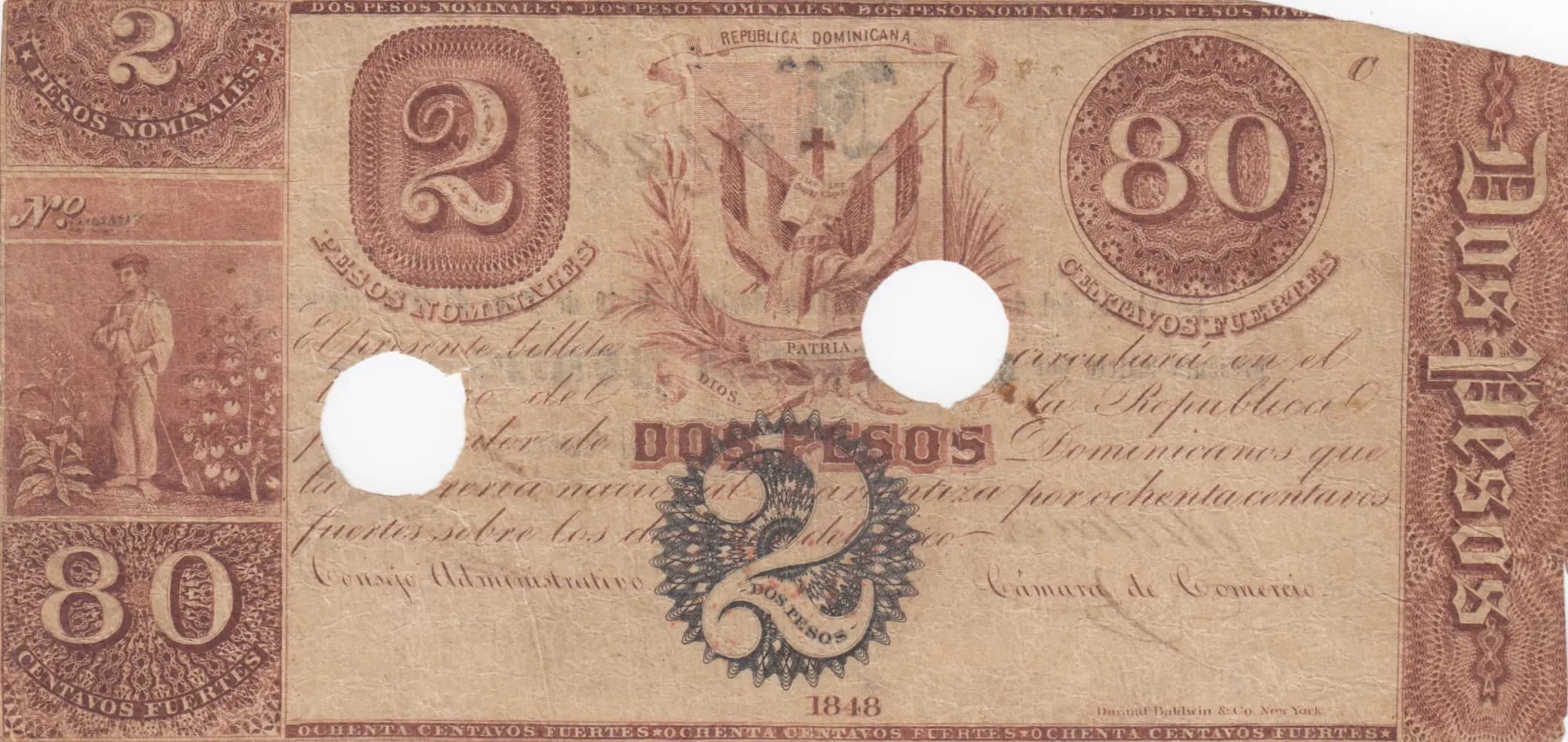
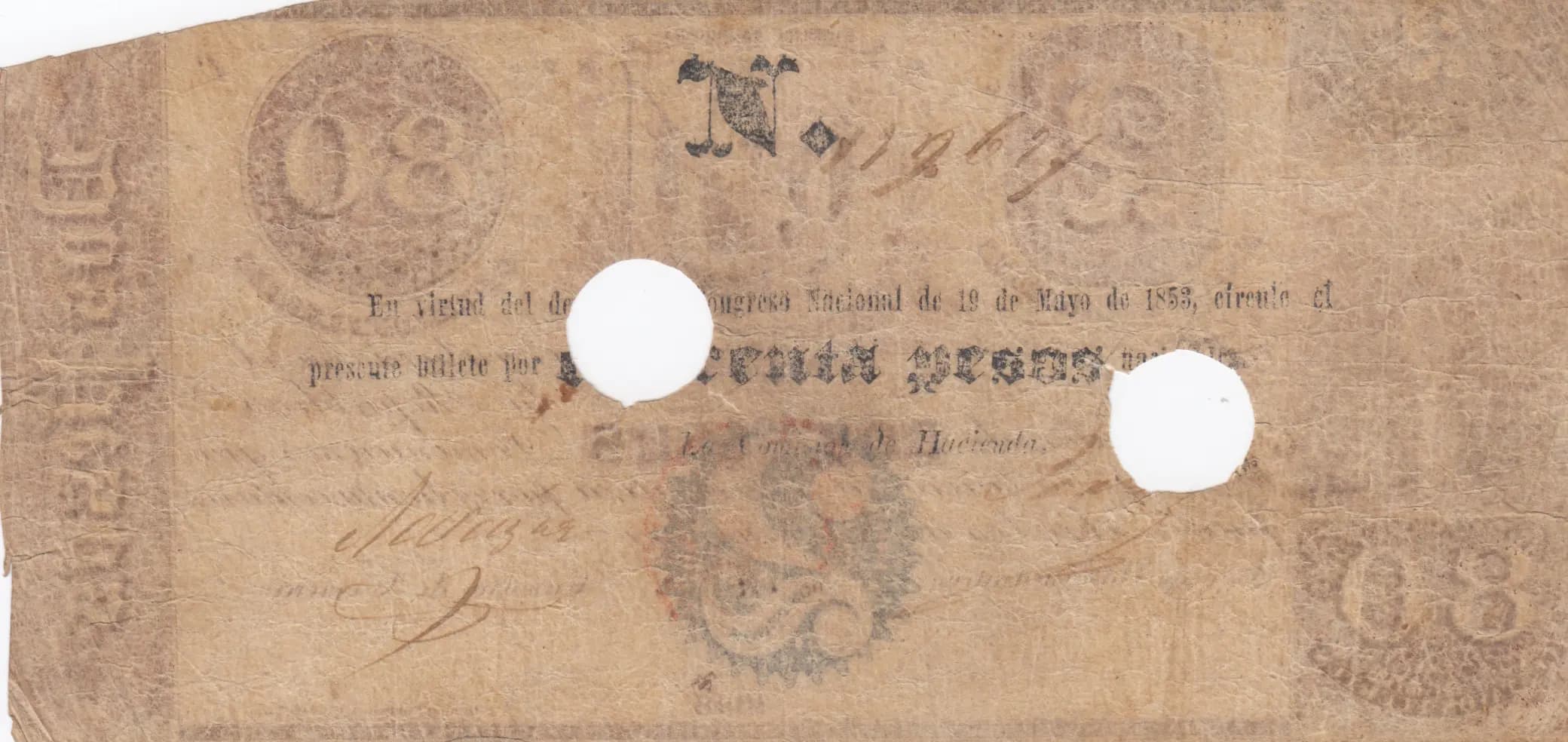
This is a scarce 1848 Dominican Republic 40 Pesos banknote (Pick P-7) in Fair condition, displaying the characteristic brown/tan color palette and agricultural imagery typical of early Dominican currency. The note features an intricate engraved design by Durand, Baldwin & Co. of New York, with a farmer figure at left, heraldic double-headed eagle, religious cross symbolism, and an important 1853 Congressional decree overprint on the reverse that documents its circulation authorization. The significant aging, foxing, and paper degradation are consistent with its near-175-year age, and the presence of handwritten signatures for authentication adds to its historical character.
Scarce. While the catalog value for this Pick number in Fair condition is listed at $225 (2016), and a comparable VG example sold for $77 in 2017 with strong bidding interest (18 bids), the note's survival rate appears limited. Early Dominican banknotes from 1848, particularly with overprints documenting specific circulation decrees, were subject to wear, loss, and potential recall/destruction during the republic's politically unstable early decades. The requirement for handwritten official signatures and the 1853 overprint suggest this was a formally authorized, traceable issue with controlled circulation, which may have limited total surviving examples. Specimens in Fair condition (showing the aging and foxing evident here) are less frequently encountered than VG examples in the secondary market.
Issued in 1848 during the early years of Dominican independence (the nation had gained sovereignty in 1844), this banknote reflects the fledgling republic's effort to establish a stable currency system. The agricultural imagery—depicting a farmer with spade and rural scenes with plants—symbolizes the nation's agrarian economy and natural wealth, while the heraldic eagle and coat of arms reinforce state sovereignty and national identity. The 1853 overprint visible on the reverse documents a key monetary decree passed by the Dominican Congress, indicating that this note remained in circulation for several years and was formally reauthorized by governmental action, reflecting the turbulent early political history of the Dominican Republic.
The obverse features a standing male figure representing a farmer or agricultural laborer positioned at left, rendered in period dress and holding a spade, symbolizing the Dominican Republic's agrarian foundation. The central design contains a prominent religious cross with radiating sunburst effect, emphasizing the Catholic faith integral to Dominican identity. A double-headed heraldic eagle with spread wings dominates the lower center of the composition, serving as the national emblem. Elaborate decorative borders frame the entire note with repeated text patterns and fine engraved line work. Multiple denomination indicators are displayed—'40 Pesos' and '80 Centavos Fuertes'—reflecting a currency conversion or dual-value system. The reverse carries the heraldic eagle again on the left side, along with printed decree text from May 19, 1853, authorizing its continued circulation, and space for handwritten governmental signatures. Rural agricultural scenery with plants and flowers enhances the left side vignette on the obverse.
FRONT SIDE: 'República Dominicana' (Dominican Republic); 'Dos Pesos Nominales' (Two Nominal Pesos); 'Patria' (Homeland/Fatherland); 'Dos Pesos' (Two Pesos); '80' and 'Ochenta Centavos Fuertes' (Eighty Strong Centavos); '1848' (year of issue); 'Danold Dalsis in S. Co. New York' (printer/engraver attribution). BACK SIDE: 'En virtud del decreto de Nuestra Nacional de 19 de Mayo de 1853, circulante el presente billete por la Ciudad de Huegoada' (By virtue of the decree of Our Nation of May 19, 1853, circulating the present banknote for the City of Huegoada); followed by handwritten signatures for official authentication.
Steel engraving with intaglio printing, executed by the New York firm Durand, Baldwin & Co., one of the premier American security printers of the mid-19th century. The fine line work in borders, intricate ornamental patterns, and detailed portraiture are characteristic of hand-engraved steel plate production. The note employs multiple colors in the brown/tan family with darker brown and black ink for text and signatures, typical of period banknote production. The handwritten signatures on the reverse indicate manuscript authentication by designated government officials, a common security practice for early currency.
This specimen represents the overprinted variety documented with the May 19, 1853 Congressional decree ('decreto Congreso Nacional de Mayo de 1853') visible on the reverse, indicating it circulated subsequent to formal governmental reauthorization. The specific City designation 'Huegoada' on the reverse may represent a regional distribution variety. The handwritten signatures, while standard authentication protocol, may vary between specimens depending on which officials signed each individual note. The dual denomination display ('40 Pesos' / '80 Centavos Fuertes') appears consistent with the Pick P-7 listing, though the arithmetic relationship (40 pesos = 80 centavos?) may reflect early Dominican currency conversion rates or a printing anomaly worth noting for specialized collectors.