20 pesos 1848
Market Prices
About This Note
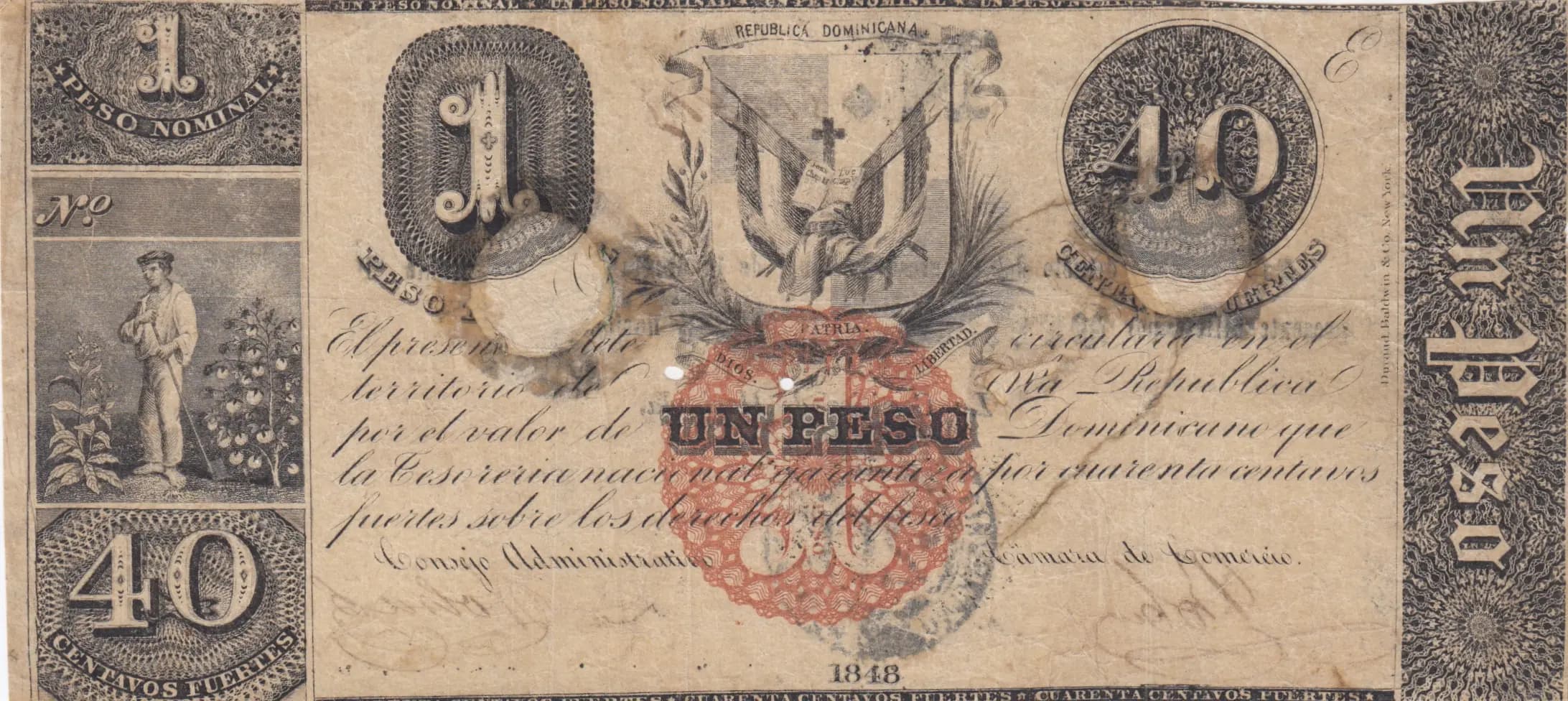
This is a Dominican Republic 20 Pesos banknote from 1848 (Pick P-6), printed by Durand, Baldwin & Co. of New York. The note features an allegorical female figure in classical dress alongside the Dominican coat of arms, with ornate circular medallions displaying denominations. The specimen exhibits Fair condition with heavy wear, significant foxing, yellowing, and creasing consistent with over 170 years of circulation—a challenging find for collectors of early Dominican currency.
Common. Although this is an early Dominican banknote from 1848, the eBay price data provided shows most comparable specimens trading in the $2.88–$8.07 USD range, with one VF example at $200 and an outlier at $450—suggesting the latter are exceptional sales rather than typical market values. The 2016 catalog value for this note in Fair condition is $175, indicating a note of modest collector demand. The denomination, while historically significant, was produced in sufficient quantities to remain accessible to collectors, and Fair condition examples are not particularly scarce.
Issued in 1848 during the early years of Dominican independence (proclaimed 1844), this banknote reflects the young republic's attempt to establish a modern currency system. The presence of the national coat of arms with its distinctive cross and shield, combined with inscriptions referencing the National Congress and Finance Commission, demonstrates the state's assertion of sovereignty and financial authority during a period of institutional consolidation following independence from Haiti.
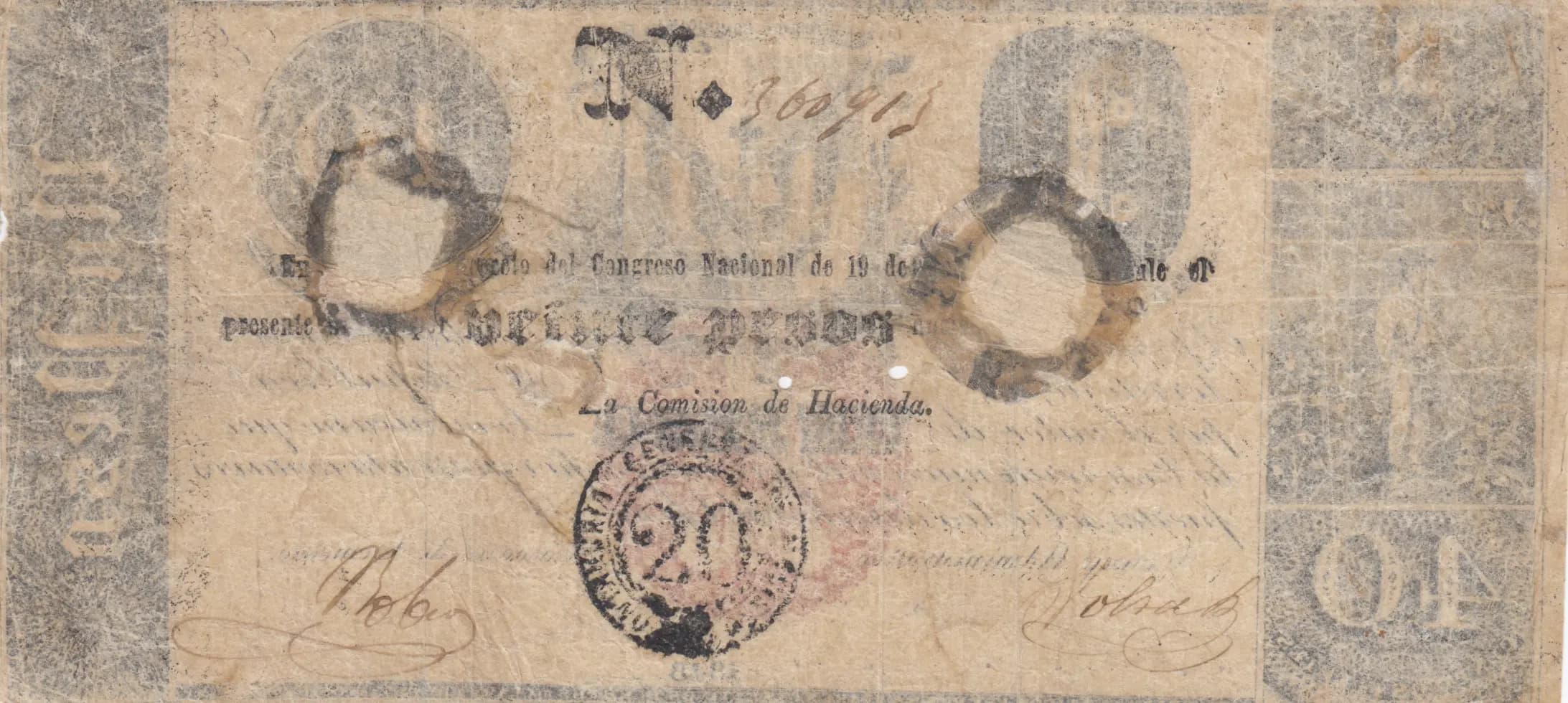
The obverse features a left-side vertical panel containing an allegorical female figure dressed in classical Greco-Roman style, representing Liberty or the Republic, positioned beside flowering plants symbolizing prosperity. The center displays the Dominican Republic's national coat of arms featuring a centered cross above a shield with laurel branches, surrounded by ornate scrollwork. Circular ornamental medallions frame key denominations: the left medallion contains 'PESO NOMINAL,' the upper center shows the numeral '1,' the right displays '40' (centavos), and the far right contains '2.' The text 'UN PESO' appears prominently with heraldic flourishes. The reverse contains governmental text referencing the National Congress decree and Finance Commission, with a central circular impressed seal displaying the denomination '20,' multiple embossed stamp impressions indicating official validation, and decorative border patterns.
Front side: 'REPÚBLICA DOMINICANA' (Dominican Republic), 'UN PESO' (One Peso), 'PESO NOMINAL' (Nominal Peso), 'CUARENTA CENTAVOS FUERTES' (Forty Strong Centavos), '1848' (date), 'Cámara de Comercio' (Chamber of Commerce), 'Consejo Administrativo' (Administrative Council). Back side: 'Decreto del Congreso Nacional de 19 de' (Decree of the National Congress of the 19th of), 'presente' (present [month]), 'La Comision de Hacienda' (The Finance Commission), 'pagador' (payer).
Steel engraving with intaglio printing, executed by Durand, Baldwin & Co., New York—a prominent security printer of the 19th century. The fine line work visible in the circular medallions, the intricate scrollwork, and the detailed allegorical figure are characteristic of hand-engraved steel plate intaglio production. The circular impressed seals and blind stamp impressions on the reverse indicate the use of embossing dies for additional security validation.
This note represents the standard 1848 issue with the overprint notation referencing 'del decreto Congreso Nacional de Mayo de 1853' (from the decree of the National Congress of May 1853), indicating a later validation or revalidation stamp applied to original 1848 stock. The reverse bears evidence of multiple official impressions and stamps from the Finance Commission and Administrative Council, typical of governmental processing and circulation during the period. Serial numbers and signatures are not clearly visible in the provided images due to wear and deterioration, preventing identification of specific numbered varieties.