100 pesos 1912
Market Prices
About This Note
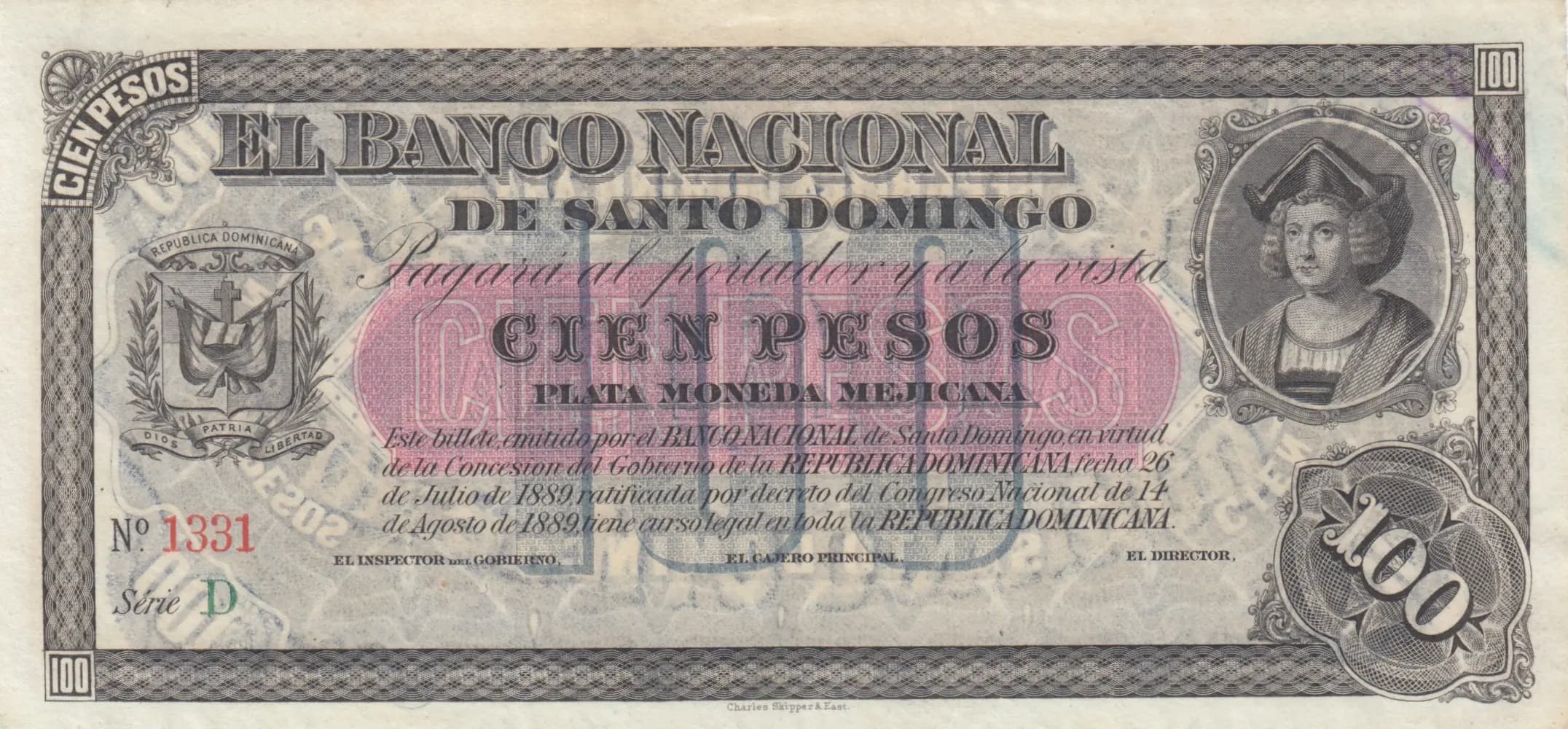
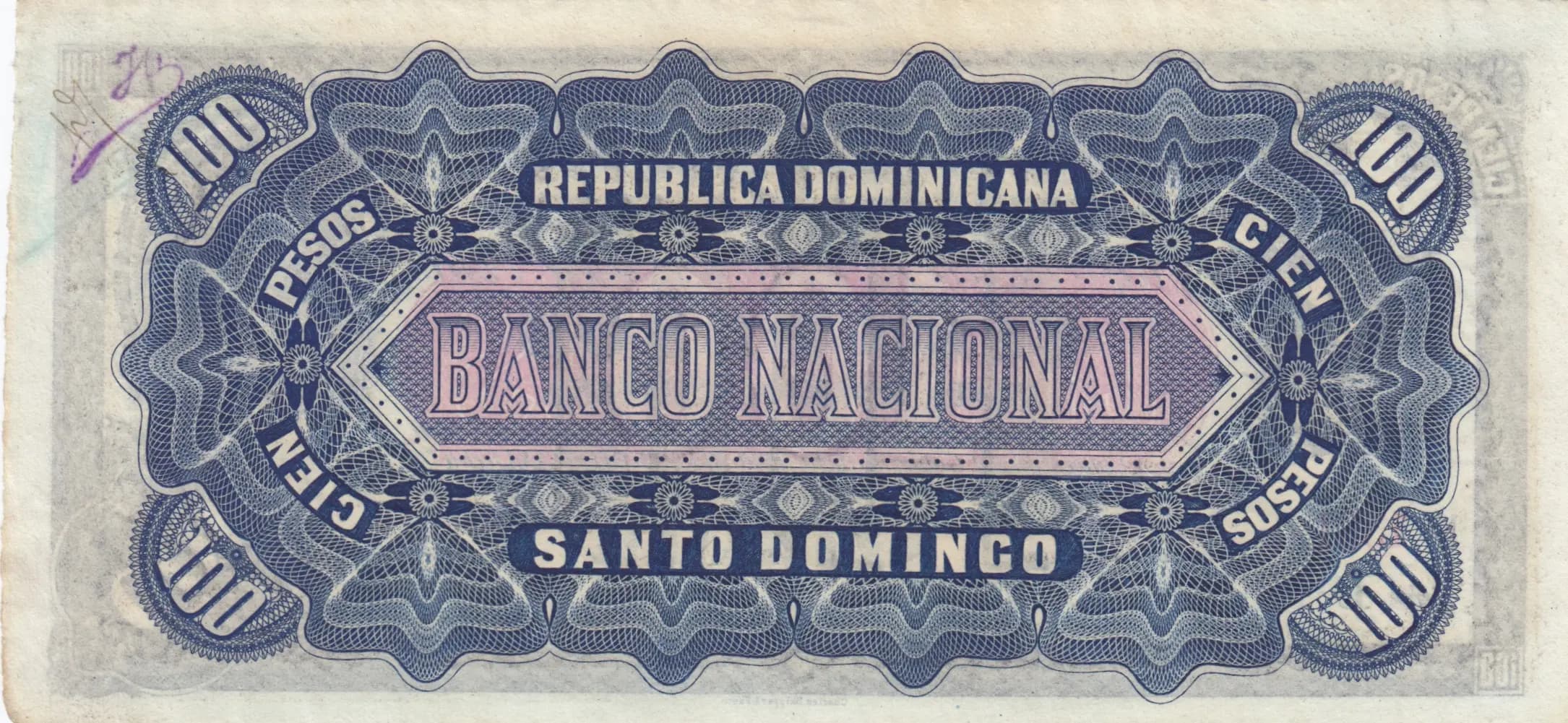
This is a 100 pesos banknote issued by El Banco Nacional de Santo Domingo in 1889, bearing the catalog designation Pick S147. The note features an attractive design with a pink/rose central oval on the front containing denomination text, a coat of arms on the left, and a portrait of a woman in Renaissance-style dress on the right. The reverse displays an elaborate blue design with ornamental cartouches and geometric patterns. This example shows significant age-related wear including foxing, yellowing, and creasing, consistent with genuine circulation from the early 20th century, and retains the handwritten notations typical of historical bank processing.
Common. The eBay market data provided shows this note trading regularly across multiple condition grades with prices ranging from $3.49 to $780.00 USD, with the VF grade (matching this specimen) listed at $495.00 USD. The consistent availability of examples across multiple grades and the wide price range indicate this was not a limited issue. Dominican Republic early banknotes from this period, while historically significant, were issued in sufficient quantities to remain obtainable for collectors. The designation as a 'remainder banknote' (unsigned specimens) in catalog references further suggests these were produced in quantities sufficient to leave remainder stock.
This banknote was issued under the concession granted by the Dominican Republic government on July 26, 1889, ratified by National Congress decree on August 14, 1889, establishing the Banco Nacional de Santo Domingo as the authorized currency issuer. The note's inscription referencing 'PLATA MONEDA MEJICANA' (Mexican Silver Currency) reflects the monetary systems in use across the Caribbean during this period, when Dominican commerce maintained ties to Mexican silver standards. The formal legal tender declaration printed on the note underscores the government's commitment to establishing a modern banking system in the late 19th-century Dominican Republic.
The obverse features a well-balanced composition with the Dominican coat of arms positioned at the left, displaying a shield containing a cross and palm fronds beneath a banner inscribed 'PATRIA' (Fatherland) and 'DIOS' (God). The central design is dominated by a pink/rose-colored oval cartouche containing denomination text. On the right side is an oval-framed portrait of a woman depicted in Renaissance-style dress with period headdress, executed in classical engraving style. A decorative rosette or wheel motif appears in the upper left corner, while geometric cross-hatching patterns form an ornamental border throughout. The reverse presents an elaborate blue composition with a central rectangular cartouche housing 'BANCO NACIONAL', surrounded by complex floral and geometric engraved patterns with scalloped decorative borders. The denomination appears multiple times on both left and right sides for clarity.
FRONT: 'CIEN PESOS' (One Hundred Pesos); 'EL BANCO NACIONAL DE SANTO DOMINGO' (The National Bank of Santo Domingo); 'PLATA MONEDA MEJICANA' (Mexican Silver Currency); 'REPUBLICA DOMINICANA' (Dominican Republic); 'Serie D' (Series D); 'Nº 1331' (Number 1331); 'EL INSPECTOR del GOBIERNO' (The Government Inspector); 'EL CAJERO PRINCIPAL' (The Principal Cashier); 'EL DIRECTOR' (The Director); Extended legal tender declaration: 'Este billete emitido por el BANCO NACIONAL de Santo Domingo en virtud de la Concesion del Gobierno de la REPUBLICA DOMINICANA fecha 26 de Julio de 1889 ratificada por decreto del Congreso Nacional de 14 de Agosto de 1889 tiene curso legal en toda la REPUBLICA DOMINICANA' (This banknote issued by the NATIONAL BANK of Santo Domingo by virtue of the Concession of the Government of the DOMINICAN REPUBLIC dated July 26, 1889 ratified by decree of the National Congress of August 14, 1889 has legal tender throughout the DOMINICAN REPUBLIC). BACK: '100 PESOS' (100 Pesos); '100 CIEN PESOS' (100 One Hundred Pesos); 'REPUBLICA DOMINICANA' (Dominican Republic); 'BANCO NACIONAL' (National Bank); 'SANTO DOMINGO' (Santo Domingo).
Steel engraving and intaglio printing, characteristic of high-security banknote production of the late 19th century. The visual analysis reveals the intricate line work, fine cross-hatching, detailed vignettes, and complex geometric patterns typical of bank note engraving from this era. The printer is identified as CS&E (likely Continental and Commercial Security Printing or similar security printer) based on catalog references. The multi-color design (black on pink/blue underprint on front; blue on reverse) was achieved through successive impressions, a standard technique for period banknote production.
This note is identified as Series D with serial number 1331, which are key variety markers. The catalog data indicates this is an unsigned remainder banknote, meaning it lacks the signature lines that would appear on notes released into actual circulation. The visual analysis confirms the absence of signatures, consistent with remainder classification. The note being undated on the actual design (despite the 1889 concession date in text) and the 1912 catalog year assignment suggests there may be variants with different series letters (A, B, C, etc.). The handwritten annotations in blue/purple ink visible on both sides are typical of bank processing marks from the era and do not constitute a printing variety but rather evidence of institutional handling.