5 öre 1951
“red cross”
About This Note
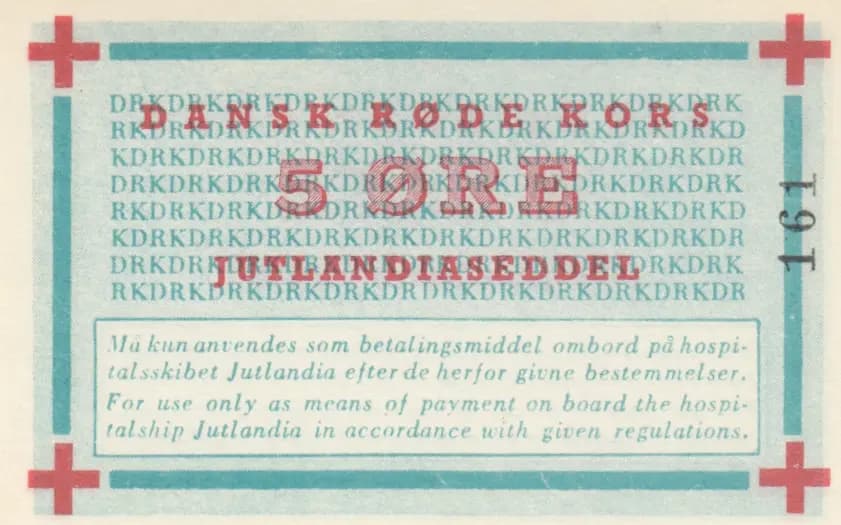
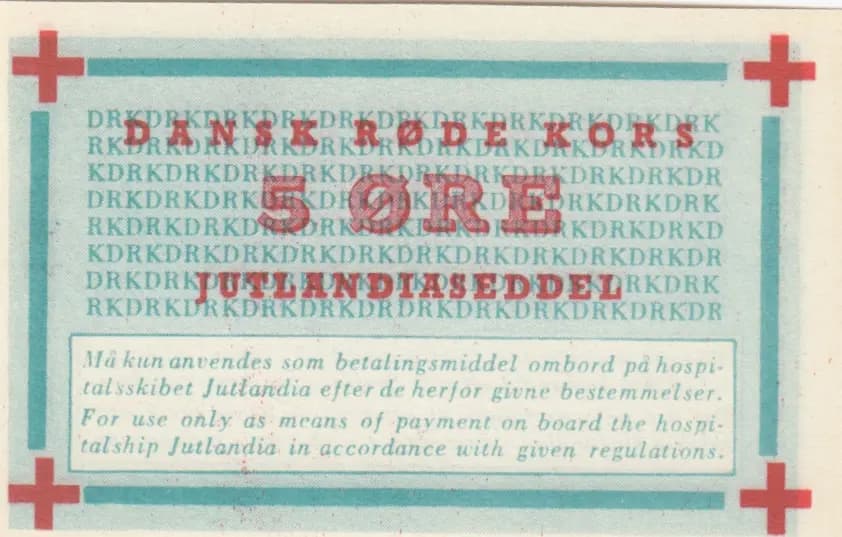
This is a distinctive 1951 Danish Red Cross emergency banknote issued for use aboard the hospital ship Jutlandia. The note features a striking teal and red color scheme with red cross symbols at the corners and bilingual instructions in Danish and English. In UNC condition, it displays only minimal aging with slight foxing and creasing, making it an excellent example of this specialized commemorative scrip.
Common. This is an emergency scrip issued by the Danish Red Cross for a specific humanitarian purpose. While not mass-produced like circulation currency, these notes were created in sufficient quantities for practical use aboard the hospital ship Jutlandia. The lack of Pick catalog listing does not indicate rarity—rather, it reflects that specialized scrip and emergency notes are often excluded from standard currency catalogs. The UNC condition grade and the straightforward design suggest that examples survive in reasonable numbers among collectors of Danish numismatic items and Red Cross memorabilia.
The Danske Røde Kors (Danish Red Cross) issued this scrip specifically for the hospital ship Jutlandia, reflecting post-World War II humanitarian efforts and the organization's role in international medical aid. The bilingual nature of the inscriptions and the explicit mention of the vessel's name underscore Denmark's engagement in international Red Cross operations during the early Cold War period. This note represents a unique intersection of numismatics and maritime history, documenting a specific charitable mission in 1951.
This emergency banknote features a symmetrical design centered on the bilingual identification of the issuing organization and its designated vessel. The dominant design elements include the red cross symbols positioned at all four corners, connected by decorative teal border lines forming a rectangular frame. The center displays 'DANSK RØDE KORS' in large red text with the denomination '5 ÖRE' prominently below, and 'JUTLANDIASEDDEL' at the bottom. The background employs a repeating text pattern (alternating 'DRK' and 'KDR') as a security measure against counterfeiting. The color scheme of teal/turquoise and red reflects the Danish Red Cross organization's branding. Notably, both sides of the note are printed identically, which was typical for emergency scrip or commemorative notes of limited circulation. Bilingual instructions appear in italicized text, accommodating both Danish speakers and international users of the hospital ship's services.
Front and Back (Identical): DANSK RØDE KORS translates to 'Danish Red Cross.' 5 ÖRE indicates the denomination of five öre. JUTLANDIASEDDEL translates to 'Jutlandia note' or 'Jutlandia certificate.' The Danish instruction reads: 'Ma kun anvendes som betalingsmiddel ombord på hospitalsskibet Jutlandia efter de herfor givne bestemmelser,' which translates to 'May only be used as a means of payment on board the hospital ship Jutlandia in accordance with the regulations given for this.' The English instruction states: 'For use only as means of payment on board the hospitalship Jutlandia in accordance with given regulations.'
Based on the visual characteristics—the sharp color registration, the precise repeating background pattern, and the clear typography—this note was produced using letterpress or offset lithography, the standard methods for banknote production in 1951. The repeating 'DRK' text pattern in the background serves as both a security feature and a design element. The quality of impression and color consistency suggest professional banknote printing, likely by a specialized Danish printing house, though the specific printer is not documented in the Pick catalog.
This note is unprinted for serial numbers or signatures, which is characteristic of emergency scrip. Both sides are printed identically, indicating no obverse/reverse distinction typical of circulation currency. No date appears on the note itself beyond the cataloged year of 1951. Without visible serial number prefixes or overprints in the analyzed images, no specific sub-varieties can be identified from this specimen. The bilingual text (Danish/English) may represent the only authorized variety for this issue.