5 kroner 1951
“red cross”
About This Note
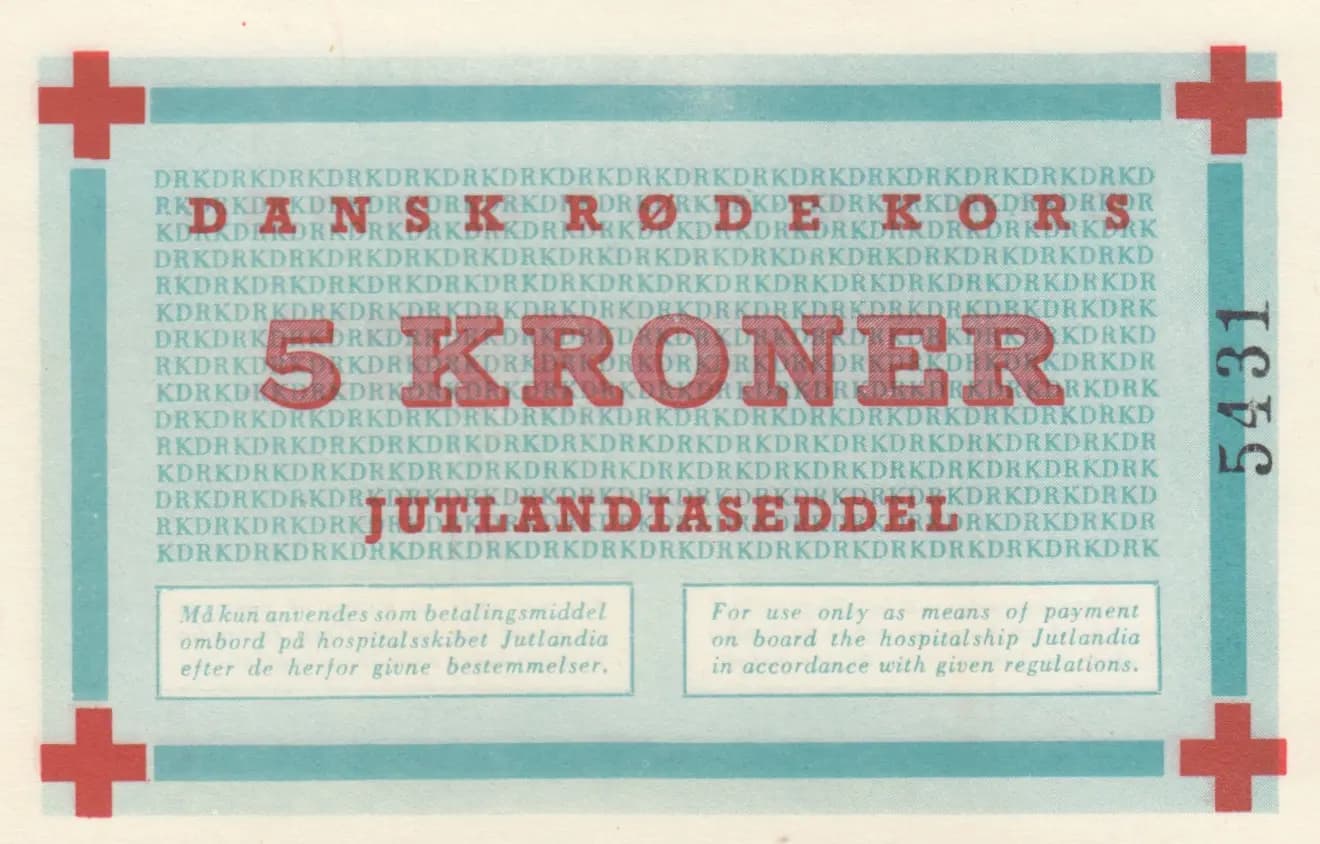
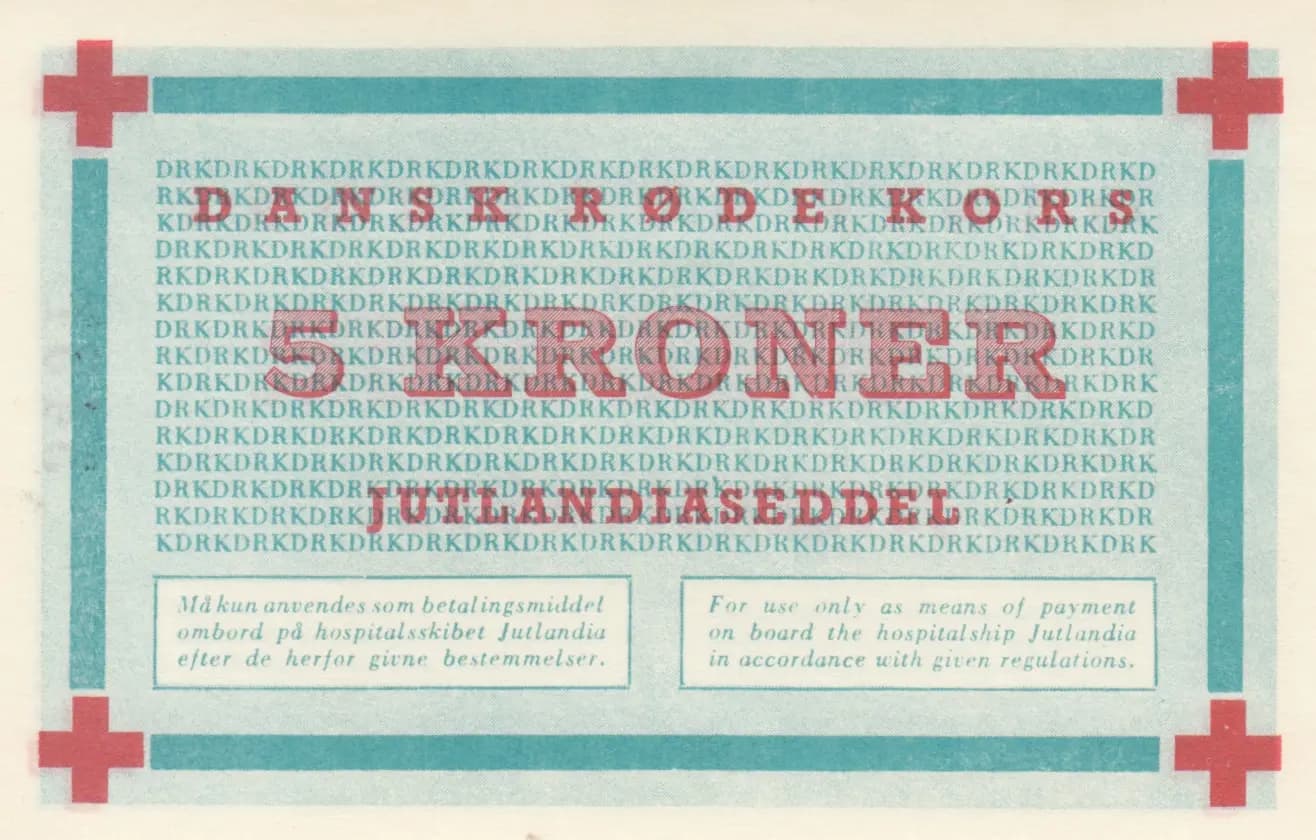
This is an exceptional uncirculated example of a specialized 5 Kroner scrip note issued by Danske Røde Kors (Danish Red Cross) in 1951, specifically for use aboard the hospital ship Jutlandia. The note features a striking teal and cream color scheme with prominent red cross symbols in all four corners and a repeating 'DRK' text security pattern. As a hospital ship scrip note rather than regular currency, this represents a fascinating numismatic crossover piece combining Red Cross organizational history with maritime service commemorations.
Common. While this is a specialized Red Cross hospital ship scrip note, the Danish Red Cross operated the MS Jutlandia for an extended period, and multiple denominations and serial numbers of this issue were printed for use aboard. Hospital ship scrip from this era, while collectible, was typically produced in sufficient quantities to support regular onboard commerce. The note's designation as 'P-unlisted' in standard catalogs (likely because Pick only cataloged government-issued legal tender) does not indicate rarity—it simply reflects cataloging scope limitations. Surviving examples in uncirculated condition are desirable but not scarce in the collector market.
The MS Jutlandia was a Danish hospital ship operated by the Red Cross, and this scrip note represents a unique monetary system used for internal transactions aboard the vessel. The bilingual Danish-English inscriptions reflect the international nature of Red Cross operations and the ship's humanitarian mission in the post-World War II era. This note exemplifies how specialized organizations created their own payment instruments for confined environments, a practice particularly common among hospital ships, military installations, and isolated communities during the mid-20th century.
This is a specialized scrip note rather than legal tender currency, issued by the Danish Red Cross for shipboard use. The design features a symmetrical layout with teal/turquoise and cream coloring as primary elements. Four red cross symbols are positioned in the corners, serving as the organizational emblem and creating a secure pattern difficult to replicate. The background incorporates a repeating 'DRK' (Danske Røde Kors) text pattern as a security feature. The central area prominently displays the issuing organization and denomination in large red typography. No portraits or monuments are depicted, as is typical for institutional scrip notes. The dual-language text (Danish and English) reflects the international scope of Red Cross humanitarian operations.
Front/Back (identical designs): Main text reads 'DANSK RØDE KORS' (Danish Red Cross) with '5 KRONER' (5 Kroner) denomination and 'JUTLANDIASEDDEL' (Jutlandia Note). Regulatory text in Danish: 'Må kun anvendes som betalingsmiddel ombord på hospitalsskibet Jutlandia efter de herfor givne bestemmelser.' English translation of same: 'For use only as means of payment on board the hospitalship Jutlandia in accordance with given regulations.' Serial number observed: 1331.
The note appears to be produced using offset lithography, evidenced by the clean color registration between the teal, red, and cream elements and the crisp reproduction of the repeating text pattern. The security background pattern of repeated 'DRK' text suggests multi-plate offset printing. The precise border work and uniform color saturation are consistent with professional commercial printing standards of the early 1950s, likely executed by a Scandinavian security printer contracted by the Red Cross.
The observed serial number is 1331. As a scrip issue, varieties may exist based on serial number ranges, printing runs, or layout variations. The bilingual design appears standardized across both sides. No overprints, date variations, or signature varieties are evident in this example. The specific serial number range and total print run are not documented in standard numismatic references, but the consecutive numbering visible suggests standard production practices for institutional scrip of this period.