250 mils 1974
Market Prices
30 salesAbout This Note
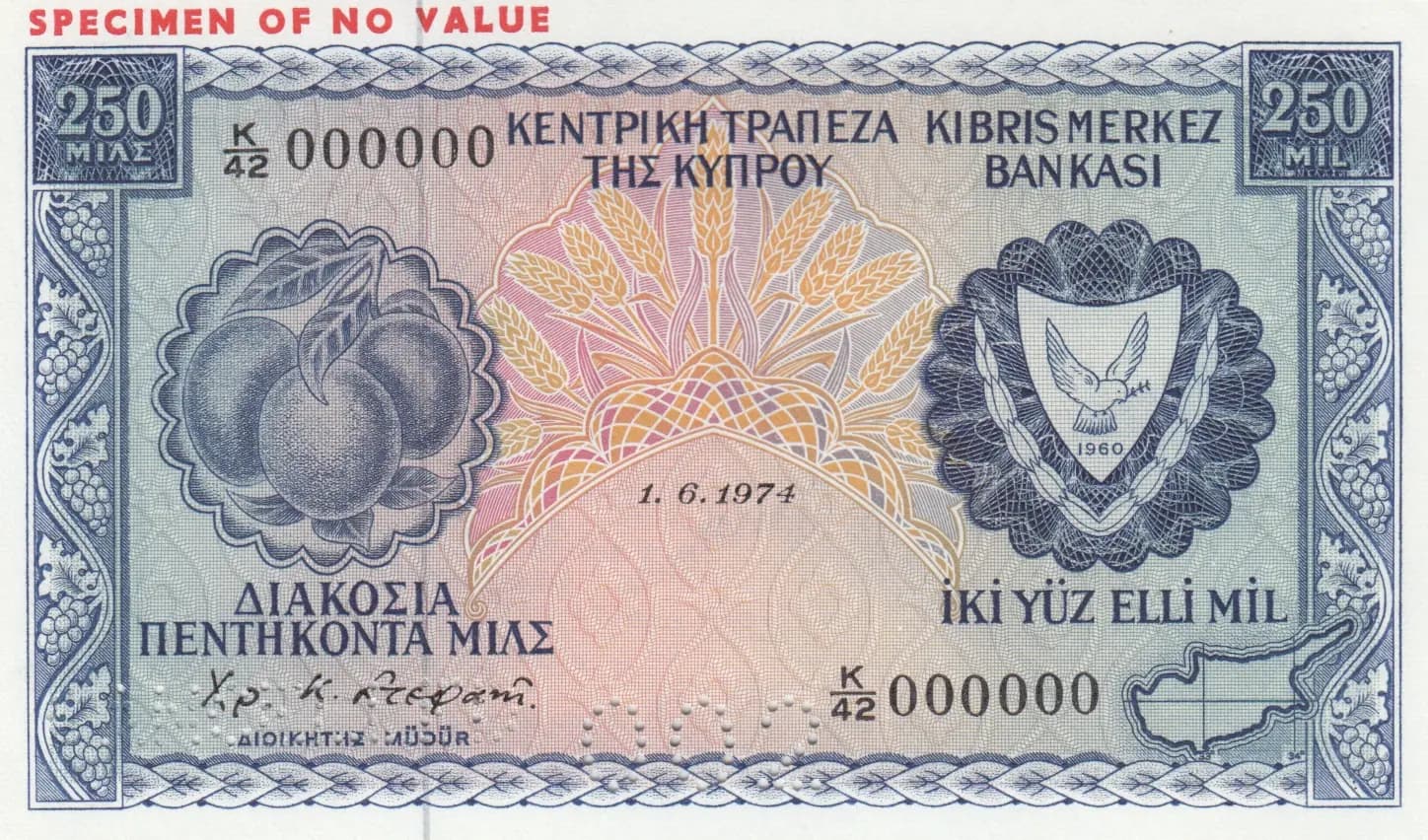
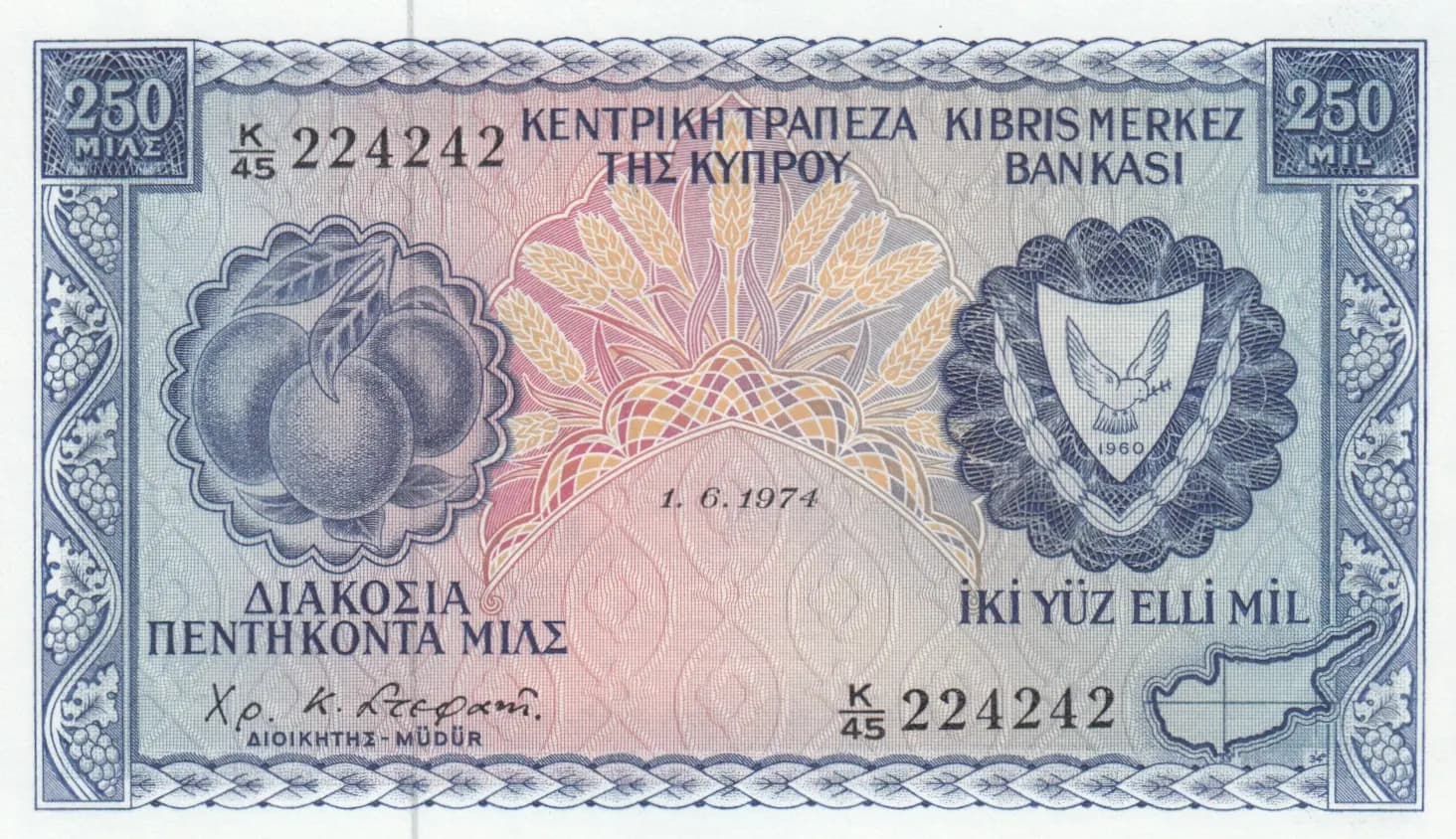
This is a crisp, uncirculated 250 Mils note from Cyprus dated June 1, 1974, representing a transitional period in Cypriot currency. The note displays exceptional condition with sharp printing, vibrant multicolored design featuring pomegranates and wheat on the obverse, and a detailed industrial/agricultural landscape on the reverse. As a P-41b variant in UNC condition, this note represents the mature design phase of Cyprus's pre-decimal currency system and carries historical significance tied to the tumultuous events of 1974 on the island.
Common. The eBay market data shows consistent sales activity across multiple condition grades, with UNC examples selling in the $34-$147.50 range (2013-2020), with a 2019 catalog value of $130 for UNC. The wide availability of sales data spanning a decade indicates substantial circulation in the collector market and healthy print runs. Notes regularly achieving prices under $50 in UNC condition are characteristic of common-grade issues. The 1974 date represents a standard issue date within the broader 1971-1982 series, not a key date or short-run variant.
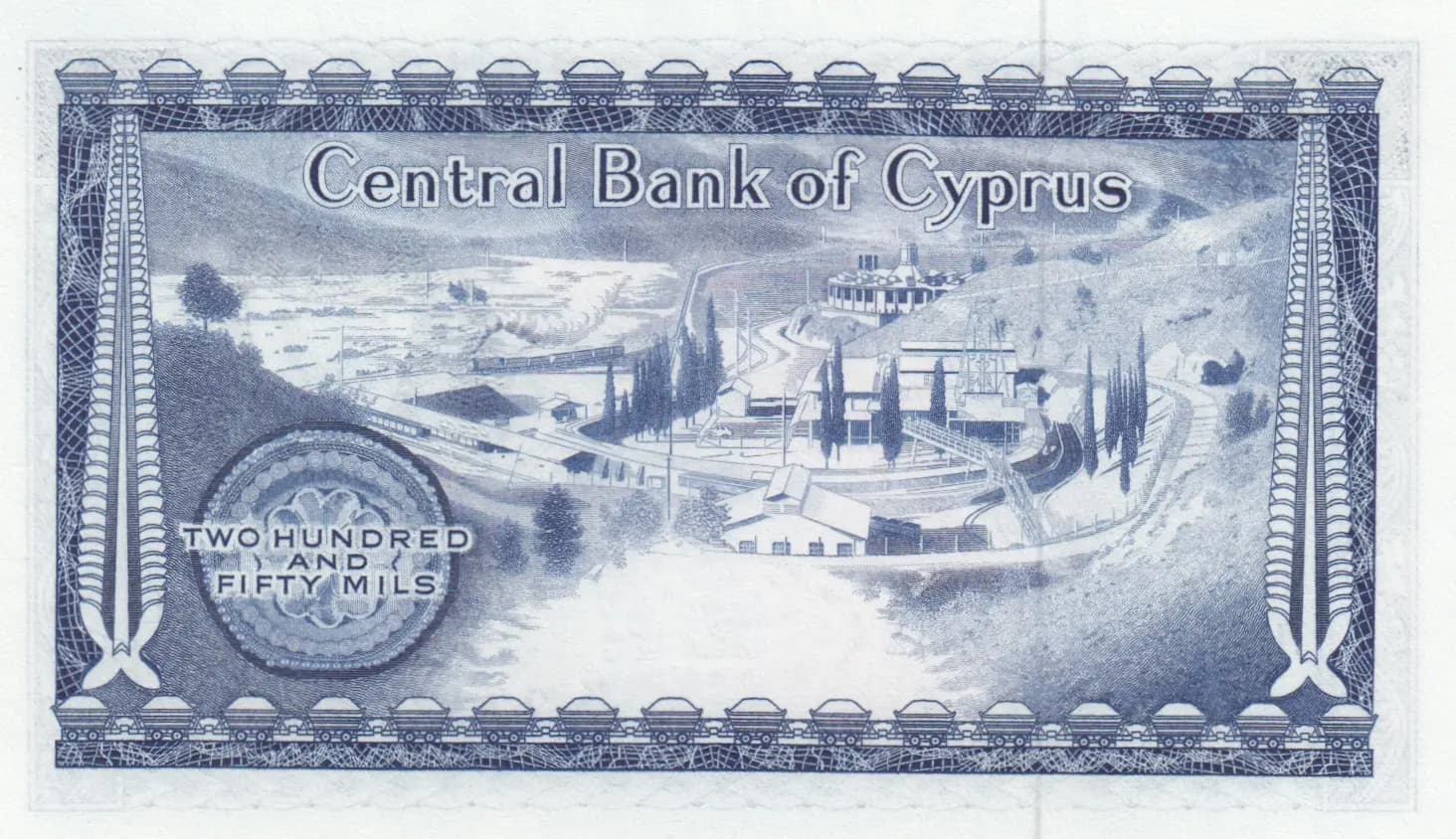
Issued by the Central Bank of Cyprus in 1974, this banknote was produced during a critical year marked by the Turkish invasion and subsequent partition of Cyprus. The bilingual inscriptions in Greek and Turkish reflect the Republic of Cyprus's constitutional framework attempting to maintain a unified monetary and political system. The industrial/agricultural imagery on the reverse—depicting mining or quarrying operations and the columned building—symbolizes Cyprus's economic development aspirations during the post-independence period, though the 1974 political upheaval would fundamentally alter the island's trajectory.
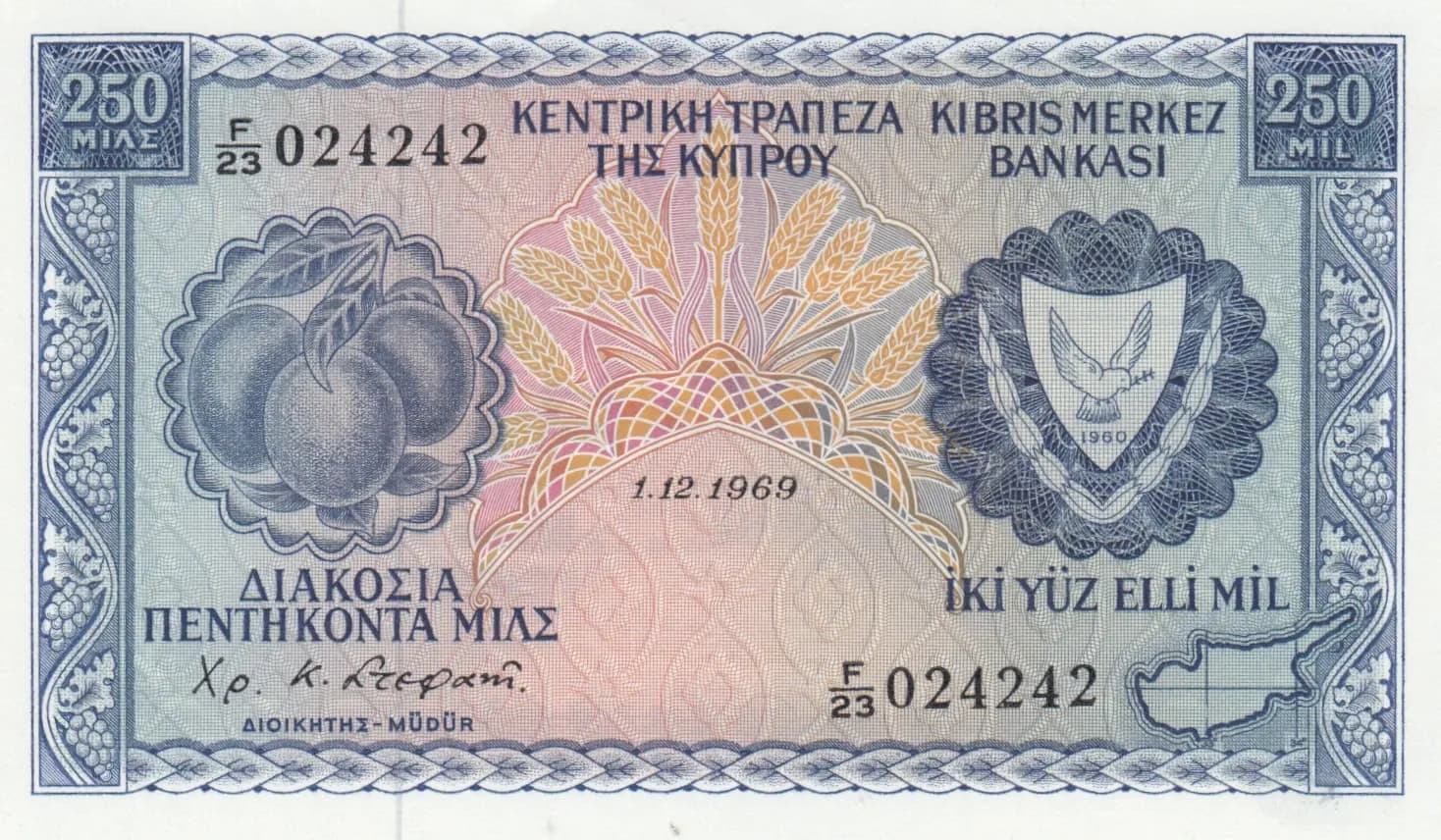
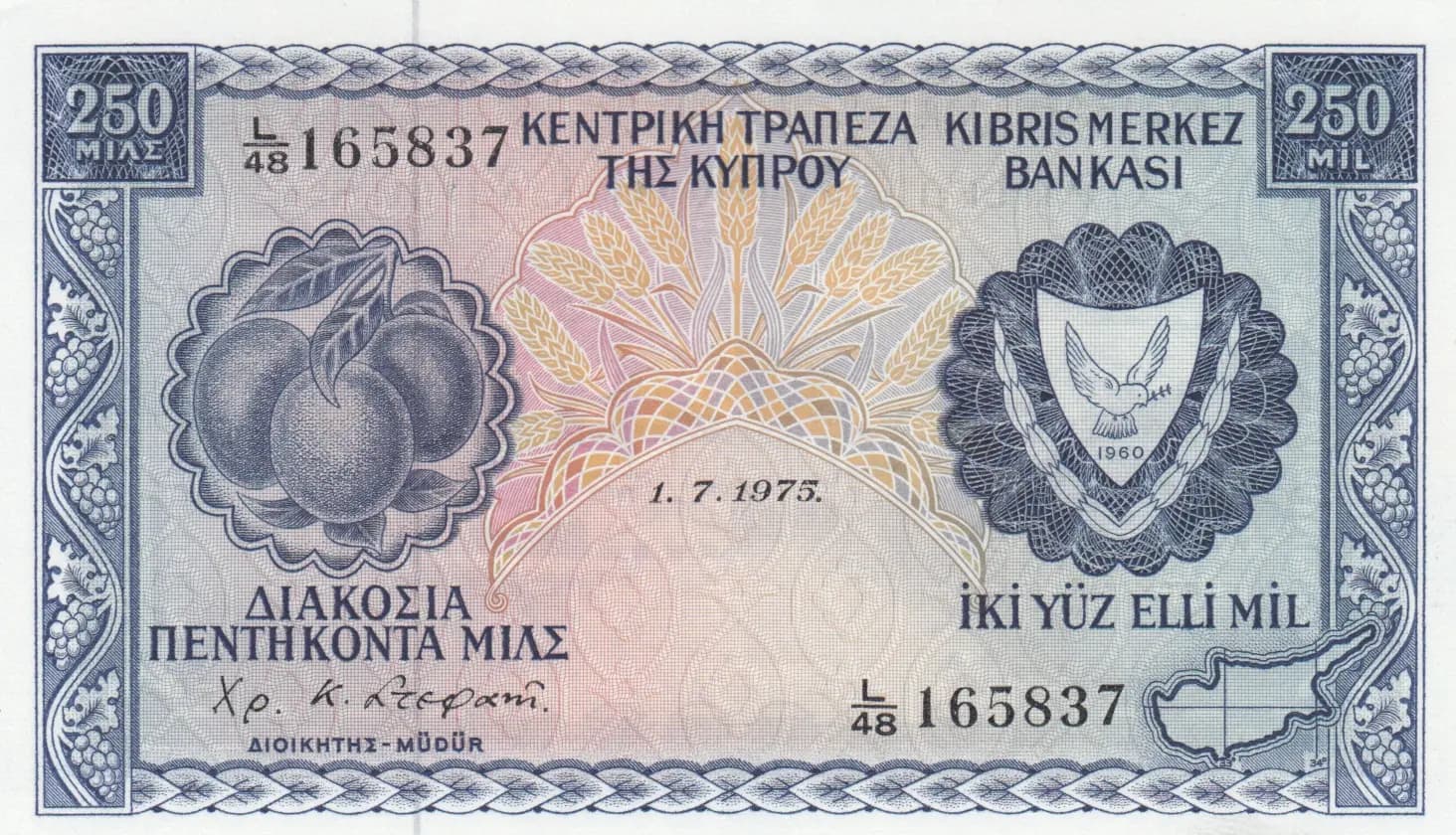
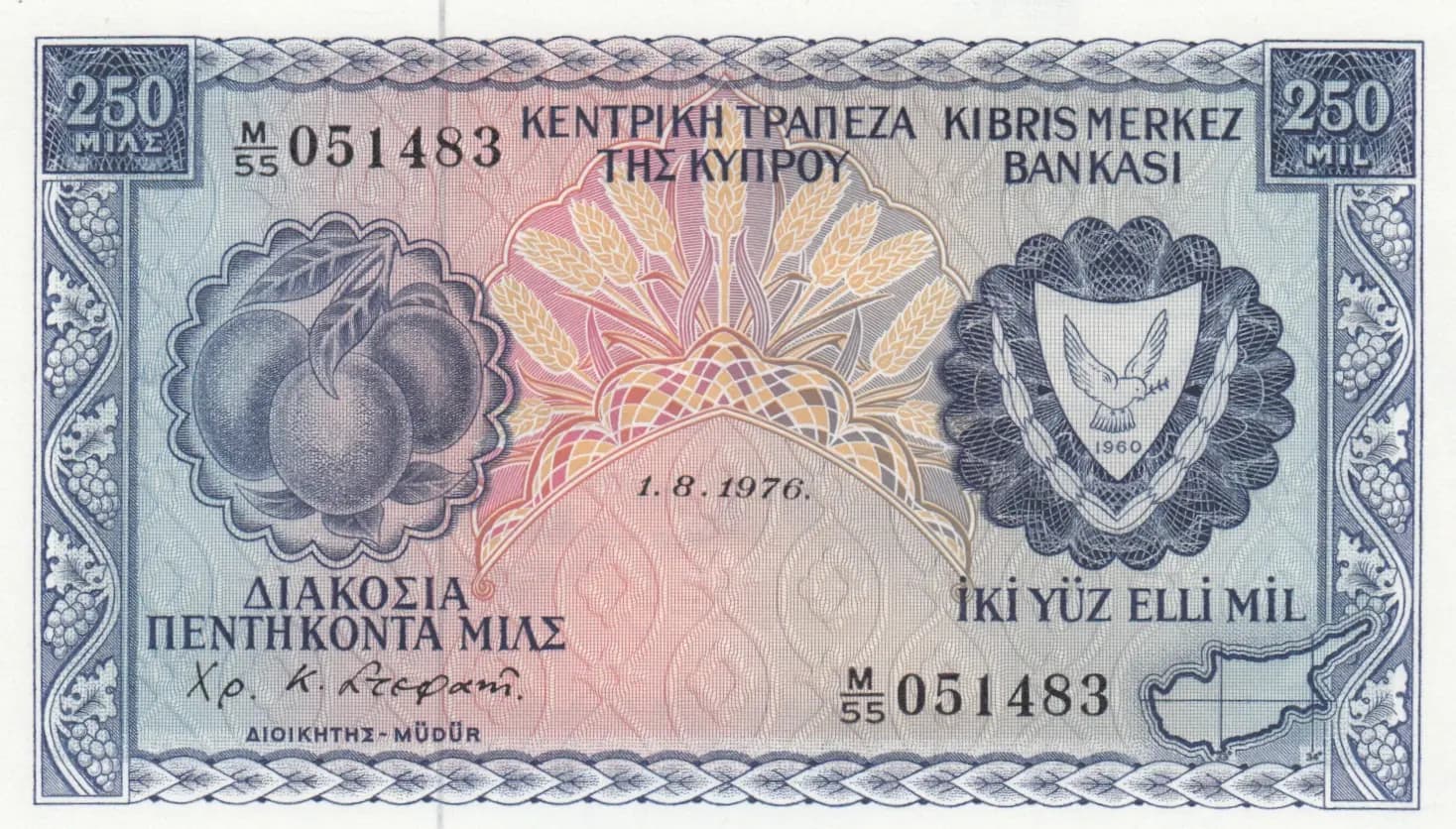
The obverse features an elegant, ornately bordered design in light blue-green with rose-colored central elements. The primary imagery comprises a circular medallion on the left containing pomegranates (representing Cyprus's agricultural heritage), flanked by wheat stalks and decorative scrollwork symbolizing the nation's agrarian economy. The right side displays the National Coat of Arms of Cyprus—a shield featuring a white dove dated 1960 (commemorating independence)—with decorative corner designs showcasing grapevines. The reverse presents an engraved landscape scene in blue tones depicting an industrial or quarrying operation, likely representing a limestone quarry given the catalog description, with columned public architecture, cypress trees, and rolling terrain rendered in fine detail. The architectural border framing both sides features repeated arch patterns characteristic of the period's currency design aesthetic.
FRONT: '250' (denomination in numerals) | 'ΜΙΛ' (Greek: mils) | 'ΚΕΝΤΡΙΚΗ ΤΡΑΠΕΖΑ ΤΗΣ ΚΥΠΡΟΥ' (Greek: Central Bank of Cyprus) | 'KIBRIS MERKEZ BANKASI' (Turkish: Cyprus Central Bank) | 'ΔΙΑΚΟΣΙΑ ΠΕΝΤΗΚΟΝΤΑ ΜΙΛΣ' (Greek: Two Hundred Fifty Mils) | 'ΙΚΙ YÜZ ELLI MİL' (Turkish: Two Hundred Fifty Mils) | '1.6.1974' (Issue date: June 1, 1974) | Signature: 'Χρ. Κ. Ρεργής' (Chris K. Rergis, Greek) | 'ΑΙΔΙΚΗΤΗΣ - MUDUR' (Greek/Turkish: Director) | Serial number 'K 45 224242'. BACK: 'Central Bank of Cyprus' (English) | 'TWO HUNDRED AND FIFTY MILS' (English).
Intaglio (recess) engraving, the standard security printing method for banknotes of this era. The note exhibits the fine line work, depth of detail, and crisp edge definition characteristic of BWC (Bradbury Wilkinson & Company) production, the assigned printer for all P-41 variants. The multicolor printing on the obverse—combining light blue-green, pink/rose, dark blue, and cream tones—demonstrates sophisticated color separation techniques typical of mid-20th century currency production. The intricate decorative borders and complex landscape engraving on the reverse are hallmarks of premium security printing to deter counterfeiting.
This note is identified as Pick P-41b, indicating it is the 'b' variant within the 250 Mils series produced by BWC. The PMG population report identifies four cataloged variants (P-41a, P-41b, P-41c, P-41s), all sharing BWC as the printer but differentiated by subtle design or security feature variations. The specific issue date of 1.6.1974 (June 1, 1974) falls within the documented issue span for this series. The serial number prefix 'K 45' appears consistent with Cypriot numbering conventions of the period, though without access to comprehensive serial range data, specific serial prefix varieties cannot be definitively assigned. The signature of Χρ. Κ. Ρεργής (Chris K. Rergis) as Director confirms this as an authorized issue.