10 pounds 1978
Market Prices
7 salesAbout This Note
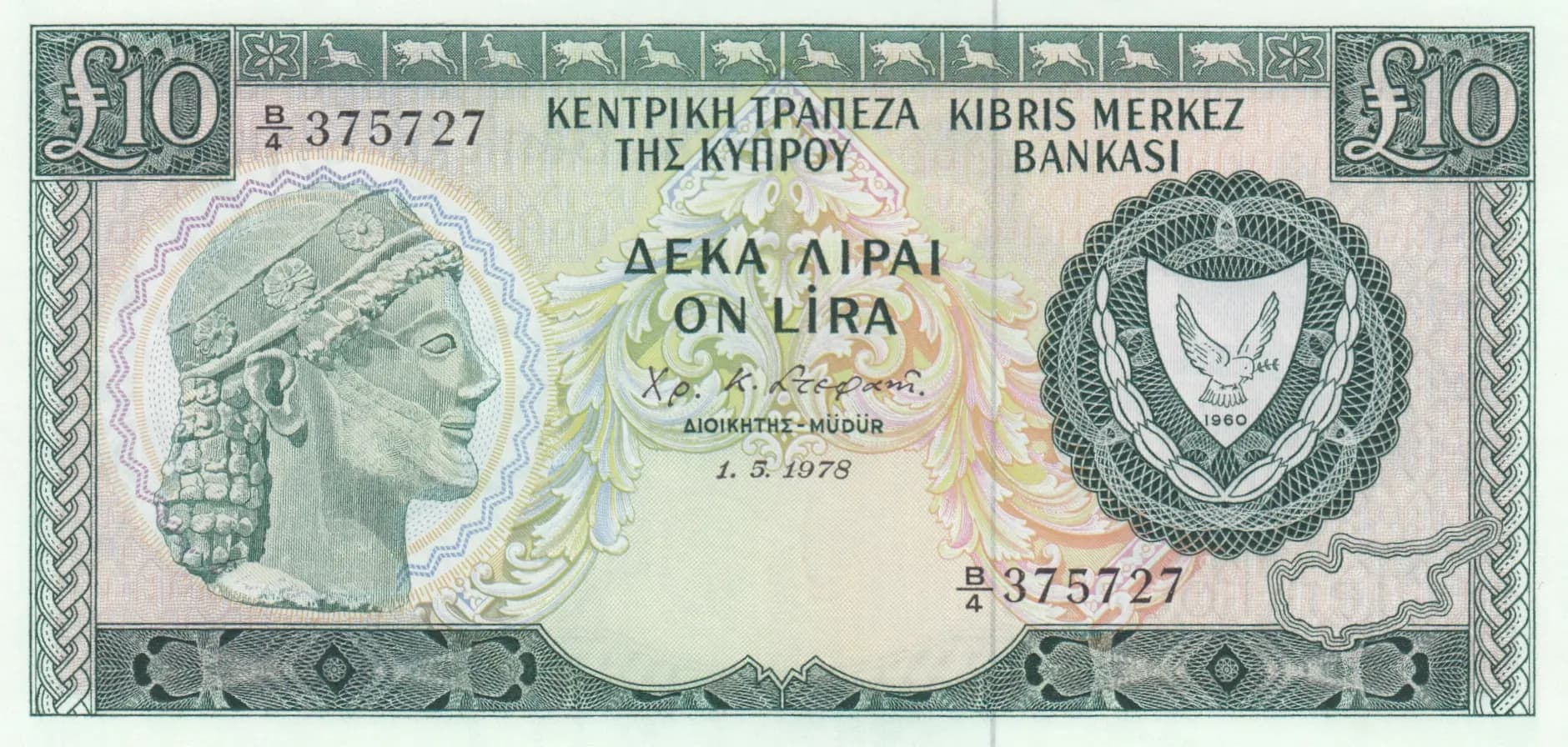
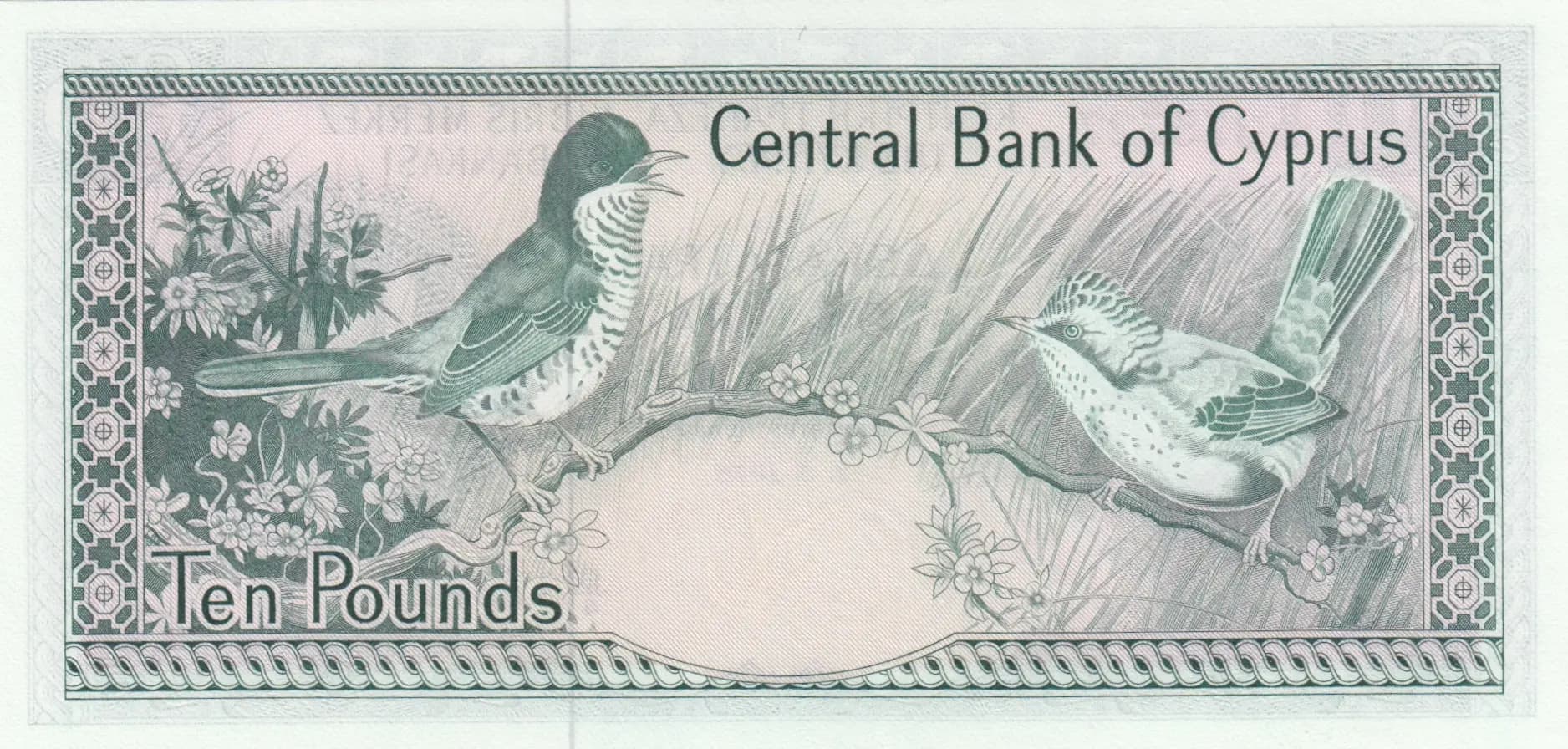
This is an exceptional example of the 1978 Central Bank of Cyprus £10 note (Pick P-48a), graded UNC and exhibiting pristine condition with no visible wear, creases, or circulation marks. The note showcases masterful engraving throughout, featuring a classical archaic portrait on the obverse and a naturalistic depiction of Cyprus warblers on the reverse, rendered in harmonious green and purple tones on a cream background. This trilingual note from the early years of the second Cyprus pound series represents an important transitional period in the nation's monetary history and remains highly sought after by collectors, particularly in uncirculated grades where catalog values reach $300.
Common. While the eBay price tracking shows UNC examples valued at $300 in 2019 catalogs, actual market sales data indicates regular circulation of this note in numismatic channels at moderate prices ($45-$199 depending on exact grade). The print run for this series was substantial, as evidenced by the availability of multiple examples on the secondary market and the lack of documented scarcity or recall issues. The denomination, timeframe, and widespread distribution through the Central Bank of Cyprus place this note firmly in the common category, though uncirculated examples command premium prices relative to circulated examples due to preservation rarity rather than absolute scarcity.
The 1978 date on this note reflects the Central Bank of Cyprus's effort to establish a distinct national currency identity following the 1974 Turkish invasion and the subsequent division of the island. The choice of an archaic classical bust—likely representing a Cypriot historical or mythological figure—connects the modern state to its ancient cultural heritage spanning millennia. The reverse design featuring indigenous Cyprus warblers emphasizes the nation's natural heritage and biodiversity, serving as a symbol of the island's independence and identity during a period of significant political and social reconstruction.
The obverse features a classical male profile portrait facing right, wearing ornate ancient headwear, positioned on the left side and surrounded by an intricate decorative frame with purple security tinting. The portrait likely depicts an archaic Cypriot ruler or deity, rendered in fine engraved detail characteristic of high-quality banknote production. The central design incorporates elaborate floral and architectural motifs with repeating animal emblems (possibly lions) along the top border, while the right side displays the national coat of arms—a white dove within an ornate circular wreath—symbolizing peace and sovereignty. The reverse presents a naturalistic ornithological study featuring two Cyprus warblers (likely Sylvia melanothorax, endemic to the island) among flowering plants and vegetation, framed by ornate geometric and floral border patterns. The color palette of greens, purples, and cream tones enhances both the classical dignity of the obverse and the natural beauty of the reverse design.
Front side: '£10' (English, denomination); 'ΚΕΝΤΡΙΚΗ ΤΡΑΠΕΖΑ ΤΗΣ ΚΥΠΡΟΥ' (Greek, 'Central Bank of Cyprus'); 'KIBRIS MERKEZ BANKASI' (Turkish, 'Central Bank of Cyprus'); 'ΔΕΚΑ ΛΙΡΑΙ' (Greek, 'Ten Pounds'); 'ON LİRA' (Turkish, 'Ten Pounds'); '1. 5. 1978' (issue date, May 1, 1978); 'Χ.Α. ΚΑΣΠΑΡΗ' (signature of Ch.A. Kasparri); 'ΔΙΟΙΚΗΤΗΣ - MÜDÜR' (Greek/Turkish, 'Governor/Director'); 'B 4 375727' (serial number). Back side: 'Central Bank of Cyprus' (English); 'Ten Pounds' (English denomination).
Intaglio engraving (recess printing) combined with multicolor lithography, evidenced by the fine cross-hatch patterns, sharp detail in the portrait and wildlife depiction, and the precise registration of multiple color layers (green, purple, cream, gray, and white). Printed by Bradbury Wilkinson and Company (BWC) of London, a renowned security printer known for high-quality banknote production. No printer imprint appears on the note itself, consistent with the catalog notation. The sophisticated security features including watermarks, fine line work, and intricate background patterns reflect BWC's expertise in anti-counterfeiting measures.
This note is cataloged as Pick P-48a, identified by printer mark BWC (without imprint). The PMG population report indicates three variants exist for this base pick number (P-48a, P-48b, and P-48s), though detailed distinguishing characteristics between variants are not fully documented in available references. The observed specimen bears the date '1. 5. 1978' and signature of Ch.A. Kasparri as Governor, with serial number B 4 375727. The catalog data indicates signature varieties exist across the 1977-1985 issue period, and specimens may be encountered with dates ranging from 1977 to 1979 for this particular plate, representing different printings within the P-48a designation.