5 colones 1941
Market Prices
3 salesAbout This Note
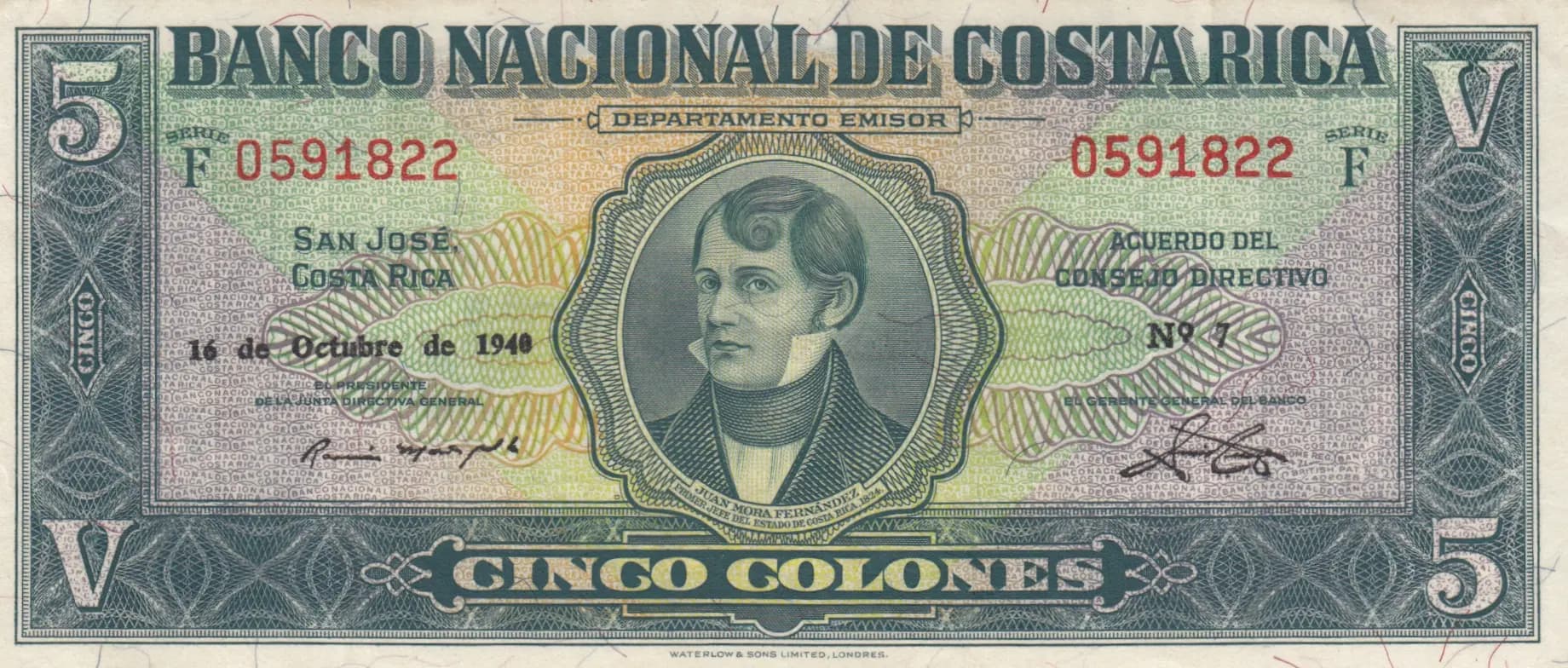
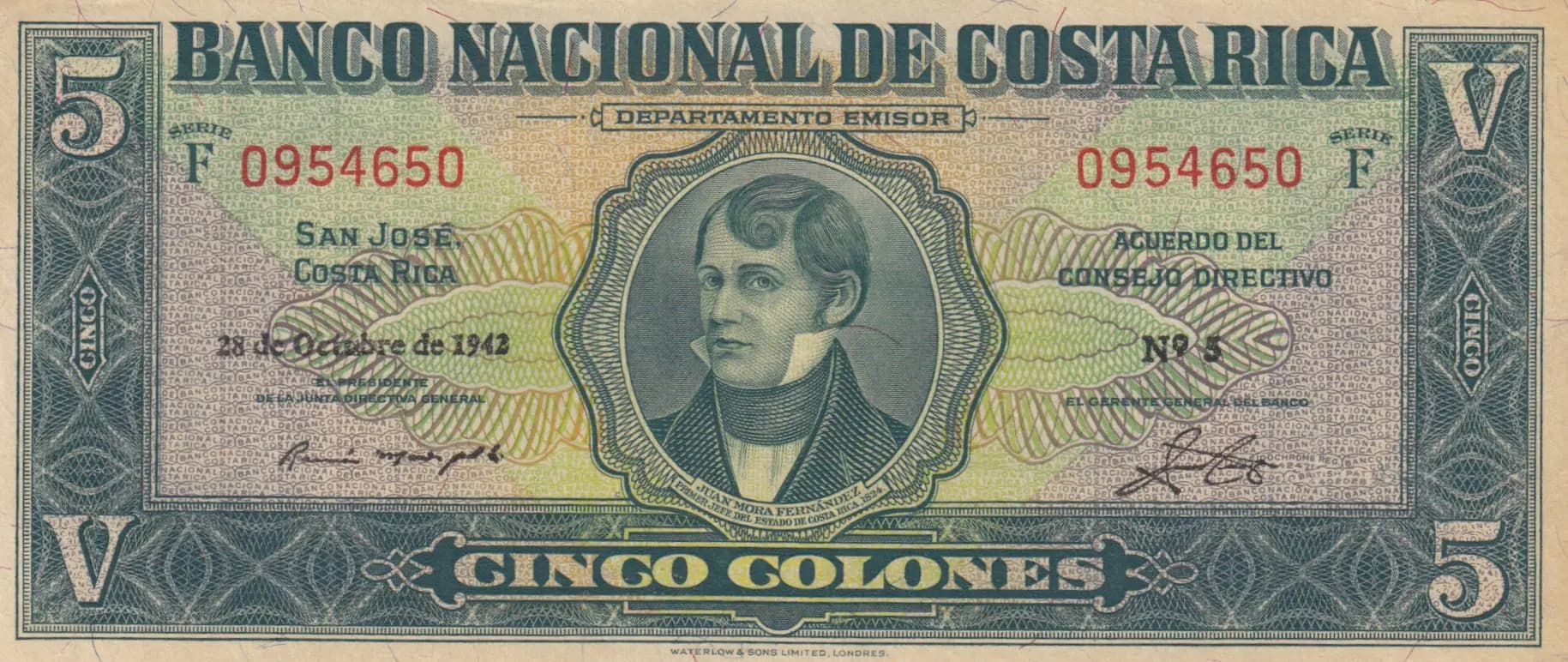
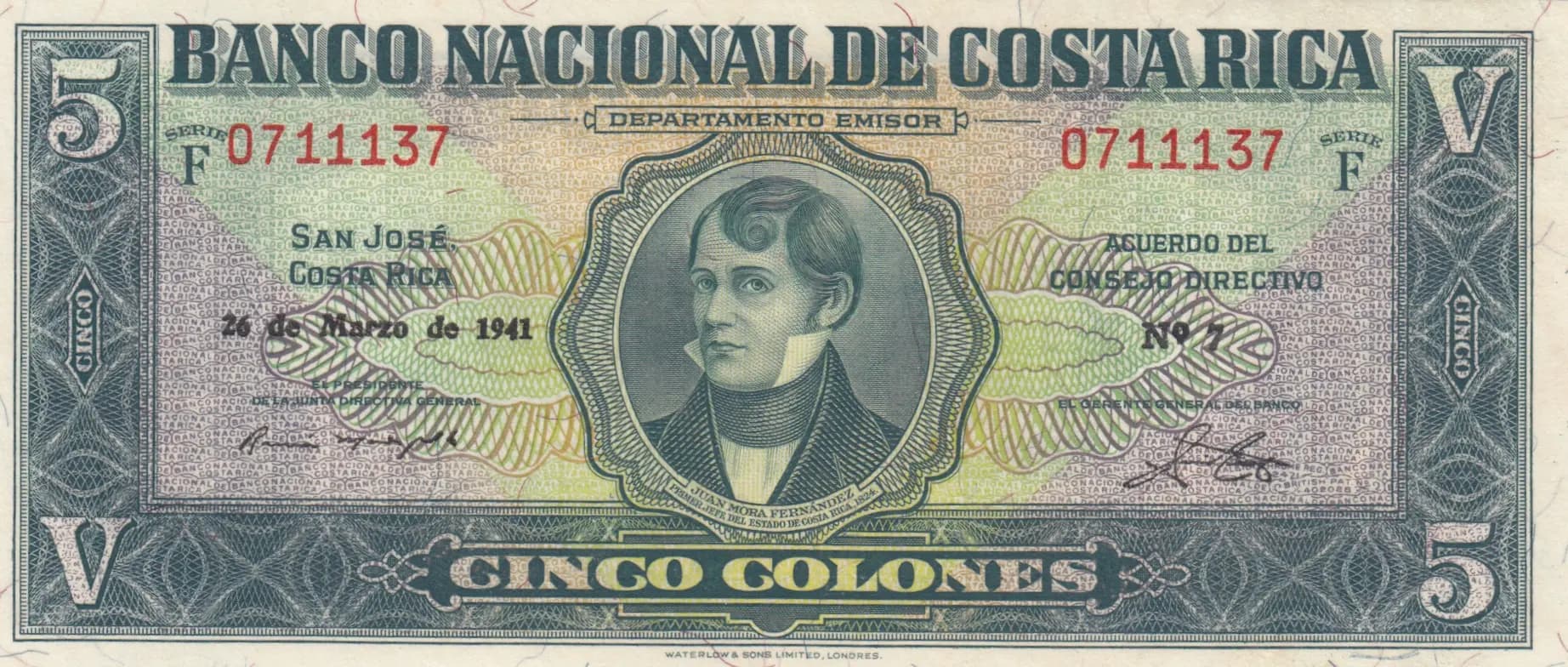
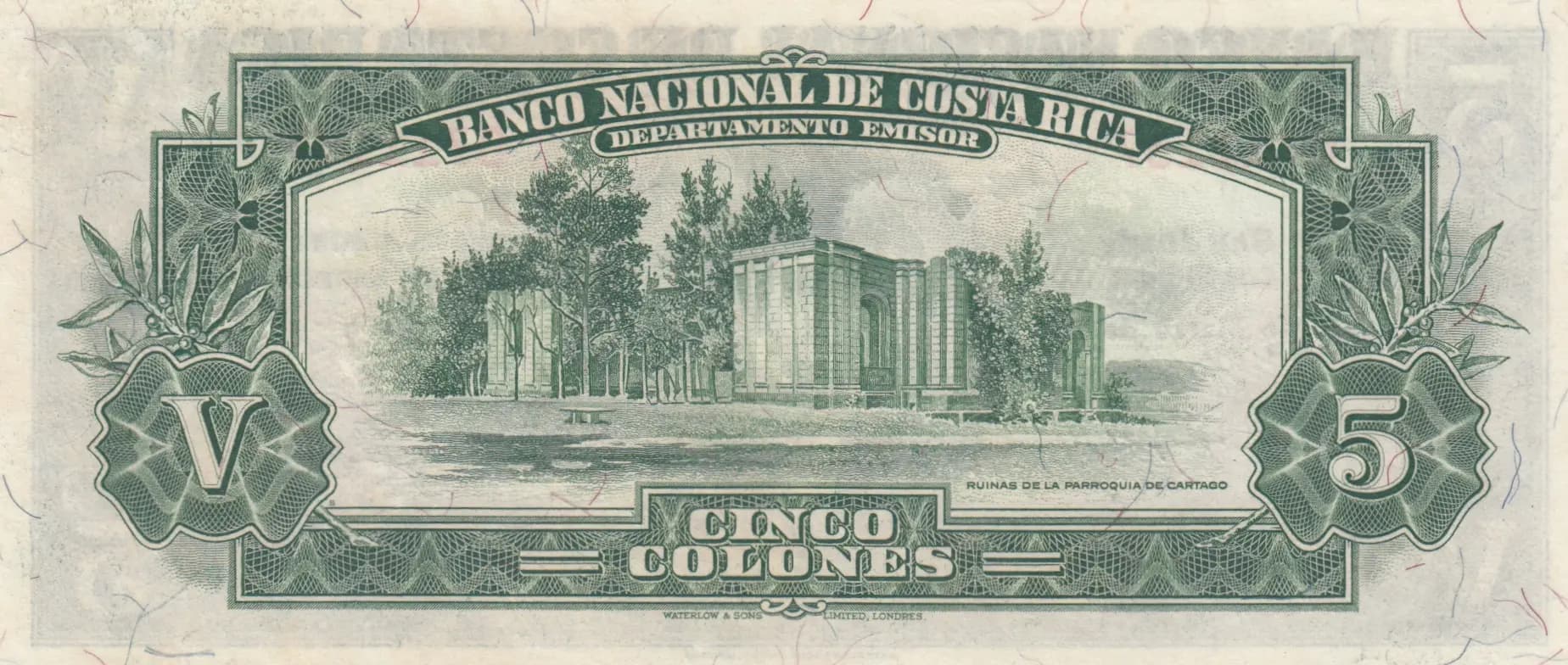
This 5 colones banknote from 1941 features a striking central portrait of Juan Mora Fernández in formal attire within an ornate oval medallion, surrounded by decorative blue-gray and pink tones with gold accents. The reverse showcases the Ruins of the Parish Church of Cartago in classical architectural detail with green toning. Despite visible aging consistent with 80+ years of circulation—including creases, fold lines, and surface fading—the note retains its essential design integrity and represents an important piece of Costa Rican monetary history from the early 1940s.
Common. The eBay market data shows this note in Fine condition selling in the range of $56-$177.50 across multiple sales over the past decade, with catalogue values (2016) at $150 UNC. These price points indicate steady demand at modest levels consistent with a commonly circulated issue. The 1939-1942 date range represents a standard regular issue with substantial print runs. While the UNC condition grade commands the highest catalog value ($150), the note's appearance shows significant circulation wear inconsistent with that grade, suggesting this particular specimen would grade lower (VF to F range) and would sell substantially below catalog in the $35-$100 range based on eBay evidence.
Issued during World War II by the Banco Nacional de Costa Rica, this 1941 note commemorates Juan Mora Fernández, Costa Rica's first Head of State and a pivotal figure in the nation's early republic. The reverse depicts the historically significant Ruins of Cartago Parish, remnants of the Spanish colonial capital damaged by earthquakes, symbolizing the nation's cultural heritage and continuity through its banking authority. The note's production by Waterlow & Sons of London reflects Costa Rica's reliance on established European security printers during the mid-20th century.
The obverse features a formally dressed male figure identified as Juan Mora Fernández, Costa Rica's first Head of State (1824-1833), rendered in classical portrait style within a central oval medallion. He is depicted with dark hair and period-appropriate 19th-century formal attire, embodying the nation's republican ideals. The design is framed by ornamental corner elements incorporating large Roman numeral V denominations within shield-shaped cartouches, connected by fine decorative borders in blue-gray and pink with cream background. Gold-toned wing-like elements flank the portrait, adding prestige to the central figure. The reverse depicts the Ruins of Cartago Parish, a historically important ecclesiastical structure rendered in fine engraved architectural detail showing classical columns, regular window patterns, surrounding vegetation, and a water body at the base. The ruins serve as a symbol of Costa Rica's colonial heritage and architectural legacy. Both sides employ the denomination 'CINCO COLONES' prominently and incorporate the bank's official marking.
FRONT SIDE: 'BANCO NACIONAL DE COSTA RICA' (National Bank of Costa Rica), 'DEPARTAMENTO EMISOR' (Issuing Department), 'SAN JOSÉ' (San Jose), 'COSTA RICA' (Costa Rica), '2 de junio de 1941' (June 2, 1941), 'ACUERDO DEL CONSEJO DIRECTIVO' (Decision of the Board of Directors), 'CINCO COLONES' (Five Colones), 'MORA FERNÁNDEZ' (Mora Fernández—identifying the portrait subject), with serial number 'F 0711137'. BACK SIDE: 'BANCO NACIONAL DE COSTA RICA' (National Bank of Costa Rica), 'DEPARTAMENTO EMISOR' (Issuing Department), 'RUINAS DE LA PARROQUIA DE CARTAGO' (Ruins of the Parish Church of Cartago), 'CINCO COLONES' (Five Colones), 'WATERLOW & SONS LIMITED, LONDRES' (Waterlow & Sons Limited, London—printer attribution).
Intaglio engraving (line engraving), executed by Waterlow & Sons Limited of London, a renowned security printer. The printing technique is evidenced by the intricate fine-line work visible throughout both sides, the repetitive micropattern designs in border areas, detailed portrait medallion engraving, and fine architectural rendering of the Cartago ruins. The multicolor printing effect (blue-gray, pink, gold toning on front; green on back) was achieved through multiple engraved plates applied in succession, a standard security printing practice of the era. The observation of detailed foliage and landscape engraving, particularly on the reverse, confirms classical intaglio methodology.
This specimen is identified as Pick P-204, the standard 1941 issue of the 5 colones (issued 1939-1942). The serial number prefix 'F' with number '0711137' is recorded on the obverse. The specific date marking visible is '2 de junio de 1941' (June 2, 1941), indicating this note's placement within the 1941 emission year. No overprints or unusual signature variants are apparent from the visual analysis. The PMG population report indicates one catalogued variant for this base Pick number, suggesting limited numismatic grading history for this particular denomination and date combination.