5 colones 1940
Market Prices
3 salesAbout This Note
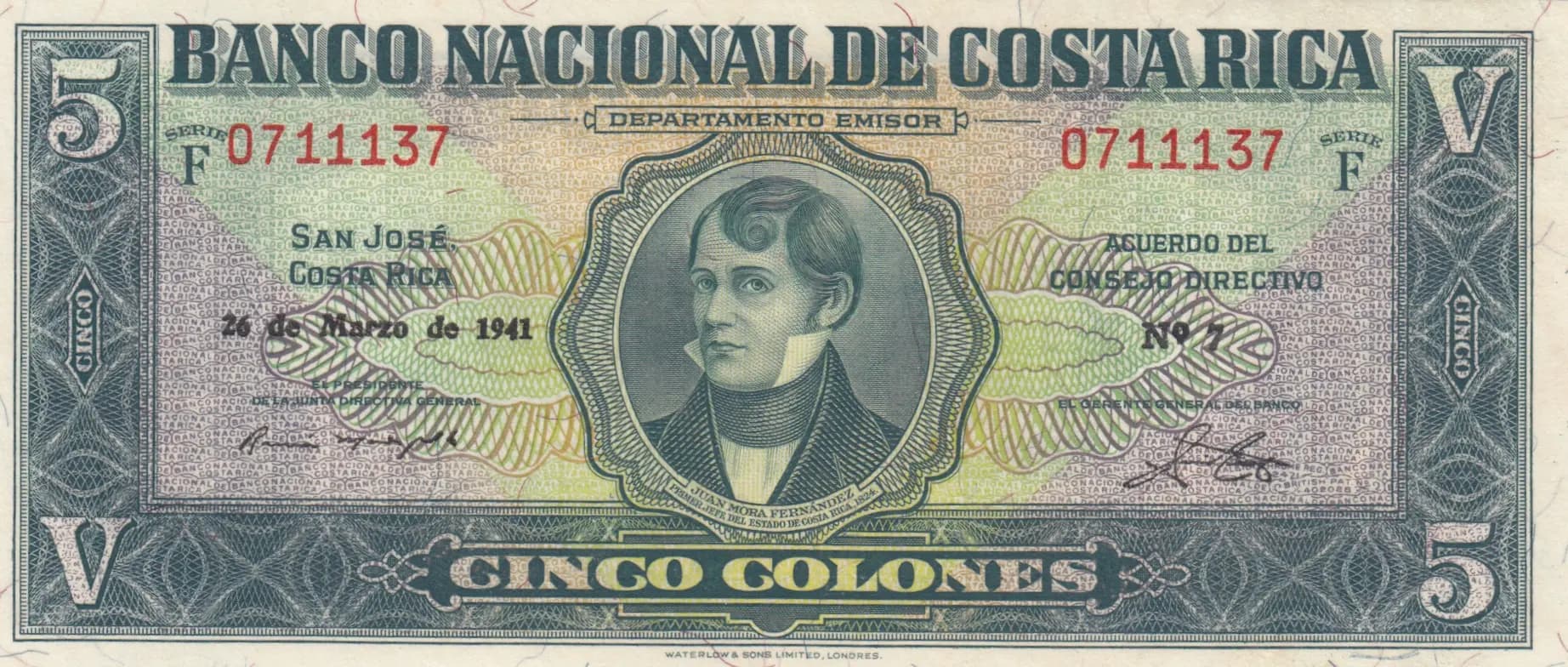
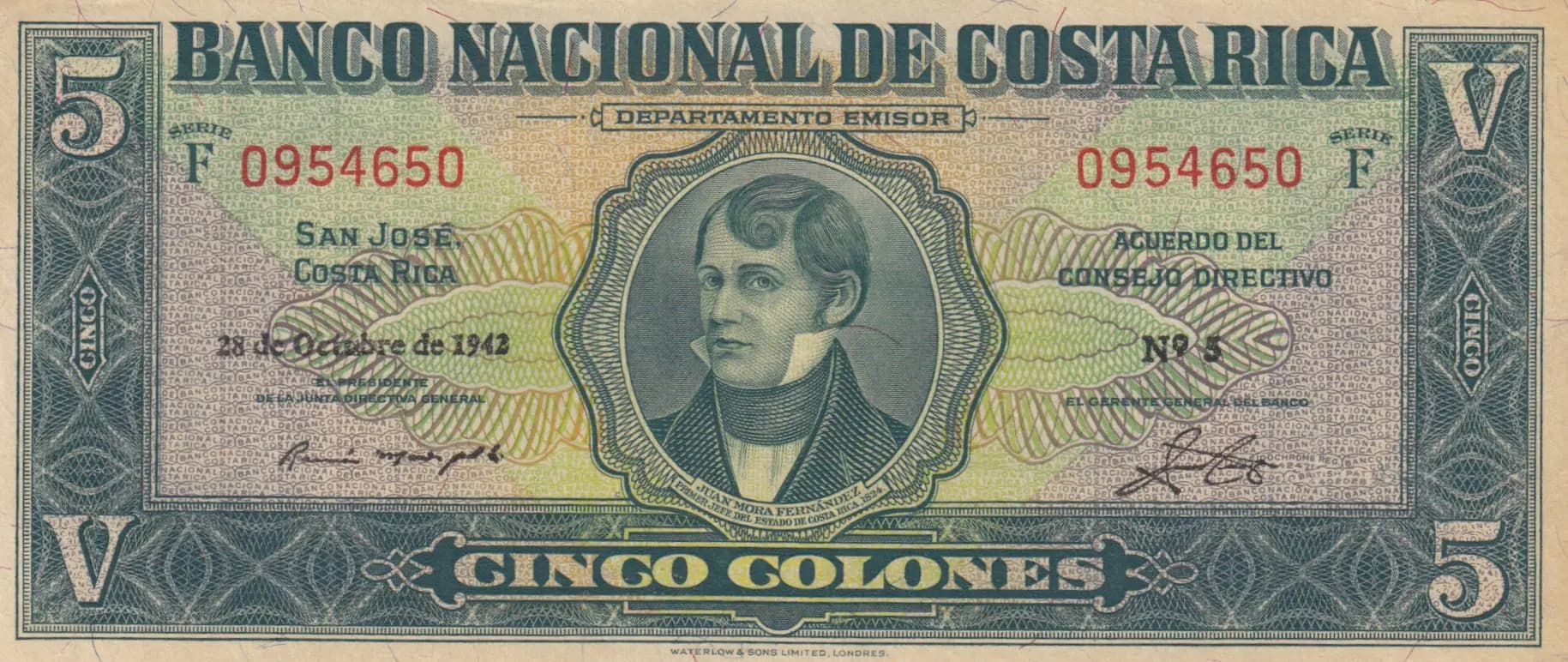
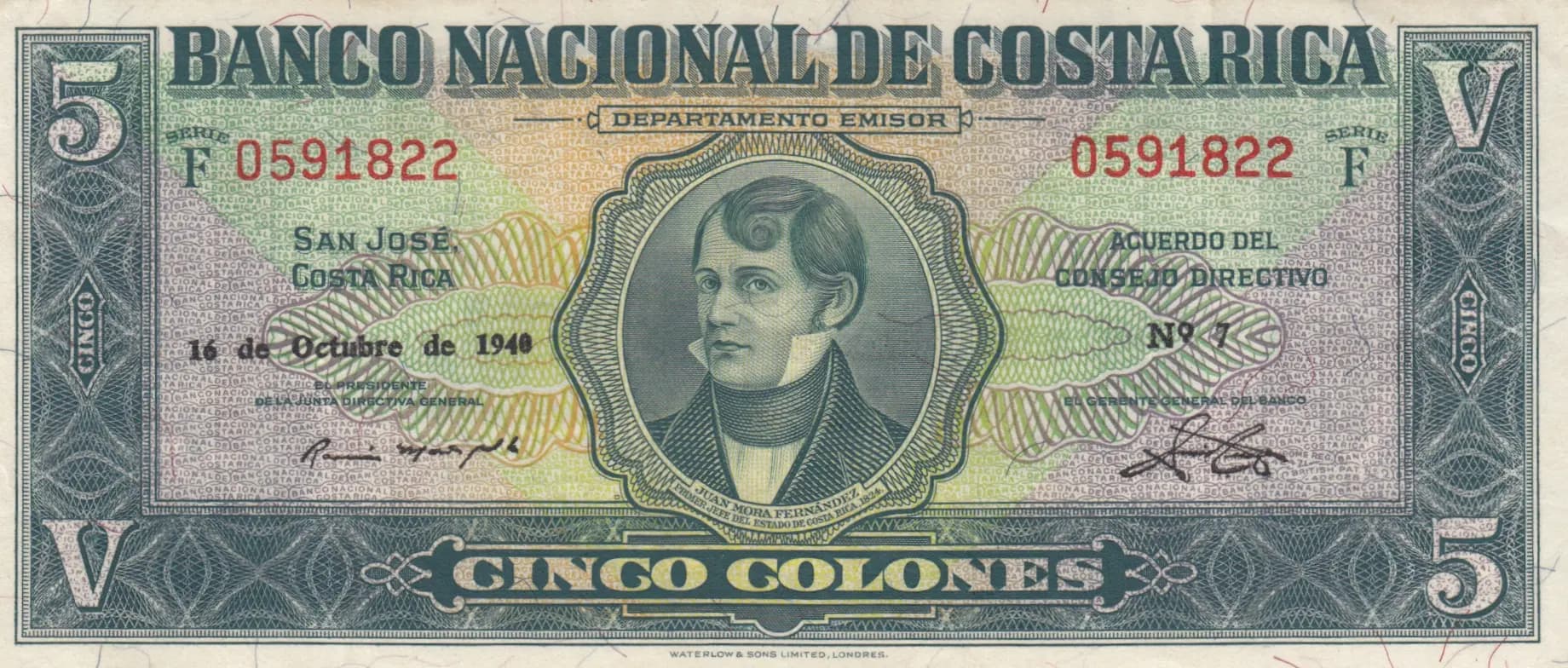
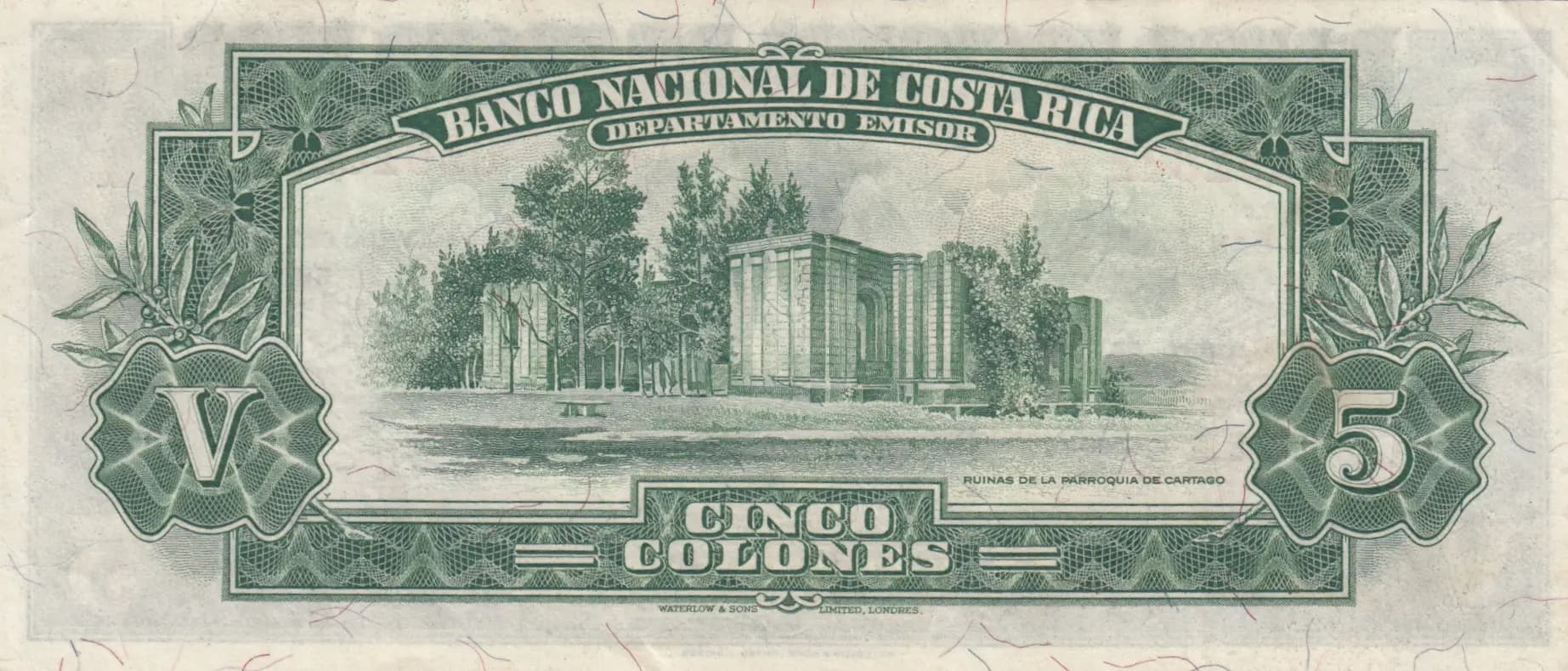
This is an AU-grade example of the 1940 Costa Rican 5 colones (Pick P-204), featuring a handsome portrait of Juan Mora Fernández in formal dress within an ornate oval frame on the obverse, and the historically significant Ruins of Cartago Parish depicted on the reverse. The note displays typical aging characteristics including horizontal fold creases and foxing consistent with a well-preserved historical banknote, with the vibrant multicolor printing (teal, green, pink, and yellow) still evident despite nearly a century of age.
Common. This note was part of a regular issue (1939–1942) with likely substantial print runs typical of a central bank's standard circulation denominations. eBay market data shows F-grade examples consistently selling between $56–$177, with catalog valuations placing AU specimens around $150. These price points and the abundance of sales history indicate this is a widely available note in the collector market despite its age, with no evidence of rarity characteristics.
Issued by the Banco Nacional de Costa Rica on October 16, 1940, during the administration of President Rafael Ángel Calderón Guardia, this note commemorates Juan Mora Fernández, a principal architect of Costa Rica's early independence and constitutional development. The reverse imagery of the Ruinas de la Parroquia de Cartago references the devastating 1910 earthquake that destroyed Cartago, reflecting the nation's historical memory and resilience during a period of relative stability in Costa Rican history.
The obverse features a three-quarter facing portrait of Juan Mora Fernández, Costa Rica's early statesman and constitutional reformer, positioned in a decorative scalloped oval frame at center. The design incorporates geometric border elements and ornamental scrollwork in teal and pink tones against a cream background, with large denomination numerals '5' in the top corners and Roman numeral 'V' in decorative squares flanking the sides. The reverse presents a detailed engraved landscape scene of the ruins of Cartago's colonial parish church, a stone structure with standing columns and walls set among tall cypress trees beside water, reflecting both architectural heritage and the nation's earthquake history. Both sides employ fine line work and intricate background patterning characteristic of high-security intaglio printing.
FRONT: 'Banco Nacional de Costa Rica' (National Bank of Costa Rica); 'Departamento Emisor' (Issuing Department); Serial number 'F 0591822' (left) and '0591822' (right); 'San José, Costa Rica'; Date '16 de Octubre de 1940' (October 16, 1940); 'Acuerdo del Consejo Directivo' (Board of Directors Agreement); 'Cinco Colones' (Five Colones); 'Waterlow & Sons Limited, Londres' (Waterlow & Sons Limited, London). BACK: 'Banco Nacional de Costa Rica' (National Bank of Costa Rica); 'Departamento Emisor' (Issuing Department); 'Ruinas de la Parroquia de Cartago' (Ruins of the Parish Church of Cartago); 'Cinco Colones' (Five Colones); 'Waterlow & Sons Limited, Londres' (Waterlow & Sons Limited, London).
Intaglio engraving with multicolor printing. Produced by Waterlow & Sons Limited of London, one of the world's premier banknote printers at the time. The visual characteristics—fine line work, detailed portraiture, intricate security patterns, decorative elements, and the depth visible in the landscape engraving—are all consistent with the intaglio process. The multicolor application visible in teal, green, pink, yellow, and black indicates separate color plates typical of this era's security printing standards.
Series F, Serial Number F 0591822. The note is dated October 16, 1940 (within the 1939–1942 issue window). Pick P-204 records one variant cataloged by PMG. No overprints, rare date variants, or signature varieties are evident in this example. The series letter 'F' and date placement are consistent with standard issuance.