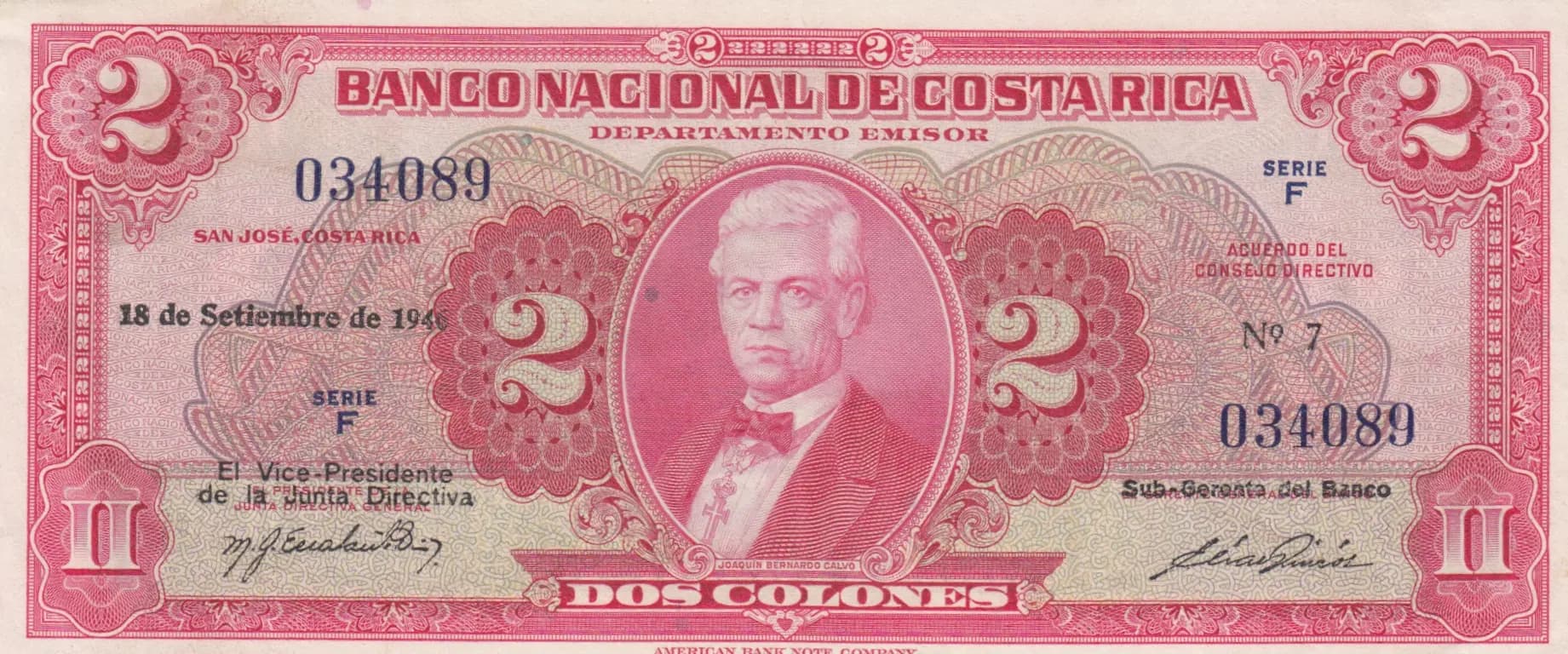
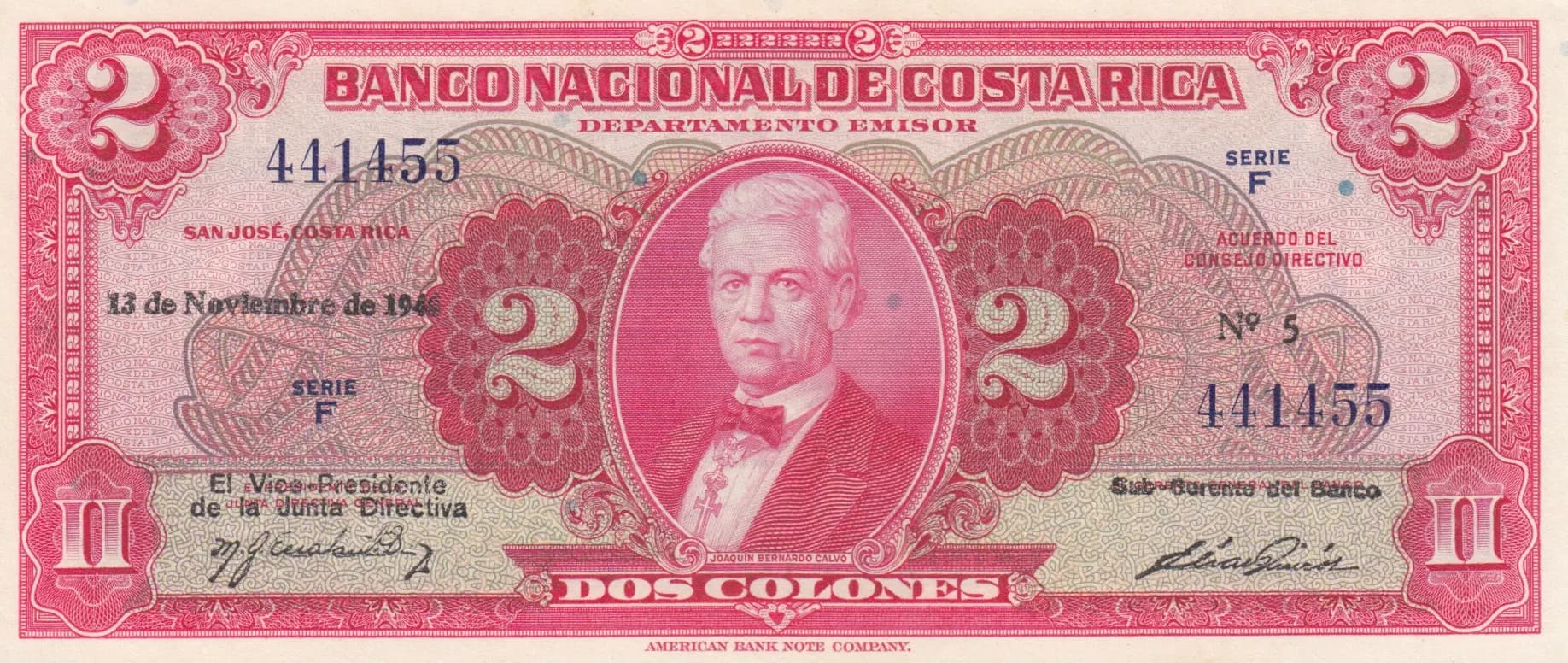
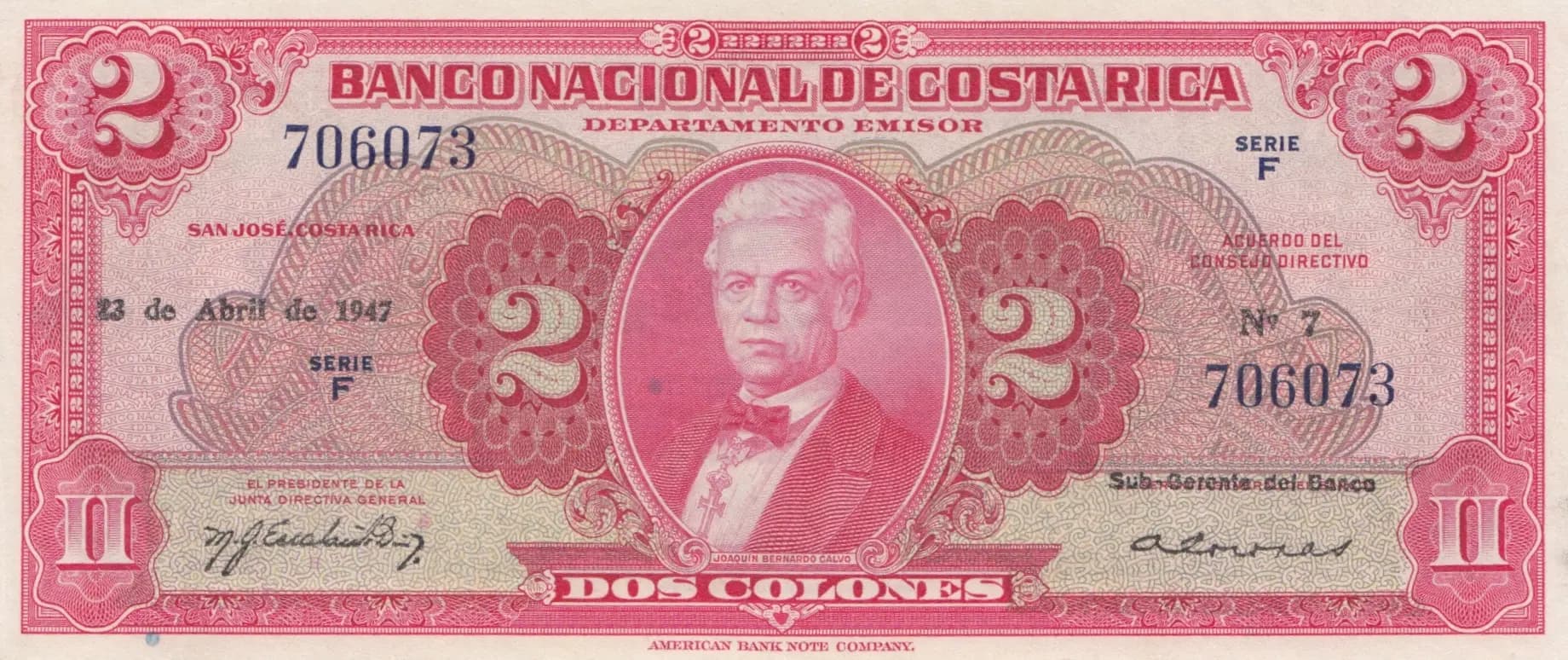
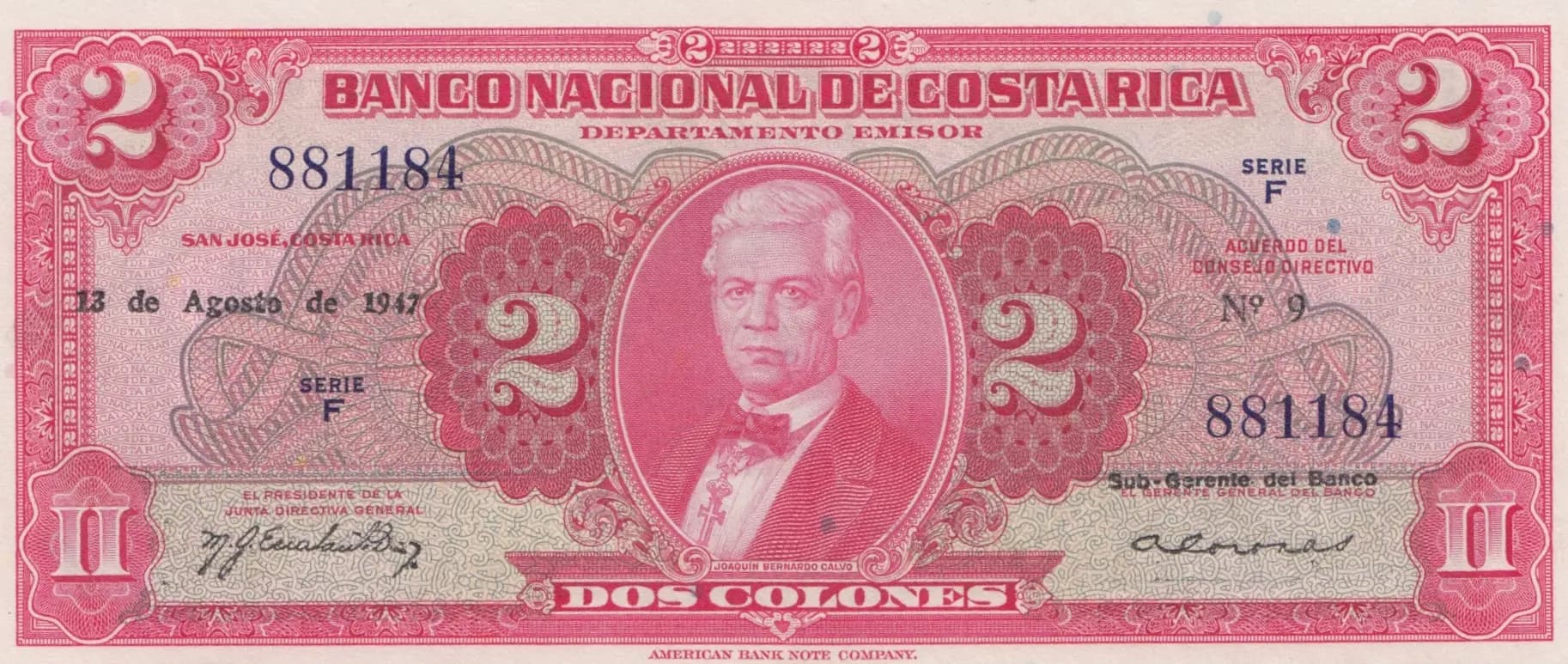
2 colones 1949
“14.12.49”
Market Prices
5 salesAbout This Note
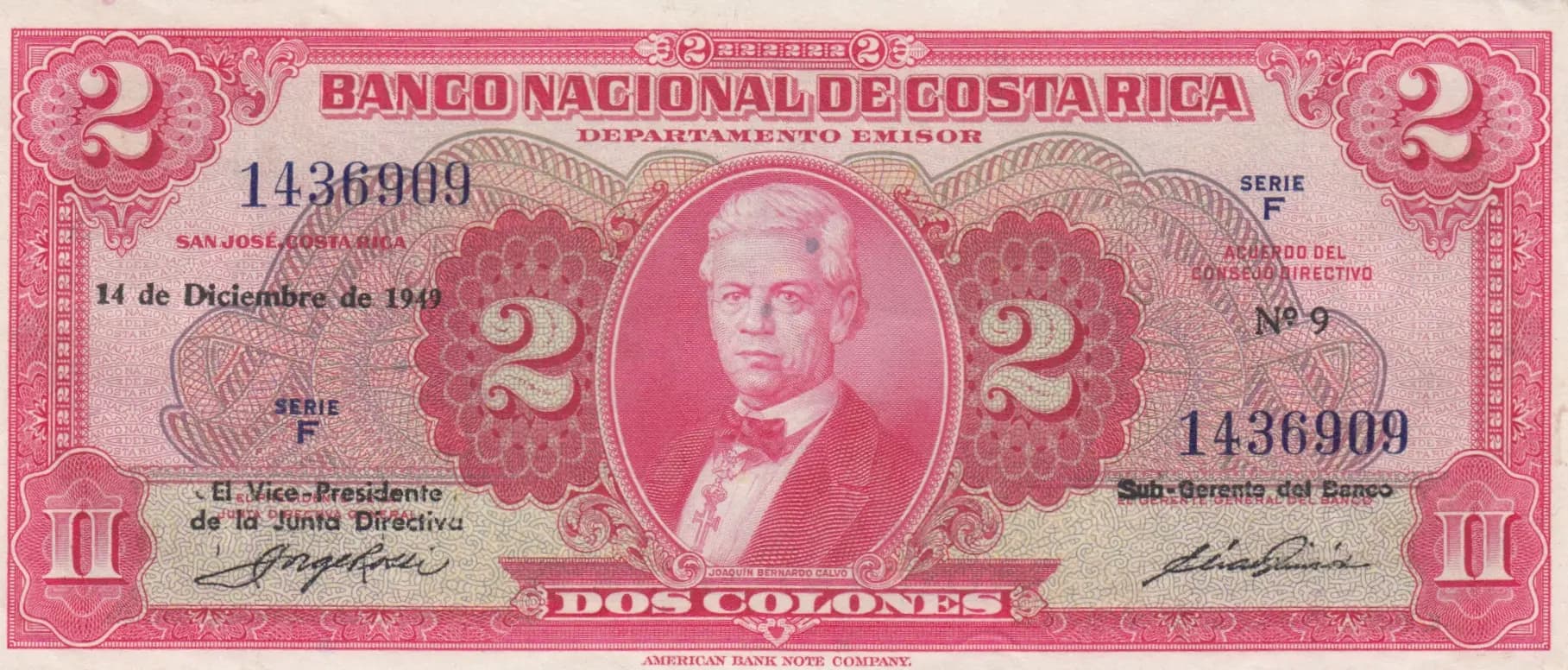
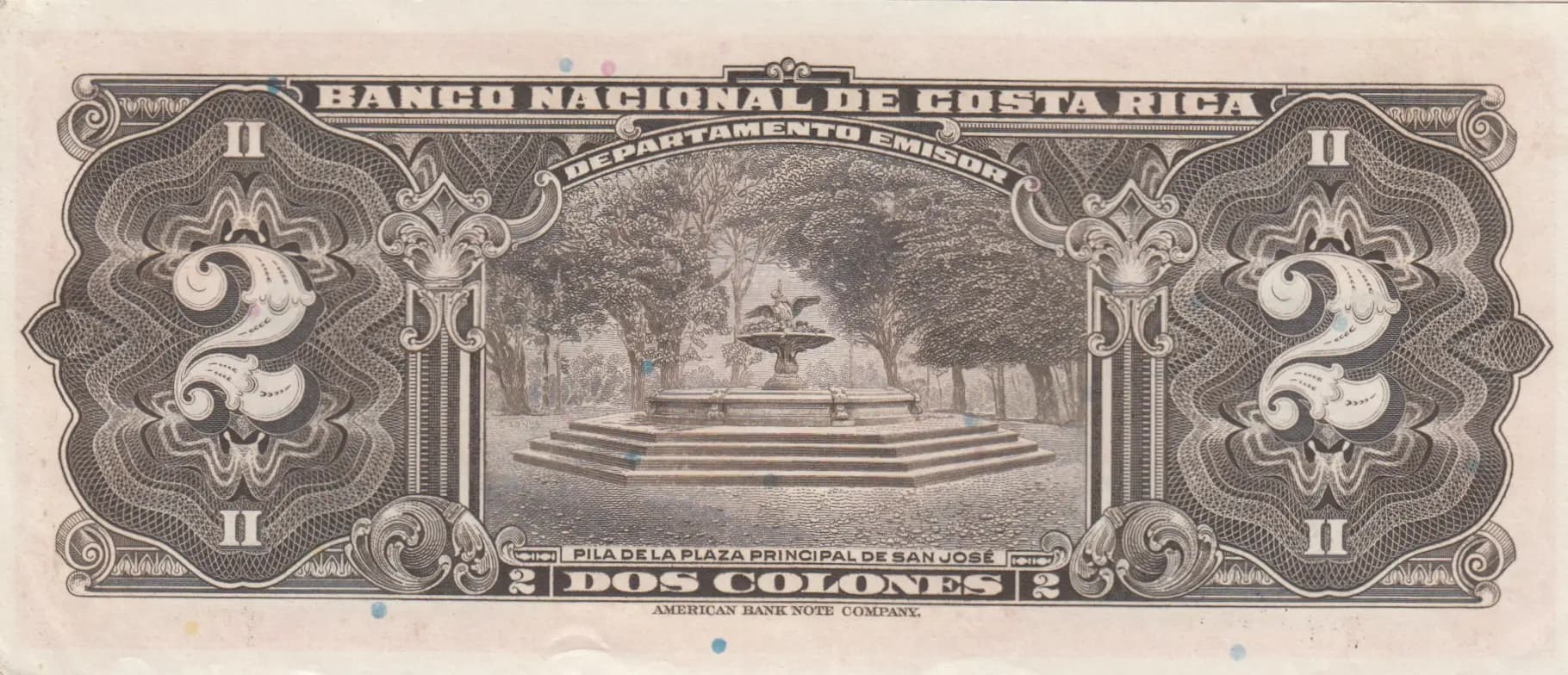
This is a pristine example of Costa Rica's 2 colones banknote from 1949, graded AU, issued by the Banco Nacional de Costa Rica on December 14, 1949. The note features elegant pink/magenta coloring on the front with a central portrait of a 19th-century gentleman and ornate decorative elements, while the reverse displays a detailed black engraving of the iconic Pila (fountain) of San José's main plaza. The exceptional condition with vibrant color, crisp engraving, and no visible wear makes this an attractive example of mid-20th century Costa Rican currency design.
Common. The 2 colones denomination from 1949 (Pick 203b) represents a standard production issue for the Banco Nacional de Costa Rica. While specific print run figures are not definitively documented in widely available sources, the series circulated for several years and examples remain readily available in the collector market. The AU condition grade enhances its desirability relative to heavily circulated examples, but the note itself is not scarce.
This 1949 issue represents the Banco Nacional de Costa Rica's post-World War II currency production, a period of economic stabilization for the nation. The choice to feature the Pila de la Plaza Principal de San José on the reverse reflects Costa Rica's pride in its capital's civic infrastructure and urban development during the mid-twentieth century. The note's production by the American Bank Note Company, a premier security printer, underscores the international standards Costa Rica maintained for its currency during this era.
The obverse features a central oval portrait of an unidentified prominent 19th-century Costa Rican figure, depicted in formal dress with bow tie, representing the nation's leadership heritage. The design is framed by elaborate Art Deco-influenced geometric and floral ornamentation in the corners, with Roman numeral II in decorative cartouches. The reverse showcases the Pila de la Plaza Principal de San José, the iconic tiered fountain that stood in San José's main plaza, depicted in a detailed landscape composition with surrounding vegetation and architectural context. This landmark imagery celebrates Costa Rica's urban heritage and civic pride. The denomination 'DOS COLONES' appears prominently on both sides, with the note's authority statements and issuing bank information carefully integrated into the overall design.
FRONT SIDE: 'BANCO NACIONAL DE COSTA RICA' (National Bank of Costa Rica); 'DEPARTAMENTO EMISOR' (Issuing Department); '14 de Diciembre de 1949' (December 14, 1949); 'SAN JOSE, COSTA RICA' (San Jose, Costa Rica); 'SERIE F' (Series F); Serial number '1436909'; 'Nº 9' (Number 9); 'ACUERDO DEL DIRECTIVO' (Board Agreement); 'El Vice-Presidente de la Junta Directiva' (The Vice-President of the Board of Directors); 'Sub-Gerente del Banco' (Sub-Manager of the Bank); 'DOS COLONES' (Two Colones); 'AMERICAN BANK NOTE COMPANY' (American Bank Note Company). BACK SIDE: 'BANCO NACIONAL DE COSTA RICA' (National Bank of Costa Rica); 'DEPARTAMENTO EMISOR' (Issuing Department); 'PILA DE LA PLAZA PRINCIPAL DE SAN JOSE' (Fountain of the Main Plaza of San Jose); 'DOS COLONES' (Two Colones); 'AMERICAN BANK NOTE COMPANY' (American Bank Note Company).
Intaglio engraving (offset engraved design), produced by the American Bank Note Company, a world-renowned security printer. The technique is evidenced by the fine line work, precise detail in the portrait rendering, intricate background patterns, and the crisp, dimensional quality of the engraved borders and decorative elements visible on both sides of the note.
This example is identified as Series F with serial number 1436909, dated 14 de Diciembre de 1949. The Pick catalog designation 203b indicates this is a recognized variety of the 1949 2 colones issue. Specific signature varieties and series designations (in this case, Series F) should be cross-referenced with the latest Pick or IBNS catalogs for comprehensive variety identification, as multiple series and signature combinations were issued for this denomination during the 1949 production period.