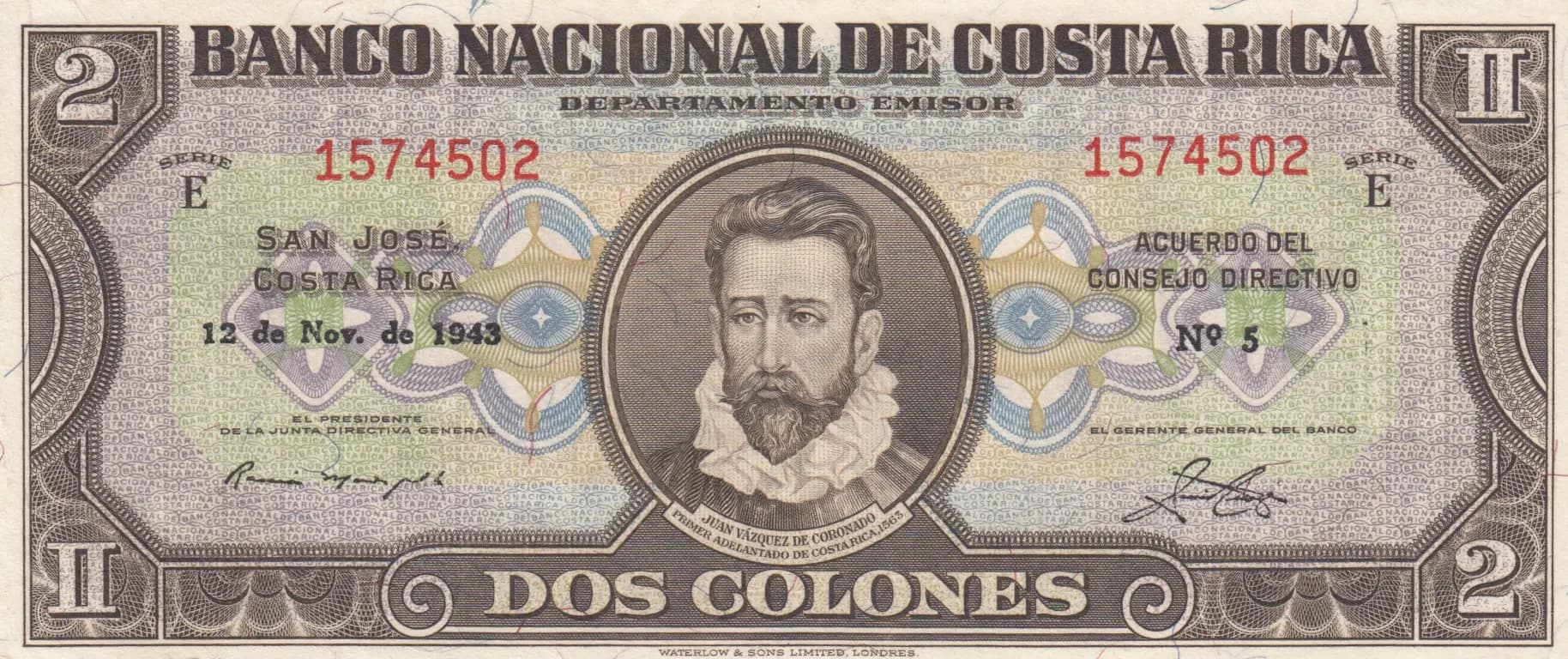
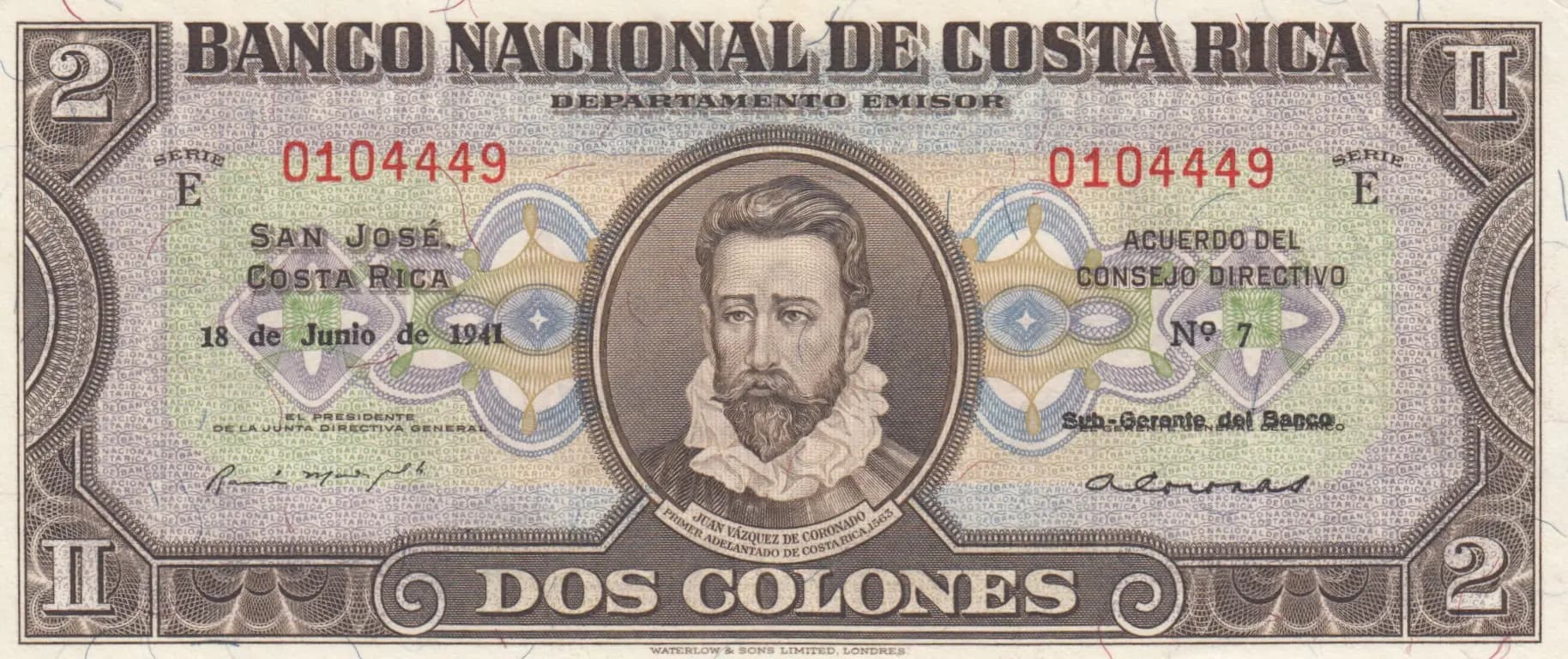
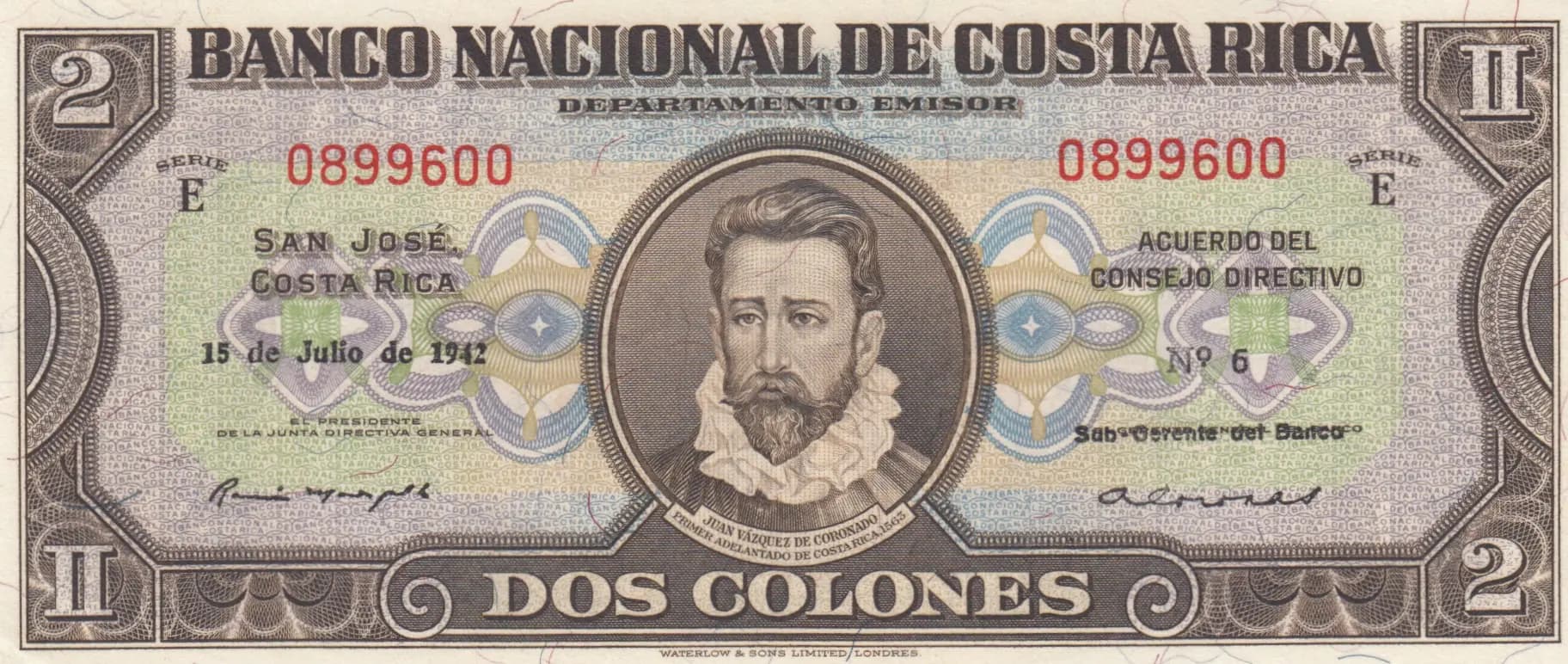
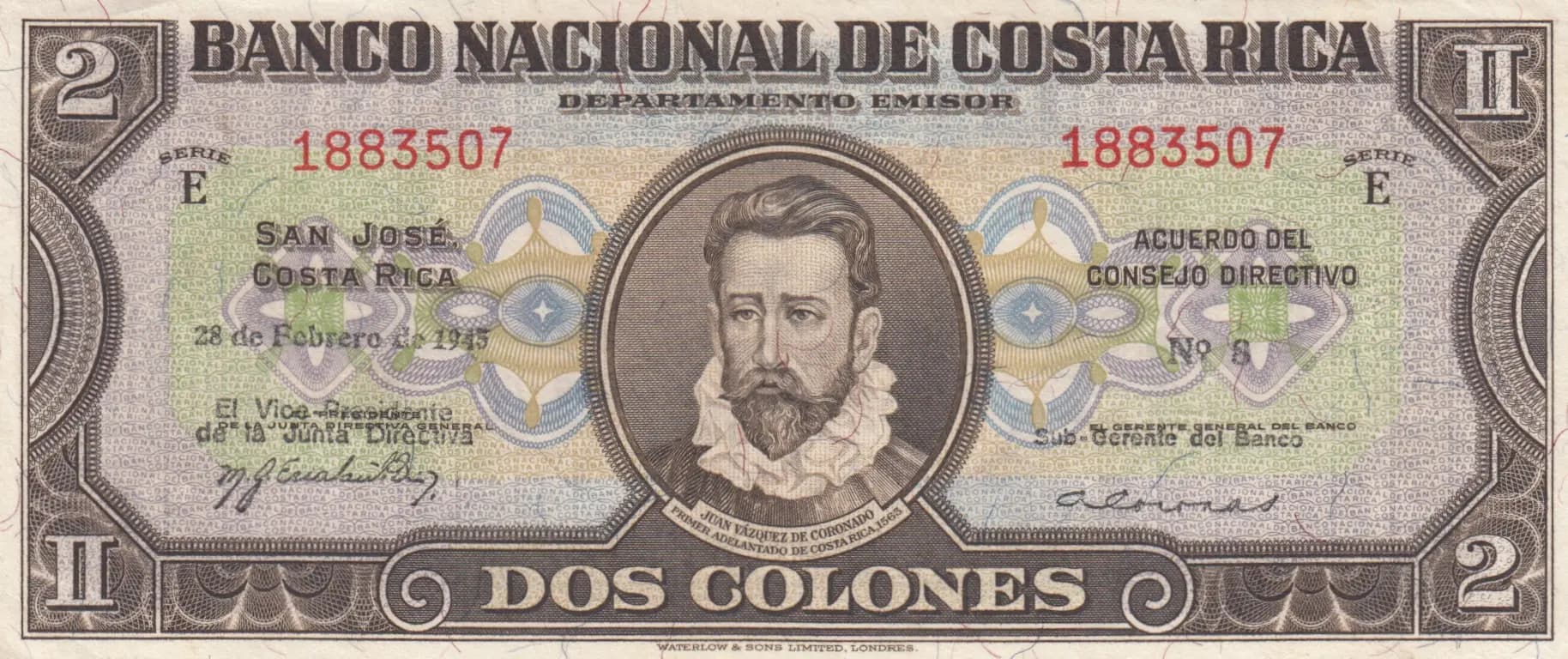
2 colones 1942
Market Prices
About This Note
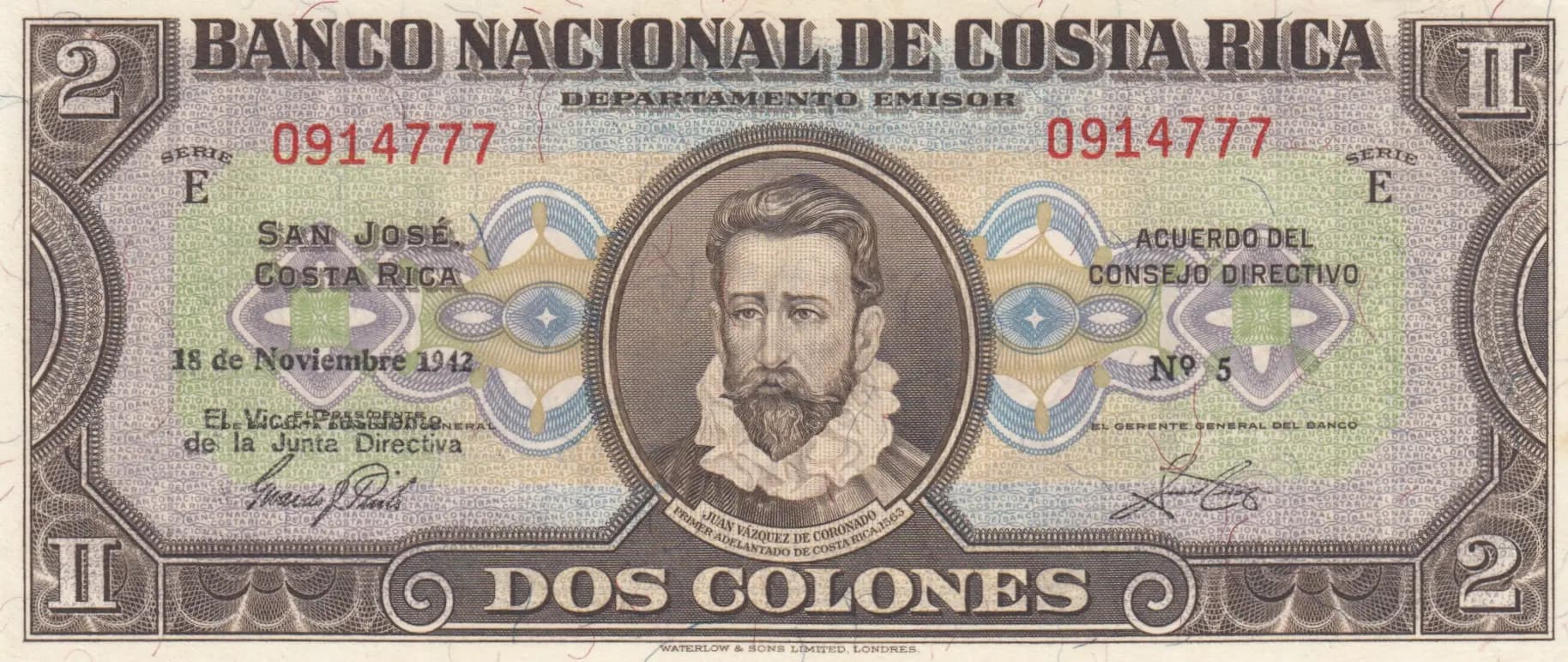
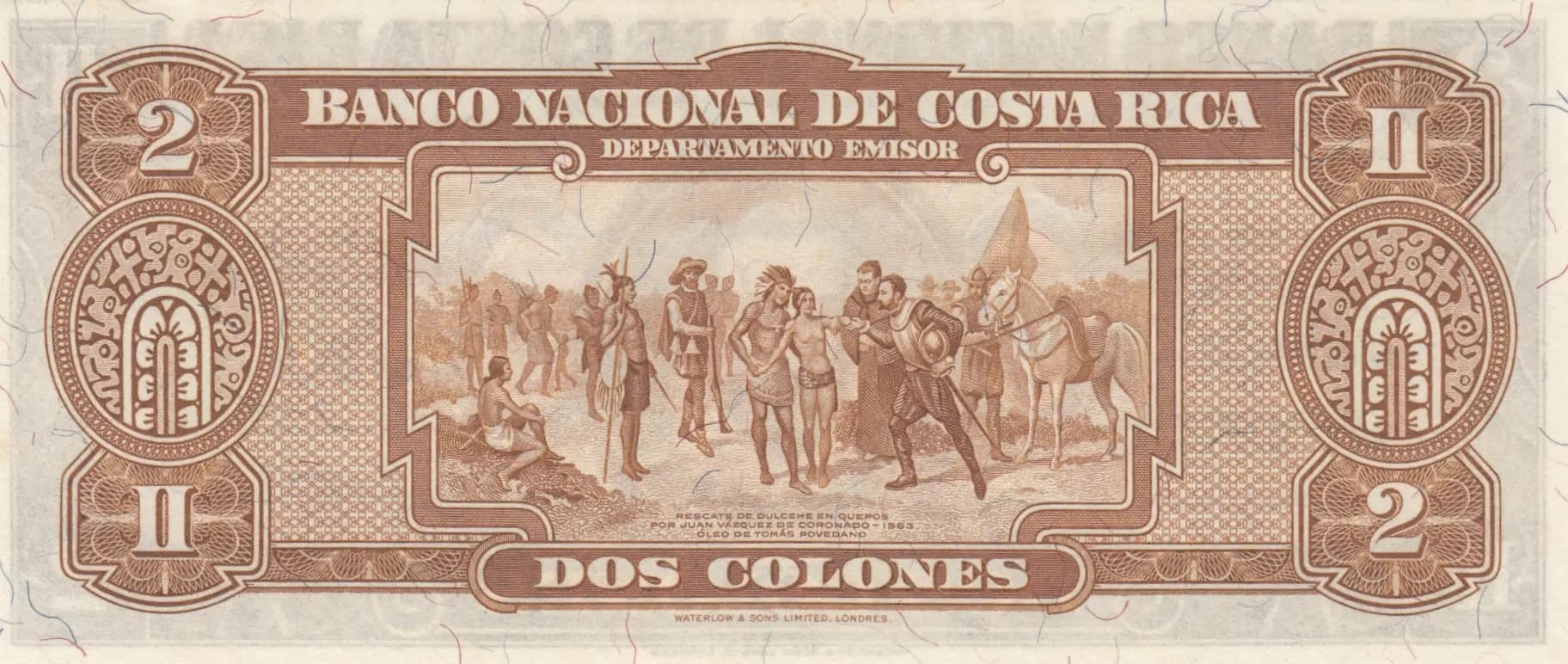
This is a well-preserved example of Costa Rica's 2 Colones note from November 18, 1942 (Pick P-201c), printed by Waterlow & Sons in London. The note features a portrait of Juan Vásquez de Coronado on the obverse and a historically significant rescue scene on the reverse, depicting Coronado's 1563 ransom of Dulche at Quepos rendered from an oil painting by Tomás Povedano. While showing visible age-related creasing and foxing consistent with an 80+ year old circulated note, the engraving quality and color palette (brown/tan with blue accents) remain clearly visible, making this an appealing example of mid-20th century Central American currency design.
Common. This is a regular issue note from a major Central American bank with a production run spanning 1941-1945. eBay market data shows wide price variation ($14.99 to $995.00 USD), with most circulated examples trading well below $100 and uncirculated examples typically under $500, indicating substantial survivors in the market. The AU condition grade of this specimen and catalog values from 2016 ($2 VG to $40 UNC) confirm this is a readily available note for collectors of Costa Rican currency or colonial Latin American themes.
Issued during the final years of World War II, this note commemorates Juan Vásquez de Coronado, the 16th-century Spanish conquistador and founder of San José who played a pivotal role in Costa Rica's colonial period. The reverse design's historical artwork depicting the 1563 rescue scene at Quepos reflects Costa Rica's deliberate choice to celebrate its Spanish colonial heritage through its currency. The note's issue date of November 18, 1942, places it within the regulatory framework established by Decreto No. 5 of the Banco Nacional's Board of Directors, demonstrating institutional continuity during wartime economic management.
The obverse features a formal portrait of Juan Vásquez de Coronado, rendered in fine line engraving within an ornate oval medallion frame, depicting him as a bearded man in 16th-17th century formal attire with a prominent white collar. The central portrait is flanked by decorative oval wreath frames and ornamental flourishes, with denomination numerals '2' appearing in shield-like corner frames. The color scheme combines brown and tan tones with blue and gray accents, with red serial numbers displayed at top center and repeated in the corners. The reverse presents a more elaborate historical scene: a detailed engraved composition depicting the 1563 rescue of Dulche at Quepos, showing indigenous peoples and Spanish colonial figures in period armor engaged in a historical transaction or encounter, with landscape elements including trees and a tent structure. Decorative circular medallions with geometric patterns frame the scene on left and right, while Roman numeral 'II' appears in corner designations. The entire note is bordered by complex ornamental patterns demonstrating high-quality security printing.
FRONT: 'BANCO NACIONAL DE COSTA RICA' (National Bank of Costa Rica), 'DEPARTAMENTO EMISOR' (Issuing Department), '18 de Noviembre 1942' (November 18, 1942), 'SAN JOSÉ, COSTA RICA' (San José, Costa Rica), 'ACUERDO DEL CONSEJO DIRECTIVO No 5' (Agreement of the Board of Directors No. 5), 'EL VICE-PRESIDENTE de la Junta Directiva' (The Vice-President of the Board of Directors), 'EL GERENTE GENERAL DEL BANCO' (The General Manager of the Bank), 'DOS COLONES' (Two Colones), 'JUAN VÁSQUEZ DE CORONADO' (Juan Vásquez de Coronado), 'WATERLOW & SONS LIMITED, LONDRES' (Waterlow & Sons Limited, London), Serial Number: E 0914777. BACK: 'BANCO NACIONAL DE COSTA RICA' (National Bank of Costa Rica), 'DEPARTAMENTO EMISOR' (Issuing Department), 'DOS COLONES' (Two Colones), 'RESCATE DE DULCHE EN QUEPOS POR JUAN VÁSQUEZ DE CORONADO - 1563 ÓLEO DE TOMÁS POVEDANO' (Ransom of Dulche at Quepos by Juan Vásquez de Coronado - 1563 Oil painting by Tomás Povedano), 'WATERLOW & SONS LIMITED, LONDRES' (Waterlow & Sons Limited, London).
Intaglio engraving (line engraving) on banknote paper, produced by Waterlow & Sons Limited of London, one of the world's premier security printers of the era. The fine line work, intricate ornamental borders, decorative medallions, and detailed portraiture are characteristic of high-security banknote production using steel plates and specialized presses. The multicolor printing (brown primary with blue, gray, and red accents) was achieved through multiple passes with different color plates, a standard technique for quality banknote production of the 1940s.
This specific example is identified as Pick P-201c, dated November 18, 1942, Series E, Serial Number 0914777. The Pick catalog distinguishes varieties of this 1942 issue by series letters and specific signature combinations. The 'VICE-PRESIDENTE' title overprint at left (as noted in external references) may indicate a specific signature variety. The date, series designation, and signature titles should be cross-referenced against Pick's complete catalog of P-201 varieties to confirm the exact sub-variety classification.