2 colones 1943
Market Prices
9 salesAbout This Note
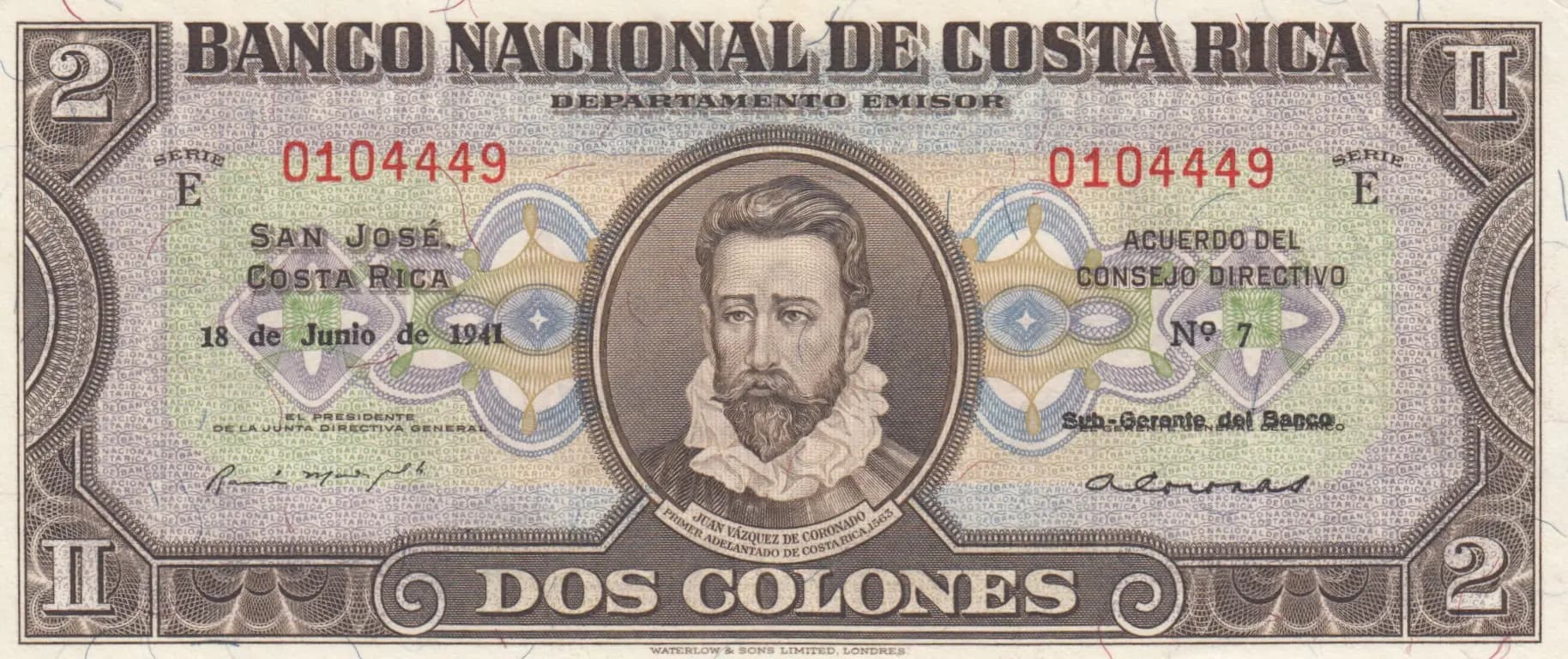
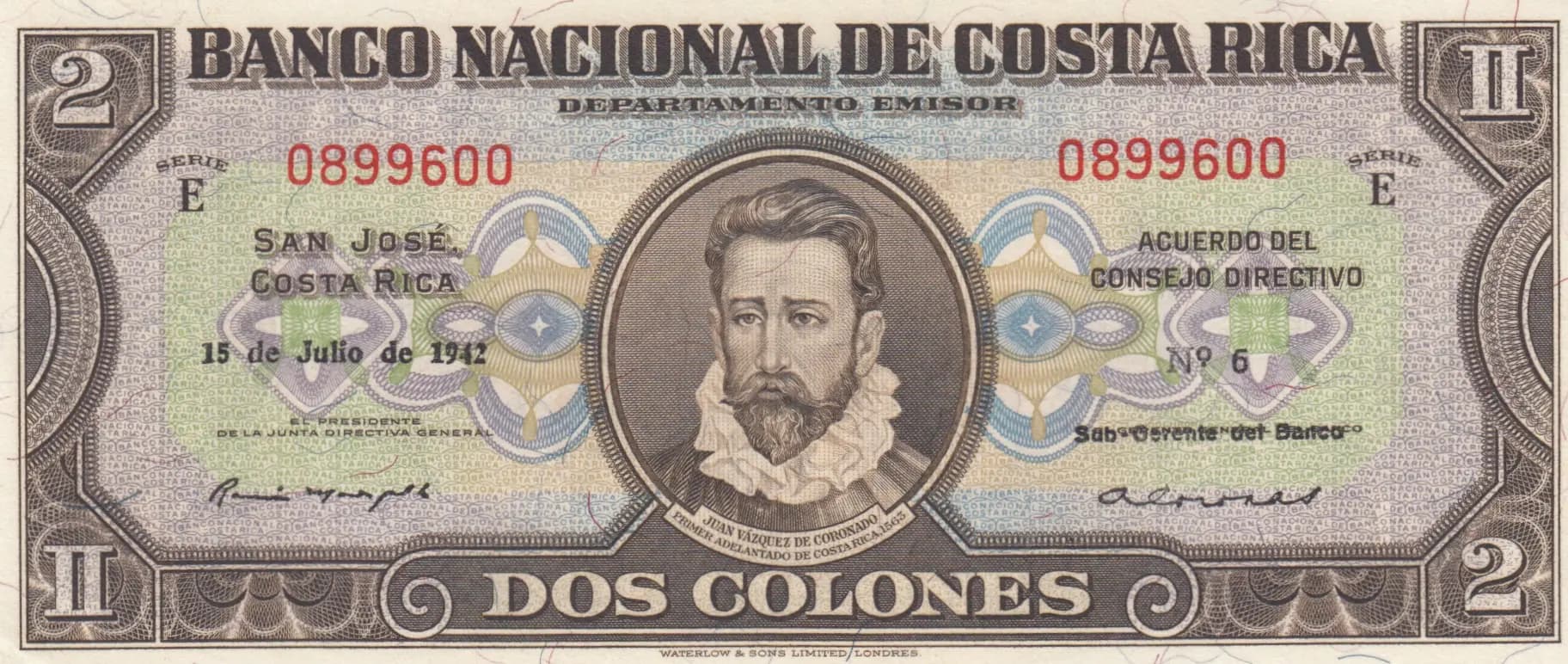
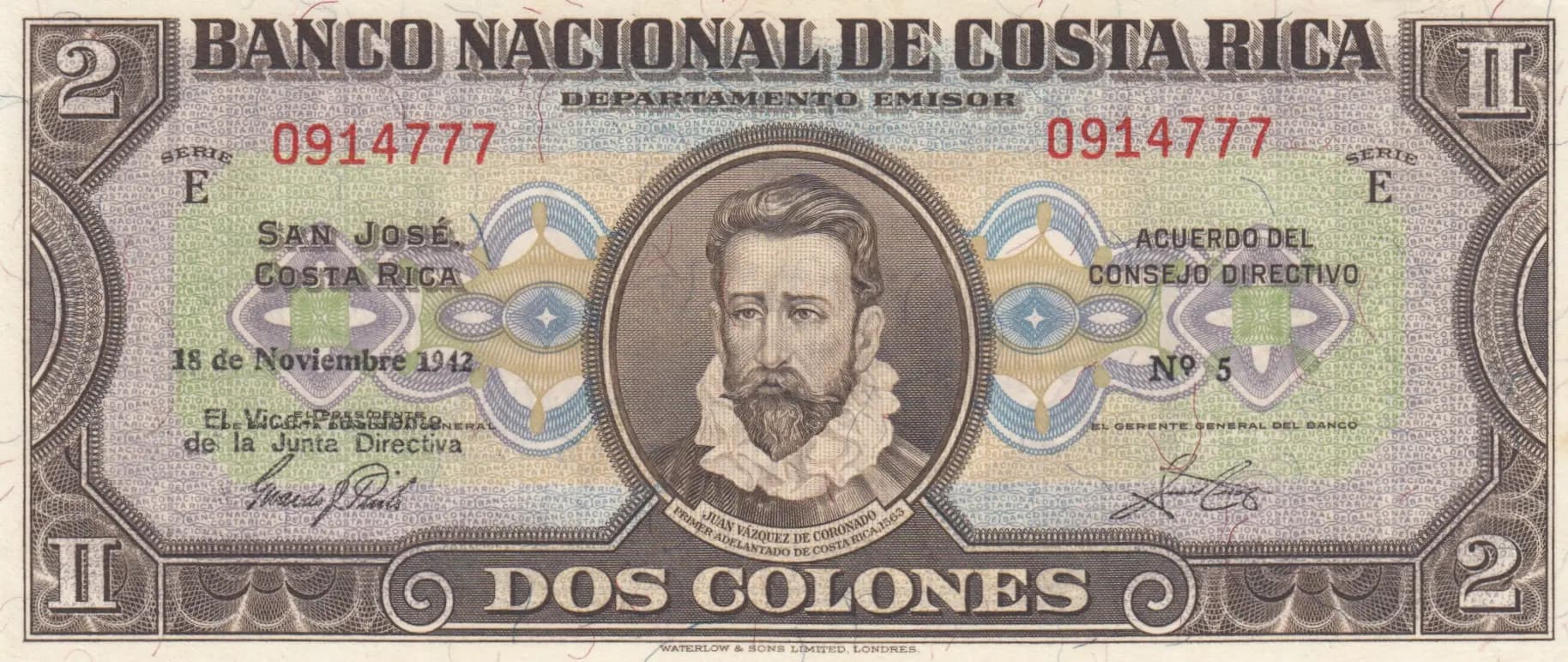
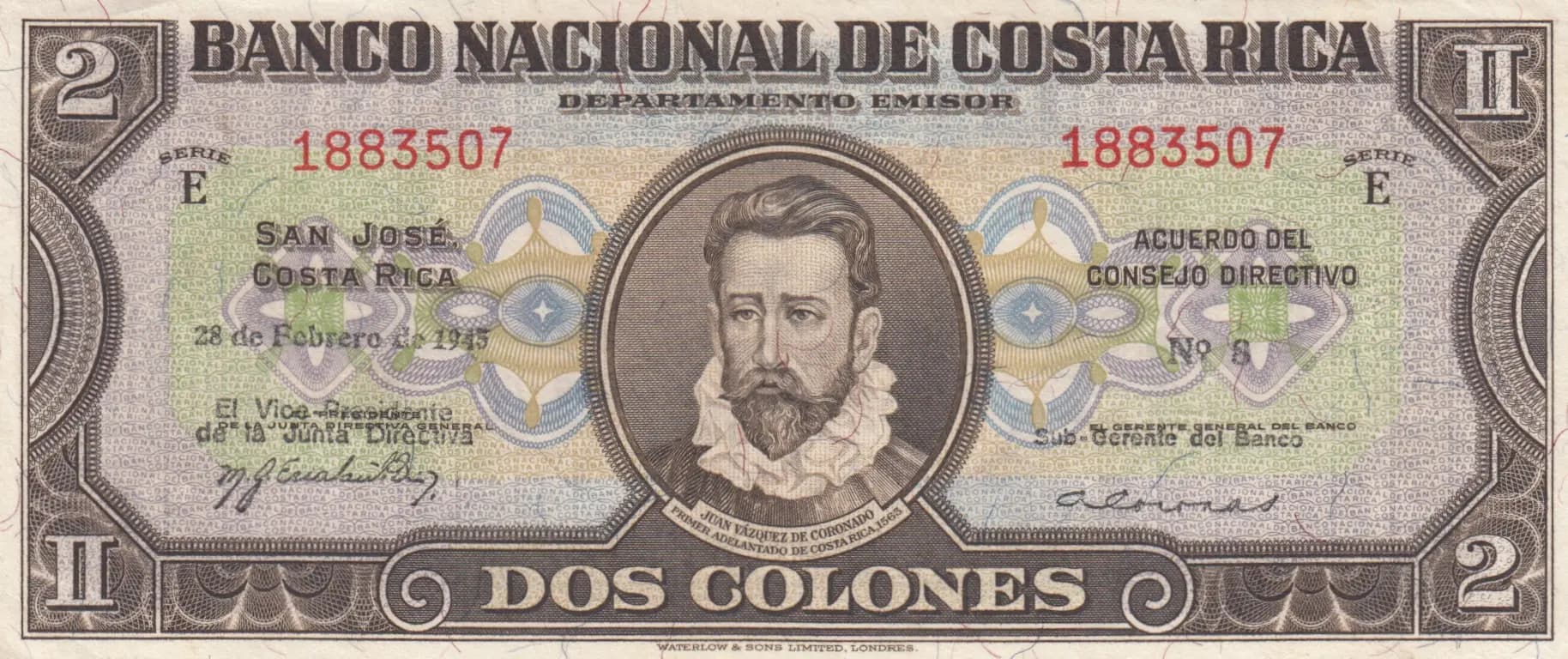
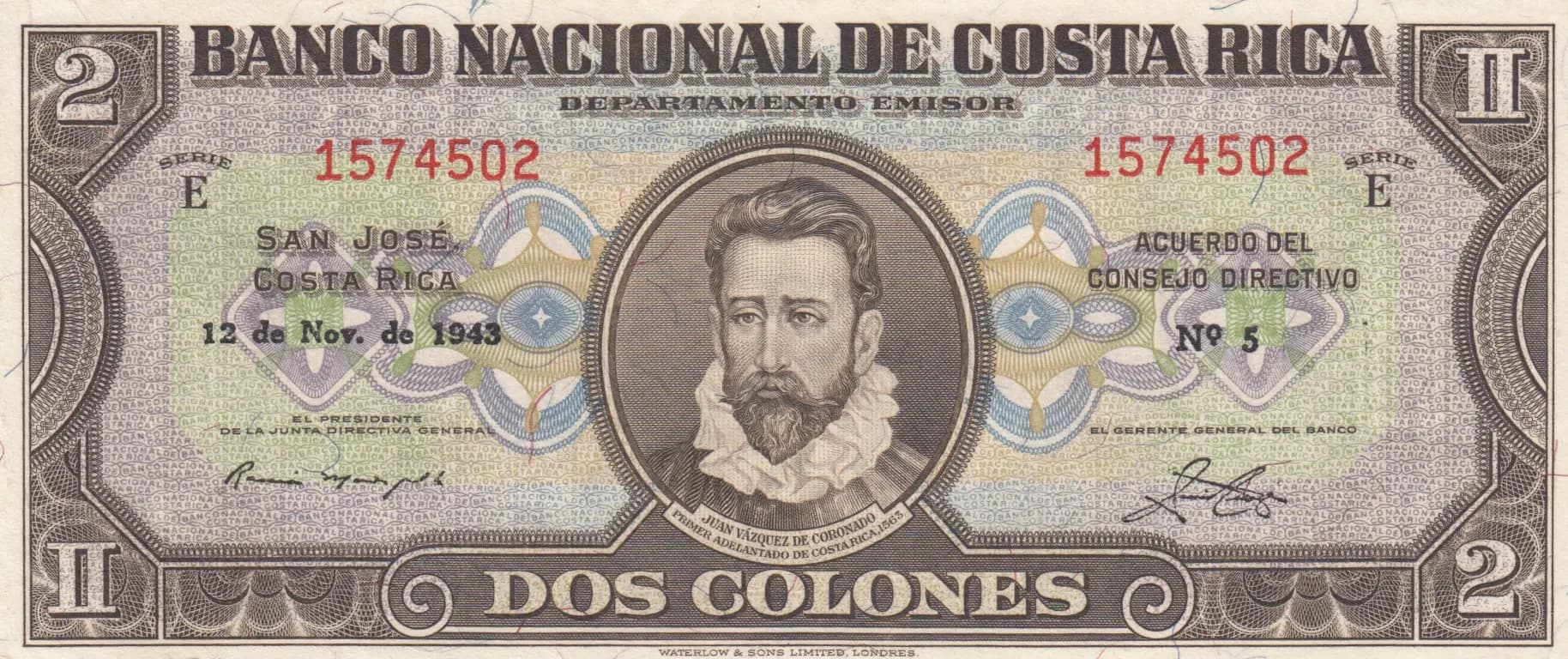
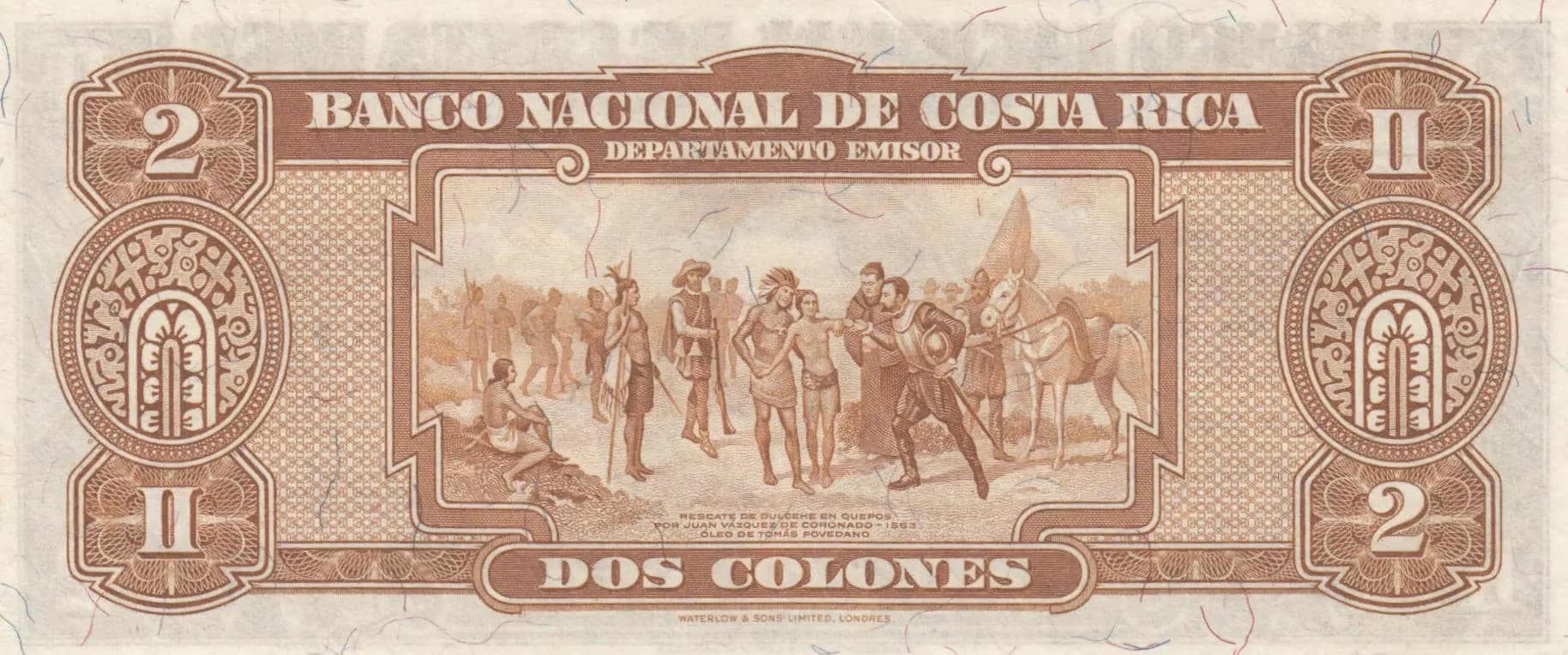
This is a well-preserved AU example of the Costa Rican 2 colones from 1943 (Pick P-201a), issued by Banco Nacional de Costa Rica and printed by the prestigious Waterlow & Sons of London. The note features an elegant portrait of Juan Vázquez de Coronado on the obverse within an ornamental oval frame, complemented by decorative rosettes and geometric patterns, while the reverse depicts a historically significant scene of Coronado's rescue of the Quecoas at Quepos in 1563, based on an oil painting by Tomás Povedano. Despite visible creasing and age-related wear consistent with circulation, the note retains strong detail and color, with the intricate engraving work clearly evident throughout—characteristics that make it attractive to both historical and general currency collectors.
Common. This is a regular issue banknote from a substantial print run during the 1941-1945 issuance period by a major national bank. The eBay price history provided shows a consistent market presence with sales ranging from $12.50 to $295, with most examples in VF condition selling in the $50-$65 range as recently as 2025. Catalog values for 2016 list UNC examples at only $45, indicating robust availability at all grade levels. The absence of any special designations, limited mintage information, or signatures suggesting rarity, combined with the regular market activity, confirms this as a common banknote. Even graded examples (PMG 65-66) sell for under $300, well within the range for commonly available vintage currency.
This note commemorates Juan Vázquez de Coronado, a pivotal figure in Costa Rican colonial history, with the reverse depicting his 1563 rescue of the Quecoas indigenous people at Quepos. Issued in 1943 during a period of economic consolidation in Costa Rica, this banknote reflects the nation's pride in its founder and colonial heritage. The choice to feature this historical rescue scene underscore Costa Rica's emphasis on the relatively peaceful nature of its colonial encounter compared to other regions, presenting a narrative of humanitarian rescue rather than conquest.
The obverse features a dignified three-quarter portrait of Juan Vázquez de Coronado, the 16th-century Spanish conquistador and founder of Costa Rica, rendered with period-appropriate attire including a white linen collar characteristic of the era. He is positioned centrally within an ornamental oval frame adorned with intricate engraved flourishes. Flanking the portrait are elaborate decorative rosettes featuring radiating sun-like patterns with four-pointed stars, creating a symmetrical composition. The corners display Roman numeral 'II' markers with geometric patterns throughout the border, reinforcing the denomination. The color scheme employs brown and tan as primary colors with green and blue accents. The reverse presents a detailed historical narrative scene depicting the titular 'Rescue of the Quecoas at Quepos in 1563,' showing multiple figures of indigenous peoples and Spanish colonial figures in what appears to be a first contact or humanitarian scenario. The scene includes natural landscape elements with trees, and notably features sailing ships visible in the background, establishing the maritime context of the encounter. This scene, based on Tomás Povedano's oil painting, is framed within an ornamental rectangular border. All four corners are anchored by large circular medallions displaying pre-Columbian geometric design motifs, connecting the note's imagery to Costa Rica's indigenous heritage.
FRONT SIDE: 'BANCO NACIONAL DE COSTA RICA' (National Bank of Costa Rica); 'DEPARTAMENTO EMISOR' (Issuing Department); 'DOS COLONES' (Two Colones); '12 de Nov. de 1943' (November 12, 1943); 'ACUERDO DEL CONSEJO DIRECTIVO No 5' (Board of Directors Agreement No. 5); 'DE LA JUNTA DIRECTIVA GENERA[L]' (Of the General Board of Directors); 'EL GERENTE GENERAL DEL BANCO' (The General Manager of the Bank); 'SAN JOSE, COSTA RICA' (San José, Costa Rica); 'WATERLOW & SONS LIMITED, LONDRES' (Waterlow & Sons Limited, London); Serial number '1574502' with series designation 'E'. BACK SIDE: 'BANCO NACIONAL DE COSTA RICA' (National Bank of Costa Rica); 'DEPARTAMENTO EMISOR' (Issuing Department); 'DOS COLONES' (Two Colones); 'RESCATE DE QUECOAS EN QUEPOS POR JUAN VAZQUEZ DE CORONADO - 1563 OLEO DE TOMAS POVEDANO' (Rescue of Quecoas in Quepos by Juan Vázquez de Coronado - 1563 Oil [Painting] by Tomás Povedano); 'WATERLOW & SONS LIMITED, Londres' (Waterlow & Sons Limited, London).
This banknote was produced using intaglio printing (engraving and/or rotogravure), the standard security printing technique employed by Waterlow & Sons Limited of London, one of the world's premier currency printers of the period. The visual analysis reveals characteristic fine line patterns, intricate engraved details, and the complex layering of ornamental design elements that are signatures of high-quality intaglio work. The precision of the portrait rendering, the delicate background patterns, and the detailed historical scene all demonstrate the sophisticated anti-counterfeiting capabilities of this printing method. The multi-color application—brown, green, and blue accents over a cream/beige base—appears to have been achieved through successive intaglio passes, a technique commonly used by Waterlow for premium banknote production.
This specimen is identified as Pick P-201a (the primary variety of the 1943 2 colones). The note bears date of issue '12 de Nov. de 1943' with series designation 'E' and serial number 1574502. Based on the catalog references, the 1941-1945 issuance included multiple date variants within this period range (1941, 4.2.1942, 20.1.1943-16.2.1944), and this specimen represents the November 1943 date variant. The visual analysis confirms 'Without signature title changes' as noted in the realbanknotes.com reference, indicating this is the standard variety without signature variations. No overprints or special markings are evident, confirming this as the regular issue variety P-201a rather than any specialized subset or emergency printing.