20 centavos 1900
Market Prices
1 saleAbout This Note
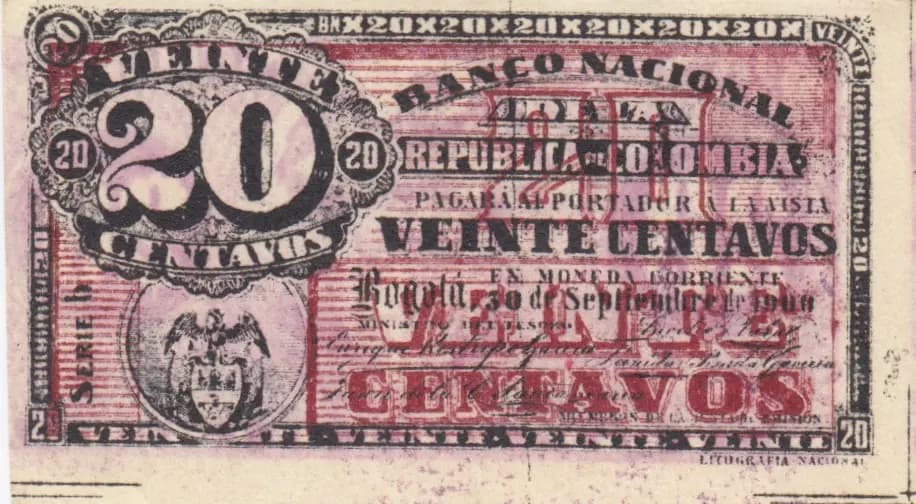
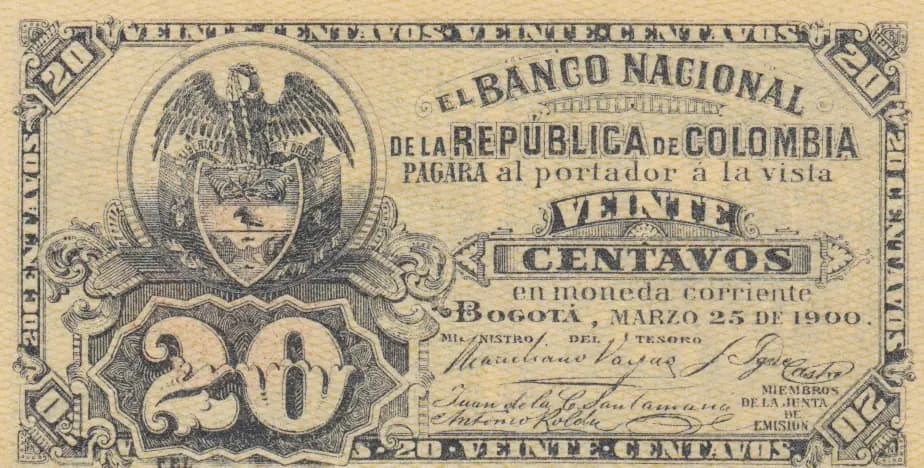
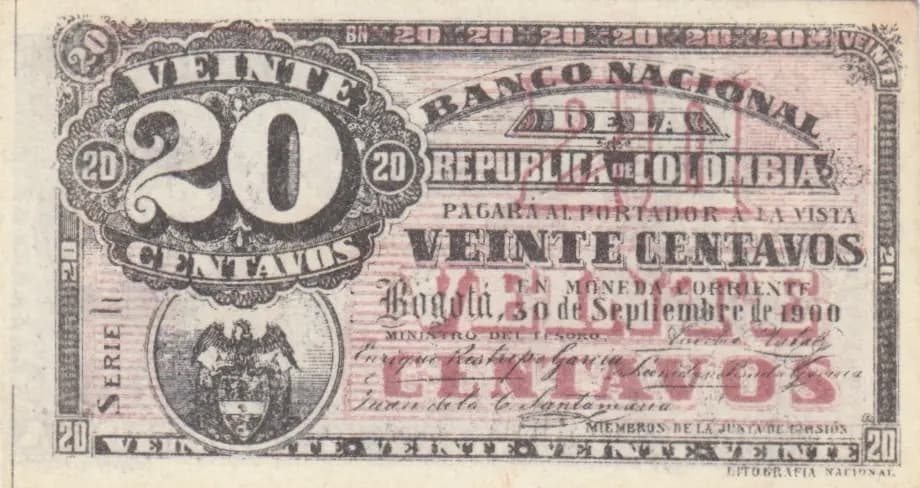
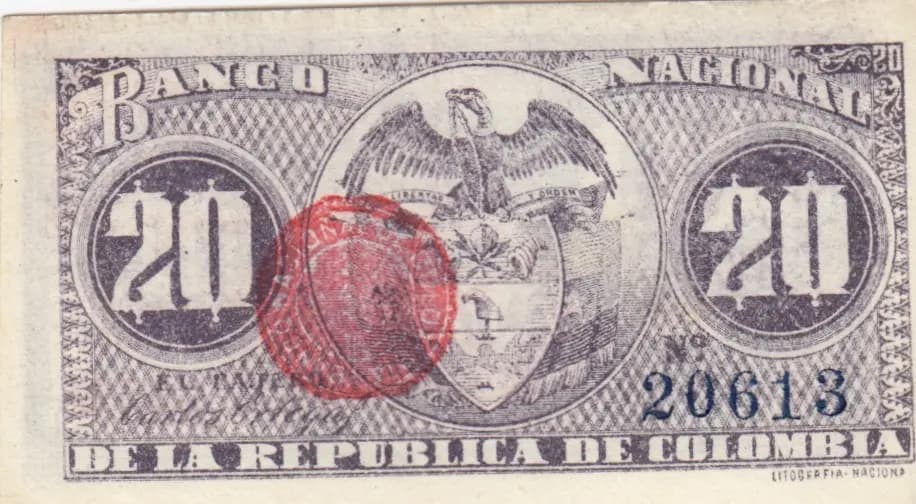
This is a Colombian 20 centavos banknote from 1900 issued by the Banco Nacional de la República de Colombia, graded in AU condition. The note features an ornate design with a prominent numeral "20" on the front accompanied by a circular heraldic eagle emblem in wine-red and black on a cream background, while the reverse displays a majestic spread-winged eagle within a central medallion in purple/violet tones with a geographic background. Despite moderate age-related wear including creasing, foxing, and discoloration throughout, the note retains strong visual definition with clear inscriptions and the characteristic wine-red underprint that distinguishes this P-265 variety from the P-265A variant.
Common. This is a regular issue from the national bank of a major South American country with a substantial print run indicated by at least 17 documented series letter varieties. Market data from realbanknotes.com shows catalog values of only $0.75 (VG), $3 (VF), and $15 (UNC) as of 2016, with eBay comparables selling in the $14-15 range for VF specimens. Notes of this denomination and issuer that trade for under $20 are universally common in the numismatic market. The AU condition grade observed here places it in the mid-range of collector interest but does not alter the fundamental commonality of the issue.
This banknote was issued in 1900 by Colombia's national bank during a period of economic consolidation following the country's late 19th-century political turbulence. The prominent heraldic eagle and shield symbols on both obverse and reverse reflect Colombia's national identity and sovereignty, while the 'pagará al portador' (payable to bearer) language demonstrates the bearer-note banking practices of the era. The use of lithographic printing by Litografía Nacional de Bogotá represents the state's capacity for domestic currency production at the turn of the century.
The obverse features a left-aligned ornate numeral '20' rendered in decorative scrollwork, with a circular Colombian national coat of arms (featuring an eagle and shield design) positioned in the lower left quadrant. The design employs a wine-red or pink underprint with fine black line patterns creating a gridded security background. The reverse presents a more elaborate central design: two symmetrical circular numeral cartouches containing '20' frame a large central circular medallion displaying the Colombian eagle with fully spread wings in a heraldic pose, set against a mapped or geographic representation background. The entire reverse employs purple and violet tones with fine cross-hatch patterning for security purposes. The denomination appears in multiple forms (numerals and spelled-out Spanish text) across both sides, consistent with banking conventions of the period.
FRONT: 'BANCO NACIONAL' (National Bank), 'REPUBLICA DE COLOMBIA' (Republic of Colombia), 'PAGARA AL PORTADOR LA LISTA' (Will pay to bearer), 'VEINTE CENTAVOS' (Twenty centavos), 'ESTA ES MONEDA CORRIENTE' (This is current currency), '20' (denomination numeral). BACK: 'BANCO NACIONAL' (National Bank), 'DE LA REPUBLICA DE COLOMBIA' (Of the Republic of Colombia), '20' (denomination numerals appearing twice), '79712' (serial number), 'LITOGRAFIA BRASIL' (Brazil Lithography).
This note was produced by lithography, specifically by Litografía Nacional in Bogotá (as stated on the obverse), with some sources indicating involvement of Litografía Brasil. The process employed multiple color separations: the wine-red/pink underprint on the front, black line work for borders and text, and purple/violet inking for the reverse. The fine line patterns and cross-hatch backgrounds visible throughout are characteristic of period lithographic security techniques. The layered color application and ornate scrollwork details are consistent with high-quality 19th-century lithographic production methods.
This note is identified as Pick P-265 with the distinctive wine-red underprint on the front, which differentiates it from the P-265A variety (noted in the catalog reference as lacking this wine-red underprint). The serial number observed is '79712' and the note carries at least one series letter (consistent with the documented 17+ series letter variations for this issue). A red overprint stamp mark is visible across the reverse center, likely an institutional or banking mark rather than a printer's variety designation. No signature varieties are apparent from the visual analysis provided.