10 pesos 1884
“19.05.84”
Market Prices
About This Note
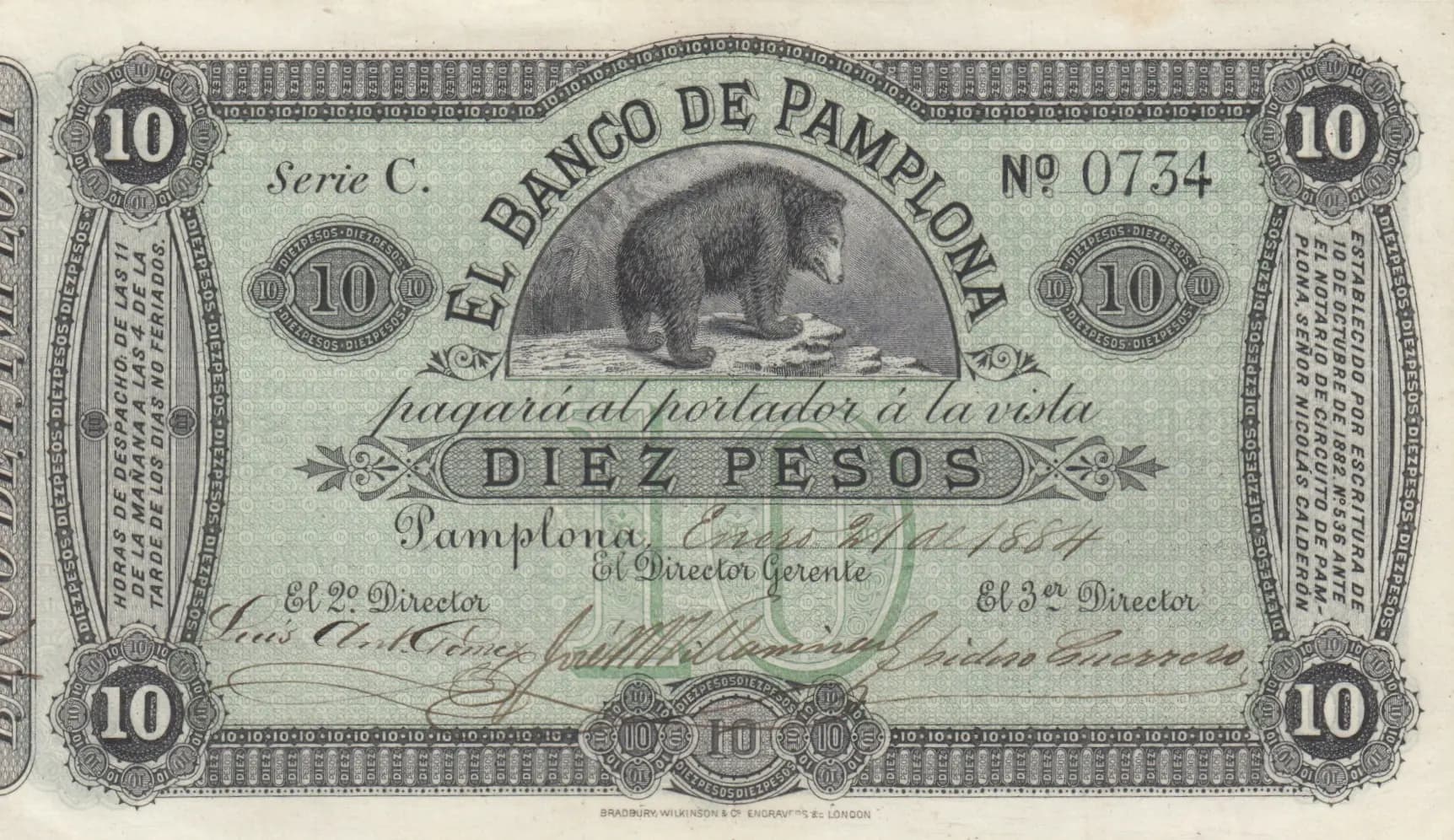
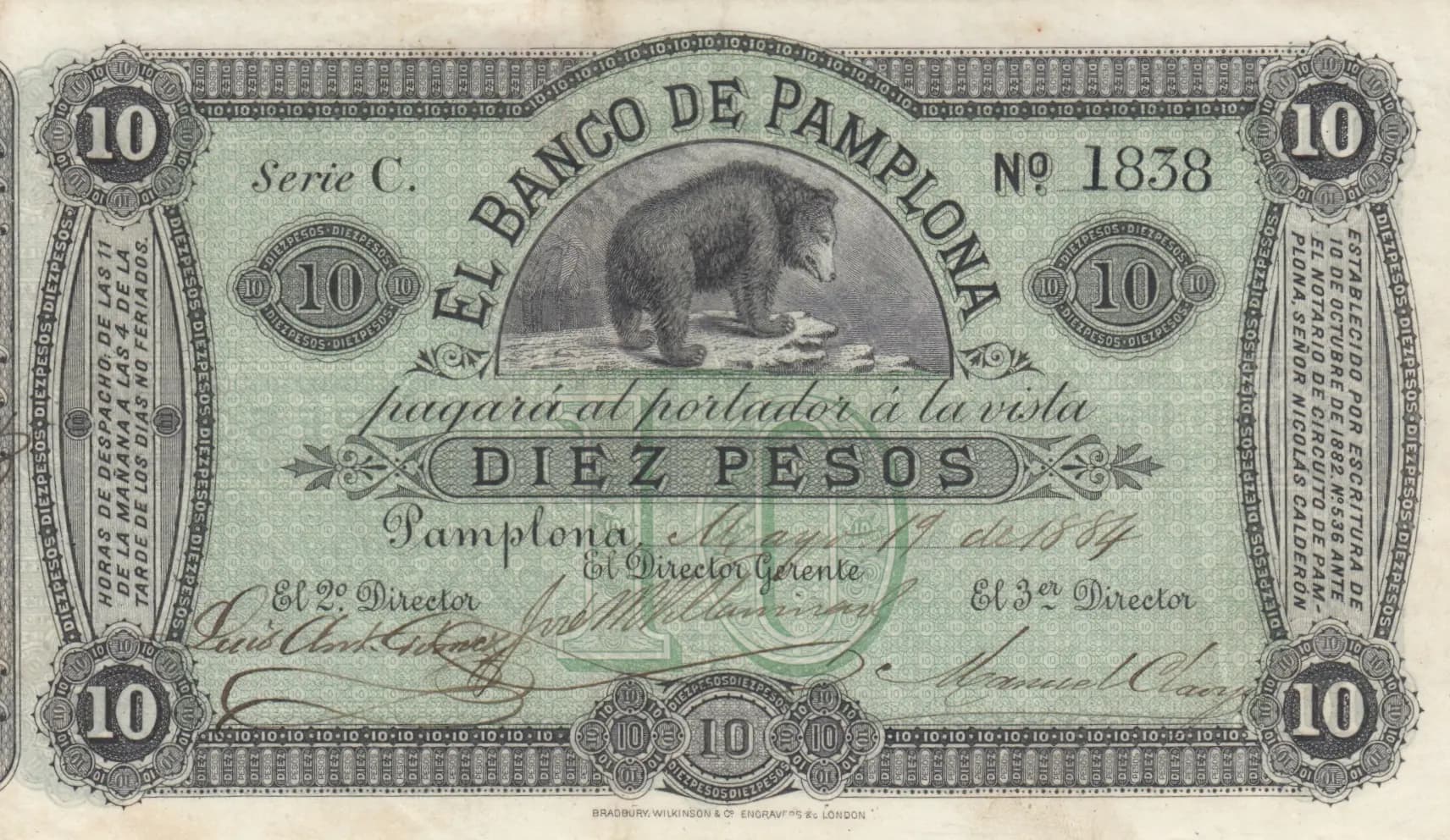
This is an AU-graded 10 pesos banknote from Banco de Pamplona, issued in 1884, representing an important example of late 19th-century Colombian regional currency. The note features a striking naturalistic bear vignette on the obverse positioned within an ornamental oval frame, with elaborate decorative borders and corner denomination indicators, all rendered in green and black by the prestigious London engraver Bradbury, Wilkinson & Co. The excellent condition preserves crisp engraving detail and well-saturated ink colors, with only minor age-related patina and foxing expected for a note of this era.
Common. Banco de Pamplona notes from this series were issued in standard quantities typical of regional Colombian banks of the 1884 period. The Pick catalog designation P-S713 indicates this is a well-documented and cataloged issue, and the specific series C, note number 1858 represents routine production within the bank's issuance cycle. No evidence suggests limited print runs, recall, or exceptional scarcity for this denomination and issuer combination. Notes from this bank and period appear in collectors' markets with reasonable regularity.
Banco de Pamplona was one of Colombia's regional banks operating during the period of decentralized currency issuance that characterized late 19th-century Colombian banking. The bear depicted on the obverse likely references Colombia's fauna and national identity, a common iconographic choice for regional banks seeking to establish legitimacy and local pride. The note's production by the esteemed London firm Bradbury, Wilkinson & Co reflects the common practice of Colombian banks commissioning high-security engraving from established European security printers to prevent counterfeiting.
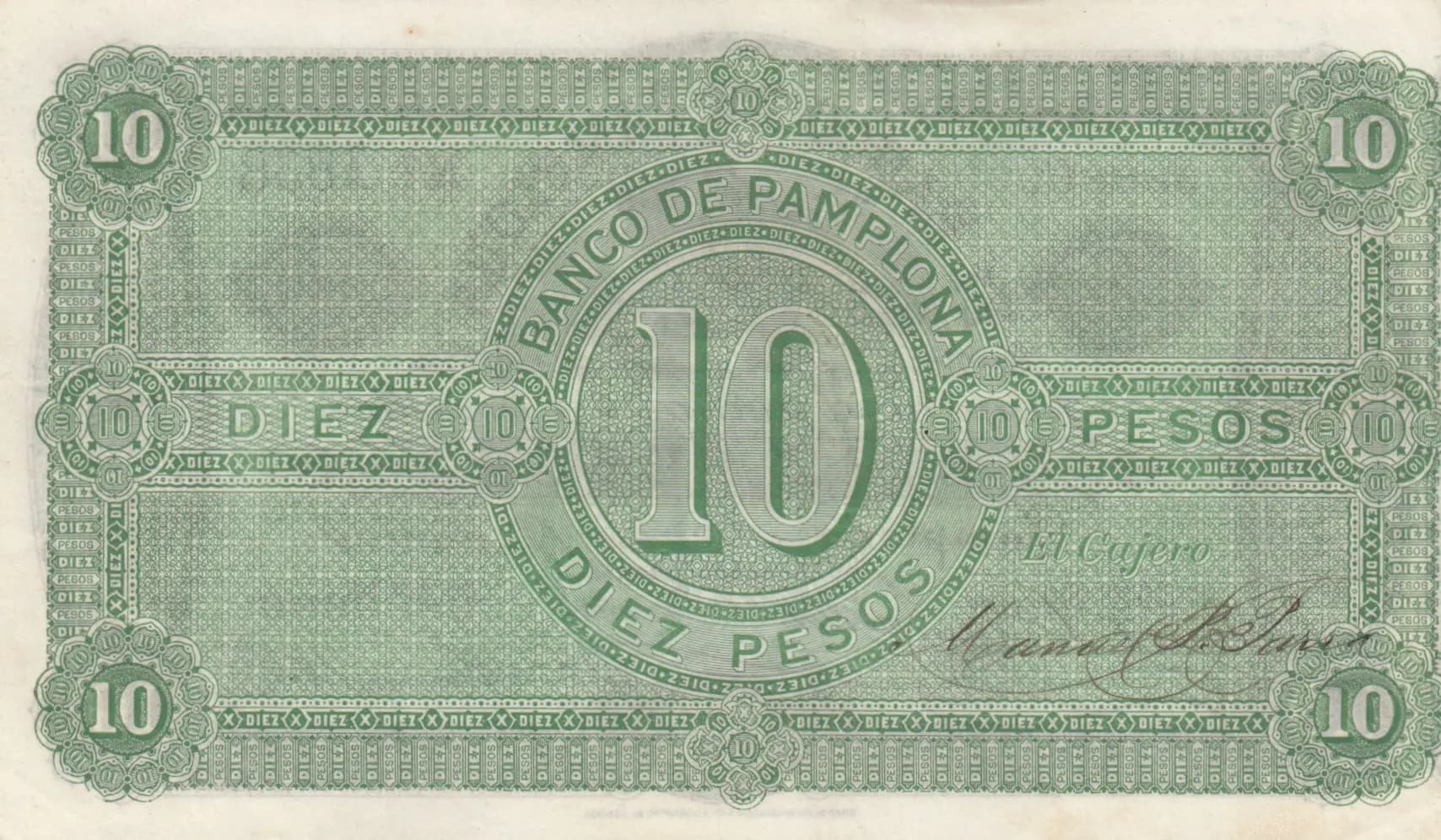
The obverse features a naturalistic depiction of a large bear (likely a grizzly or similar Ursidae species) shown in profile facing left, standing on rocky or mountainous terrain. The bear is positioned within an ornate oval frame serving as the central vignette. The design incorporates elaborate security-focused decorative borders with repeating geometric and floral pattern elements, with ornamental circular emblems containing the numeral '10' positioned at all four corners. The reverse presents a more austere design focused on denomination, with a large central numeral '10' surrounded by concentric circular frames and the repeated word 'DIEZ' forming decorative border elements. Both sides employ fine line engraving throughout, creating visual complexity intended to deter counterfeiting. The color scheme is predominantly green with black printed elements on a cream/white paper base.
Front side: 'EL BANCO DE PAMPLONA' (The Bank of Pamplona) / 'Juguete al Portador i la Vista' (Payable to Bearer on Sight) / 'DIEZ PESOS' (Ten Pesos) / 'Serie C' (Series C) / 'No 1858' (Number 1858) / 'Pamplona' (city name) / 'El Director Gerente' (The Managing Director) / 'El 2º Director' (The 2nd Director) / 'El 3er Director' (The 3rd Director) / 'BRADBURY, WILKINSON & Co ENGRAVERS LONDON' (printer attribution) / Handwritten signatures and dates. Back side: 'BANCO DE PAMPLONA' (Bank of Pamplona) / 'DIEZ PESOS' (Ten Pesos) / 'DIEZ' (Ten, repeated in decorative border pattern).
Steel engraving and intaglio printing, as evidenced by the crisp, fine line detail work visible throughout both sides of the note. The note was engraved and printed by Bradbury, Wilkinson & Co of London, a prestigious security printer specializing in high-quality banknote production. The intricate border patterns, fine line work in the background, and sharp denomination indicators all demonstrate the sophisticated intaglio techniques characteristic of this firm's security printing methods.
This example is identified as Series C, Note Number 1858. The handwritten signatures and dates visible on the obverse (marked '19.05.84' in collector notes, likely May 19, 1884) represent authorization signatures from Banco de Pamplona's three directors as required by the note's legend. Variations in this series likely exist based on different director signatures, date combinations, and serial number ranges. The specific series designation 'C' may indicate subsequent print runs or batches, suggesting varieties exist among earlier or later series letters.