10 pesos 1915
Market Prices
About This Note
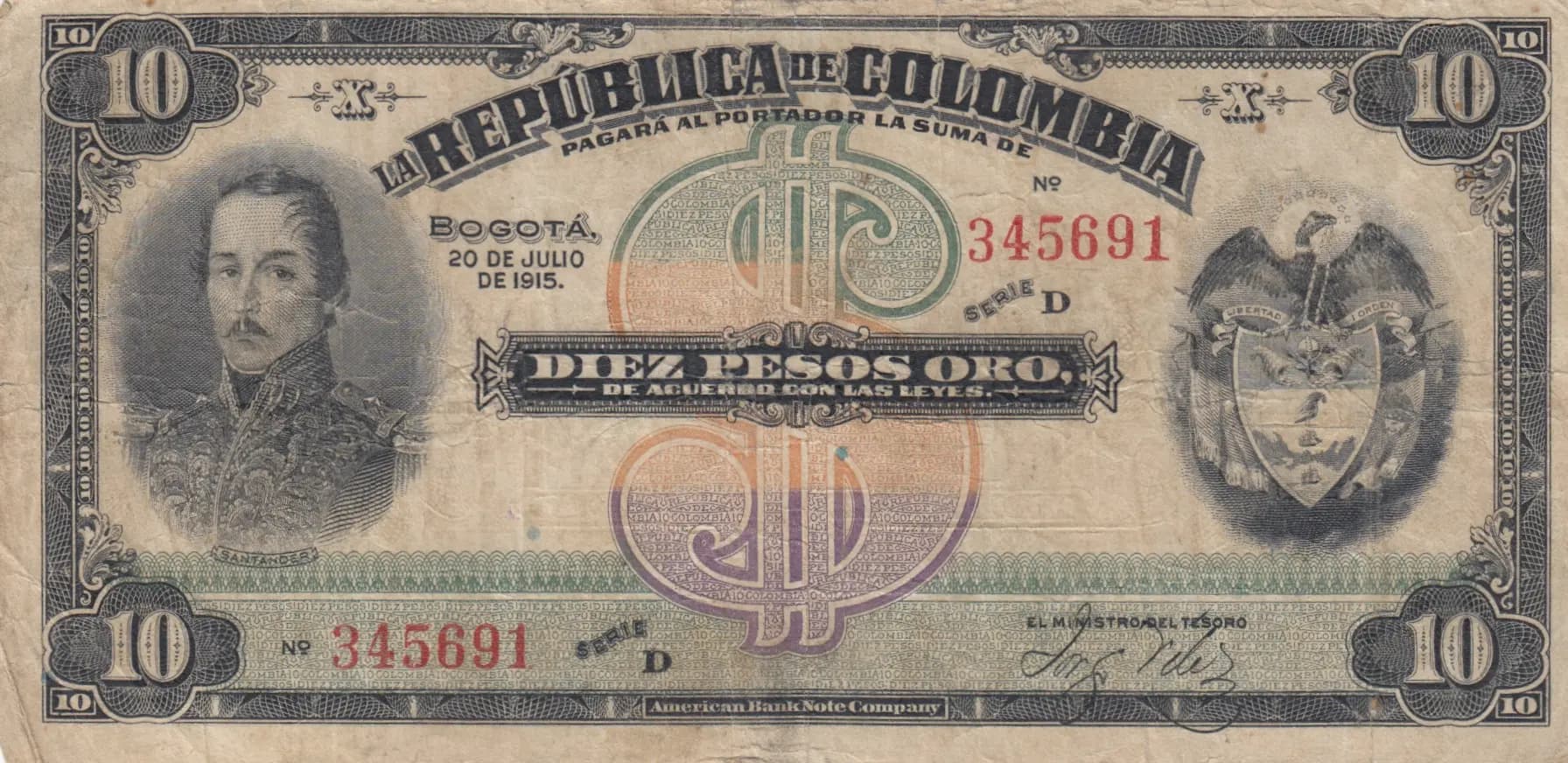
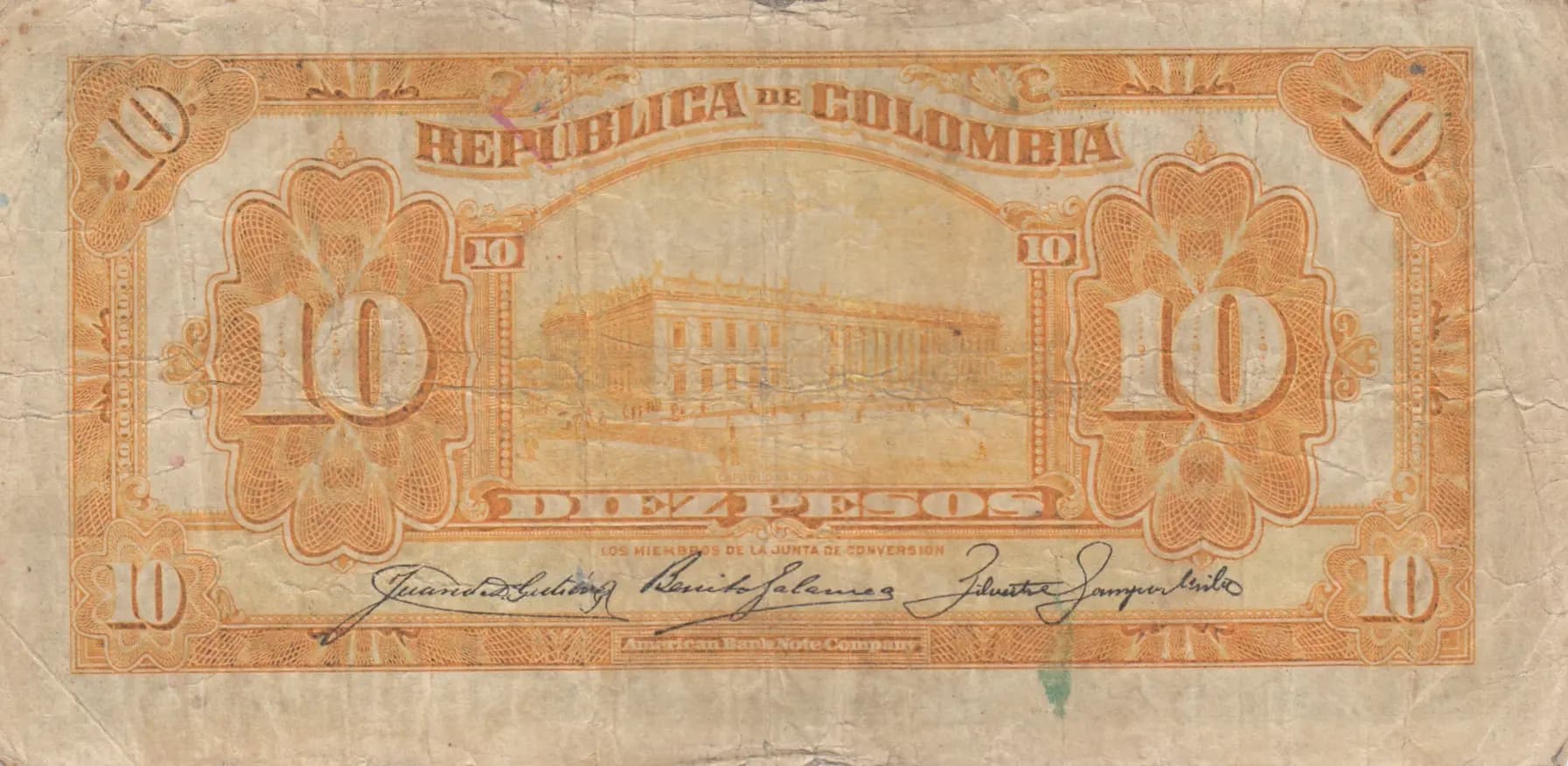
This is a Colombian 10 Pesos Oro note from 1915, issued by the República de Colombia and printed by the American Bank Note Company. The note features a portrait of General Francisco de Paula Santander in military dress on the obverse and the National Capitol building on the reverse, both rendered in the fine detail characteristic of early 20th-century security printing. In Fair (F) condition, the note shows extensive circulation wear with yellowing, foxing, creasing, and fading typical of a 109-year-old banknote that has seen genuine use.
Common. The eBay market price data provided shows numerous listings with prices typically ranging from $1.99 to $26.99 USD for UNC specimens, with 2016 catalogue values of $125 for Fine condition. Notes that trade regularly at well-defined market prices and appear frequently across multiple dealer listings are definitively common issues. This 10 Pesos denomination from 1915 was part of a regular issue with multiple series (A-D), indicating substantial print runs. The observed Fair condition grade places this example in the lower price tier, consistent with a common but worn specimen.
This note was issued during Colombia's Conversion Board period (Junta de Conversión) under the monetary reforms of the early 1900s, as evidenced by the inscription referencing the Conversion Board members on the reverse. The depiction of General Santander, a founding figure of the Colombian state and vice president under Bolívar, reflects the nation's veneration of its independence-era leaders. The National Capitol building on the back symbolizes the institutional stability and centralized authority that Colombia sought to project during this period of financial reorganization.
The obverse features a left-facing portrait of General Francisco de Paula Santander, rendered in formal military dress uniform with decorative chest insignia, positioned at the left side of the note. The center contains the denomination text and promise-to-pay clause in Spanish, with ornate circular medallions and scrollwork throughout. The Colombian national coat of arms—depicted as an eagle with spread wings—appears on the right side. The note employs a gray and black color scheme with red serial numbers. The reverse depicts the Palacio de Capitanía General (National Capitol), a classical government building with multiple stories, columns, and regular window placement rendered in fine architectural detail. The back features an orange and tan color scheme with decorative medallions bearing the numeral 10 in the corners. All sides are framed with ornate scrollwork and floral border patterns characteristic of Baroque-influenced banknote design of the period.
FRONT SIDE: 'LA REPÚBLICA DE COLOMBIA' (The Republic of Colombia) / 'PAGARÁ AL PORTADOR LA SUMA DE' (Will pay to the bearer the sum of) / 'DIEZ PESOS ORO' (Ten Gold Pesos) / 'BOGOTÁ, 20 DE JULIO DE 1915' (Bogotá, July 20, 1915) / Serial number: 3456691 / 'SERIE D' (Series D) / 'American Bank Note Company' / 'EL MINISTRO EL TESOROERO' (The Minister/The Treasurer) — BACK SIDE: 'REPÚBLICA DE COLOMBIA' (Republic of Colombia) / 'DIEZ PESOS ORO' (Ten Gold Pesos) / 'LOS MIEMBROS DE LA JUNTA DE CONVERSION' (The Members of the Conversion Board) / Hand-written signatures of board members / 'American Bank Note Company'
Intaglio (steel engraving) produced by the American Bank Note Company of New York. The visual analysis reveals characteristic intaglio features including fine line work, cross-hatching, intricate geometric patterns, and the bold sculptural quality of the engraved portraits and architectural elements. The multiple color layers (black on green, purple, and orange underprints for the obverse; light orange for the reverse) indicate multicolor intaglio printing, a signature technique of ABNC for high-security currency production.
This note is identified as Series D, which according to the reference material was actually issued by the Banco de la República rather than the Junta de Conversión that issued Series A-C. Series designations (A, B, C, D) represent the primary variety markers for this Pick number. The serial number observed (3456691) is consistent with standard serial numbering for this issue. The three hand-written signatures on the reverse appear to represent the Conversion Board members present at the time of issue, which may vary by signature sets, though without comprehensive signature roster data, specific signature variety classification cannot be definitively established from this example alone.