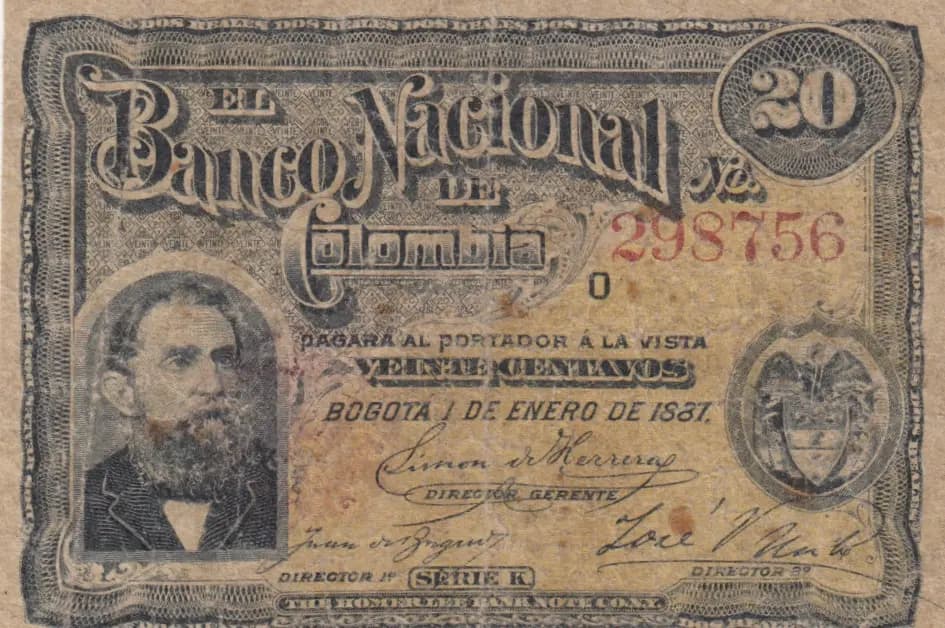
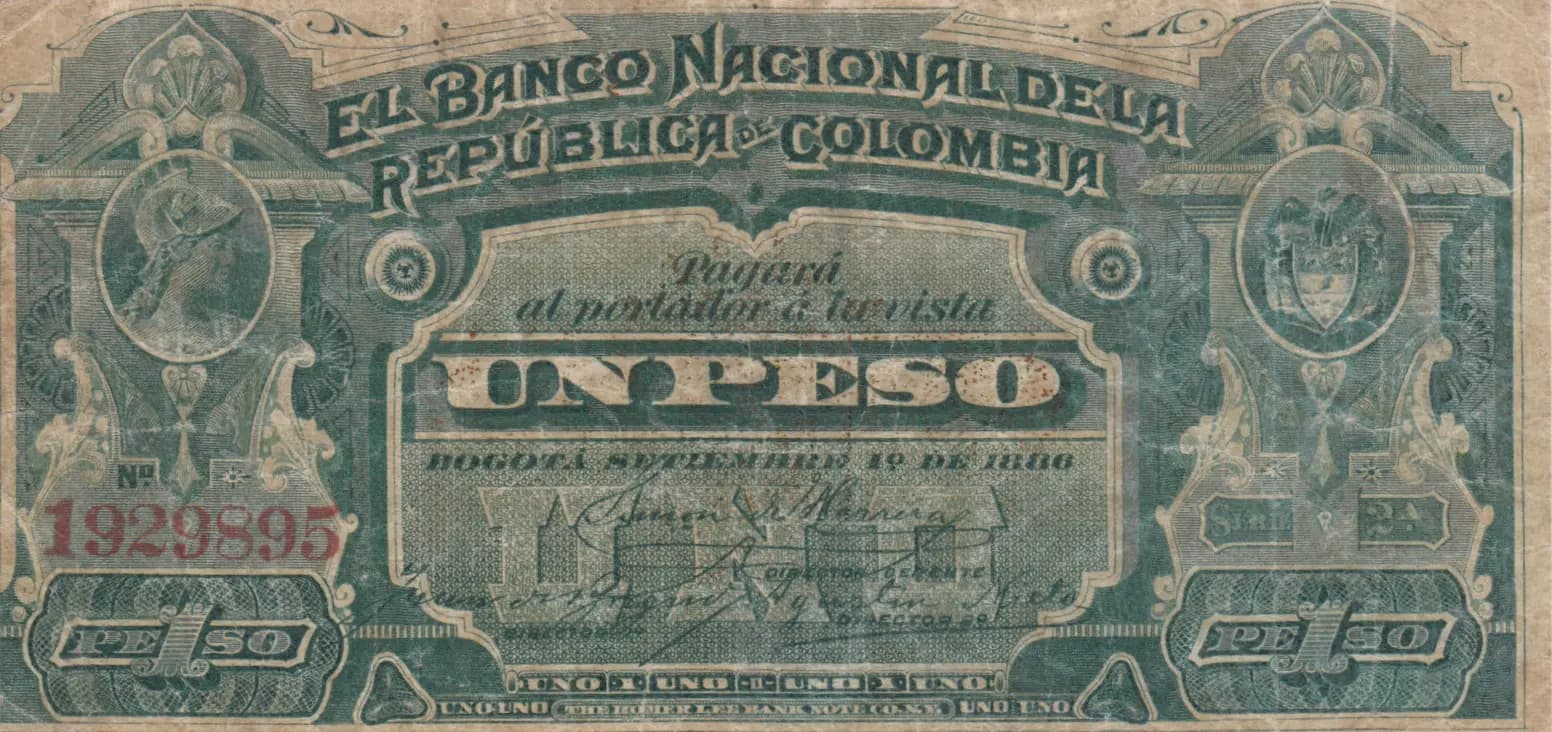
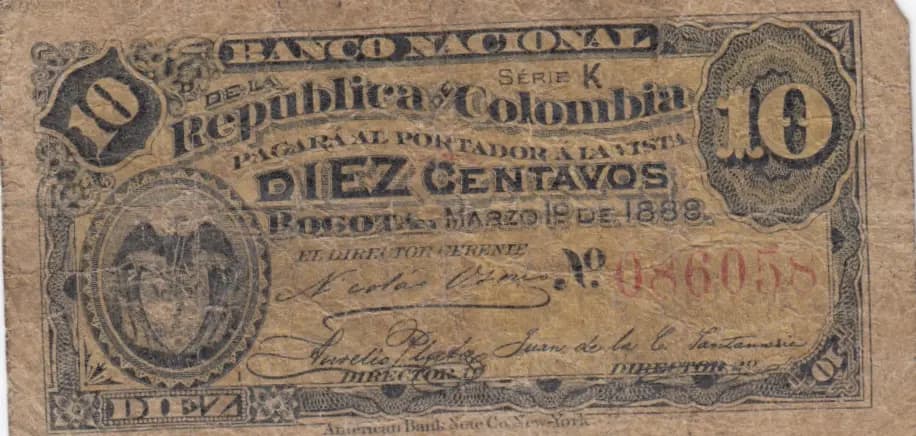
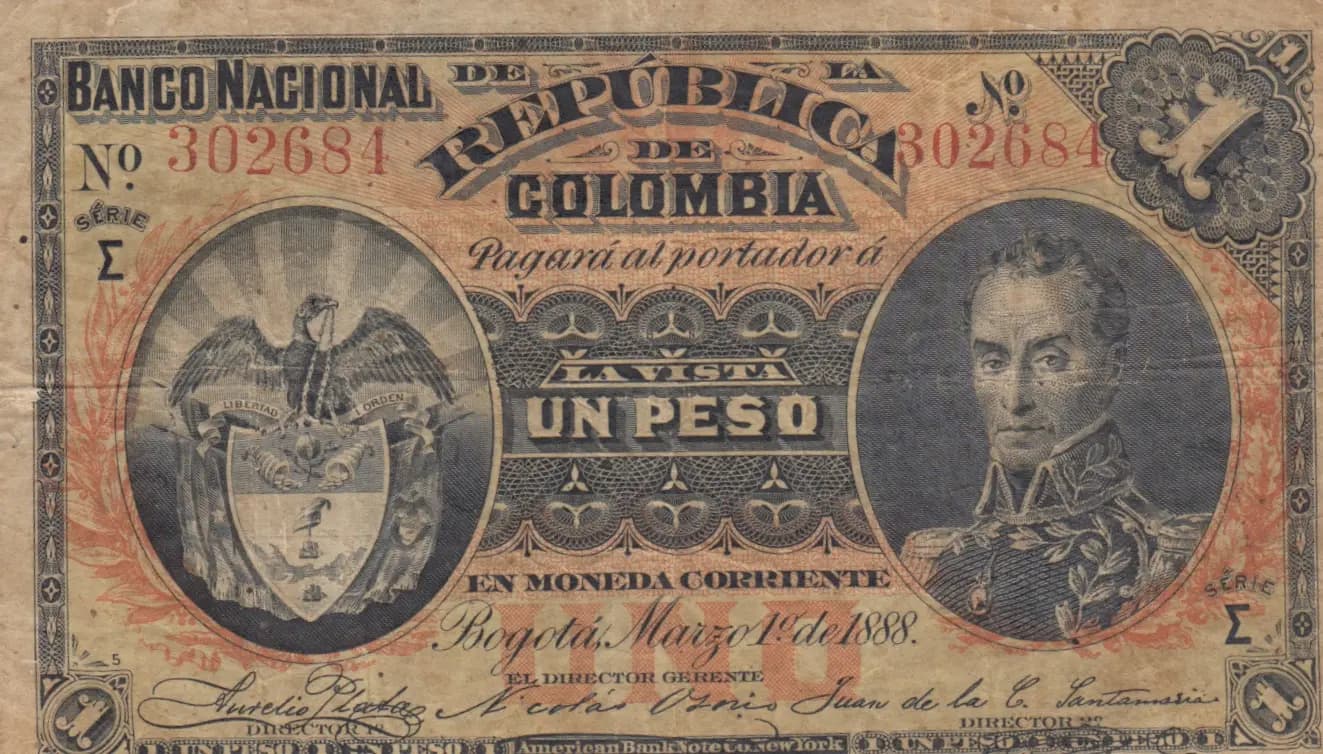
10 centavos 1893

Market Prices
5 salesAbout This Note
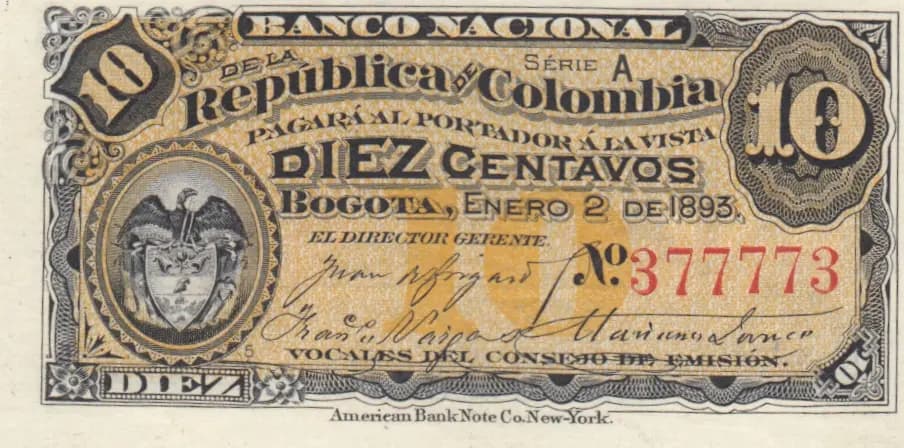
This is a Colombian 10 centavos note issued by the Banco Nacional de la República de Colombia on January 2, 1893, printed by the American Bank Note Company. The note displays exceptional preservation with clear legibility of all design elements, ornate classical engraving, and the characteristic tan/beige coloration of period currency. The prominent Colombian coat of arms featuring an eagle, combined with fine decorative borders and handwritten signatures, exemplifies the security printing standards of late 19th-century Latin American banking.
Common. While this is a 19th-century Colombian banknote of legitimate historical interest, the eBay market pricing data provided indicates F-grade examples typically sell for $15–$41, with catalogue values at $4 (F) in 2016. Notes trading regularly in this price range and with consistent auction activity represent standard collector material rather than scarce issues. The denomination (10 centavos) was a foundational circulation note likely issued in substantial quantities. No evidence suggests an exceptionally limited print run or recall.
The Banco Nacional de la República de Colombia was established during a period of monetary reform in Colombia following years of political instability and civil conflict. This 10 centavos denomination, equivalent to 1 Real under the period's monetary system, represents the bank's effort to establish a stable national currency. The use of the Colombian national coat of arms—featuring the heraldic eagle—symbolized the bank's authority to issue currency on behalf of the sovereign state, a critical assertion during an era when banking stability was precarious in Latin America.
The obverse features a classical bearer-demand format typical of 19th-century Latin American currency. The central design element is the Colombian national coat of arms positioned in the center-left, which includes a shield bearing an heraldic eagle in profile—a symbol of national sovereignty and power. The denomination numerals appear in ornamental geometric frames in the upper left and right corners. Ornate scrollwork and rosette decorations frame the entire note, with fine parallel lines creating secondary borders typical of American Bank Note Company security printing. The note includes spaces for two handwritten signatures (the Director and Manager), along with the serial number 377773 prefixed with Series A designation. The printer's imprint 'American Bank Note Co. New-York.' appears at the bottom, confirming production by the preeminent U.S. security printer of the era.
FRONT: 'BANCO NACIONAL DE LA REPÚBLICA DE COLOMBIA' (National Bank of the Republic of Colombia); 'PAGARÁ AL PORTADOR Á LA VISTA' (Will pay to bearer on sight); 'DIEZ CENTAVOS' (Ten centavos); 'BOGOTÁ, ENERO 2 DE 1893' (Bogotá, January 2, 1893); 'SERIE A' (Series A); 'EL DIRECTOR GERENTE' (The Managing Director); 'Nº377773' (Serial number 377773); 'DIEZ' (Ten); 'American Bank Note Co. New-York.' (printer attribution); 'ROGAMOS DEL CONSEJERO EMISIÓN' (We request from the advisory board of issuance).
Intaglio engraving (steel plate engraving), executed by the American Bank Note Company of New York. The note demonstrates the characteristic fine line work, detailed cross-hatching, and precision registration associated with classical banknote engraving. The ornamental borders, scrollwork, and coat of arms details were all engraved into steel plates, which were then used to transfer ink under high pressure to create the distinctive tactile quality and anti-counterfeiting security of period currency.
This specific note is identified as Series A with serial number 377773. The series designation and individual serial numbering suggest multiple series were issued. The presence of handwritten signatures in designated blanks (for the Director and Managing Director) indicates this is a formally completed, issued specimen rather than an unissued remainder. Varieties for this Pick number may include different series (A, B, C, etc.) and signature combinations, though detailed variety cataloging for this denomination is not extensively documented in standard references.