1 peso 1883
Market Prices
About This Note
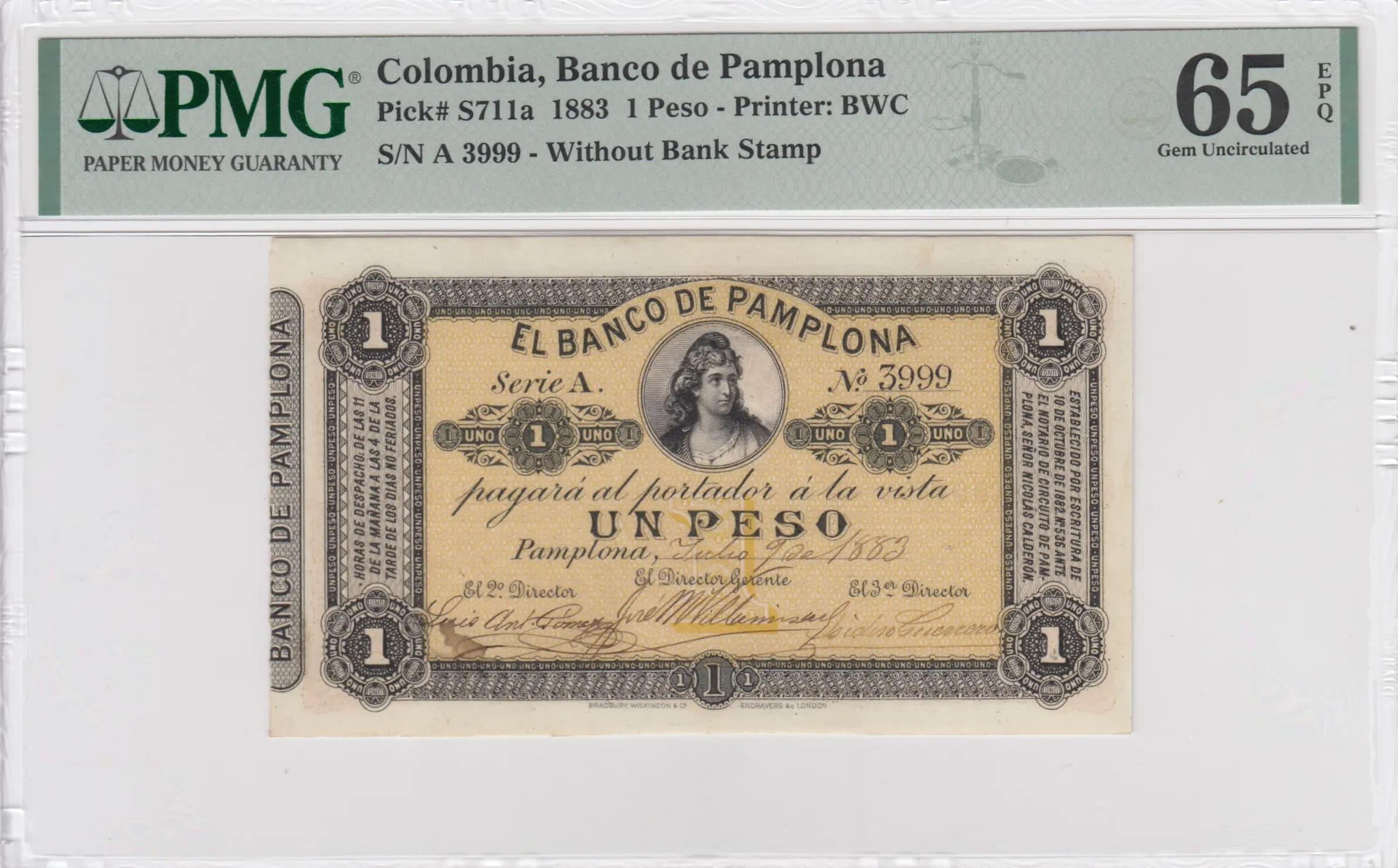
A remarkable example of the 1883 Banco de Pamplona 1 Peso note (Pick S711a) graded PMG 65 EPQ, representing a key piece of Colombian regional banking history. The note displays exceptional preservation with a beige/cream field, ornate black decorative borders, and a classical female portrait at center, all rendered in fine engraved detail without visible circulation wear. This Series A specimen (No. 3999) exemplifies the sophisticated design standards of late 19th-century Colombian regional banks and remains desirable for both Colombian and Latin American numismatic collections.
Common. While regional Colombian banknotes can vary in collector appeal, the eBay price tracking data shows this denomination and type trading across a wide range of conditions ($20–$4,195 USD), with multiple listings in lower grades (VG, XF) at modest prices ($58–$199), indicating adequate supply at most condition levels. The PMG 65 EPQ grade represents a premium example, but the underlying note type itself is not scarce. No evidence suggests a restricted print run or recall.
The Banco de Pamplona was one of Colombia's regional issuing banks during the decentralized banking era of the 1880s, when provincial banks had the authority to issue their own currency. The classical female allegorical portrait featured at the note's center reflects the design conventions of Latin American banknotes from this period, often representing Liberty, Commerce, or national virtues. This 1883 emission occurred during a significant period of Colombian monetary experimentation, as the nation worked to establish stable banking institutions following independence.
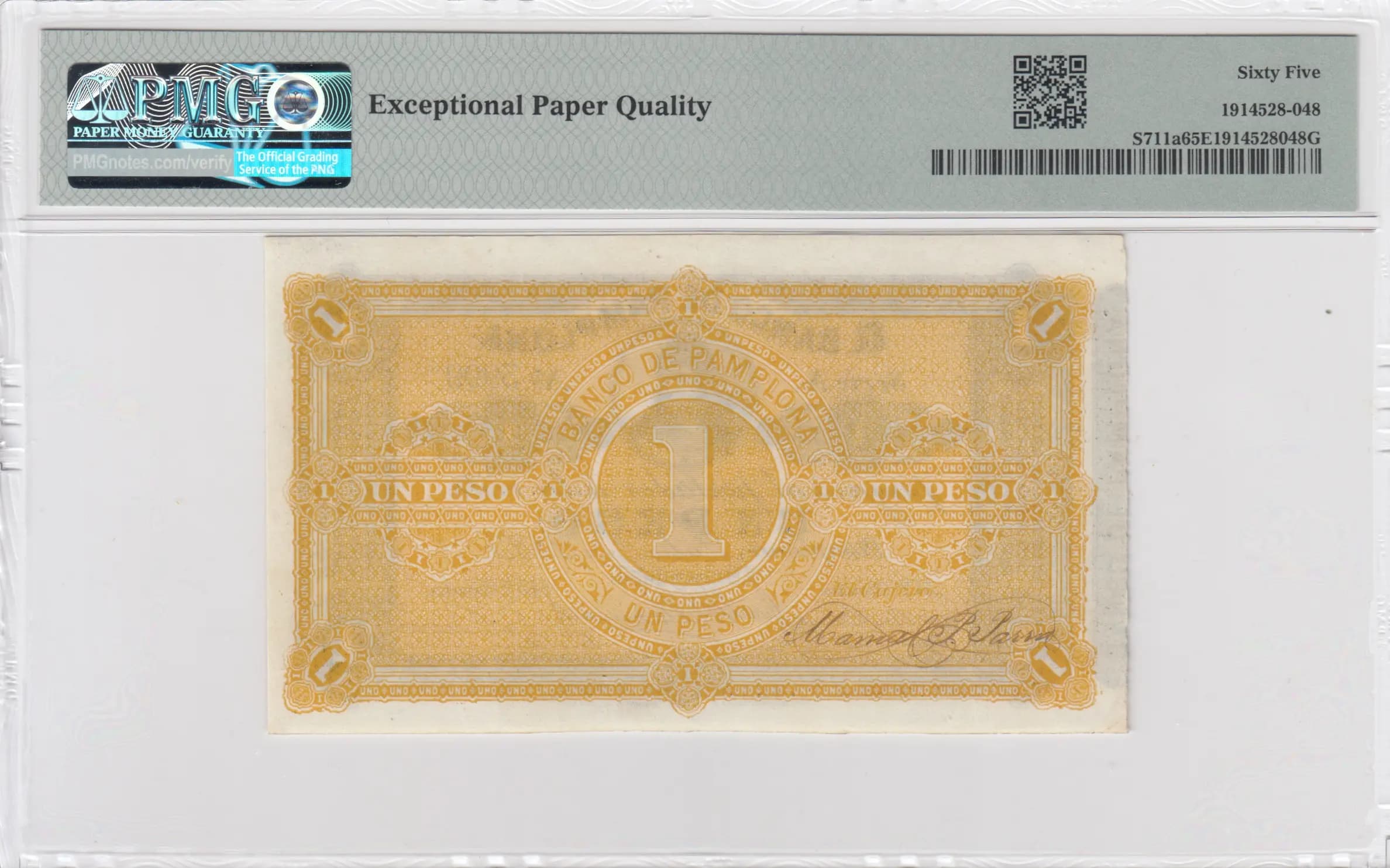
The obverse features a classical female allegorical portrait in an oval frame positioned at the center of the note, likely representing Liberty or a national virtue typical of 19th-century Latin American banknote iconography. The design is framed by ornate corner medallions containing rosette patterns and circular seal frames on both left and right sides, with the denomination numeral '1' positioned in corner ornaments. The entire composition is rendered in black on a gold/beige underprint with intricate scrollwork, flourishes, and fine cross-hatching providing both aesthetic appeal and security through complexity. The reverse adopts a simpler monochromatic gold design with repeating geometric and floral border patterns, a central circular denomination frame, and corner medallions, all characteristic of the period's banknote security printing practices.
FRONT: 'EL BANCO DE PAMPLONA' (The Banco de Pamplona) | 'Serie A' (Series A) | 'Nº 3999' (No. 3999) | 'UNO' (One) | 'pagara al portador á la vista' (will pay to bearer on sight) | 'UN PESO' (One Peso) | 'Pamplona' (Pamplona) | 'El 2º Director' (The 2nd Director) | 'El Director Gerente' (The Managing Director) | 'El 3er Director' (The 3rd Director) | BACK: 'BANCO DE PAMPLONA' (Banco de Pamplona) | 'UN PESO' (One Peso) | '1' (1)
Intaglio engraving (also known as line engraving or steel plate engraving), executed by Banknote World Currency (BWC), the noted security printer credited in the catalog data. The fine line work, cross-hatching visible in the background, intricate border patterns, and the crisp impression of ornamental designs are all hallmarks of intaglio printing. The two-color printing (black on gold underprint for the obverse; monochromatic gold for the reverse) was achieved through multiple plate passes, a standard technique for security banknotes of the 1880s.
This note is identified as Series A (Serie A), serial number 3999, which is the specific variety designation visible on the obverse. The Pick catalog designation S711a may distinguish this from other varieties (such as S711b or S711c) that could represent different series, printer variations, or security feature iterations. Without additional comparative material, this Series A example represents the standard recognized type; collectors should note the series and serial number range when seeking matched sets or specific varieties.