50000 custom gold units 1948
Market Prices
1 saleAbout This Note
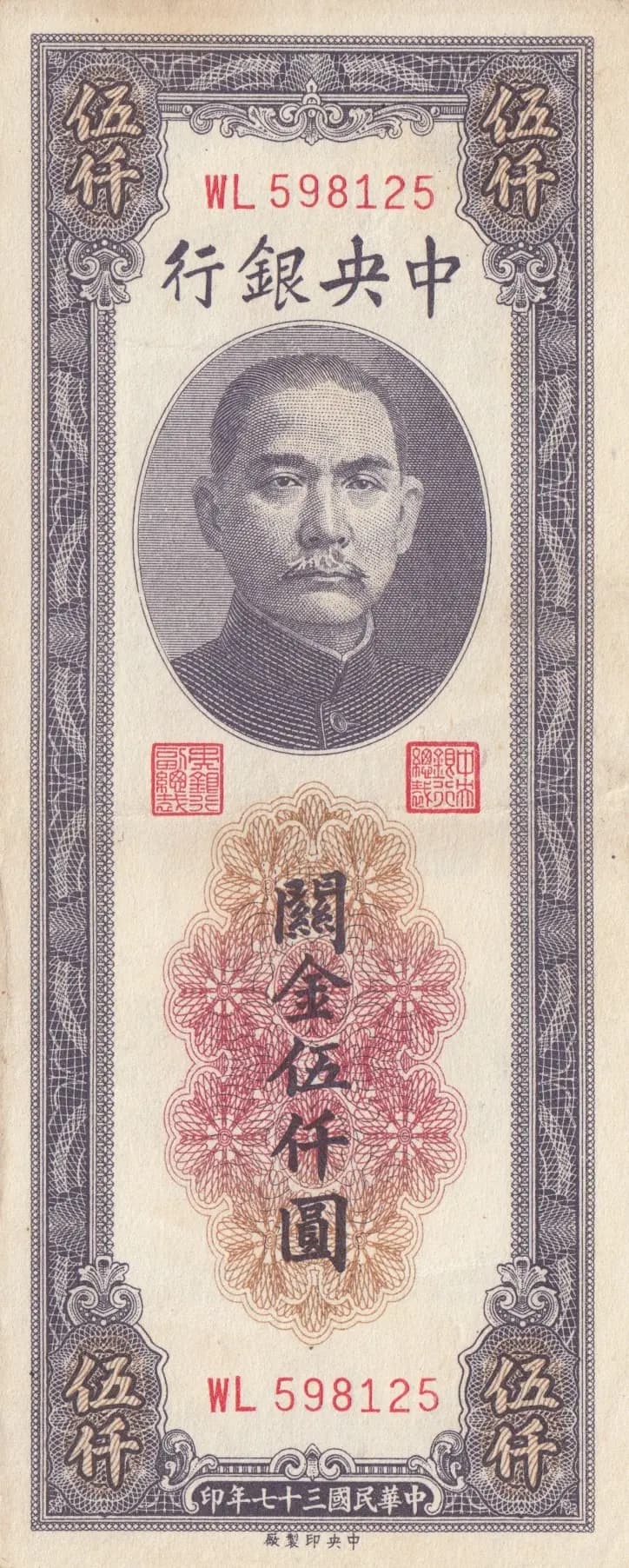
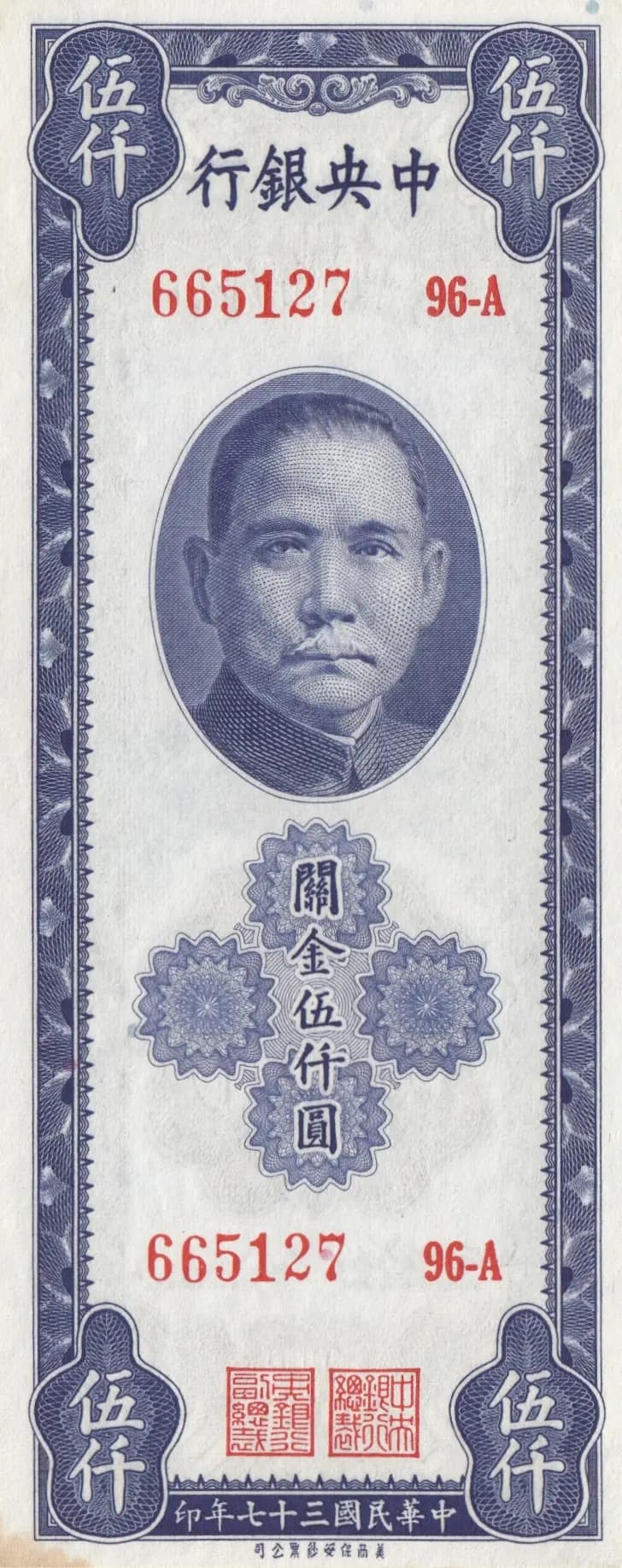
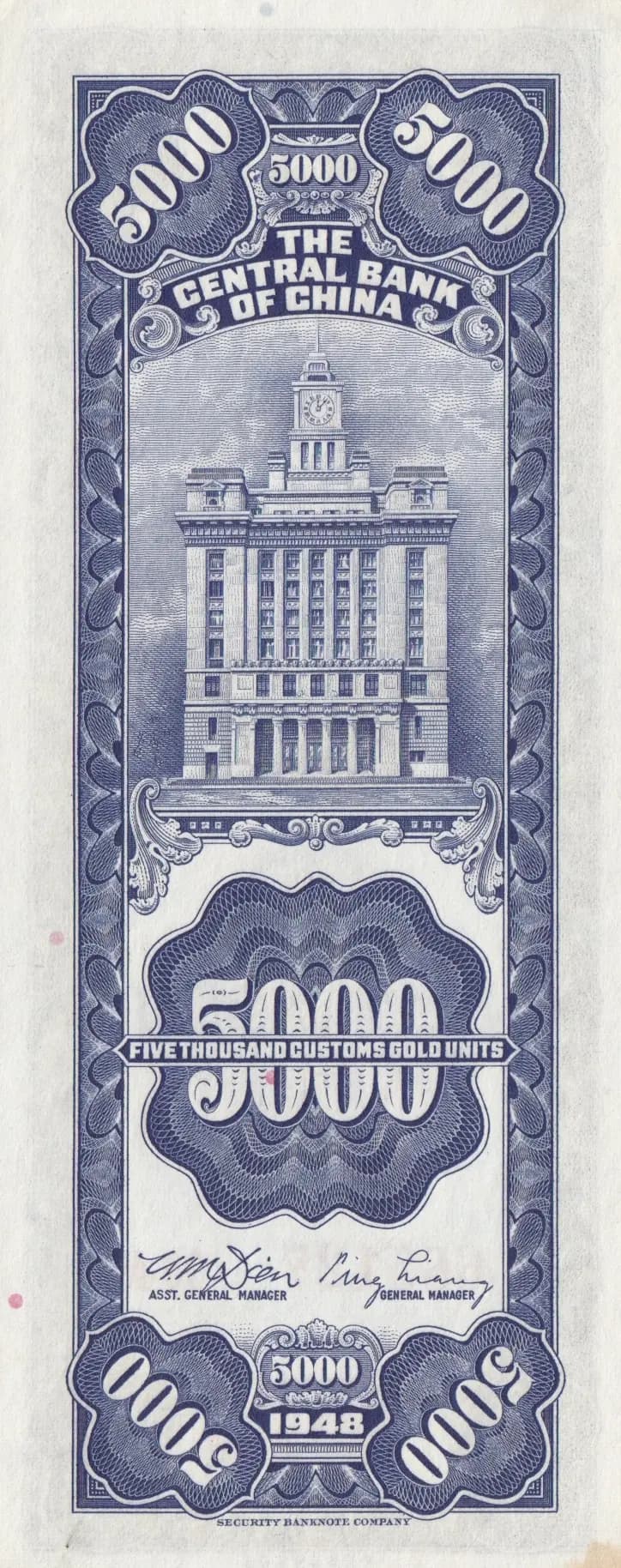
This is a Chinese Central Bank 5000 Customs Gold Units note from 1948, presented in AU (About Uncirculated) condition. The note features a portrait of Sun Yat-sen on the obverse in blue tones with red denomination text, while the reverse displays the distinctive Central Bank of China building with its prominent clock tower. The exceptional state of preservation with no visible creases, tears, or wear, combined with clear signatures and crisp printing, makes this an attractive example for collectors of Chinese Republican-era currency.
Common. The reference catalog values from 2016 indicate VG at $2, VF at $7.50, and UNC at $30, with a documented eBay sale of a UNC example for $33 in 2013. These low valuations and modest market activity indicate substantial surviving quantities of this note. While Chinese banknotes from 1948 have historical interest, this particular Pick number appears to have had a reasonable print run with adequate surviving specimens across multiple condition grades.
This note was issued during the final years of the Republic of China before the Communist takeover, representing a period of significant monetary and political transition. The Central Bank building depicted on the reverse symbolized the institutional authority attempting to stabilize China's economy amid civil war and hyperinflation. The denomination in 'Customs Gold Units' reflects an attempt to create a more stable currency standard tied to gold value rather than the increasingly worthless paper yuan of the period.
The obverse features a formal portrait of Sun Yat-sen (founder of the Republic of China), depicted in profile-like pose within an ornate oval frame, rendered in the classical engraved style typical of high-value currency. The portrait is surrounded by elaborate traditional Chinese decorative corner cartouches and rosette patterns below the frame. The reverse displays the Central Bank of China's institutional headquarters—a classical multi-story building with a prominent clock tower, regularly-spaced windows, and formal architectural detailing. Both sides employ intricate decorative borders with Chinese ornamental elements. The note's blue and white color scheme with red accent text on the obverse creates strong visual hierarchy emphasizing the denomination.
OBVERSE: 五佰 (Five hundred - corner repeats); 中央銀行 (Central Bank); 開金佰伍圓 (Five hundred yuan - horizontal text); 中華民國七十二年印 (Printed in the 72nd year of the Republic of China). Serial number: 665127. Reference: 96-A. REVERSE: 5000 (appears in four corners and center); THE CENTRAL BANK OF CHINA (English text); FIVE THOUSAND CUSTOMS GOLD UNITS (English denomination); 1948 (year of issue); ASST. GENERAL MANAGER and GENERAL MANAGER (signature lines); SECURITY BANKNOTE COMPANY (printer attribution).
Intaglio (engraving) on steel plates, produced by Security Banknote Company (SBNC), as indicated on the reverse. The fine line crosshatching, detailed portrait engraving, intricate architectural rendering, and complex border designs are all characteristic of professional security banknote production using engraved steel plates. No evidence of lithography or other secondary printing methods is visible; this is a single-pass intaglio production.
The observed example carries serial number 665127 with variety designation 96-A. The handwritten signatures of the General Manager and Assistant General Manager are present but illegible in the provided images; signature varieties may exist among issued notes. The note displays the standard 1948 issue date. No overprints, underprints, or other exceptional marking varieties are apparent from the visual analysis. Collectors should note that later Communist overprints on Republican-era notes do not apply to this piece based on its condition and appearance.