500 yuan 1944
Market Prices
31 salesAbout This Note
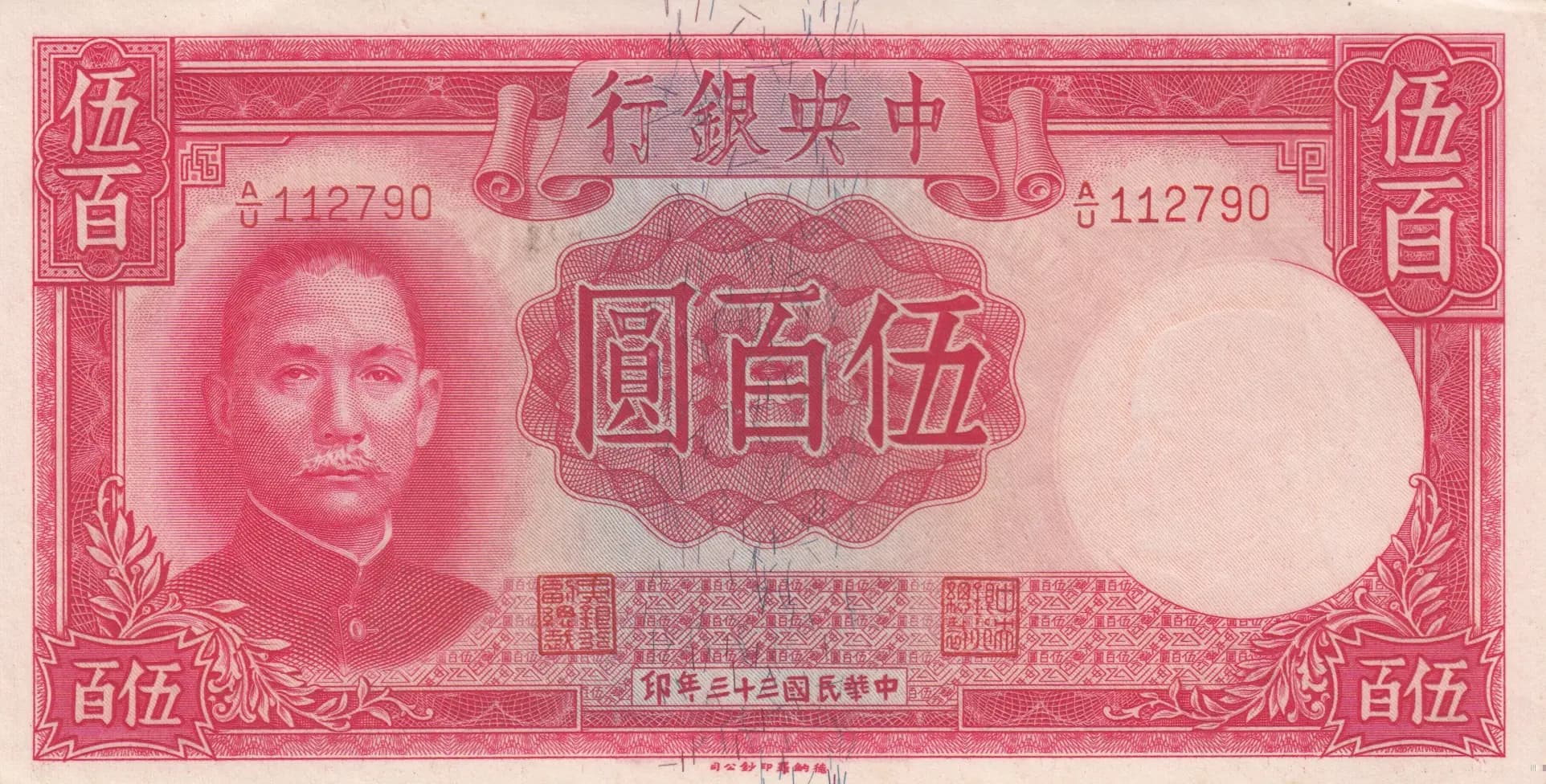
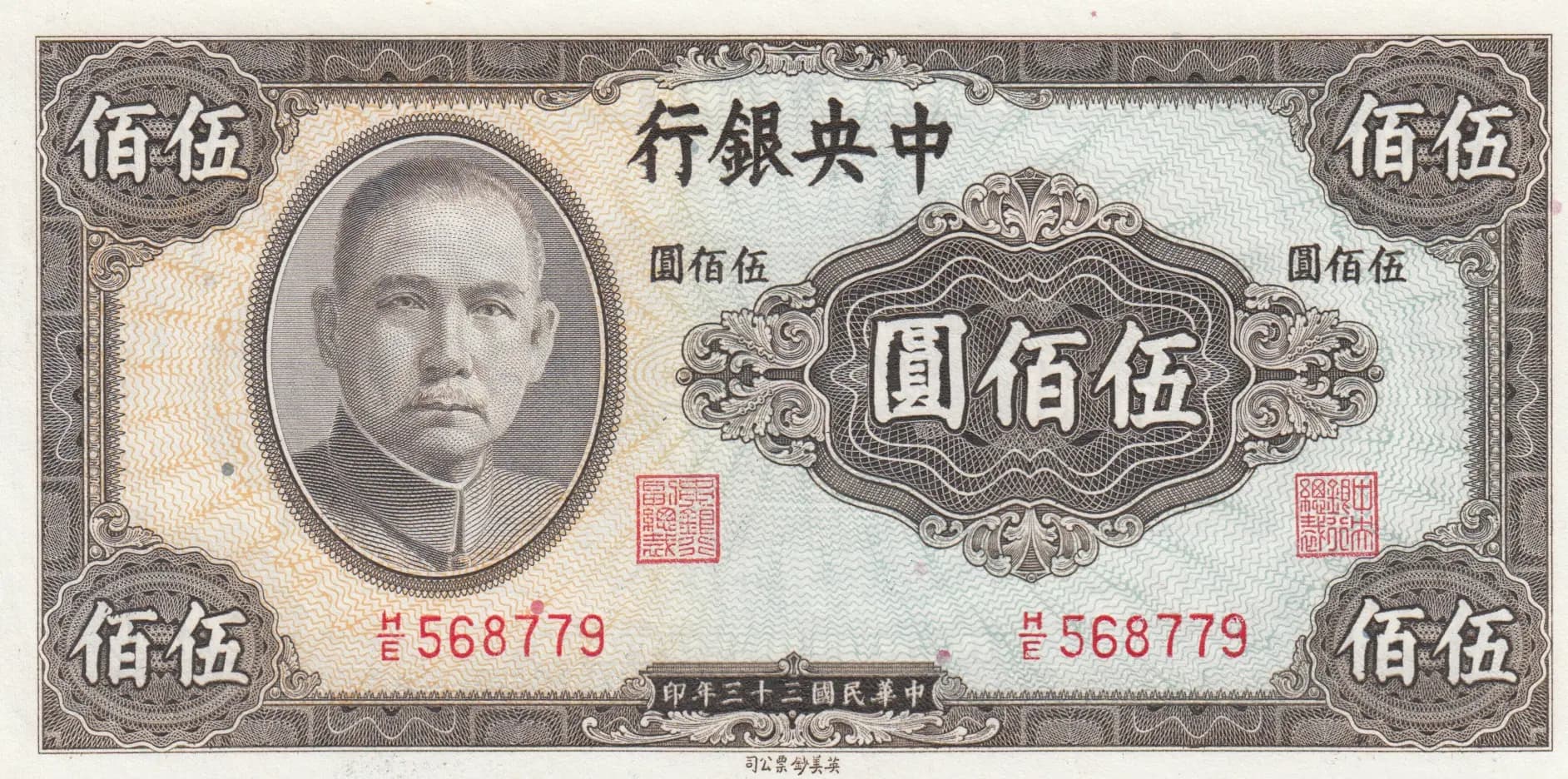
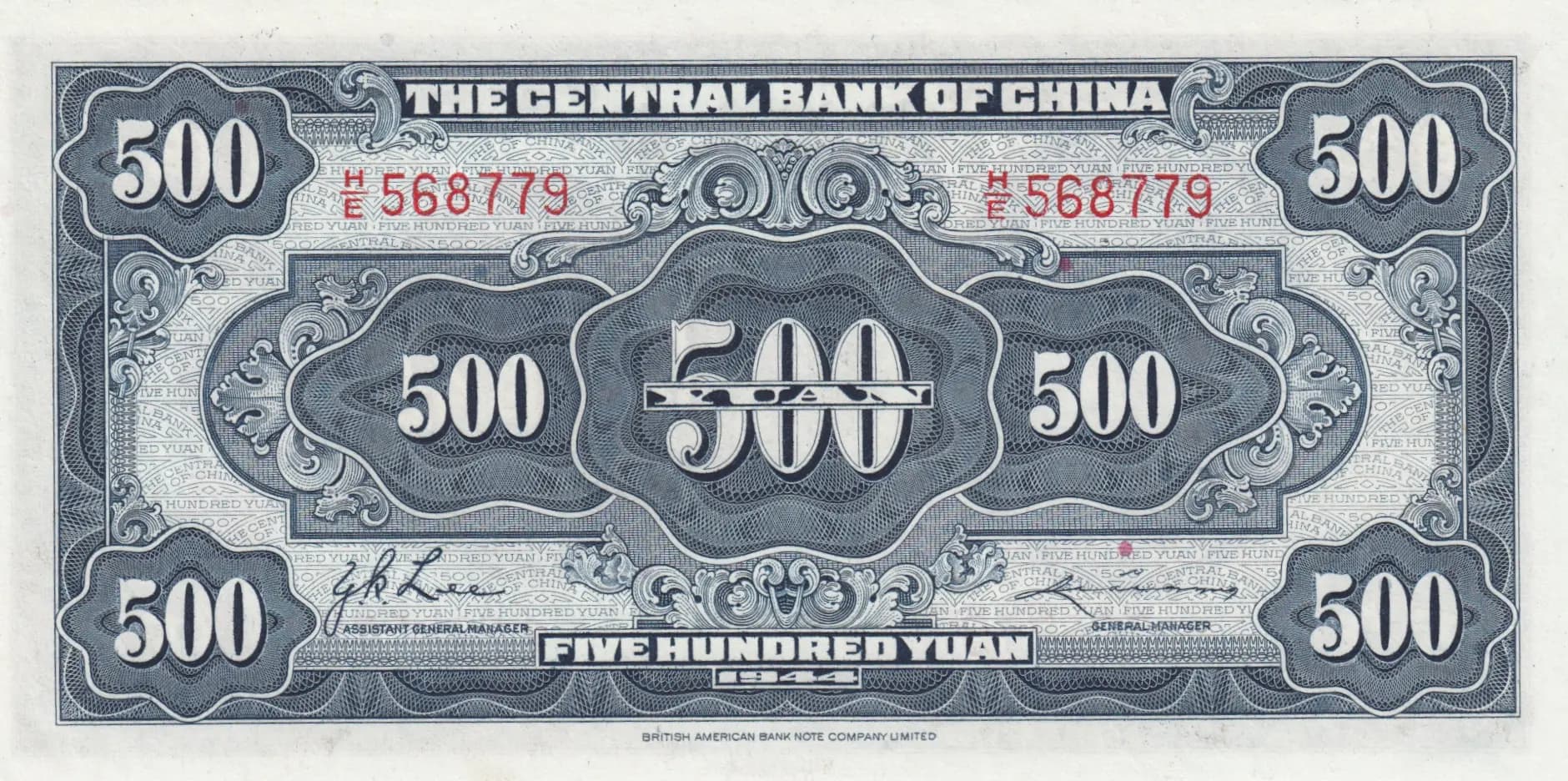
This is a 500 Yuan banknote issued by the Central Bank of China in 1944, presented in uncirculated condition with crisp printing and no visible wear. The note features a formal portrait of a man in the center-left of the obverse, surrounded by ornate decorative borders and security guilloche patterns rendered in brown, cream, and black tones on the front, with a striking dark blue reverse. The exceptional preservation and clear, sharp printing make this an attractive example of Chinese wartime currency for collectors.
Common. The catalog values and eBay auction history strongly support a common classification. The 2016 catalog value for UNC is only $15, and the eBay transaction history shows consistent sales of this note in various grades, with UNC examples selling for $15-$45 over a 15-year period, indicating steady but modest collector demand. The print run for this regular issue was substantial, and the note is readily available on the market at affordable prices. Pieces in UNC grade appear with reasonable frequency in the secondary market.
Issued during the final year of World War II and the Chinese Civil War, this 500 Yuan note represents the Central Bank of China's monetary efforts during the Republic of China (ROC) period. The Chinese date shown on the front—'中華民國三十三年' (Year 33 of the Republic, corresponding to 1944)—reflects the official dating system used by the Nationalist government. The bilingual English-Chinese inscriptions and British American Bank Note Company Limited printer credit indicate the international cooperation and Western printing expertise employed to combat counterfeiting during this turbulent period.
The obverse features a formal portrait of Sun Yat-sen (referred to as 'SYS' in catalog references), the founding father of the Republic of China, positioned in the center-left within an oval frame. The portrait shows a middle-aged Asian man with short dark hair facing forward in a dignified formal style. The note is framed by an elaborate ornamental border with intricate scrollwork and decorative corner medallions displaying Chinese characters '佰伍' (Five Hundred). Red square seals with Chinese characters flank the portrait at the top and bottom right. The reverse displays large '500' numerals in all four corners with a prominent decorative cartouche in the center containing denomination information. The background throughout features sophisticated guilloche patterns, cross-hatching, and repeating security text that reads 'HUNDRED YUAN.' The color scheme combines dark brown on pale orange and light olive-green on the obverse with dark blue/navy and gray tones on the reverse, characteristic of late-period ROC banknote design.
OBVERSE: '中央銀行' (Central Bank) / '圓佰伍' (Five Hundred Yuan) [appears multiple times] / '佰伍' (Five Hundred) / 'H 568779' (Serial Number) / '中華民國三十三年' (Year 33 of the Republic of China—1944). REVERSE: 'THE CENTRAL BANK OF CHINA' / '500' (denomination in numerals, corner positions) / 'FIVE HUNDRED YUAN' / '1944' / 'H 568779' (Serial Number) / 'ASSISTANT GENERAL MANAGER' / 'GENERAL MANAGER' / 'BRITISH AMERICAN BANK NOTE COMPANY LIMITED' / 'YUAN HU' (signature or name) / 'HUNDRED YUAN' (repeated in background security text).
This note was produced by the British American Bank Note Company Limited (BABNC), one of the world's premier security printers, as credited on the reverse. The printing technique employed is intaglio (engraved) printing, evidenced by the crisp, sharp line work visible in the guilloche patterns, the intricate cross-hatching throughout, and the precise, deeply impressed imagery. The sophisticated anti-counterfeiting measures include complex ornamental borders, fine-line security work, repeating background text patterns, and the multi-color overprinting technique combining separate color passes (brown/olive-green on obverse, blue on reverse).
The catalog references '2 serial number varieties' for this Pick number. The observed example displays the serial number 'H 568779' with an 'H' prefix, representing one of the known variety types. Collectors should note variations in serial number prefix letters and ranges as documented in specialized Chinese currency references, though both varieties remain common and similarly valued. No other notable varieties (overprints, signature variants, or printing location variations) are indicated for this regular issue.