5 yuan 1960
Market Prices
65 salesAbout This Note
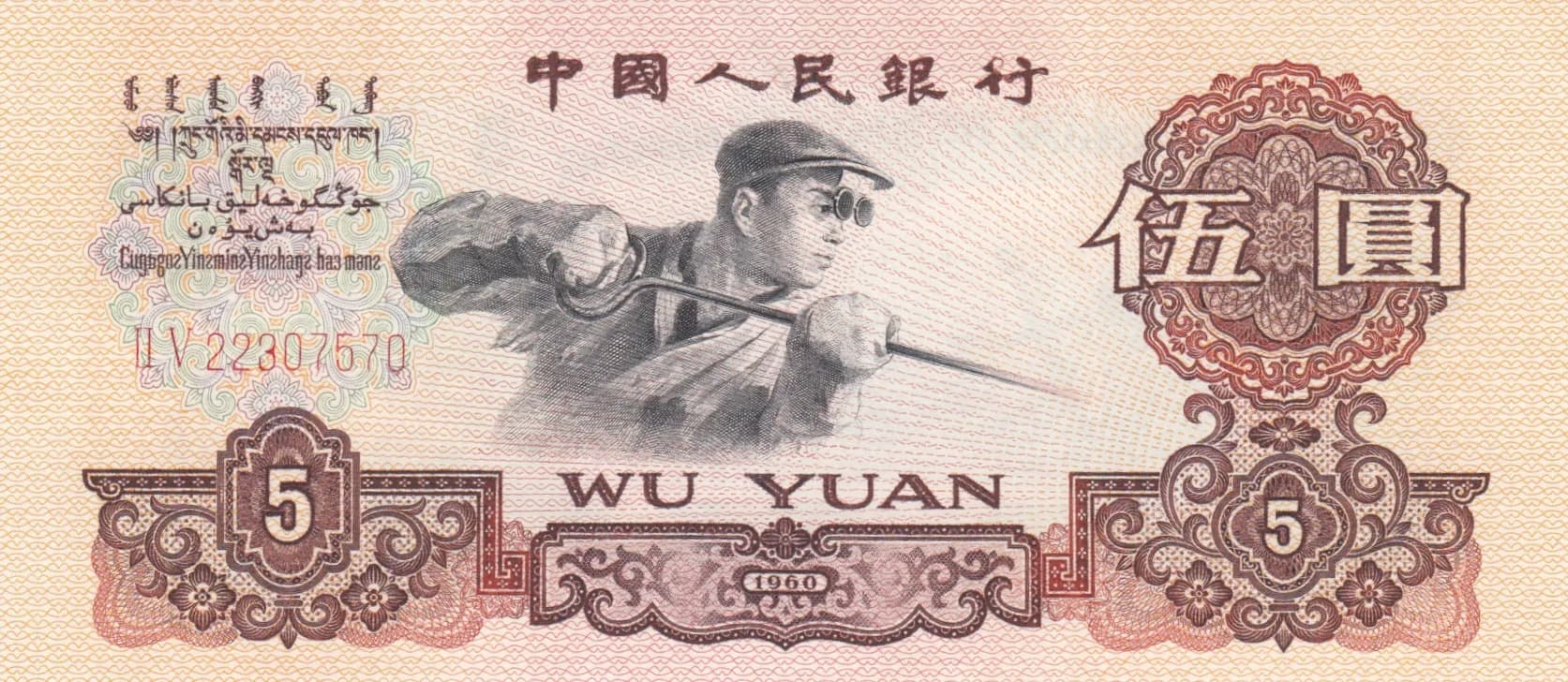
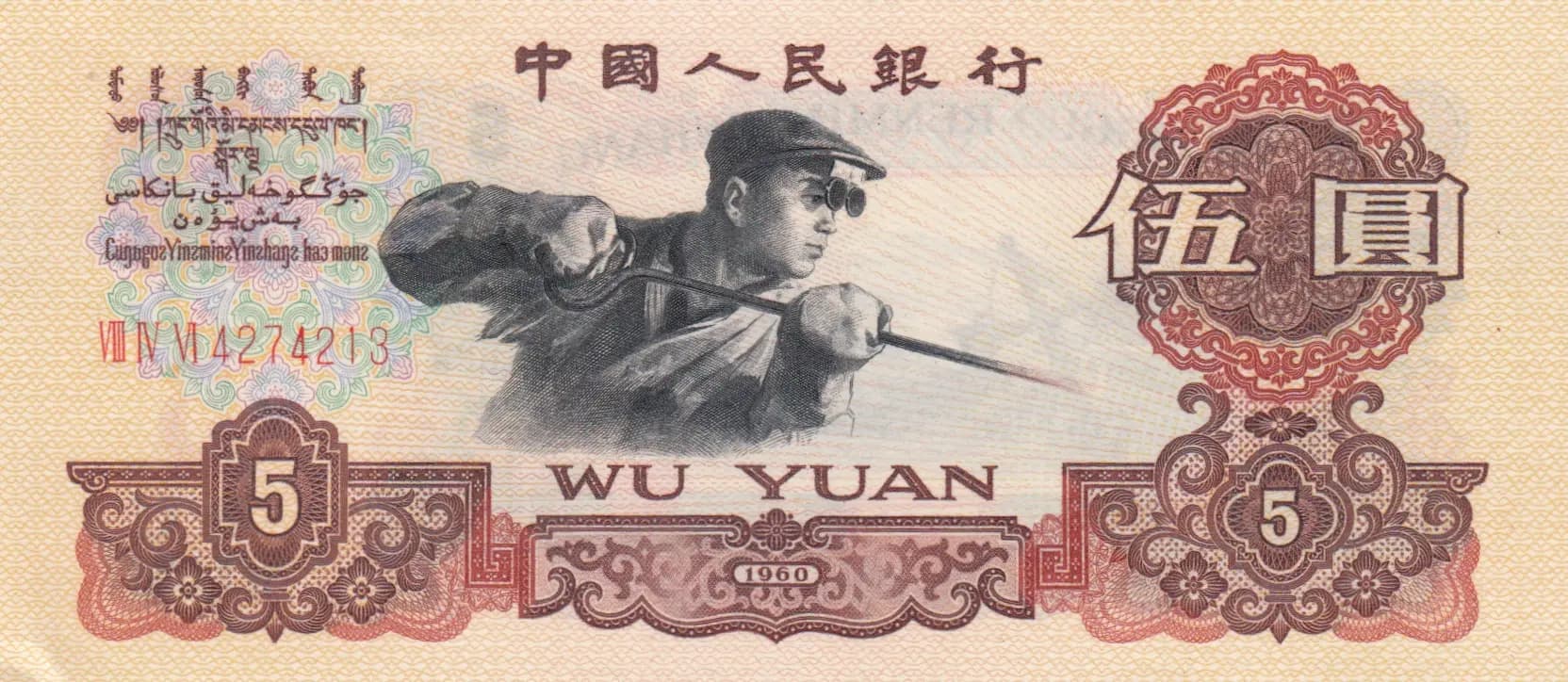
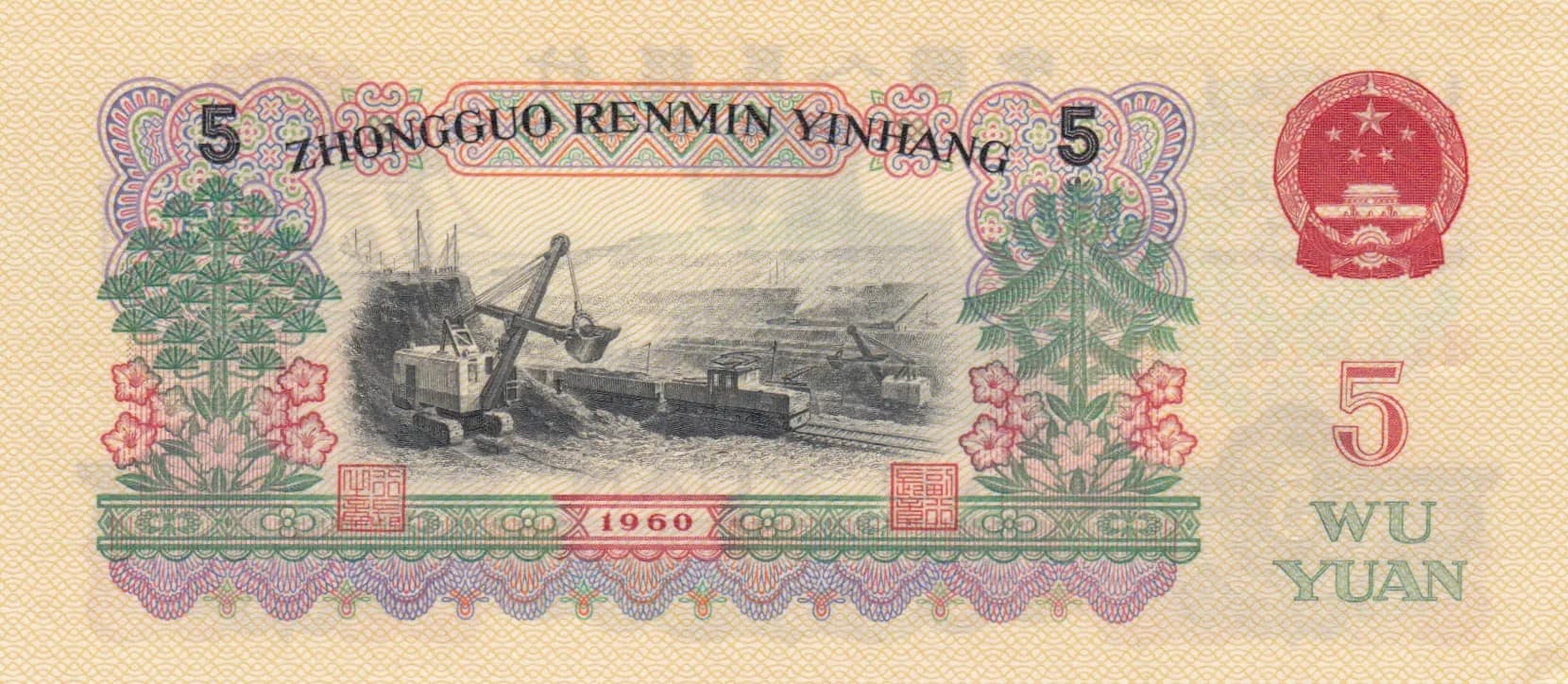
This is a crisp, uncirculated example of the 1960 Chinese 5 yuan note (Pick 876a), presenting the classic design themes of the People's Republic's early economic development era. The obverse features a worker in profile with surveying equipment rendered in fine black and white engraving against a warm cream background with vibrant red, green, and pink ornamental borders. The reverse showcases an industrial port scene with cargo ship, loading cranes, and railway infrastructure, emphasizing the nation's modernization narrative. In UNC condition, this note represents the upper tier of collector demand for this issue, with recent market activity showing comparable specimens trading in the $50-130 range depending on grading service certification.
Common. The 1960 5 yuan (Pick 876a) is a regular issue with substantial circulation, evidenced by the robust eBay market activity spanning from 2012 to 2025 with multiple sales monthly and significant price variation based on condition and certification level rather than scarcity. Recent ungraded UNC examples have sold in the $23-56 range (2020-2022), and PMG-graded specimens consistently achieve $60-130 depending on grade level (64-68). The extensive price history shows this note's availability in the secondary market, confirming it is not scarce or rare—only notably valuable when presented in premium grades by professional grading services.
The 1960 5 yuan note was issued during the Great Leap Forward period, reflecting the People's Bank of China's effort to promote industrial and economic development messaging on its currency. The obverse's worker with surveying instruments and the reverse's depicted port facility with mechanical loading equipment served as propaganda imagery celebrating China's modernization projects and labor-based economy. This issue predates the Cultural Revolution by several years and represents a relatively early post-1949 design philosophy emphasizing progress and collective industrial achievement.
This 1960 5 yuan note features two distinct thematic sides reflecting mid-20th century Chinese economic priorities. The obverse presents a portrait of a worker (likely representing a surveyor or engineer) wearing a flat cap and sunglasses, depicted in profile holding surveying or measuring instruments—symbolizing technical expertise and modernization. The reverse depicts an industrial port complex featuring a cargo vessel with mechanical loading cranes, railway infrastructure, and freight handling equipment, emphasizing maritime commerce and transportation development. Both sides employ ornate decorative borders featuring traditional Chinese patterns in red, maroon, green, and blue, with the national emblem (five-star seal) appearing prominently on the reverse. The color scheme of cream/beige underprint combined with multicolor border work creates visual distinction while maintaining the note's authenticity markers.
Front side: '中国人民银行' (Zhongguo Renmin Yinhang / People's Bank of China), '伍圆' (Wu Yuan / Five Yuan), 'WU YUAN' (English), '1960' (year of issue), 'III N YB 4274218' (serial number with Roman numeral prefix III). Back side: 'ZHONGGUO RENMIN YINHANG' (Pinyin transliteration / People's Bank of China), '5' (denomination numeral), 'WU YUAN' (English), '1960' (year of issue).
Intaglio engraving (line engraving) combined with multicolor offset lithography for the decorative borders and background elements. The fine black and white portrait and industrial scene on both sides exhibit the characteristic sharp detail and dimensional quality of intaglio work typical of mid-20th century Chinese banknote production. The People's Bank of China employed state security printing facilities for this issue; specific printer attribution would be to PBOC internal printing operations or contracted Chinese security printers of the period.
The observed serial number prefix 'III' (three Roman numerals) is consistent with standard 1960 5 yuan production. Varieties for Pick 876a are known to include different serial number prefixes (typically two or three Roman numerals) indicating separate printing batches. The watermark is documented as a large star with four small stars (S/M number C284-11). No specific overprints or date variations are evident on this specimen; this represents the standard regular issue type without additional designations.