5 fen 1939
About This Note
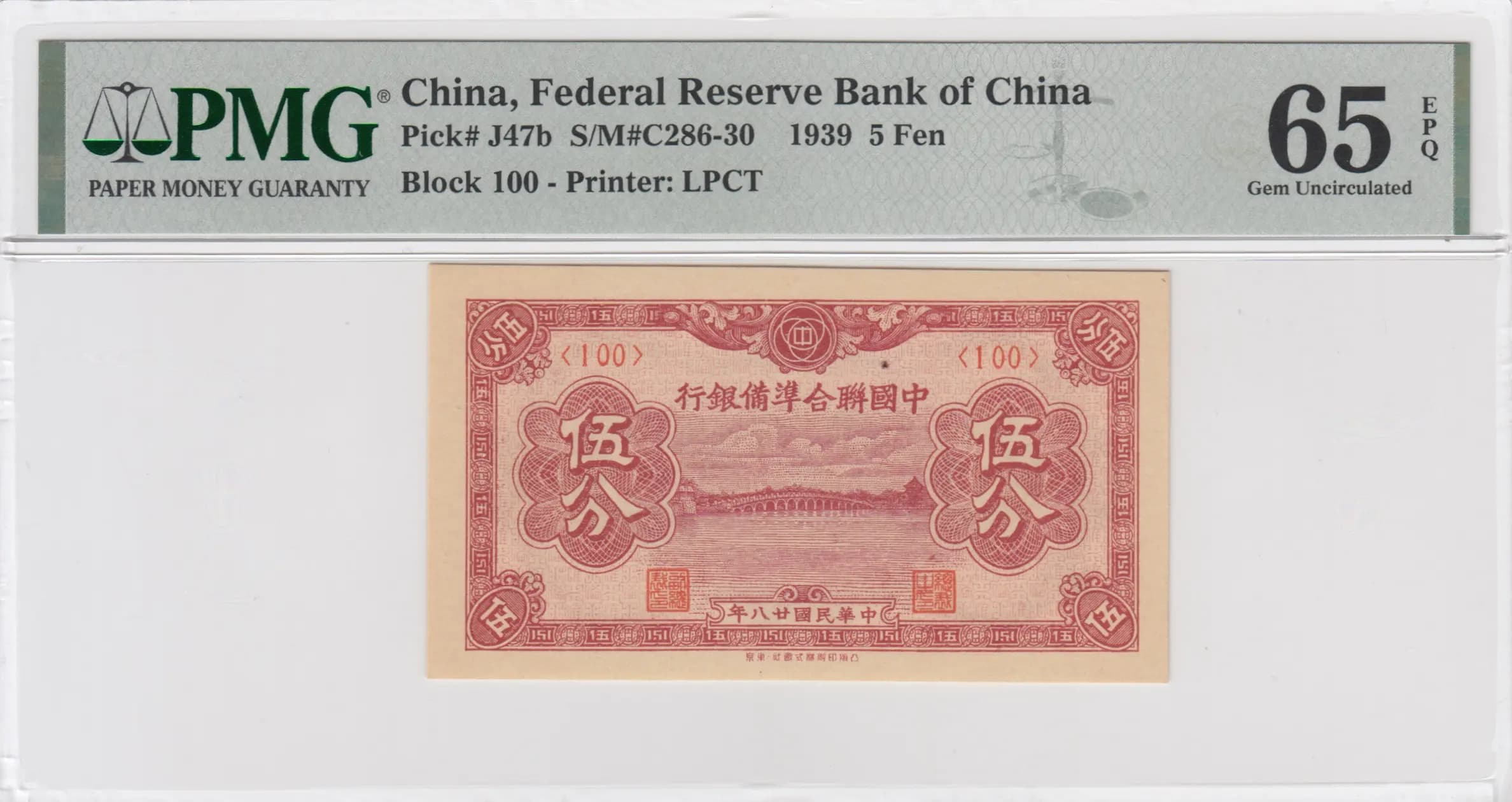
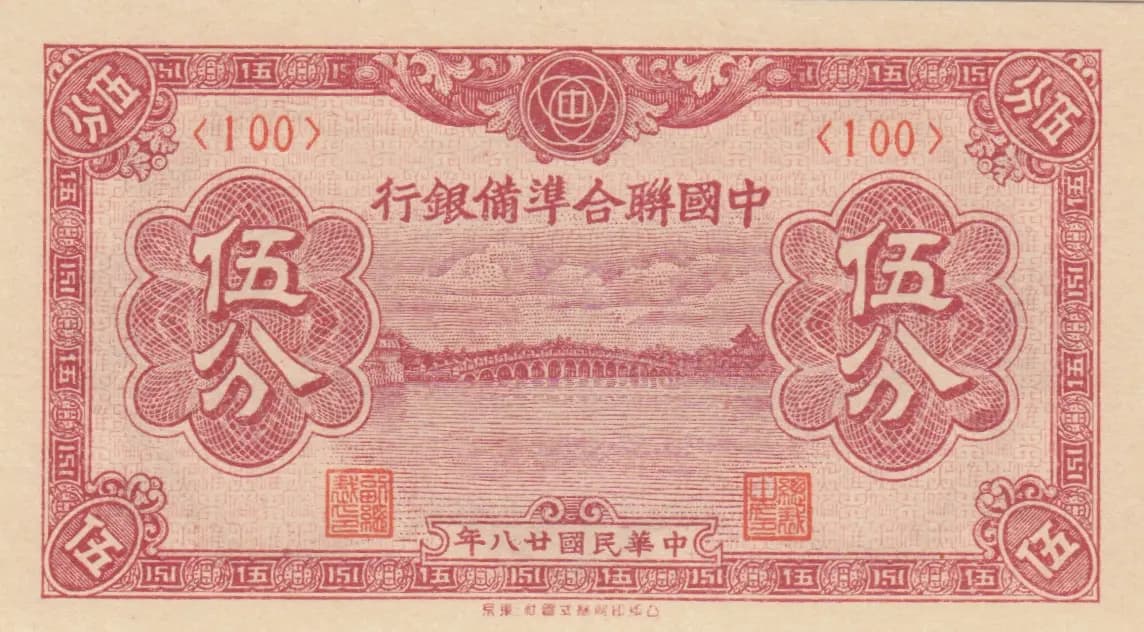
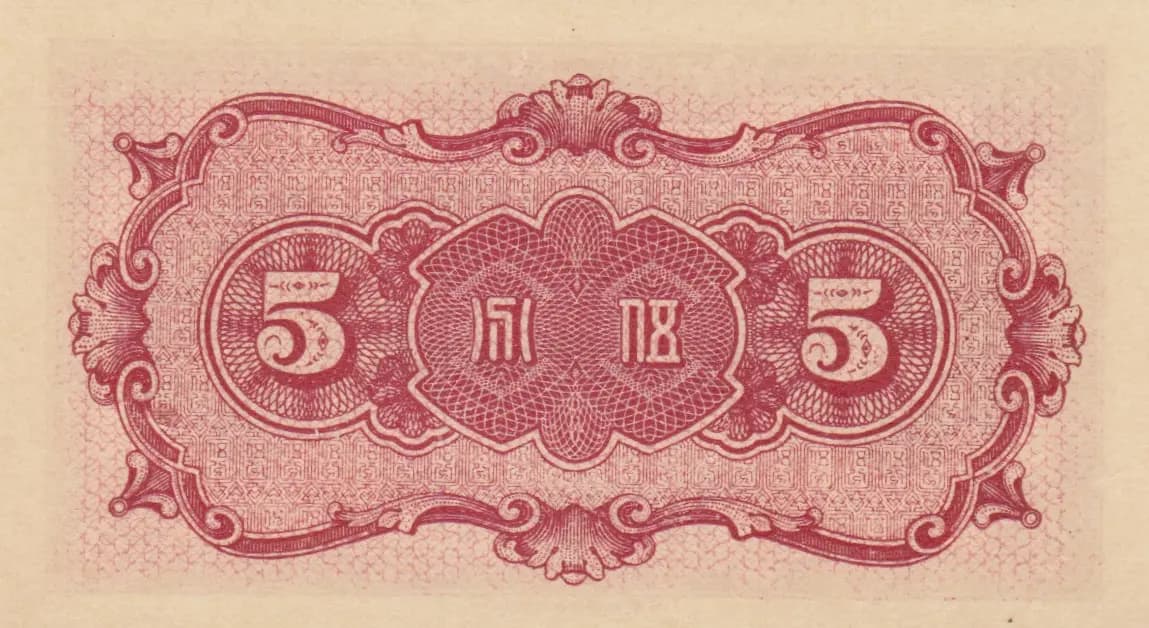
This is an exceptional example of a 1939 Chinese Federal Reserve Bank 5 fen note (Pick J47b) in uncirculated condition. The note displays the characteristic rose-pink color scheme with ornate traditional Chinese decorative borders, a central landscape vignette featuring a bridge or aqueduct structure, and crisp, well-preserved printing throughout with no signs of wear or circulation. The fine engraving quality, symmetrical back design with security-print geometric patterns, and pristine condition make this an attractive example of early Republican-era Chinese fractional currency.
Common. The Federal Reserve Bank of China issued these notes in substantial quantities during the 1939 period, and fractional currency denominations (particularly 5 fen notes) were produced in large runs for everyday circulation. Even in uncirculated condition, this Pick J47b variety does not command premium prices indicative of scarcity; surviving examples are readily available to collectors at modest valuations. The note's survival in UNC condition reflects the archival preservation practices common for banknote hoards rather than exceptional rarity.
Issued in 1939 by the Federal Reserve Bank of China during the Second Sino-Japanese War, this 5 fen note represents the monetary system of the Chinese Republic during a tumultuous period of Japanese invasion and internal division. The Federal Reserve Bank of China, despite its name suggesting a central banking function, was one of several competing note-issuing authorities during China's fragmented Republican era. The landscape vignette depicting infrastructure—likely representing modernization efforts—reflects the nationalist government's aspirations during this conflict period.
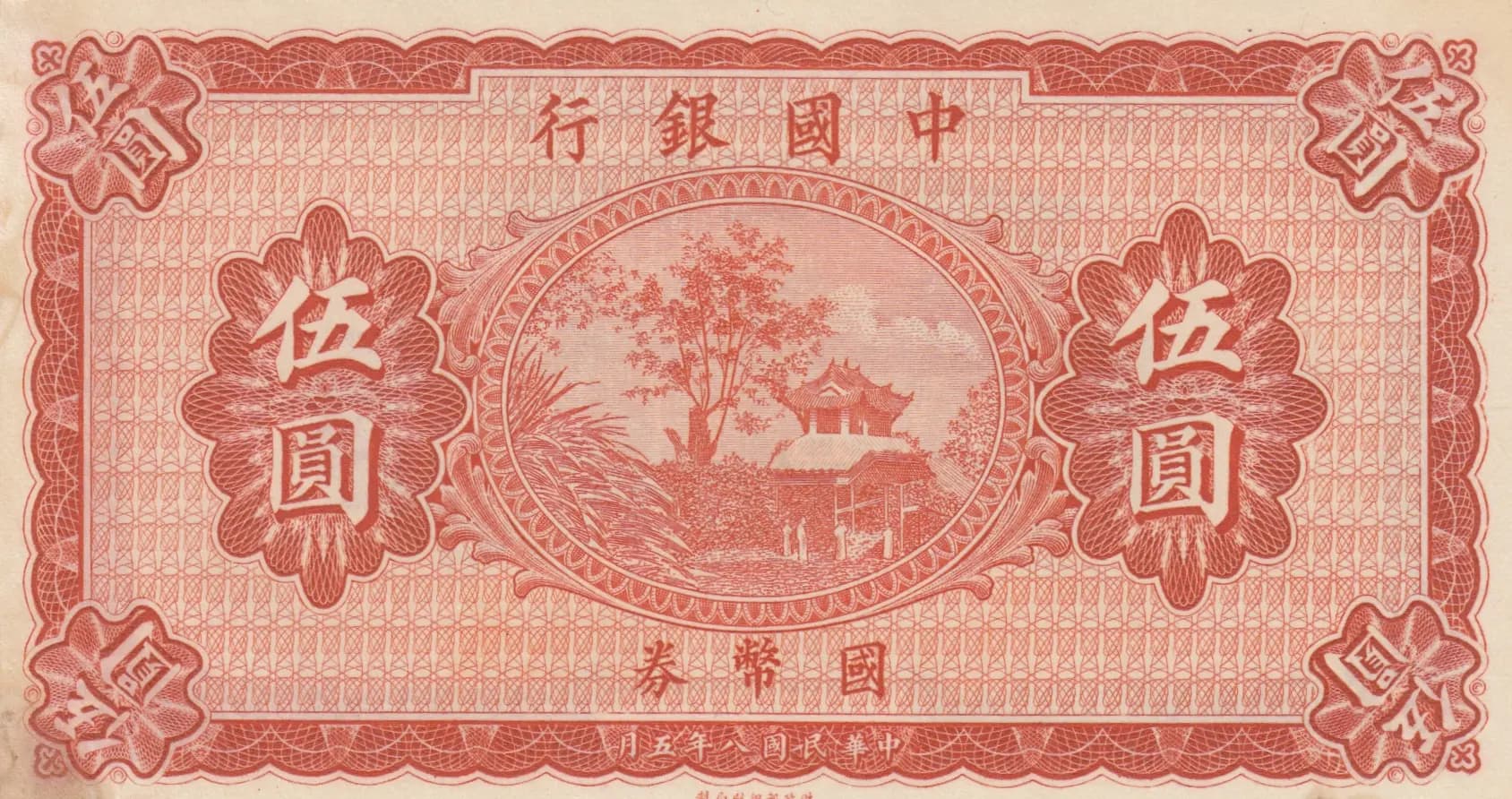
The note features a classical design reflecting late-Republican Chinese aesthetic principles. The front displays an ornamental oval frame containing a landscape vignette of significant infrastructure—a bridge or aqueduct spanning water with buildings visible in the background, likely symbolic of national development and engineering prowess. Large stylized Chinese character '五' (five) appears in decorative oval cartouches on the left and right sides of the central image. The ornate decorative border features traditional Chinese cloud scrolls, geometric patterns, and corner ornaments with a circular emblem at the top center. The back employs a symmetrical design emphasizing security elements, with the denomination displayed in both Arabic (5) and Chinese (伍 and 分) numerals within ornate circular medallions and cartouches, surrounded by fine geometric patterns and repetitive character background designed to prevent counterfeiting.
Front side: '〈100〉' (one hundred in decorative numerals, likely a printer's reference); '中國聯合準備銀行' (Chinese United Preparatory Bank—the issuing institution); '五' (Five, the denomination in Chinese characters); '中華民國五年八月' (Chinese Republic, Year 5, Month 8—corresponding to August 1916 in the Republican calendar, though the actual issue date is 1939). Back side: '5' (Arabic numeral denomination); '伍' (Five in traditional Chinese characters); '分' (Fen, the currency subdivision).
This note was produced using intaglio (engraved) printing, the standard security printing method for banknotes of this era. The fine line work visible throughout the border designs, the detailed landscape engraving in the central vignette, and the crisp impressions of decorative elements indicate professional bank note engraving. The geometric security-print background patterns on the reverse are characteristic of advanced anti-counterfeiting techniques employed by established currency printers serving the Chinese banking authorities.
This note is cataloged as Pick J47b, the 'b' variety designation indicating a specific printing or signature variety of the 1939 Federal Reserve Bank 5 fen issue. Without visible serial number prefixes, signature variations, or overprint differences discernible in the provided images, the specific distinguishing characteristics of the 'b' variety cannot be definitively identified from the visual analysis alone. Collectors should consult detailed Pick catalog references or specialist literature on Federal Reserve Bank of China notes for the precise distinguishing features of this variety designation, which may relate to signatures, serial number ranges, printer marks, or subtle design variations.