5 dollars 1930
Market Prices
74 salesAbout This Note
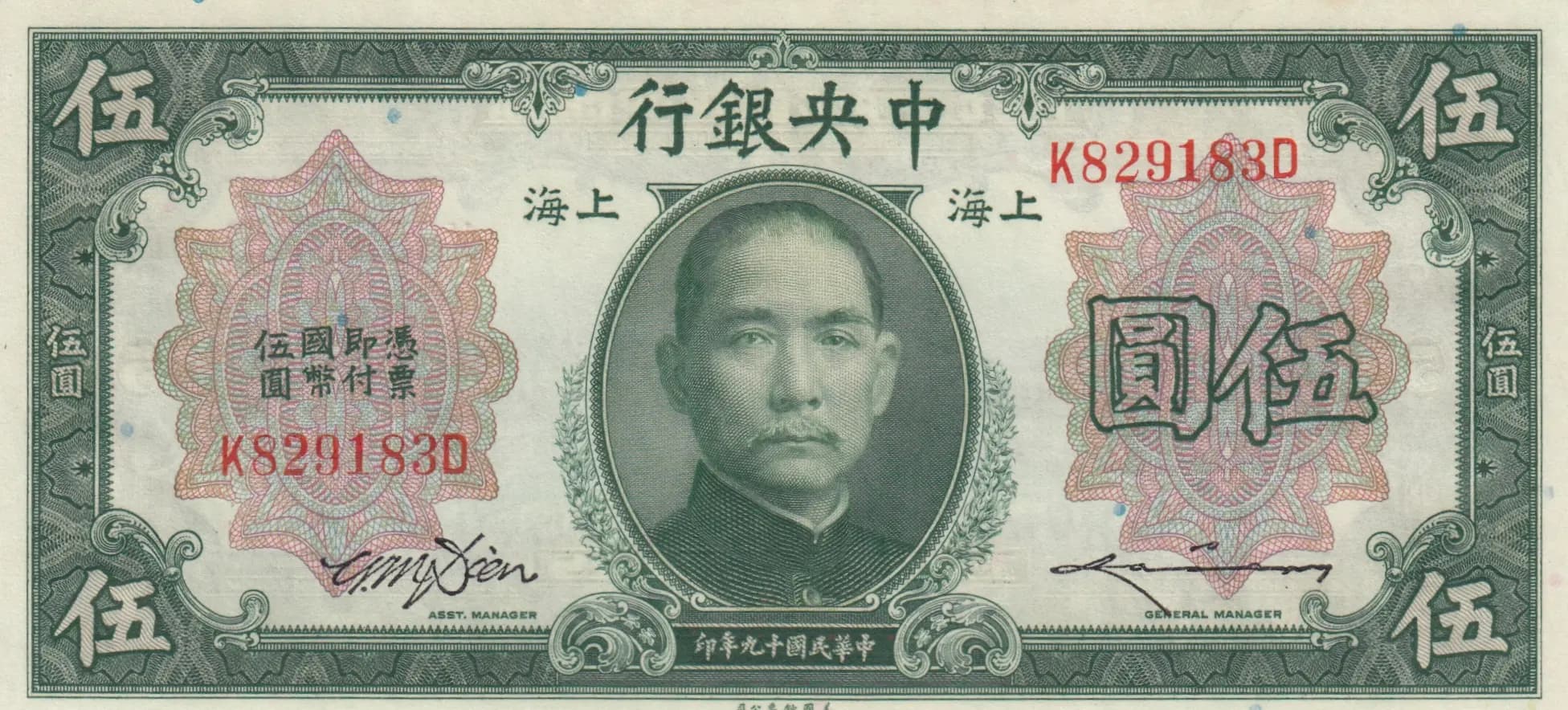
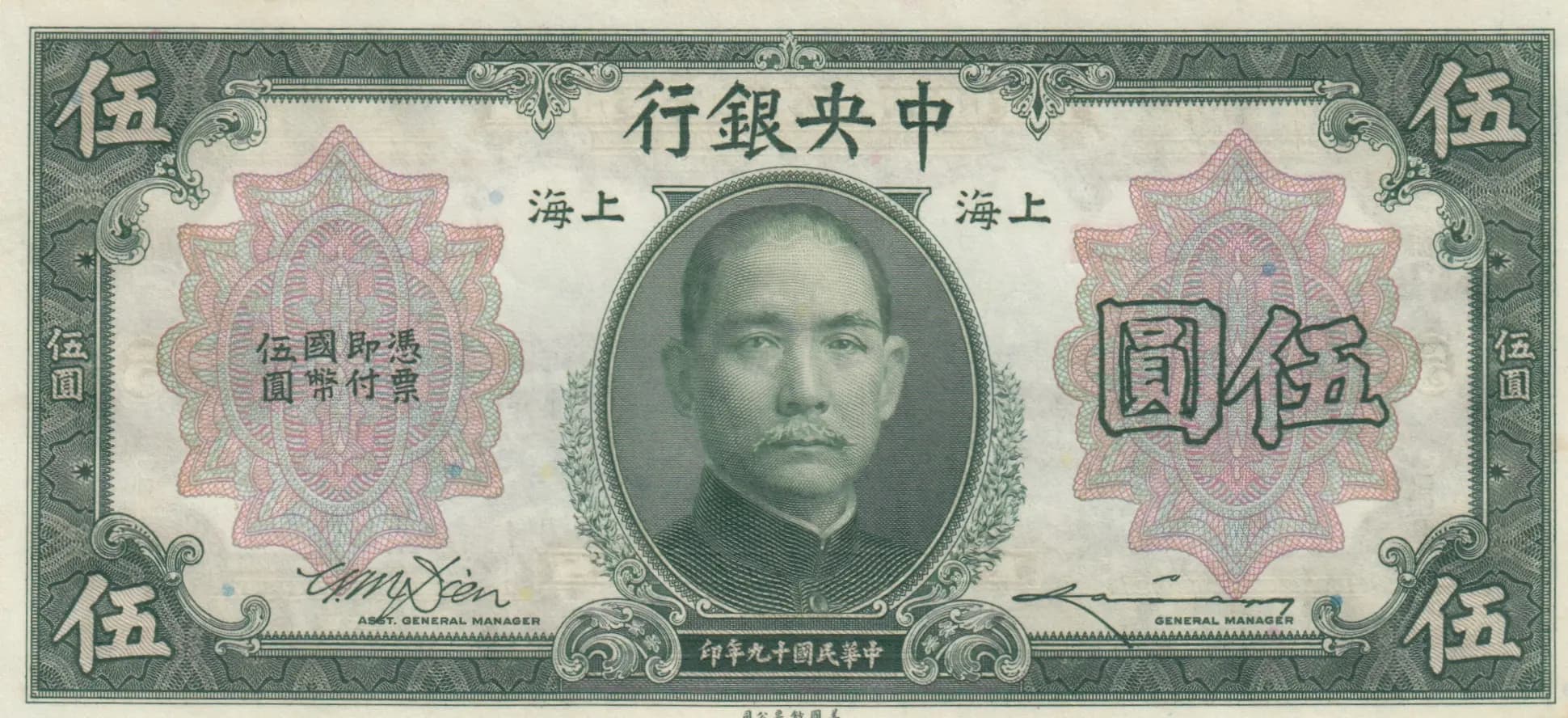
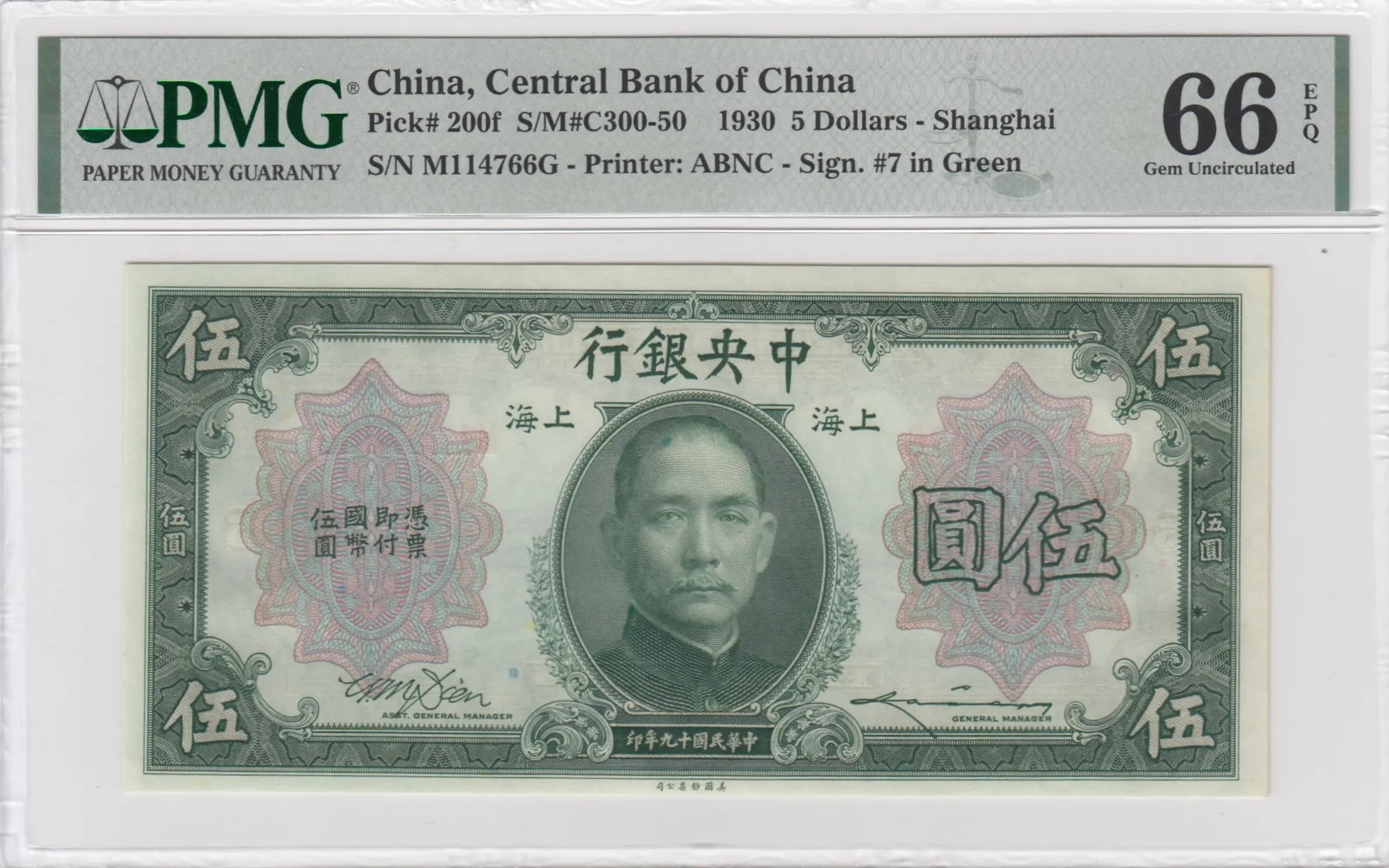
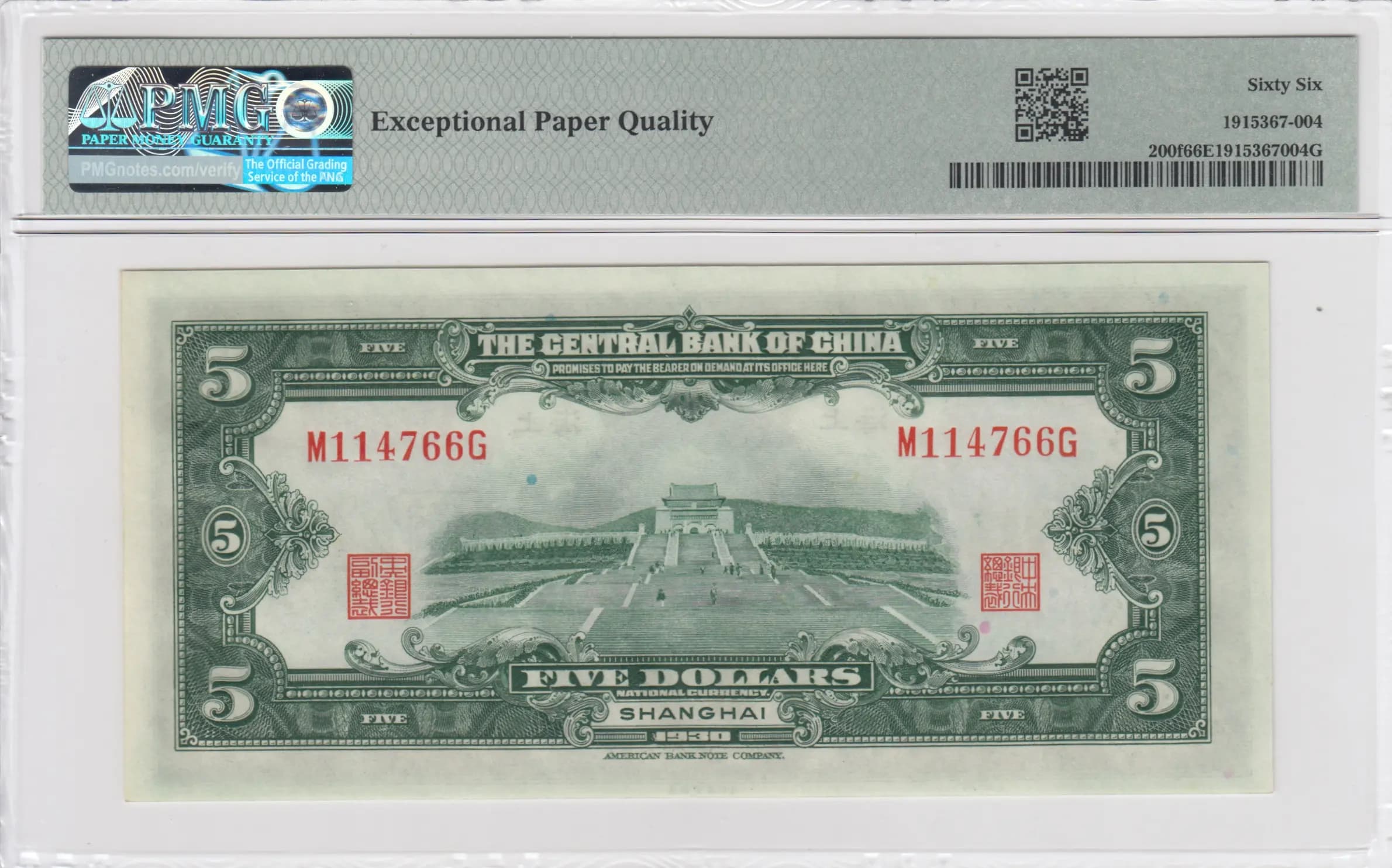
This 1930 Central Bank of China 5 Dollar Shanghai note (Pick 200f) presents in exceptional PMG 66 EPQ condition with pristine paper quality and sharp printing throughout. The obverse features an ornately framed portrait of a male figure in formal attire surrounded by decorative rosette patterns in pink/red against a green background, while the reverse displays an impressive architectural landmark (likely representing a significant government or cultural building) with red seal stamps flanking the central design. The note represents a significant piece of Republican-era Chinese currency history, printed by the American Bank Note Company and bearing both Chinese and English inscriptions reflecting the international character of 1930s Shanghai finance.
Common. eBay auction data demonstrates consistent market activity with PMG 66 examples selling regularly in the $26-$59 range over the past decade, with typical sales in the $26-$44 range in recent years (2019-2025). The extensive price history shows numerous examples in all grades appearing regularly at auction, indicating a healthy circulation of surviving examples. While catalogued values list modest figures ($4-$9 depending on grade as of 2016), the actual market has proven stronger, but the frequency of sales and consistent price ceiling suggests this is a regularly encountered issue rather than a scarce variety.
This note was issued during the period of the Republic of China (1912-1949), specifically during the Nanjing Decade when the Nationalist government sought to modernize China's currency system. The Central Bank of China's issue of foreign-currency-denominated notes from Shanghai reflects the city's status as a major international financial center and treaty port in the early 20th century. The architectural landmark depicted on the reverse likely represents an important civic or ceremonial structure associated with the Nationalist government's modernization efforts and national aspirations during this period of Chinese history.
The obverse features a centered oval portrait frame containing a formally attired male figure, likely representing a prominent political or financial leader of the Republican era, surrounded by ornate circular decorative elements and pink/red rosette patterns with elaborate scrollwork and flourishes in green. The reverse depicts a monumental architectural structure with symmetrical design viewed from a formal front approach with a broad plaza or avenue, centered on the note with red seal stamps (chops) positioned on either side of the building image, characteristic of official government currency design. Both sides employ classical engraved border ornamentation in green with cream-colored paper stock, representing the refined aesthetic standards of American Bank Note Company's international currency production. The bilingual presentation (Chinese and English) on both sides emphasizes the international commercial context of Shanghai in 1930.
FRONT: Central Bank (中央銀行) | Shanghai (海上) | Five (五) | Dollar/Yuan (圓) | Five Dollars (五圓) | Printed by Republic of China (中華民國印製) | Five nation print ticket with attachment (五國印票帶付票) | BACK: THE CENTRAL BANK OF CHINA | FIVE | 5 | PROMISES TO PAY THE BEARER ON DEMAND AT ITS OFFICE HERE | M114766G (Serial Number) | FIVE DOLLARS | SHANGHAI | 1930 | AMERICAN BANK NOTE COMPANY
Engraved intaglio printing with multi-color process (green, pink/red, and black inks on cream stock). Printed by American Bank Note Company (ABNC), as indicated by the imprint on the reverse. The fine line work, complex rosette patterns, decorative borders, and sharp serif elements visible throughout are characteristic of ABNC's high-security engraved currency production. The red seal stamps appear to have been applied as overprints or as part of the plate design.
This is Pick 200f, representing a specific catalogued variety of the 1930 Central Bank of China 5 Dollar Shanghai issue. The serial number M114766G appears in red on both sides of the reverse, printed as part of the currency control system. The note exhibits control overprints characteristic of Chinese currency production of this period. Specific signature and overprint varieties exist within the Pick 200 series; this example's particular serial number range and overprint configuration should be verified against detailed Pick catalogue documentation to confirm the precise sub-variety designation.