5 dollars 1930
Market Prices
8 salesAbout This Note
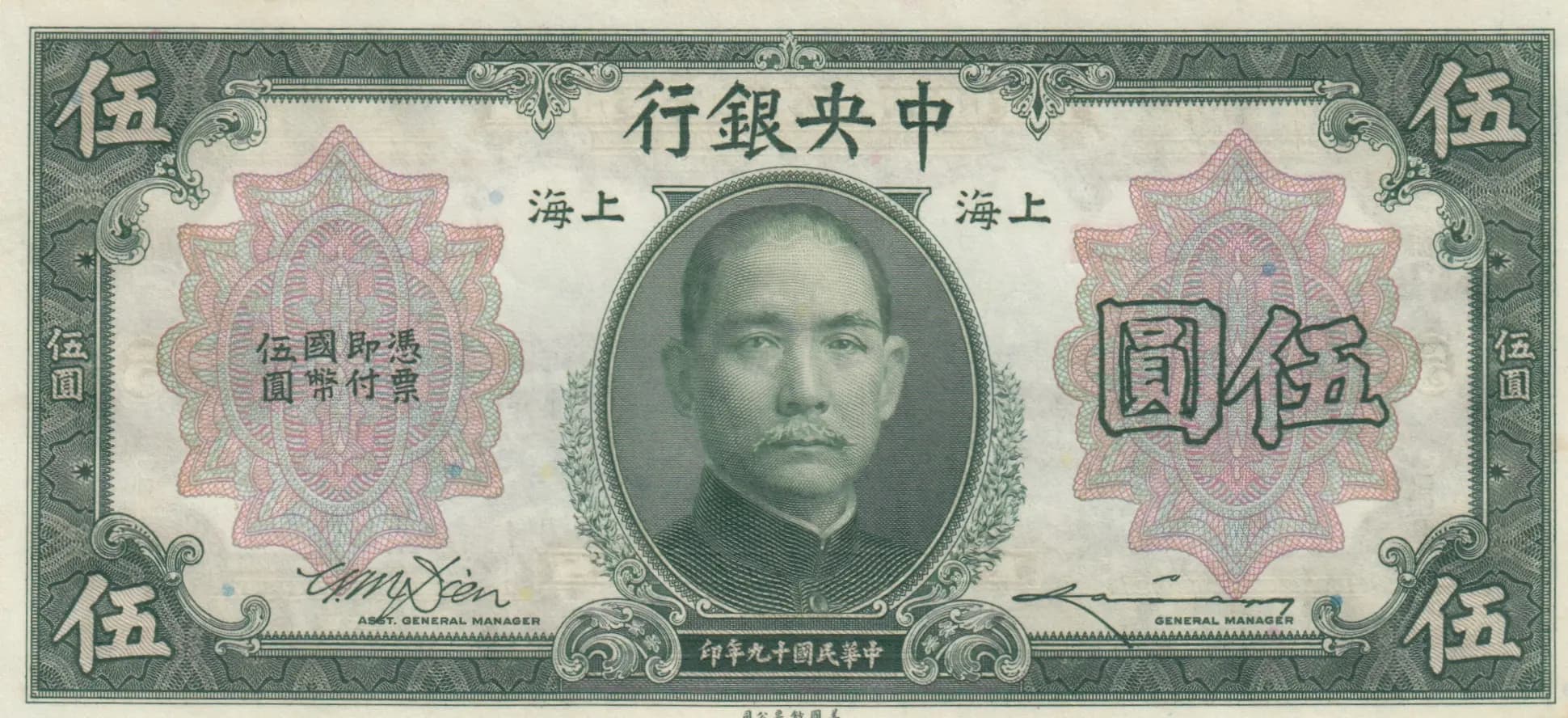
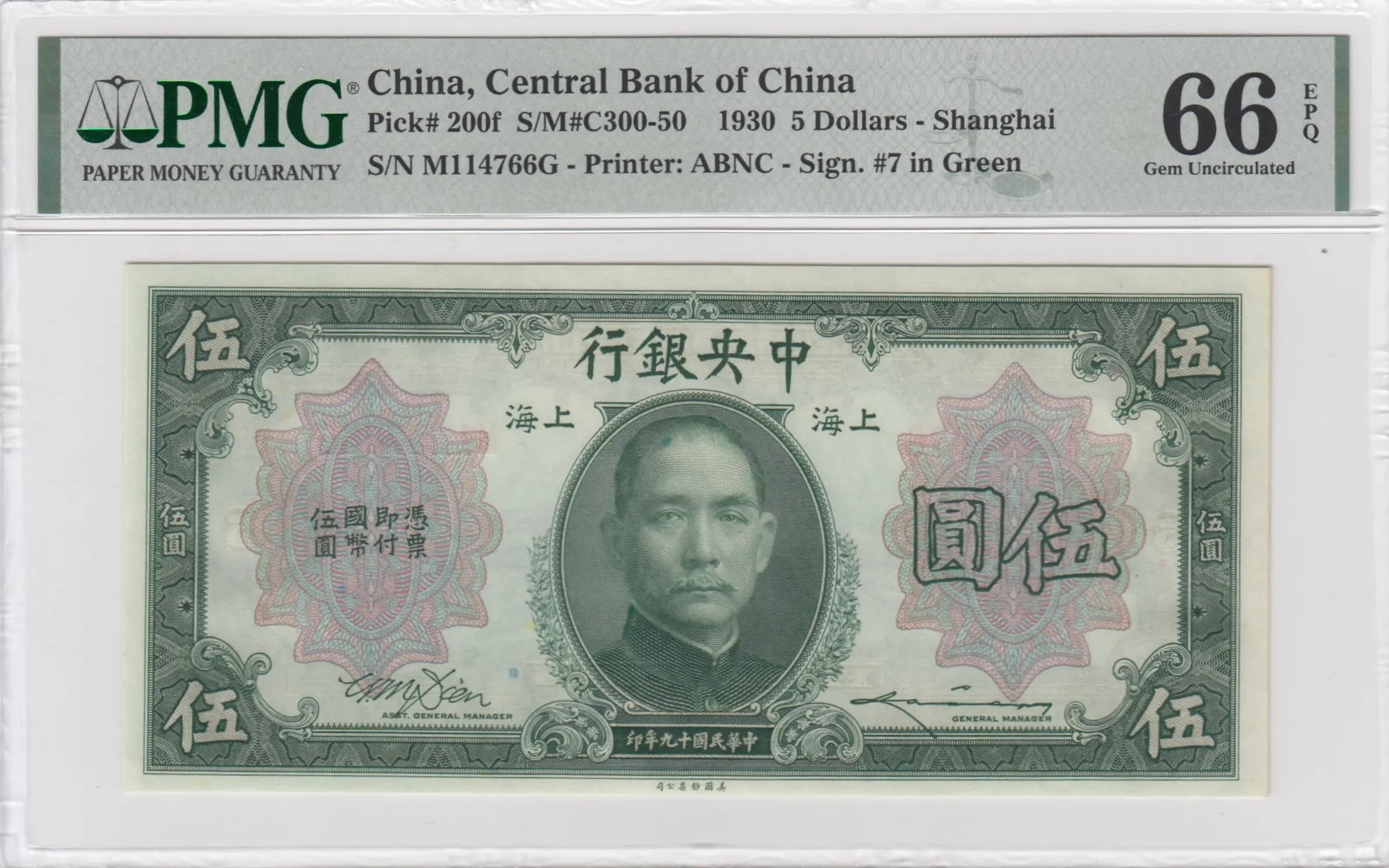
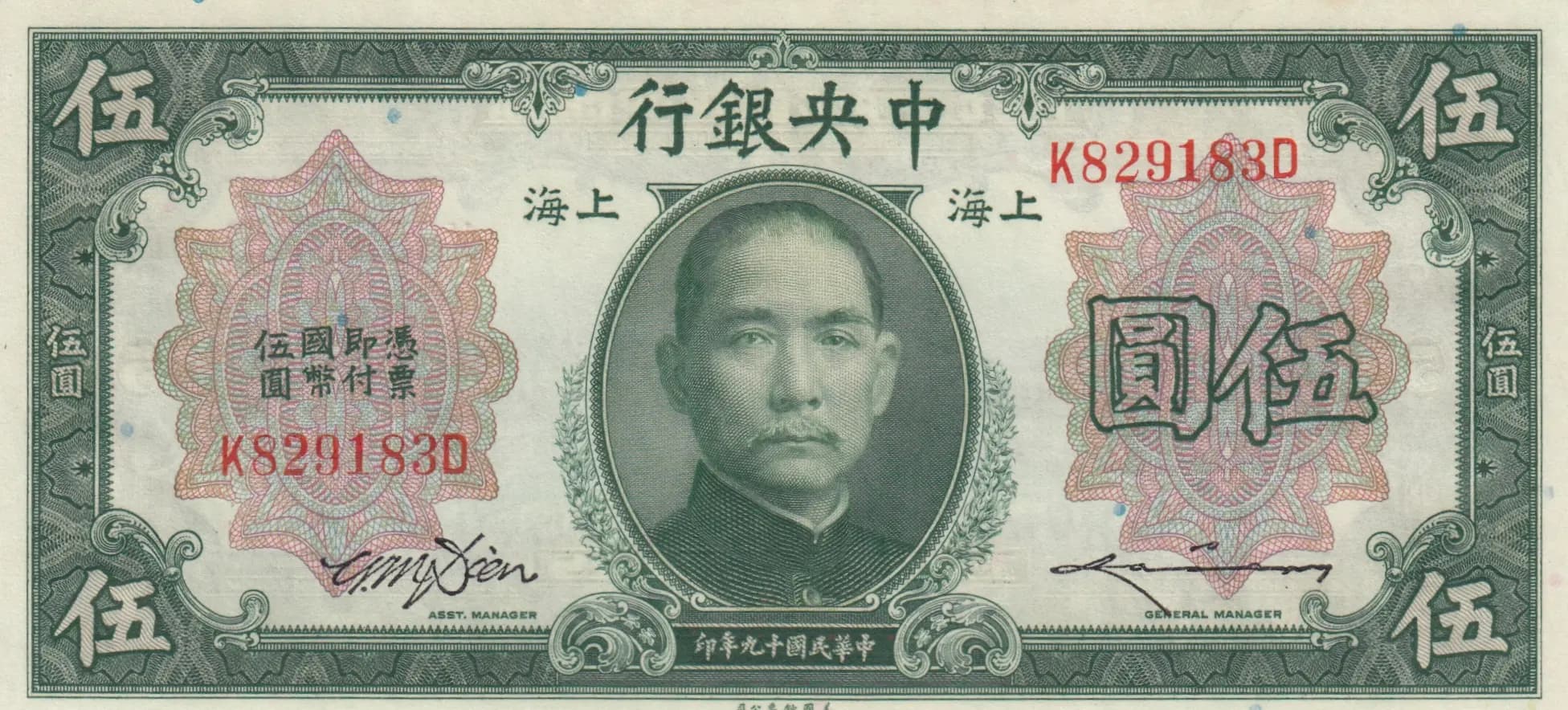
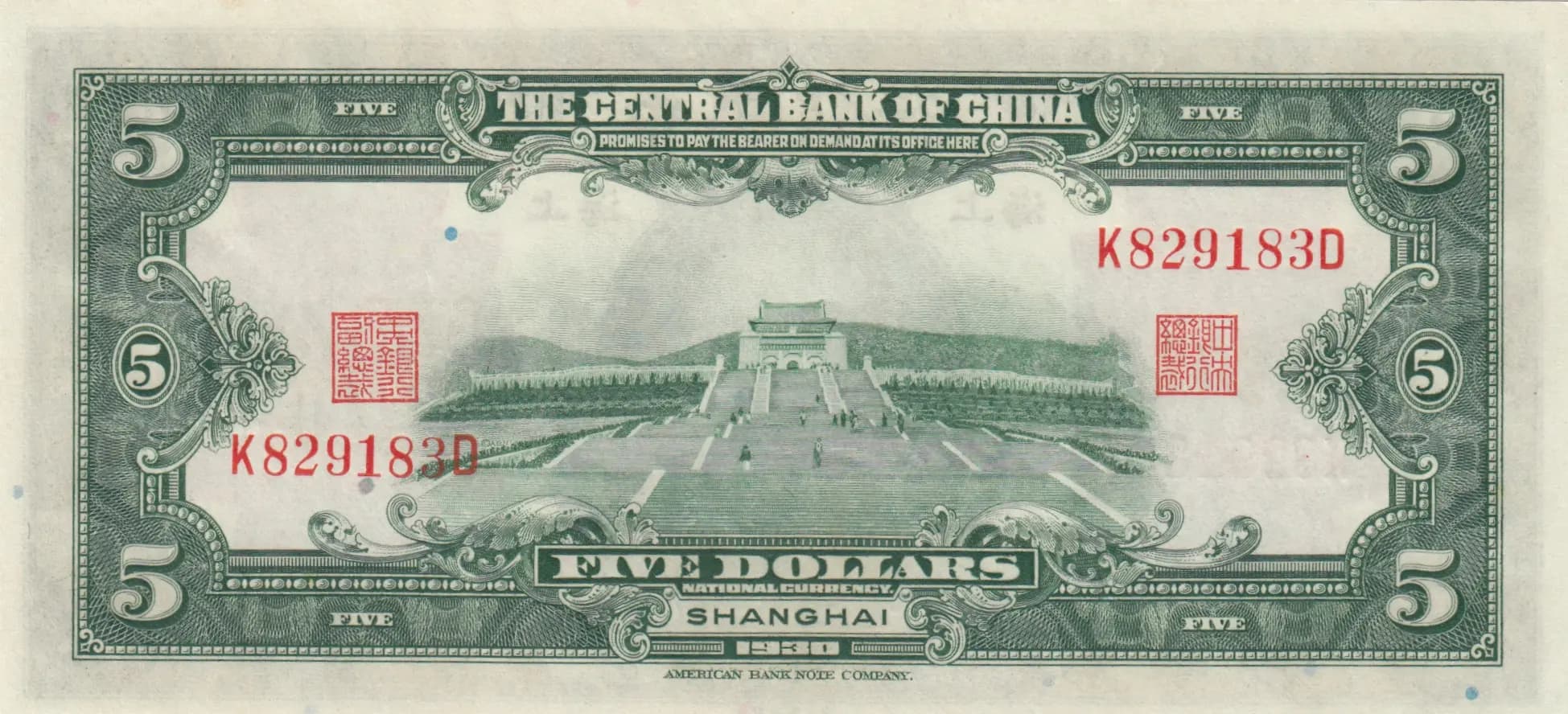
This Central Bank of China 5 Dollar note from 1930 (Pick-200e) presents in exceptional Uncirculated condition with crisp paper and vibrant color preservation. The front features an elegant portrait medallion of a dignified gentleman flanked by ornate pink rosette decorations, while the reverse displays a classical architectural monument in a detailed landscape vignette. The note exemplifies high-quality American Bank Note Company engraving work and represents an important piece of Republican-era Chinese currency history.
Common. Despite its age and historical significance, this note remains common in the numismatic market. eBay transaction data shows UNC examples have sold for under $10-$12, and even PMG-graded examples (PMG 65-66) typically range from $35-$65. These price points, combined with the existence of multiple documented sales over several years, indicate adequate supply in the collector market. The Central Bank of China issued substantial quantities of this denomination during 1930, and many examples have survived in decent condition.
Issued by the Central Bank of China in 1930 during the early Republican period, this note reflects China's modernization efforts and international financial integration. The reverse depicts what appears to be a significant national monument or ceremonial structure, likely commemorating an important historical or cultural landmark. The English language text and American Bank Note Company imprint demonstrate the international character of Chinese banking and currency production during this era of Chinese monetary reform.
The obverse features a formal portrait of an Asian gentleman in modern Western formal attire, centered within an ornate oval frame enriched with botanical elements. This portrait is flanked by two large, intricately patterned pink/red rosette or star-shaped decorative elements with geometric designs, creating a balanced symmetrical composition. Green corner ornaments frame the design. The reverse showcases a detailed landscape engraving of what appears to be the Sun Yat-sen Mausoleum or similar important Republican monument—a classical Chinese-style structure with a central gateway flanked by symmetrical pathways and landscaped grounds with trees and elevated terrain in the background. Denomination markings ('5') appear prominently in all four corners of the reverse, and red square seals with Chinese characters serve as official validation marks. The entire design demonstrates exceptional engraving depth with sophisticated guilloche patterning throughout.
{"front":{"中央銀行":"Central Bank","海上":"Shanghai","伍圓":"Five Dollars/Yuan (appears multiple times)","K829183D":"Serial number","國家紀念票":"National commemorative note","中華民國紀年":"Republic of China","ASST. MANAGER":"Assistant Manager","GENERAL MANAGER":"General Manager"},"back":{"5":"Denomination (corner indicators)","THE CENTRAL BANK OF CHINA":"The Central Bank of China","FIVE":"Five (denomination)","FIVE DOLLARS":"Five Dollars","SHANGHAI":"Shanghai","PROMISES TO PAY THE BEARER ON DEMAND AT ITS OFFICE HERE":"Promise clause - standard currency obligation","NATIONAL CURRENCY":"National Currency","AMERICAN BANK NOTE COMPANY":"American Bank Note Company (printer)","K829183D":"Serial number"}}
Intaglio engraving (steel plate engraving), executed by the American Bank Note Company of New York, one of the world's premier security printers. The note exhibits characteristic deep engraving with fine line work, elaborate guilloche patterns, and precise color registration visible in the multi-color design (green, red, black, and cream). Security features include intricate engraved details, red colored overprint for the serial number, and formally applied red seal stamps.
Pick-200e designation indicates this is the 'e' variety of the 1930 5 Dollar note. The observed serial number prefix 'K' and Shanghai origin mark are consistent with standard production varieties. The note carries signatures identified as 'ASST. MANAGER' and 'GENERAL MANAGER' positions typical of 1930-era Central Bank issues. No exceptional overprints or date variants are apparent in this specimen, making it a representative standard circulation variety of this denomination rather than a scarce sub-variety.