25 yuan 1940
Market Prices
9 salesAbout This Note
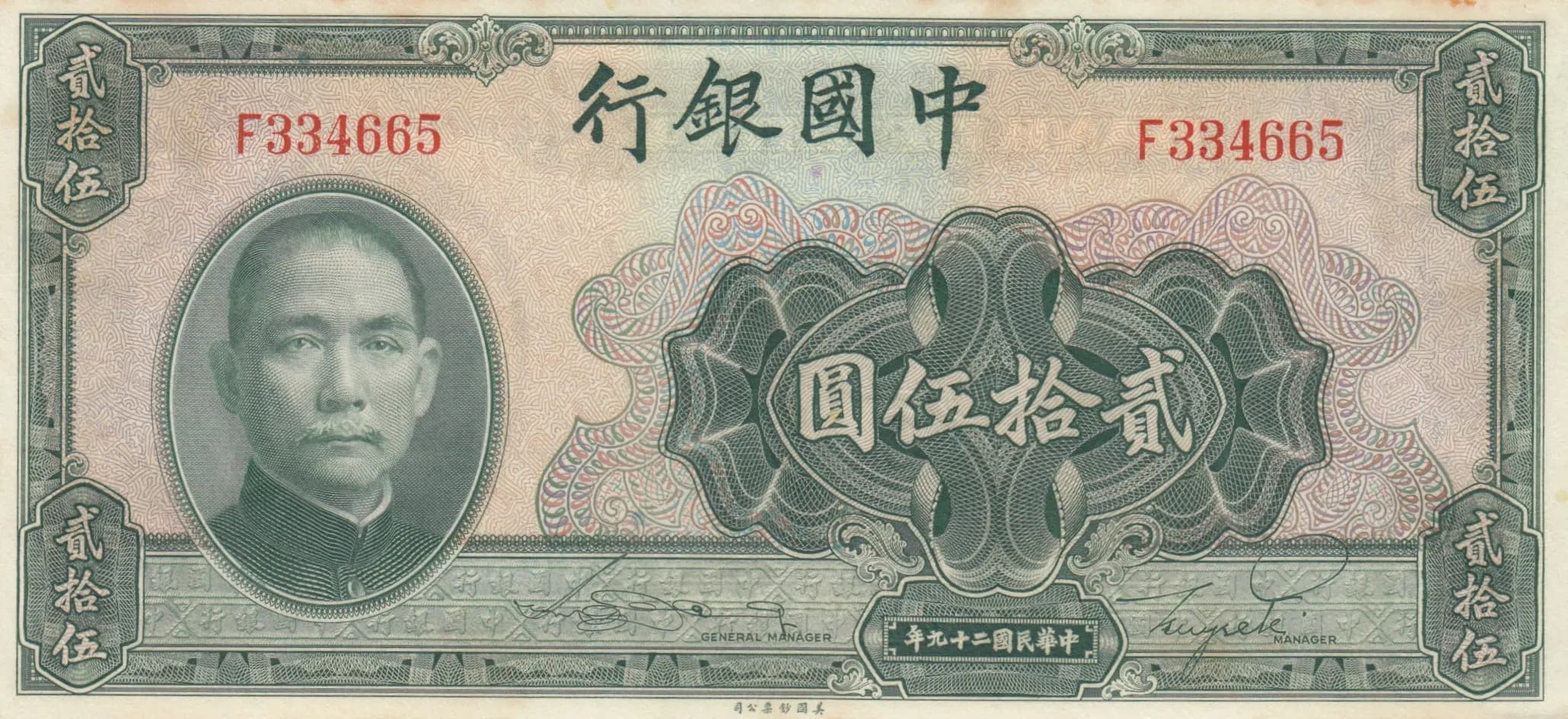
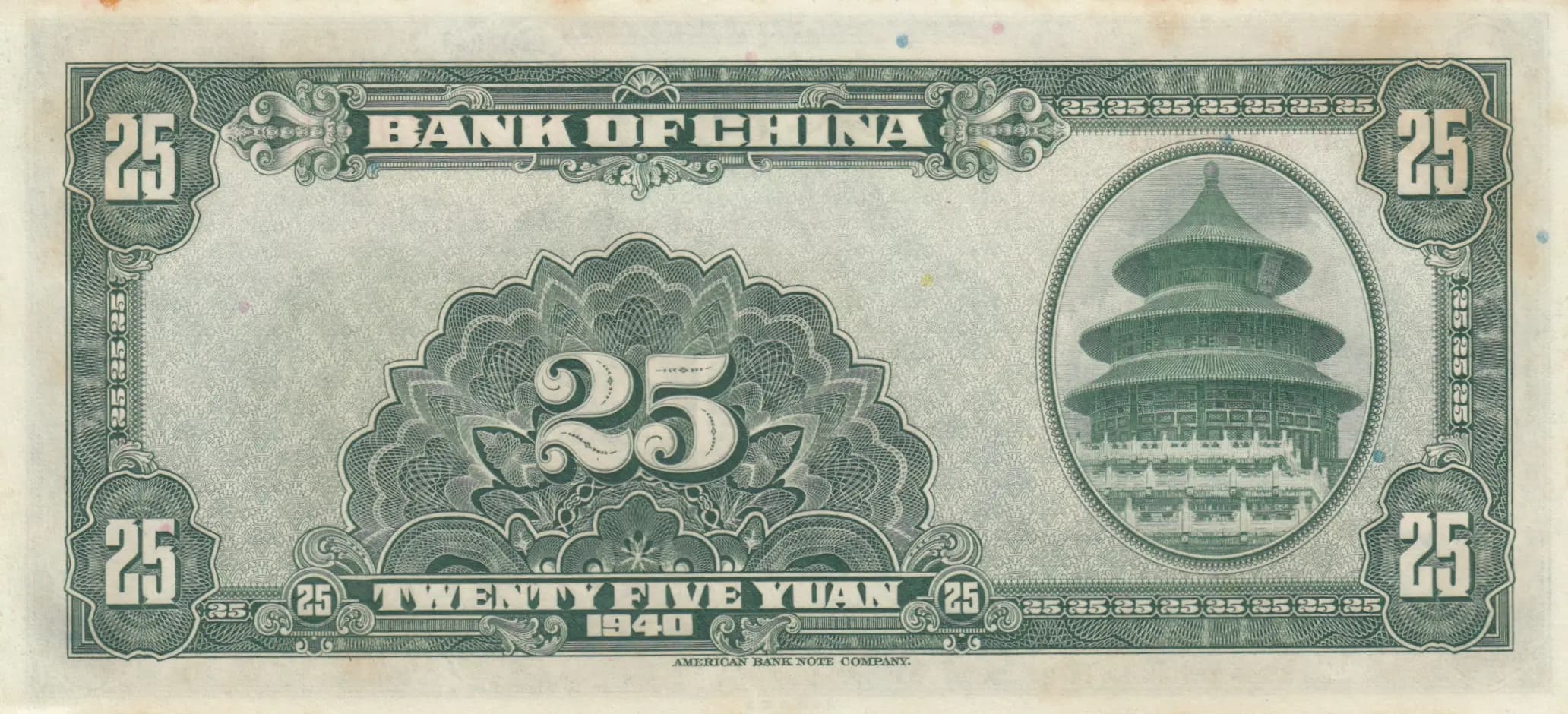
This is a Bank of China 25 yuan note from 1940, graded AU, featuring exceptional preservation with minimal circulation wear and light foxing consistent with its age. The obverse displays a formal portrait of Sun Yat-sen in an oval frame surrounded by ornate green and multicolor decorative borders, while the reverse showcases a beautifully engraved Temple of Heaven in similar oval framing. The note exemplifies the high-quality security printing standards of the American Bank Note Company during this critical period in Chinese monetary history.
Common. While this note exhibits attractive iconography and fine craftsmanship, the catalog values and eBay market data indicate consistent availability at modest prices. Recent comparable sales in AU-equivalent condition (EF grades) have ranged from $37.50 to $42, with the 2016 catalog valuing AU condition (UNC) at $450. The regular issue designation and presence in multiple sales venues suggest adequate supply relative to collector demand, typical of Bank of China notes from this period despite wartime production circumstances.
Issued during the Second Sino-Japanese War (1937-1945), this Bank of China note represents currency produced during a period of significant political and economic upheaval in China. The inclusion of Sun Yat-sen's portrait reflects his revered status as the founder of the Republic of China, while the Temple of Heaven imagery symbolizes Chinese cultural heritage and national continuity. The American Bank Note Company's involvement in production underscores the technical cooperation between American security printers and the Chinese financial authorities during wartime conditions.
The obverse features a formal portrait of Sun Yat-sen (the 'SYS' referenced in catalog data), positioned in a central-left oval cartouche with elaborate scrollwork borders rendered in green and pink/beige tones. The reverse depicts the Temple of Heaven, a three-tiered pagoda structure with characteristic curved roofs and ornamental architectural details, centered in an oval frame on the right side. Both sides employ intricate geometric patterns, fine-line engraved backgrounds, and ornamental corner designs with denomination markers, all executed in the refined security printing style characteristic of early 20th-century currency design.
Front side: '中國銀行' (Bank of China), '貳拾伍' (Twenty-five [yuan]), 'GENERAL MANAGER', 'MANAGER', Serial number 'F334665'. Back side: 'BANK OF CHINA', '25', 'TWENTY FIVE YUAN', '1940', 'AMERICAN BANK NOTE COMPANY'.
Intaglio engraving (recess printing), executed by the American Bank Note Company, using multiple color plates applied sequentially. The fine line work visible in the portrait rendering, geometric patterns, and architectural details—combined with the stated printer attribution—confirms the use of traditional steel-plate engraving techniques. The multicolor underprint and color separation suggest the use of separate engraved plates for each color component (green, pink/beige, and black ink).
Serial number F334665 with red-colored serial number printing observed. This specimen falls within the C294-242 S/M classification referenced in the catalog. The specific serial number prefix 'F' and the red serial number coloring may help distinguish varieties, though without access to comprehensive serial range documentation for this Pick number, definitive variety classification cannot be determined from the visual evidence alone. The note's AU condition and preservation state represent the premium end of commonly encountered examples.