1000 yuan 1945
Market Prices
4 salesAbout This Note
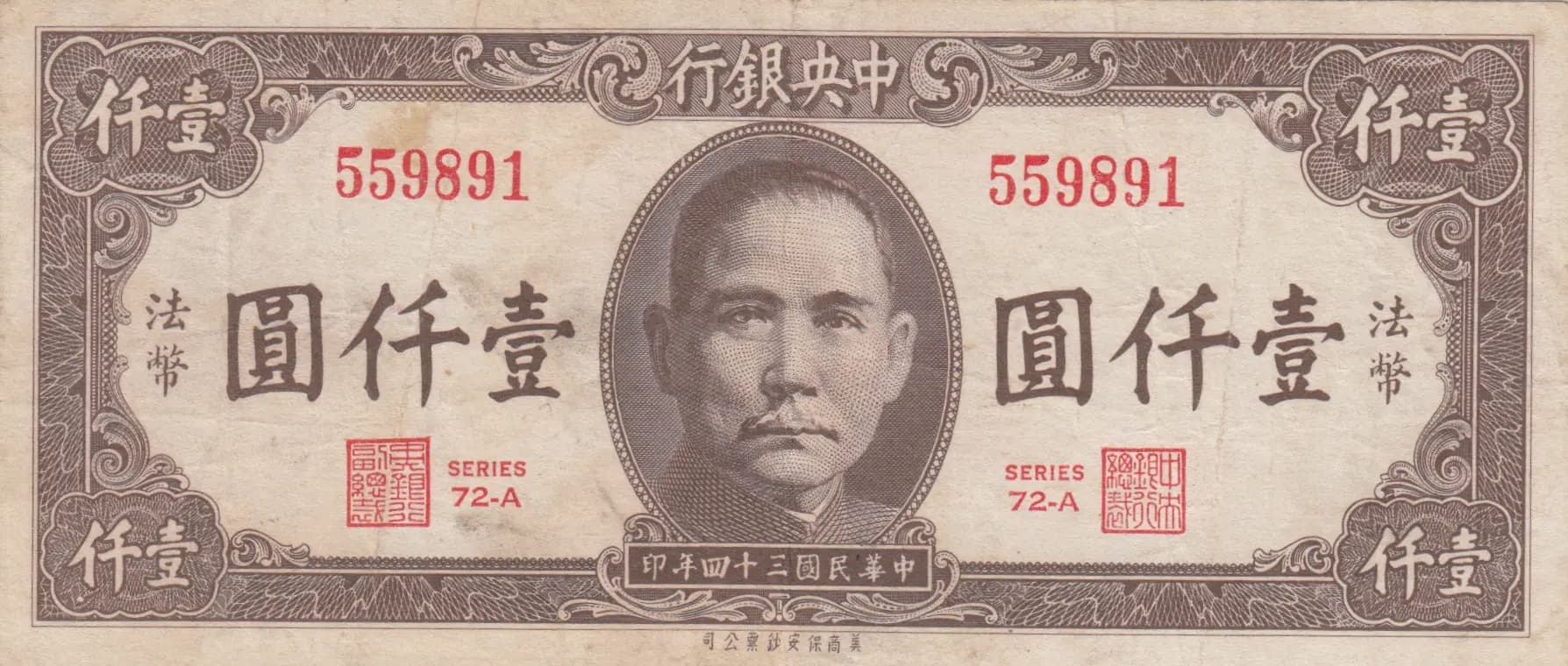
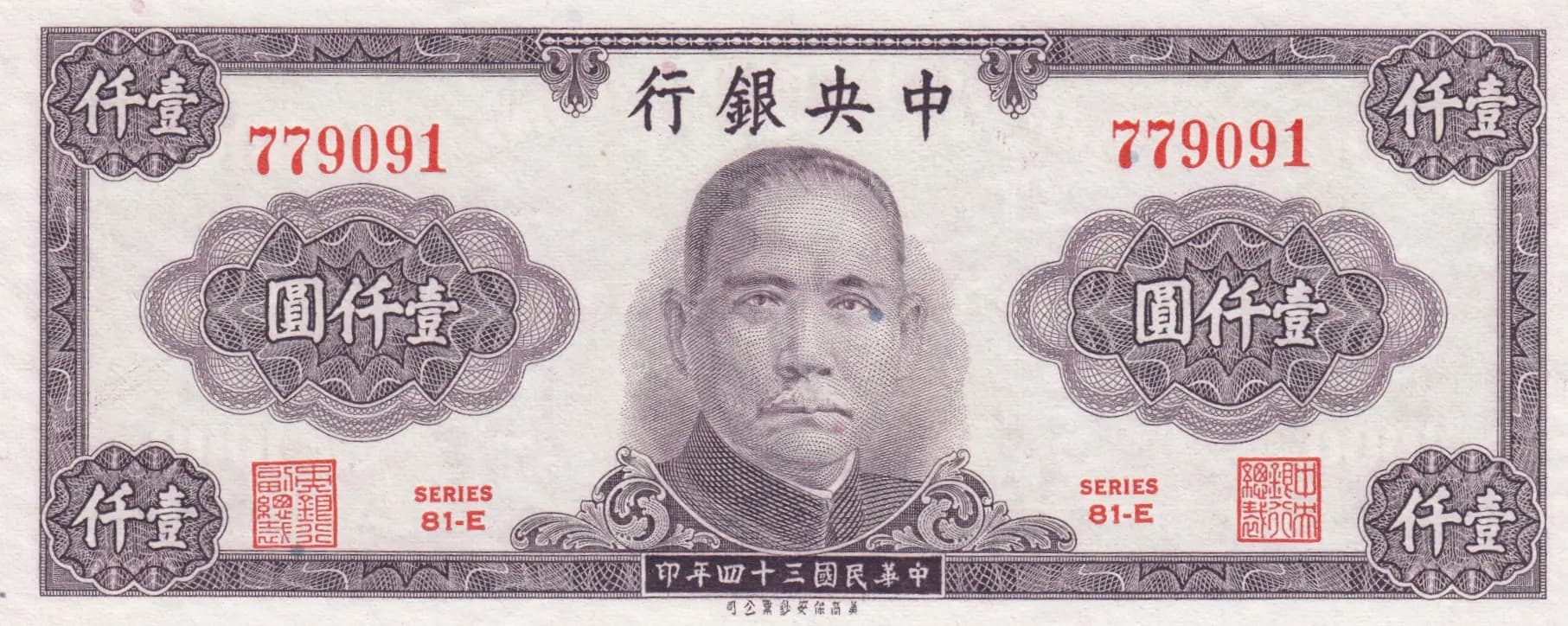
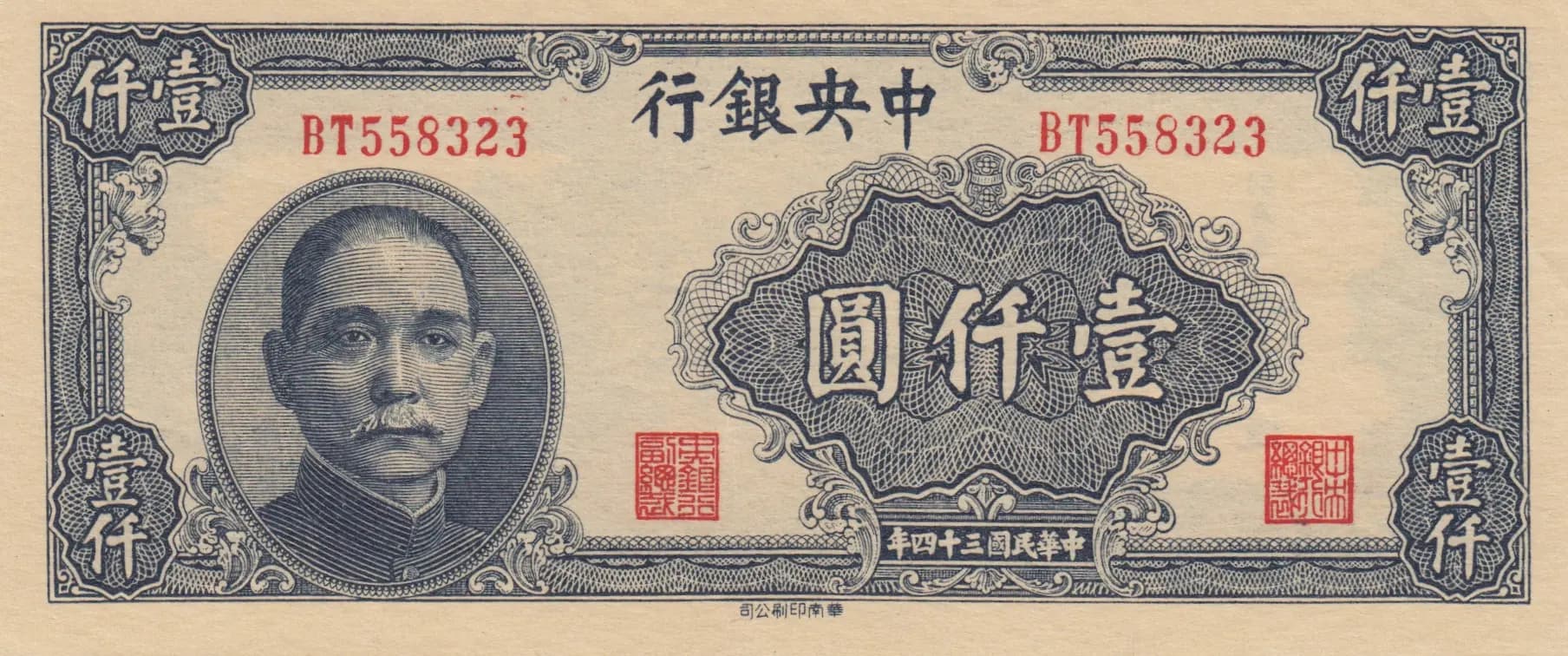
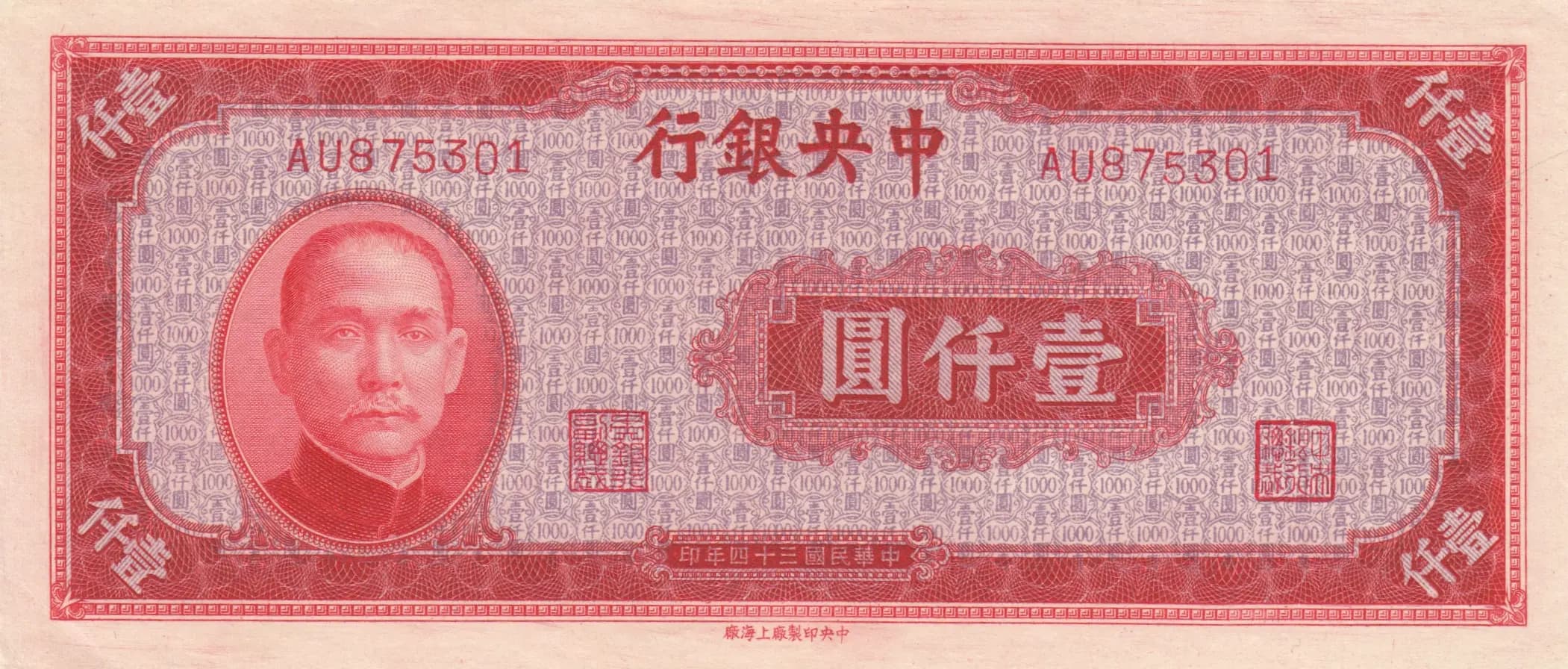
A spectacular example of the 1945 Central Bank of China 1000 Yuan note (Pick P-287) in AU condition, featuring vibrant red-orange and pink coloring with a cream underprint. The obverse displays a formal portrait of Sun Yat-sen in an oval frame on the left, surrounded by intricate fine-line engraving, decorative rosettes, and repeated Chinese numerals forming a sophisticated security pattern. This note represents a critical period in Chinese monetary history, issued during the final year of the Second Sino-Japanese War, and remains visually stunning with no evidence of circulation, foxing, or wear.
Common. This denomination and series saw substantial circulation within China during 1945 and the immediate post-war period, and multiple examples have appeared in market sales over the past decade. The eBay price tracking data shows consistent availability at moderate prices across various condition grades (VF at $10.80, AUNC at $38, UNC at $76.05), indicating this is a regularly traded note rather than a scarce issue. The 2016 catalog values ($50 for UNC) further support common classification. No evidence of limited print runs, government recall, or extreme scarcity is present in market behavior.
Issued in 1945 by the Central Bank of the Republic of China, this denomination reflects the severe inflation that plagued China during the late Japanese occupation and the final phase of the Chinese Civil War. The portrait of Sun Yat-sen (founder of the Republic of China) on the obverse underscores the note's nationalist legitimacy during a period of political and military turmoil. The crossed-axes emblem visible in the corners and the formal design with Chinese seals and stamps represent the government's attempt to maintain monetary authority and public confidence in currency during wartime economic collapse.
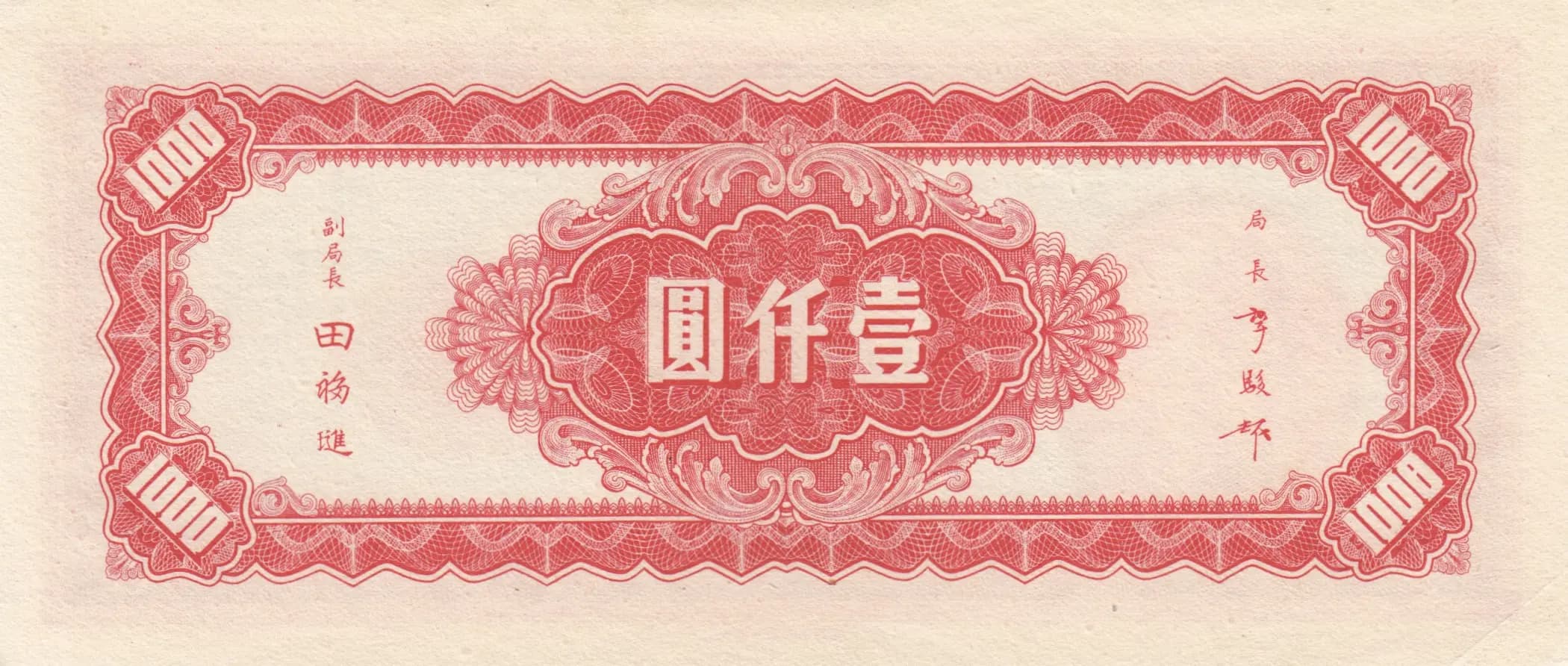
The obverse features Sun Yat-sen, the founding father of the Republic of China, portrayed in formal Western attire within a prominent oval frame positioned in the lower left quadrant. His stern expression reflects the gravity of the era. The center displays a large decorative cartouche containing the denomination '壹千圓' (One Thousand Yuan). The background employs a sophisticated repeating pattern of Chinese numeral '1000' as a security device. Crossed-axes emblems (representing the Nationalist government) appear in both upper corners. Ornamental rosettes, scrollwork, and classical borders frame the entire design. The reverse presents a more restrained layout, dominated by an elaborate central cartouche with floral and scrollwork motifs, surrounded by repeated geometric patterns in the four corners and an ornamental border framework. Both sides maintain the red-orange and pink color scheme on a cream background, characteristic of high-denomination Republican-era currency.
OBVERSE: 中央銀行 (Central Bank) — 壹千圓 (One Thousand Yuan) — 中華民國 (Republic of China) — Serial numbers: AU875301 and AU875361 (Latin prefix with numerical designation). REVERSE: 壹千圓 (One Thousand Yuan) — 中華民國 (Republic of China) — 長 (Director/Governor) — 副長 (Deputy Director) — 券 (Certificate/Voucher/Bond) — Additional administrative and signature-related characters indicating official authorization and issuing authority.
Intaglio/engraving process with fine-line techniques, evidenced by the intricate linear patterns, detailed security numerals, ornamental borders, and the dimensional quality visible in the portrait rendering. The catalog reference notes 'Chinese 8 characters' identifying the printer (likely a government-controlled security printing facility). Multiple color runs were employed to achieve the red-orange and pink overlay on the cream/beige base stock. The precision of the repeating background numerals and the delicate rosette patterns indicate professional security printing by the government printer, consistent with Central Bank of China standards of the period.
Serial number prefix 'AU' is documented on this example (AU875301/AU875361). The specific variety corresponds to the Pick P-287 regular issue of 1945. No overprints, date variations, or emergency issues are evident. The note appears to represent the standard production run from the Central Bank of China for this denomination and year. Signature blocks and administrative characters on the reverse are consistent with standard issue characteristics for this Pick number, though specific signature identification would require closer examination of the individual characters in the authorization block.