100 yuan 1940
Market Prices
50 salesAbout This Note
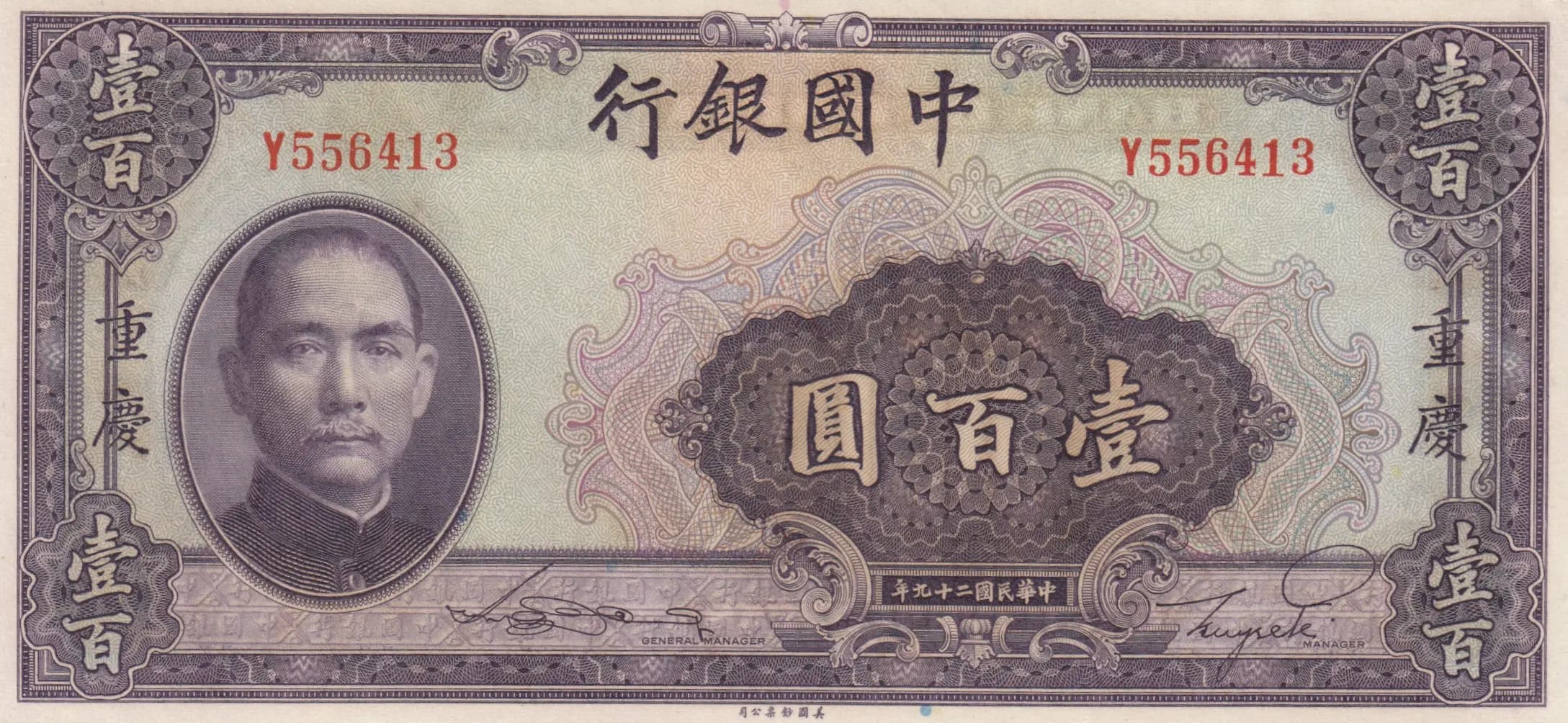
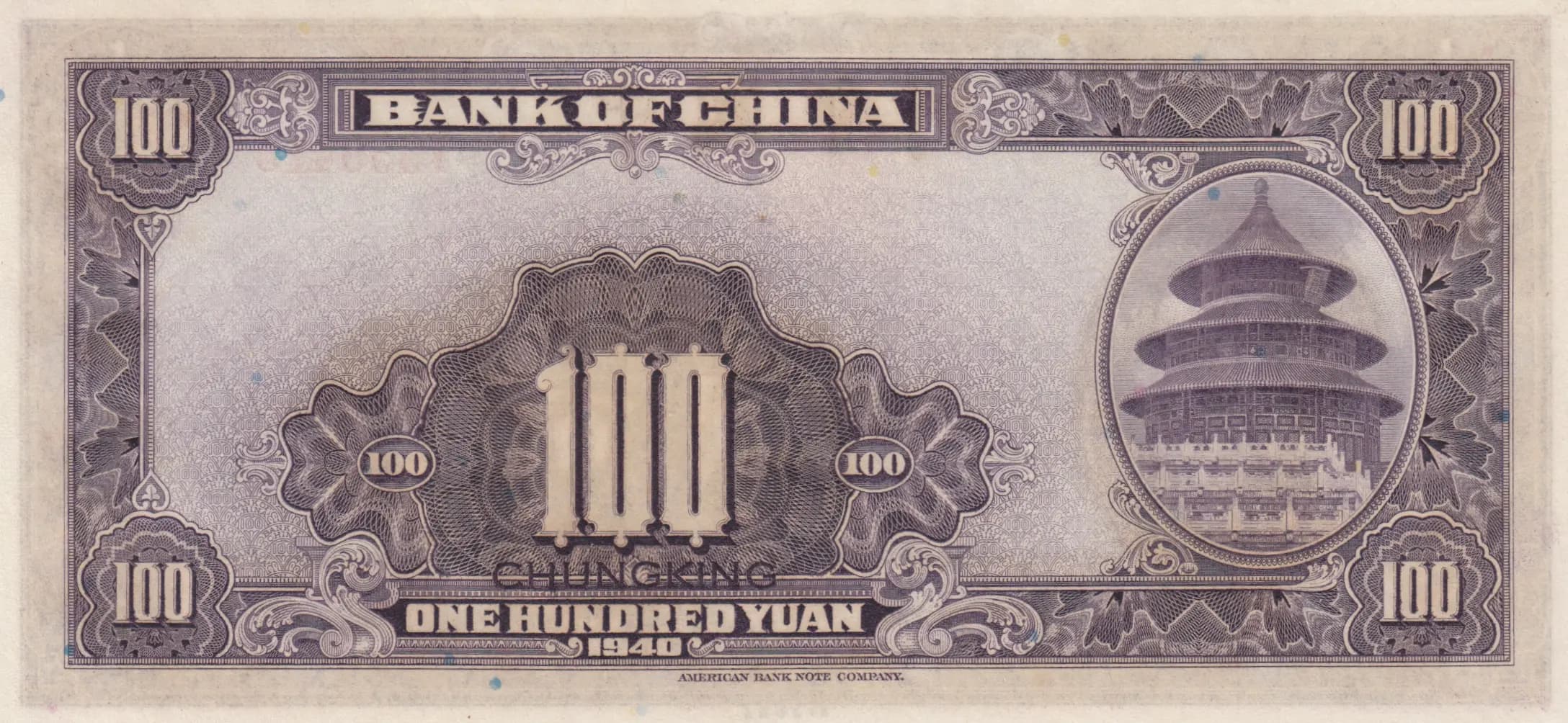
This Bank of China 100 yuan note from 1940 presents in AU condition with sharp printing, vibrant purple-mauve coloring, and minimal wear characteristic of lightly circulated or uncirculated specimens. The note features an oval-framed portrait of Sun Yat-sen on the obverse and the iconic Temple of Heaven on the reverse, rendered in the refined engraved style typical of American Bank Note Company production. This particular example displays excellent color retention and crisp detail throughout, making it an appealing mid-grade collectible of this significant wartime Chinese currency issue.
Common. The eBay sales data shows this note trading consistently in the $2-$12 range for circulated examples, with even higher-graded specimens (PMG 64, AUNC) rarely exceeding $67. The large number of documented sales over more than a decade indicates substantial market availability. The 2016 catalog value of $50 for UNC reflects a robust circulation of this issue, typical of a regular-issue banknote from a major central bank with significant print runs.
Issued during Japan's invasion of China, this 100 yuan note reflects the Bank of China's operations from the wartime capital of Chungking (visible on both obverse and reverse). The portrait of Sun Yat-sen (1866-1925), founder of the Chinese Republic, serves as a nationalist symbol of the ROC government's continuity and legitimacy during the Second Sino-Japanese War period. The Temple of Heaven landmark on the reverse represents traditional Chinese sovereignty and cultural heritage, reinforcing the government's claim to represent all of China during this tumultuous period.
The obverse displays a formal oval portrait vignette of Sun Yat-sen (孫中山), the founding father of the Republic of China, positioned at left and framed within an ornate baroque-style oval with security borders. The reverse features a prominent circular architectural vignette of the Temple of Heaven (天壇), Beijing's iconic multi-tiered pagoda structure symbolizing imperial and national authority. Both sides employ elaborate filigree borders, ornamental rosettes in all four corners, scalloped frames around the denomination, and intricate geometric patterns characteristic of high-security banknote design. The purple-mauve color scheme with beige underprinting creates sophisticated contrast throughout the design.
OBVERSE: 中國銀行 (Bank of China) / 壹百圓 (One Hundred Yuan) / Y556413 (Serial number, appearing left and right) / 民國十二國民 (Republic of China) / GENERAL MANAGER / CHUNGKING (location reference). REVERSE: BANK OF CHINA / ONE HUNDRED YUAN / 1940 (date) / 100 (denomination numeral, multiple locations) / CHUNG-KUO (China in romanization) / AMERICAN BANK NOTE COMPANY (printer attribution)
This note was produced using steel engraving and intaglio printing methods by the American Bank Note Company (ABNC), as indicated by the printer's mark on the reverse. The fine line work, detailed portraiture, ornamental filigree, and complex geometric patterns visible throughout are characteristic of intaglio security printing. The sharp impression, crisp vignettes, and precise color registration demonstrate the high-quality production standards maintained by ABNC, a leading international currency printer of the era.
This example corresponds to Pick P-88b, the standard variety of the 1940 Bank of China 100 yuan issue printed by ABNC. The serial number Y556413 visible on this specimen represents the regular numbering series for this issue. The imprint location 'CHUNGKING' on both obverse and reverse identifies this as from the wartime production period when the Bank of China operated from the Sichuan capital. Variations in signature blocks and minor printing subtleties may exist across the series, but the core design represents the standard P-88b type.