10 yuan 1941
About This Note
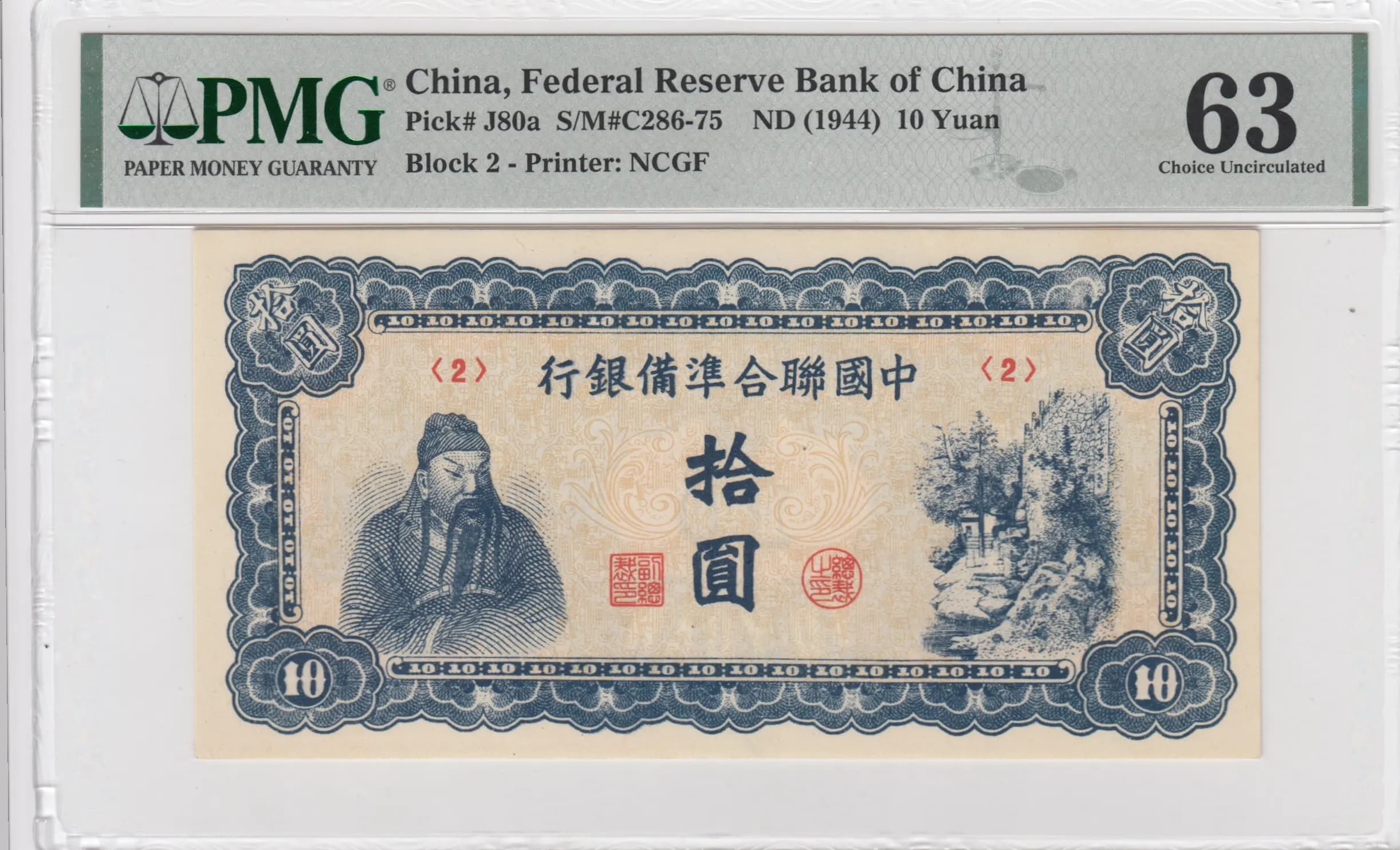
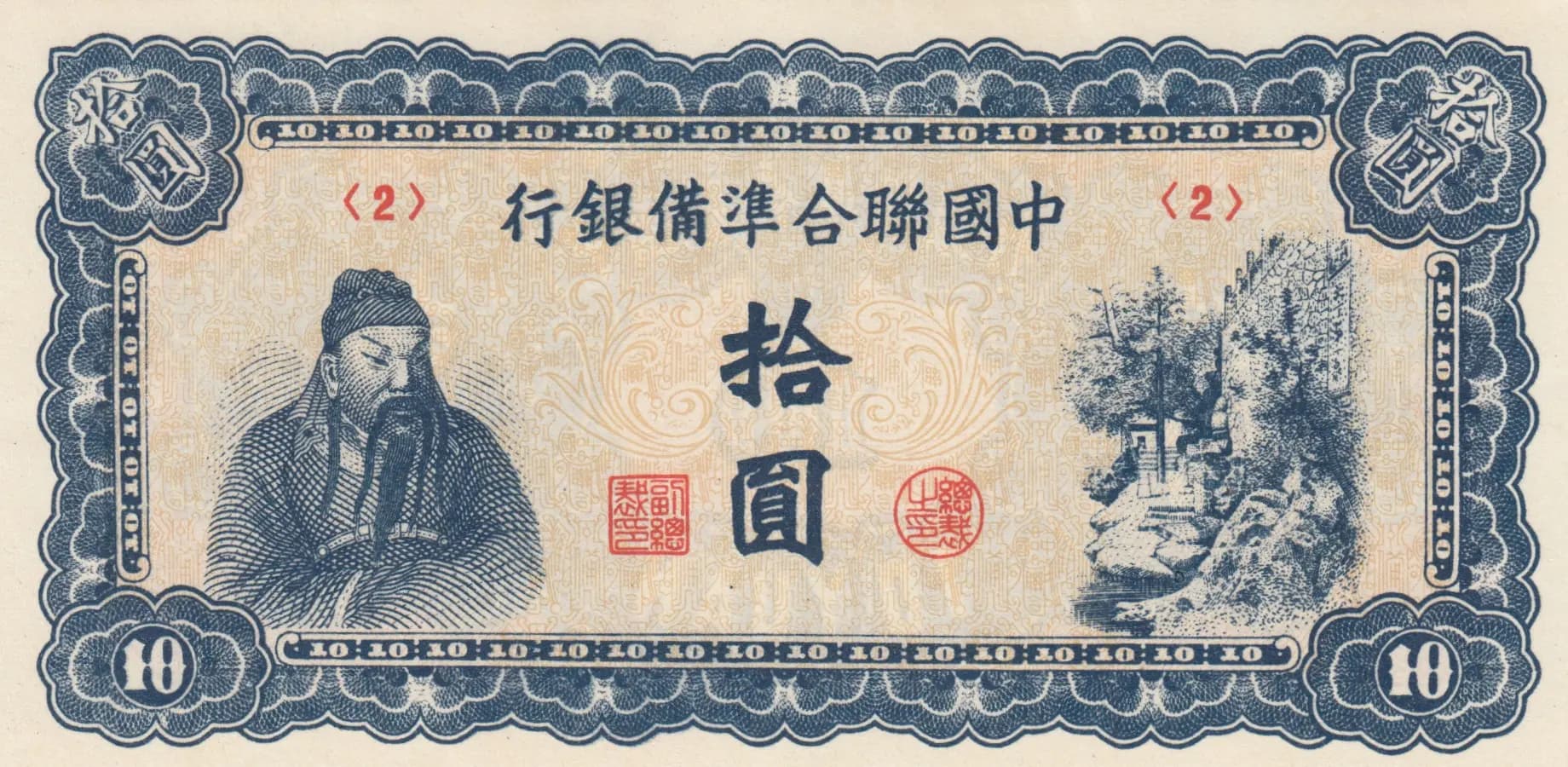
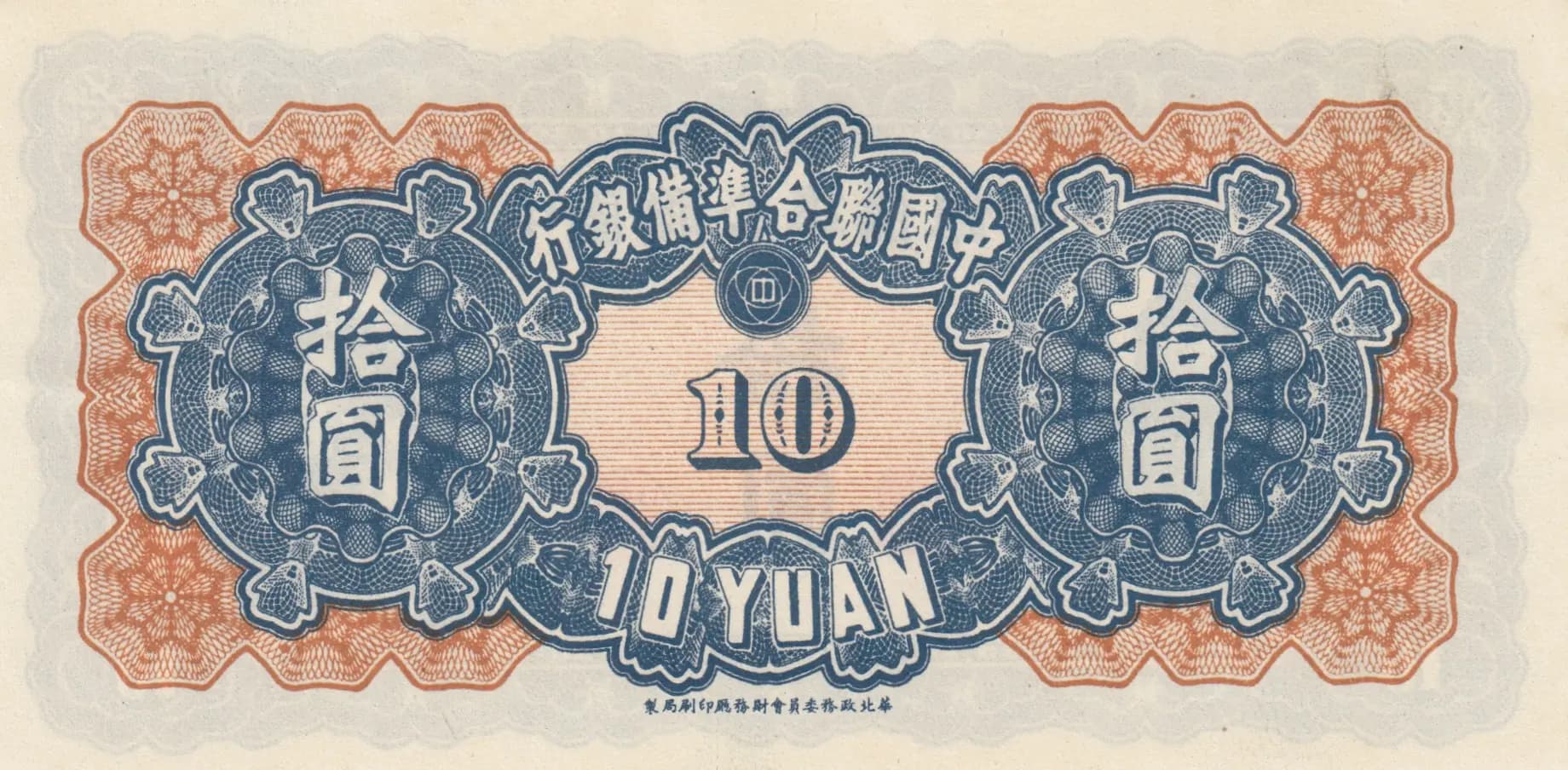
This is an exceptionally well-preserved example of the Chinese United Reserve Bank's 1941 10 Yuan note (Pick J80), displaying outstanding condition consistent with AU grading. The note features striking blue ornamental borders with scalloped edges framing a cream-colored center, a dignified portrait of a bearded gentleman in traditional Chinese dress on the obverse, and an elegant symmetrical reverse design with cloud-scroll medallions in orange and blue. The vibrant colors, sharp engraving details, and absence of wear suggest minimal circulation, making this an attractive specimen for collectors of Chinese currency from the Republican era.
Common. The Federal Reserve Bank of China issued substantial quantities of this denomination during 1941, and examples in AU condition remain available in the collector market. No evidence suggests exceptional scarcity, recalled issues, or production limitations that would elevate this to rare status. While well-preserved examples are always desirable, the standard print runs of this Pick number support a common classification.
Issued in 1941 by the Federal Reserve Bank of China during the Second Sino-Japanese War, this note represents a critical period of Chinese monetary independence and resistance. The portraiture and landscape imagery reflect traditional Chinese cultural values, while the bilingual presentation (Chinese characters and Western denomination markers) demonstrates the modernizing banking institutions of the Republic of China. The Tokyo printing notation visible on the reverse is notable, as it documents the complex pre-war supply chains for currency production, reflecting the intricate economic relationships of the era.
The obverse features a left-facing portrait of a distinguished bearded gentleman wearing traditional Chinese formal attire with a cap, positioned in the left third of the note. To the right is a mountainous landscape scene with waterfalls and trees, rendered in fine detail. The composition is framed by an ornate blue decorative border with scalloped edges and corner ornamentations. Three red seals—rectangular on the left and circular in the center and right—provide official authentication marks characteristic of Chinese Republican-era currency. The reverse presents a symmetrical design with two identical ornate blue medallions containing the denomination, separated by a central circular emblem, set against an orange/rust geometric patterned background with cloud-scroll designs and decorative floral motifs in the corners.
Front Side: 中國聯合準備銀行 (Chinese United Reserve Bank); 拾 (Ten); 圓 (Yuan); 〈2〉 (Issue/Marking Two); Security pattern with repeated denominational marking (10). Back Side: 拾圓 (Ten Yuan); 中國聯合準備銀行 (Chinese United Reserve Bank); 10 (Arabic numeral denomination); DIYUAN (Romanized phonetic spelling of currency denomination); 東京印刷所印刷製造版權所有比 (Printed and manufactured by Tokyo Printing Works, all rights reserved).
Intaglio engraving, characteristic of high-security banknote production of the 1940s. The fine line work visible throughout the note, intricate background patterns, ornate borders, and the depth of the portrait indicate steel plate engraving. The printer was Tokyo Printing Works (東京印刷所), as documented in the reverse inscription, reflecting Japan's advanced security printing capabilities that were employed for Chinese Republican currency during this period.
This example is identified as Pick J80 (Chinese United Reserve Bank, 10 Yuan, 1941) with the marking 〈2〉 visible on the obverse, indicating this is the second issue or variety of this design. The Tokyo printing attribution is consistent with documented production of this series. No obvious plate varieties, overprints, or anomalies are evident in the observed specimen. Serial numbers and signature varieties may exist within the J80 designation but cannot be definitively assessed from the provided imagery.