10 yuan 1936
Market Prices
16 salesAbout This Note
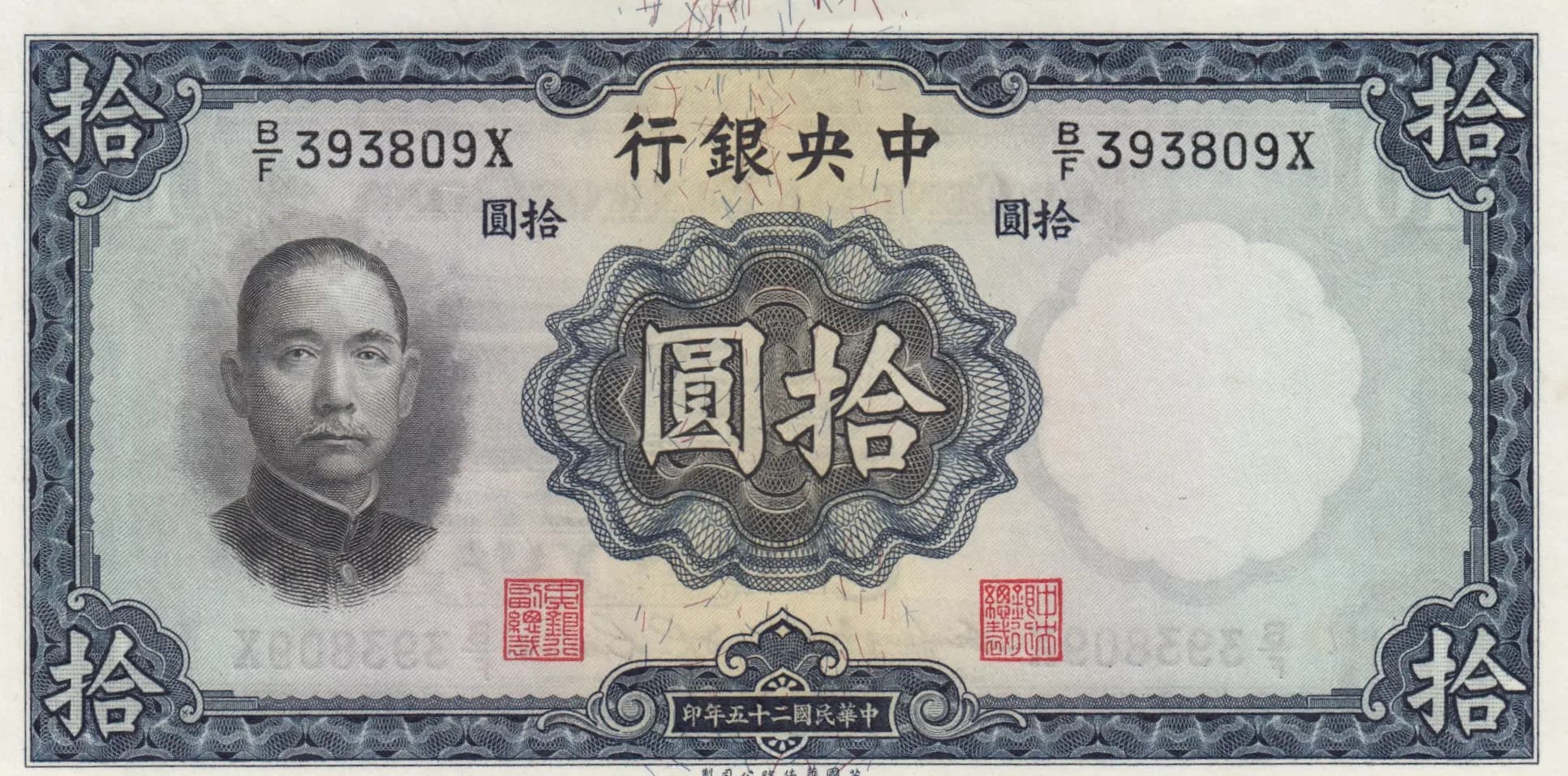
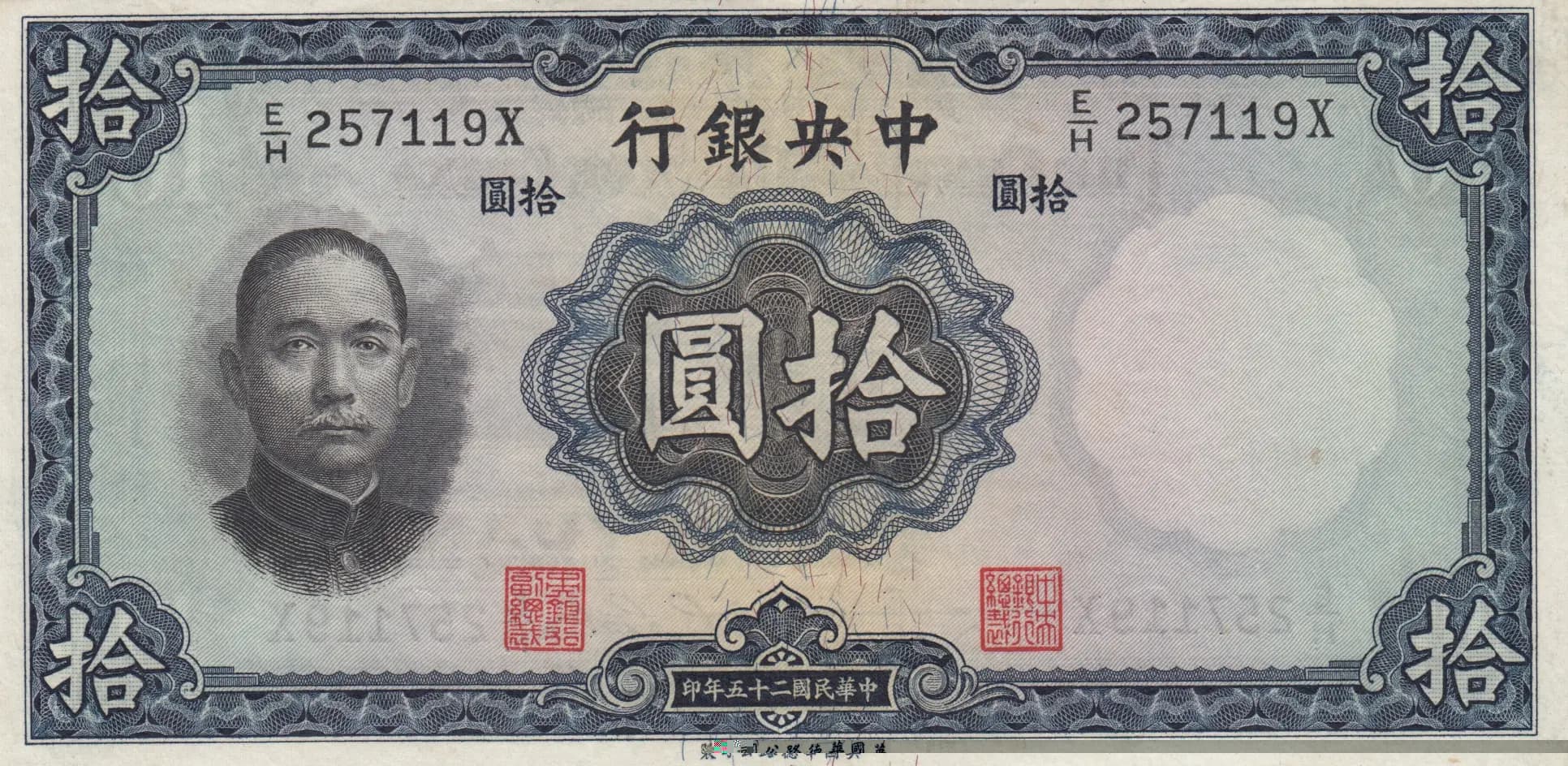
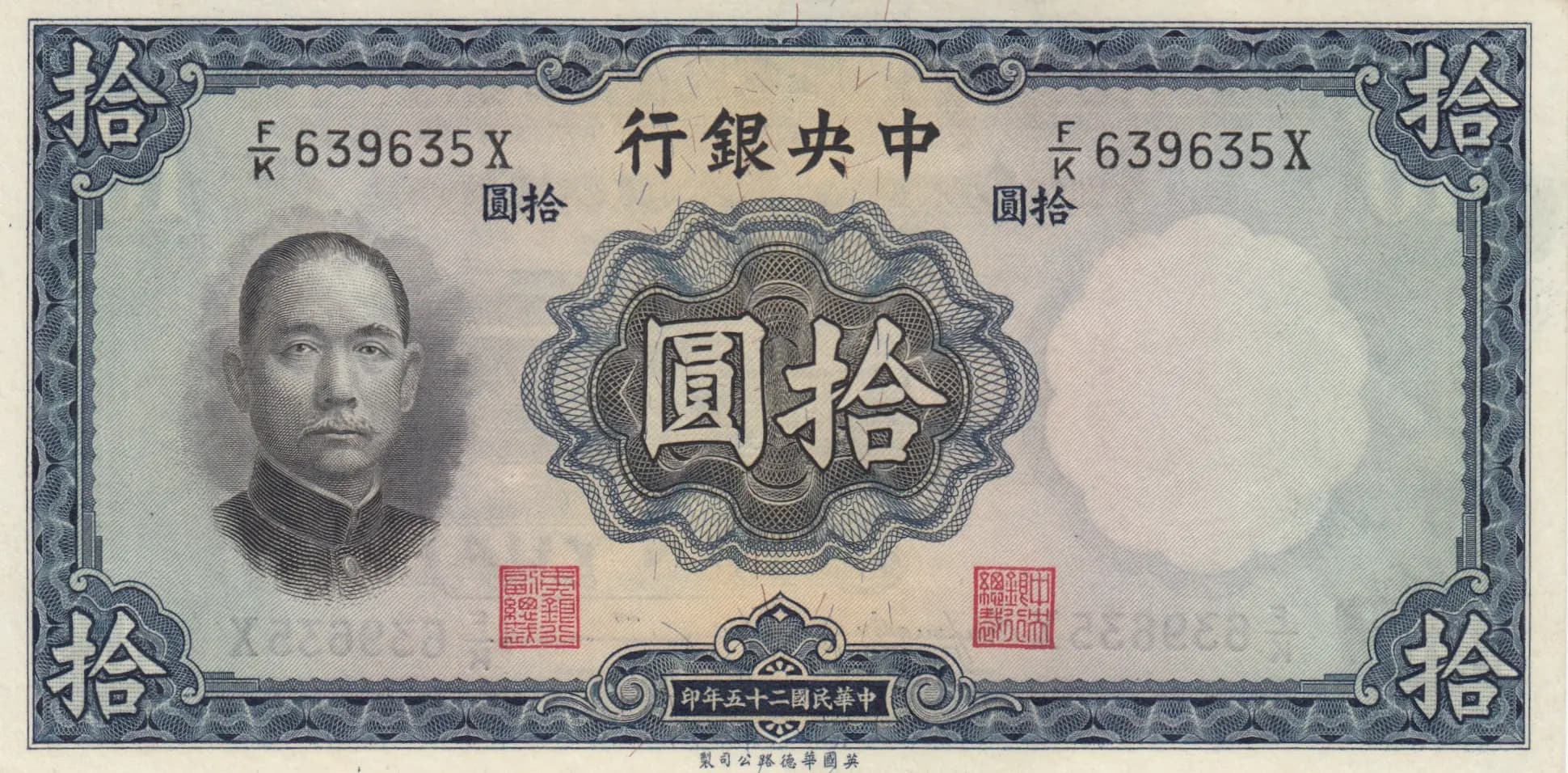
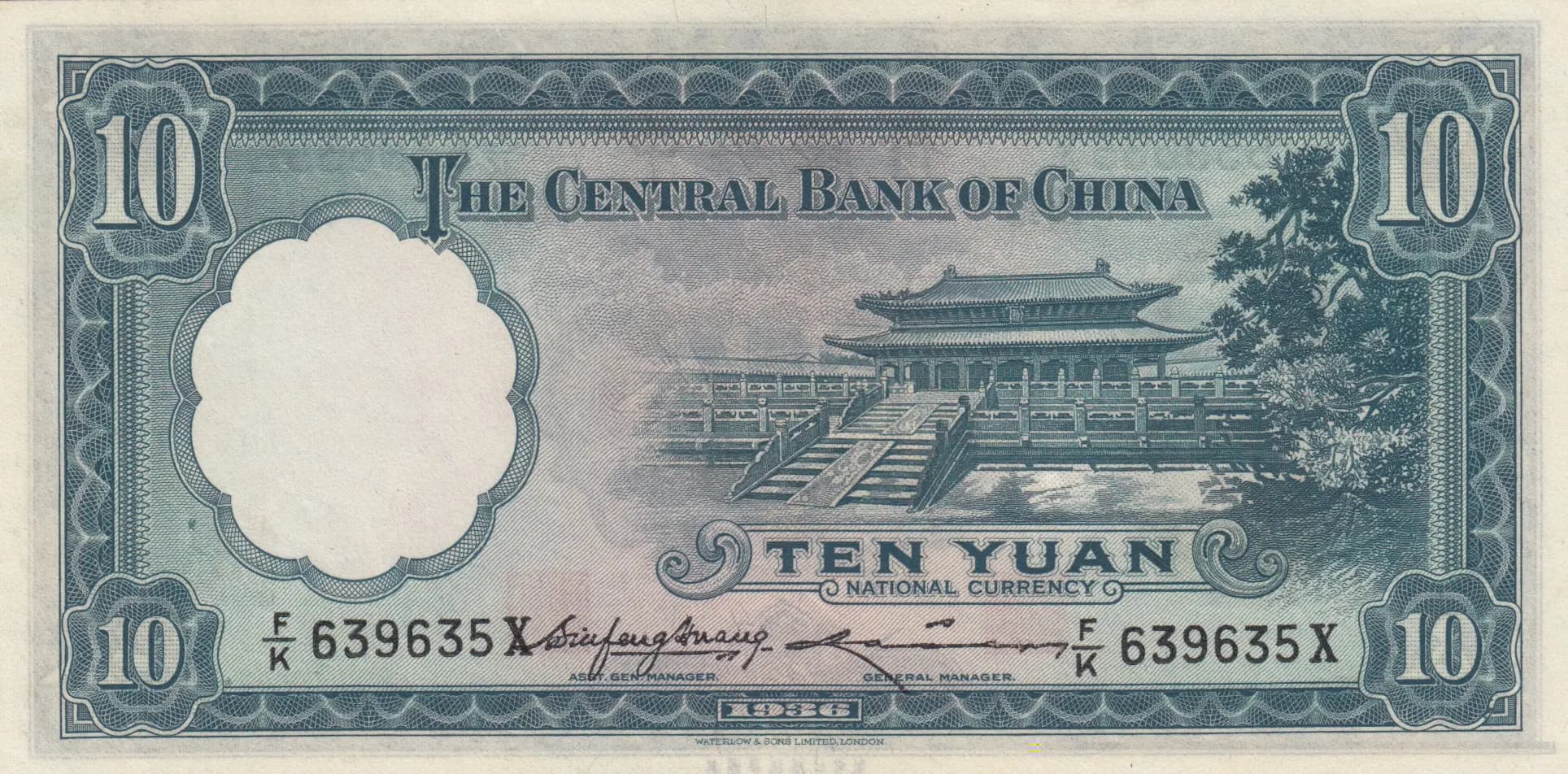
This is a Central Bank of China 10 Yuan note from 1936 (Pick-218b), printed by Waterlow & Sons Limited, London. The note displays exceptional condition with vibrant blue-gray, green, and cream coloring, fine engraving throughout, and no visible circulation wear—consistent with the UNC grade assigned. The obverse features a formal portrait on the left with ornate decorative rosettes and red seals, while the reverse showcases a detailed multi-tiered traditional Chinese architectural structure (the Palace of China in Peking) with English denomination and issuer text, making this an important example of early Chinese currency issued during the Republic of China period.
Common. The eBay price history clearly indicates this note trades at modest valuations: UNC examples sold for $36-$42 in 2015, while PMG 64 graded notes brought $23-$29 in recent years (2017-2026). Current catalog values (2016) list UNC at only $8. Despite its age (1936) and historical significance, print runs for Central Bank of China notes from this period were substantial, and survival rates are good. The abundance of sales data and relatively consistent pricing indicate ready market availability. This is a common note in the broader context of early 20th-century Chinese currency.
This note was issued by the Central Bank of China during the Republic of China era (Year 12 of the ROC calendar, equivalent to 1923 in Western dating, though the note is dated 1936), a period of significant political and economic transition in China. The inclusion of both Chinese and English inscriptions reflects the international commercial importance of the era and China's engagement with Western financial institutions. The architectural vignette of the Palace of China in Peking on the reverse served as a symbol of Chinese national heritage and sovereignty during a tumultuous period of Japanese invasion and internal conflict.
The obverse features a formal portrait of a man in profile facing left, rendered in fine engraving detail and positioned on the left side of the note. The portrait is surrounded by an ornate design framework including a central scalloped rosette cartouche containing Chinese characters and flanked by red square seals—a traditional security and authenticity element in Chinese banknotes. Elaborate scrollwork and traditional Chinese border patterns frame the design in the corners and edges, with a cream/beige background providing contrast to the blue-gray and black printing. The reverse depicts the Palace of China in Peking—a multi-tiered traditional Chinese architectural structure with characteristic curved roofs and ornamental details, positioned centrally with trees and landscaping elements. A large blank scalloped cartouche on the left side provides balance to the composition. English text identifying the issuer and denomination is prominently displayed in serif typeface. Both sides employ repetitive decorative border patterns as additional security measures.
FRONT: 中央銀行 (Central Bank), 圓拾 / 拾圓 (Ten Yuan, rendered two ways), 中華民國十二年 (Republic of China, Year 12), Serial numbers: E639635X and K639635X. BACK: THE CENTRAL BANK OF CHINA, TEN YUAN, NATIONAL CURRENCY, Denomination: 10, Serial numbers: E639635 X and K639635 X, ASST. GEN. MANAGER, GENERAL MANAGER, WATERLOW & SONS LIMITED, LONDON (printer attribution), 1936 (issue year).
Intaglio engraving (line engraving), the standard security printing method for banknotes of this era. Executed by Waterlow & Sons Limited of London, one of the world's premier security printers. The fine line work visible throughout, the complex rosette patterns, detailed architectural vignette, and sharp serif typography are all characteristic of high-quality intaglio production. Multiple color printing was used to achieve the blue-gray, green, black, cream, and red tones visible on both obverse and reverse.
This note is cataloged as Pick-218b, indicating it is one of six known varieties (P-218a through P-218f) for the 10 Yuan 1936 Central Bank of China issue. All variants share the same printer (W&S / Waterlow & Sons). The 'b' designation likely reflects differences in serial number prefixes, signature combinations, or minor design elements characteristic of production batches. The observed serial numbers (E639635X / K639635X and matching pairs on reverse) are consistent with this printing period. Without comparison to other varieties, the specific distinguishing characteristics of P-218b cannot be definitively stated, but the note's characteristics align with standard production of this well-documented variety.