10 000 yuan 1947
Market Prices
7 salesAbout This Note
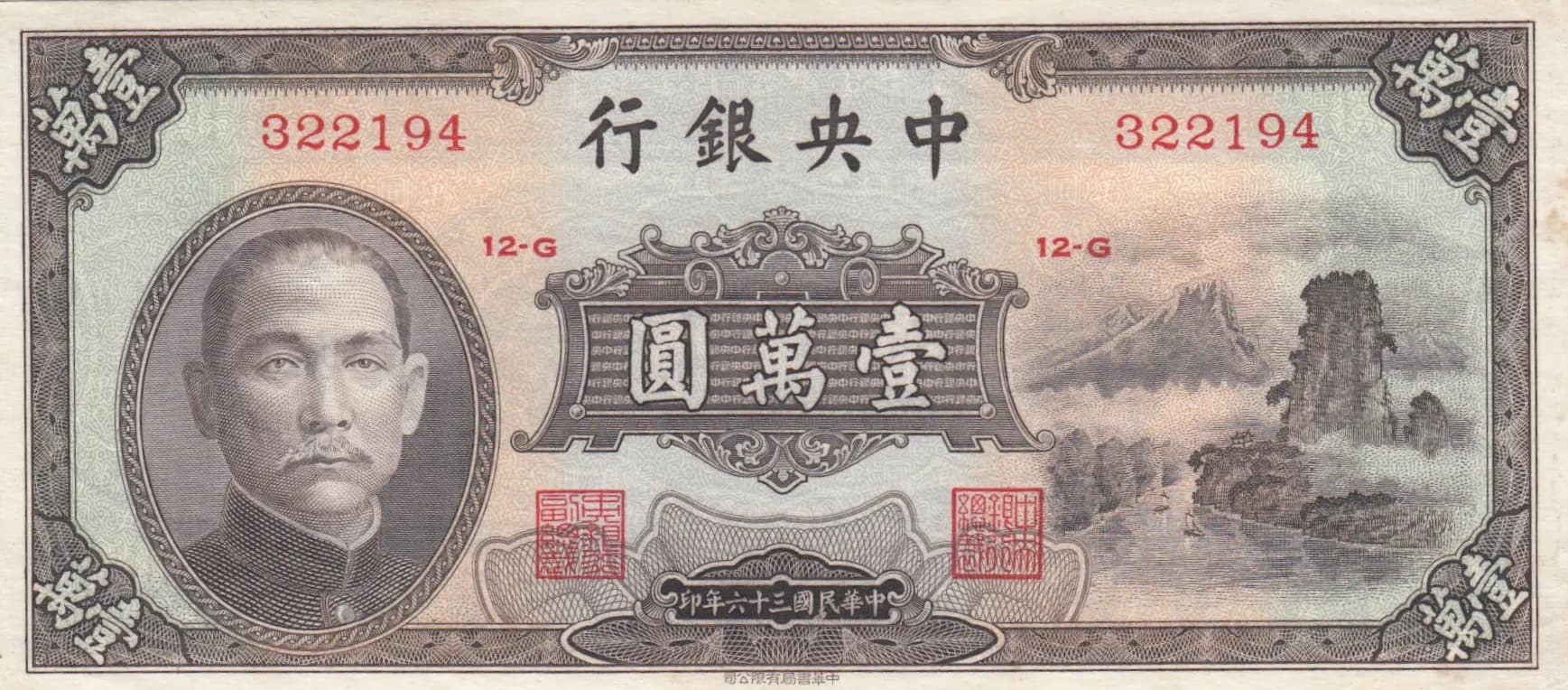
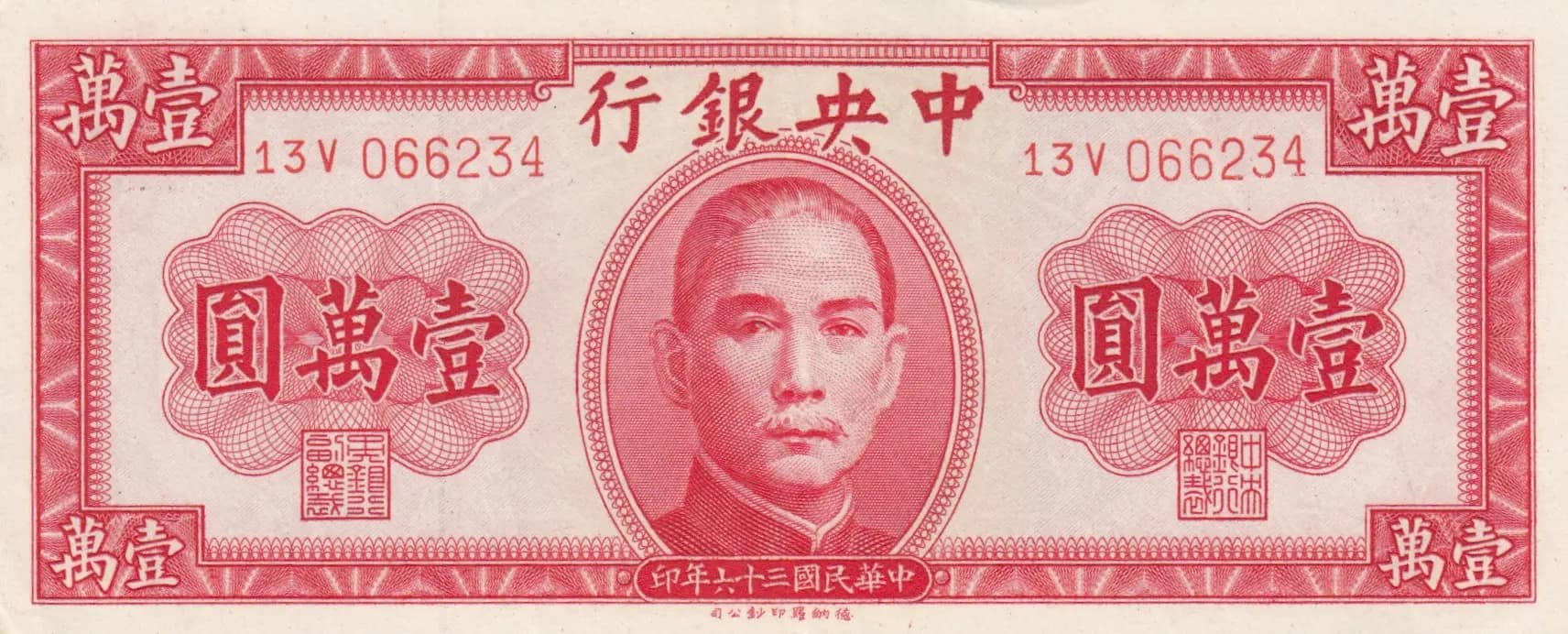
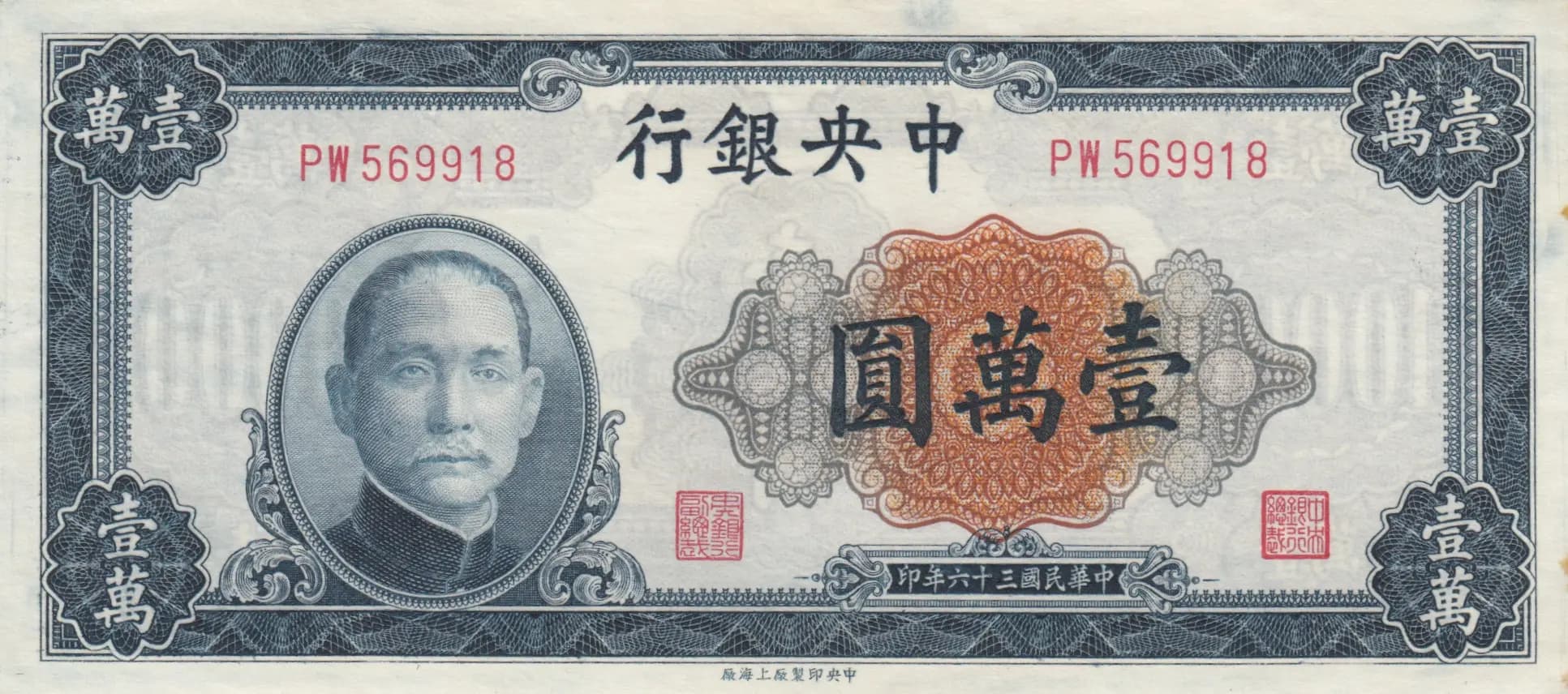
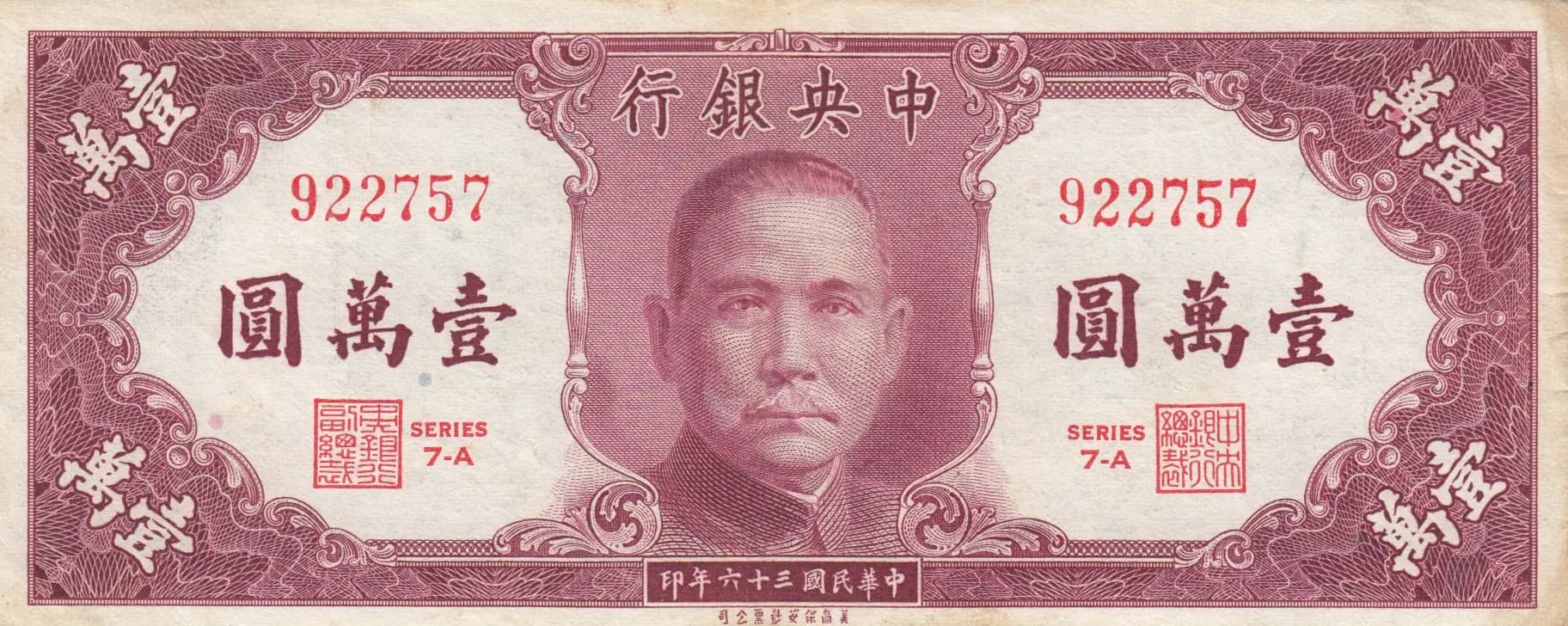
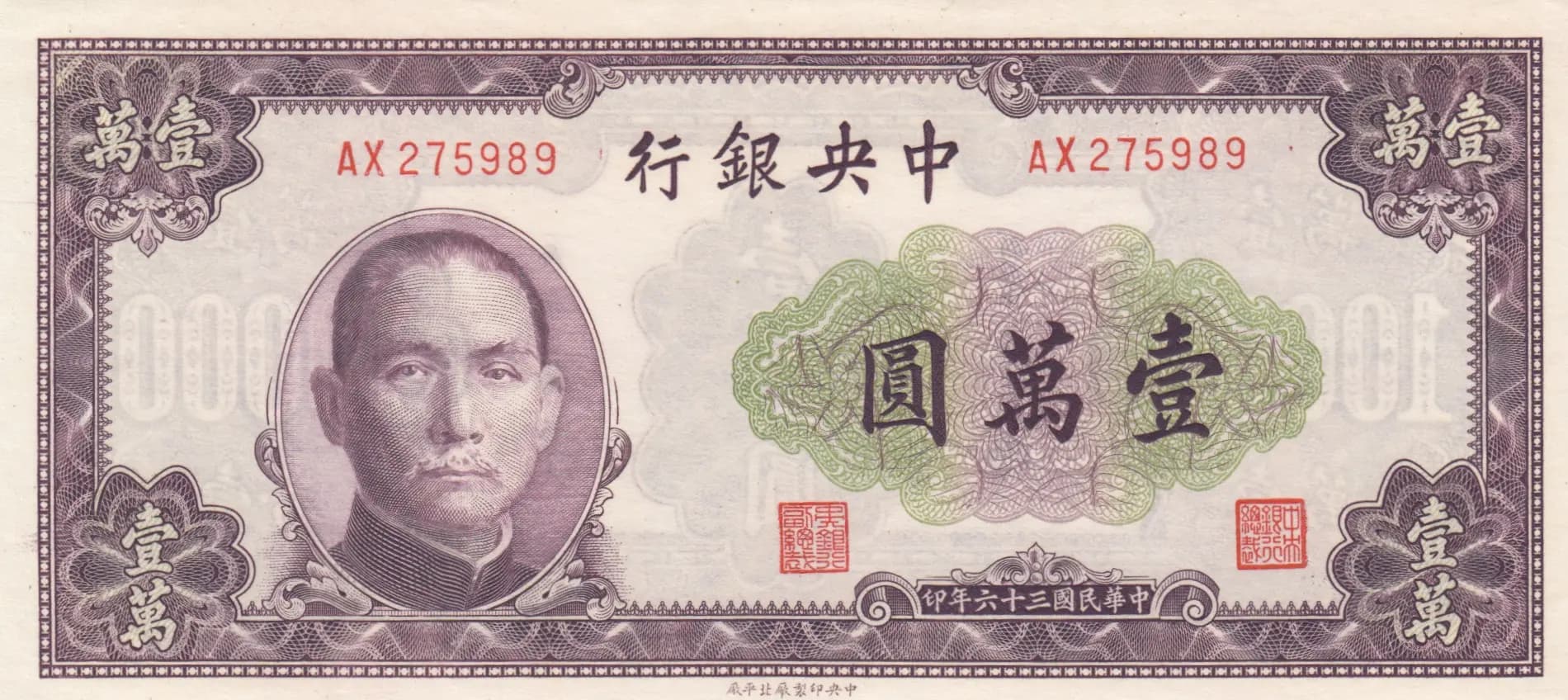
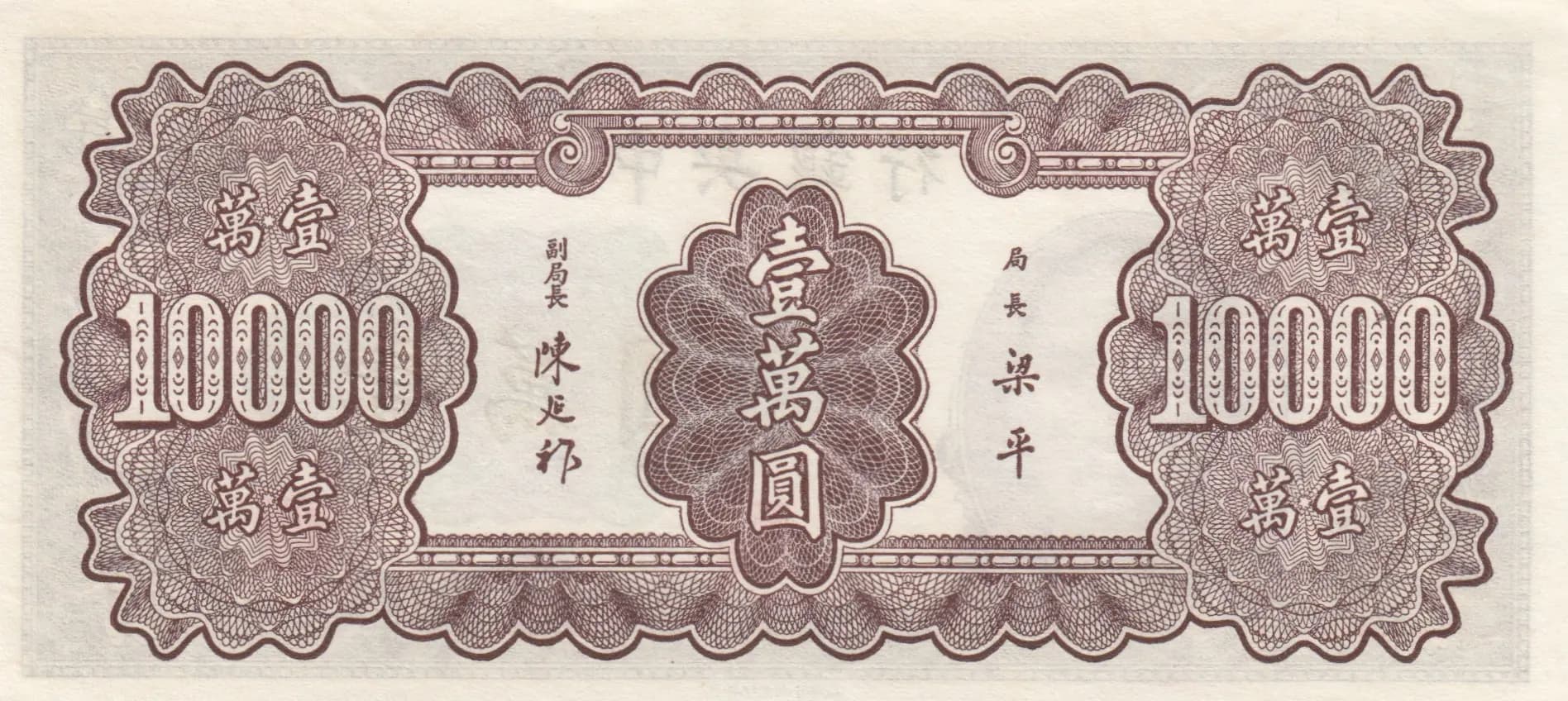
This 10,000 yuan note from the Central Bank of China (1947) presents an exceptional example of mid-20th century Chinese currency design, rendered primarily in purple/mauve tones with complementary green and red accents. The obverse features a portrait of Sun Yat-sen in an oval frame at the lower left, surrounded by ornate decorative borders with traditional Chinese design elements, while the reverse displays an elaborate symmetrical design with large rosette patterns and prominent denomination numerals. The note appears to be in uncirculated condition with no visible creases, tears, or wear, clean margins, and a paper tone consistent with proper age and storage, making it a desirable example for collectors of Republican-era Chinese currency.
Common. The eBay pricing data provides clear evidence of this note's common status in the market: comparable examples in VF condition sold for $25, while PMG 64-graded specimens reached only $89-405, with most sales ranging well below $100. The 2016 catalog value of $90 for UNC examples further confirms this is a readily available note to collectors. Large print runs were typical for this denomination during the 1947 issue period, and surviving examples remain reasonably available despite the intervening 75+ years.
Issued during the final years of the Republic of China before the Communist takeover, this 1947 note represents a critical period of monetary instability and hyperinflation that plagued the Chinese Nationalist government. The portrait of Sun Yat-sen (founder of the Republic) on the obverse reinforced state legitimacy during an increasingly desperate political and military situation. The denomination of 10,000 yuan itself reflects the severe currency debasement that characterized the late Republican period, as denominations reached ever-higher values to represent actual purchasing power.
The obverse features a formal portrait of Sun Yat-sen (1866-1925), founder of the Republic of China, rendered in an oval frame positioned at the lower left in purple/mauve tones characteristic of the Central Bank of China's later Republican issues. The composition is framed by ornate decorative borders incorporating traditional Chinese design motifs including floral and foliate patterns in the corners, ornamental scroll designs at top and bottom, and elaborate geometric border patterns executed in fine engraved line work. The center of the note displays red rectangular seals/stamps and Chinese characters indicating denomination and issuing authority. The reverse presents a fully symmetrical design dominated by large decorative rosette and flower patterns positioned on both left and right sides, with a central ornamental cartouche containing Chinese inscriptions and additional scrollwork and flourishes throughout. The overall aesthetic reflects high-quality engraved banknote production with careful attention to security details and traditional Chinese artistic conventions.
Front side: '行銀央中' (Central Bank of China, read right to left); '圓萬壹' (Ten thousand yuan, read right to left); '中華民國六十二年' (Republic of China Year 62, corresponding to 1947); Serial number 'AX275989'. Back side: '10000' (Arabic numerals for ten thousand); '圓' (Yuan); '壹萬圓' (Ten thousand yuan); '副總裁' (Vice President); '局長' (Director); Signature line indicators and official designations for bank officials.
Intaglio (engraved line) printing, the standard security printing method for Chinese currency of this period. The visual analysis reveals fine line work throughout the design, elaborate geometric patterns, ornate border work, and careful color separation in the denomination areas—all characteristic of intaglio production. The note was printed by the Central Bank of China using Chinese engravers and printers, as indicated by the Chinese character printer marks visible on the reverse. The multiple colors (purple/mauve, green, red, beige/cream) were likely applied through separate printing passes, a sophisticated technique employed for higher-denomination notes.
This specific example carries serial number AX275989, with the 'AX' prefix being part of the standard serial numbering system used during this 1947 issue. The date inscription '中華民國六十二年' (ROC Year 62) confirms this is from the 1947 issue, which is consistent with the Pick catalog designation P-322. Signature varieties exist for this note type based on the officials serving as Vice President and Director of the Central Bank at the time of printing, though specific signature identification would require expert examination of the signature blocks on the reverse.