1 sen 1939
About This Note
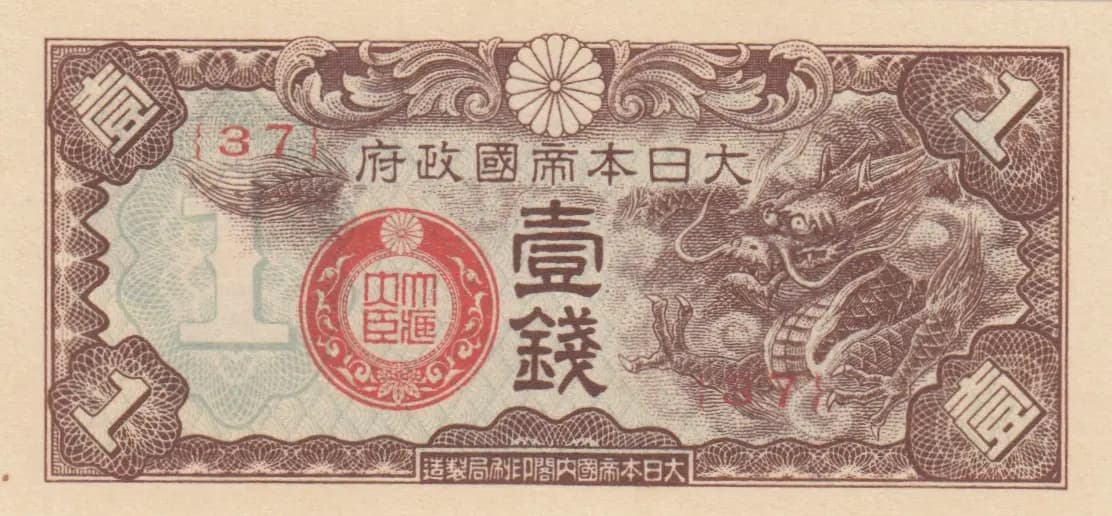
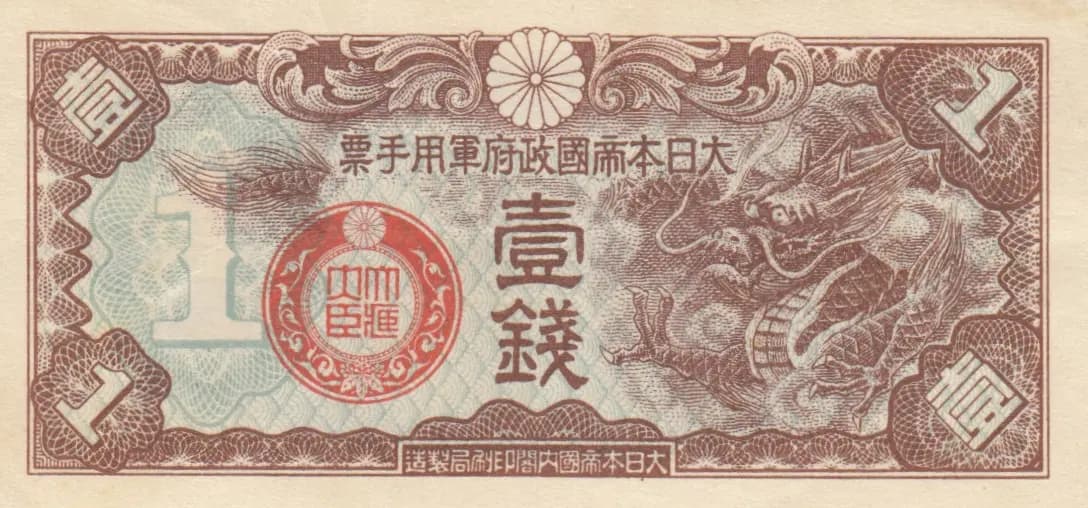
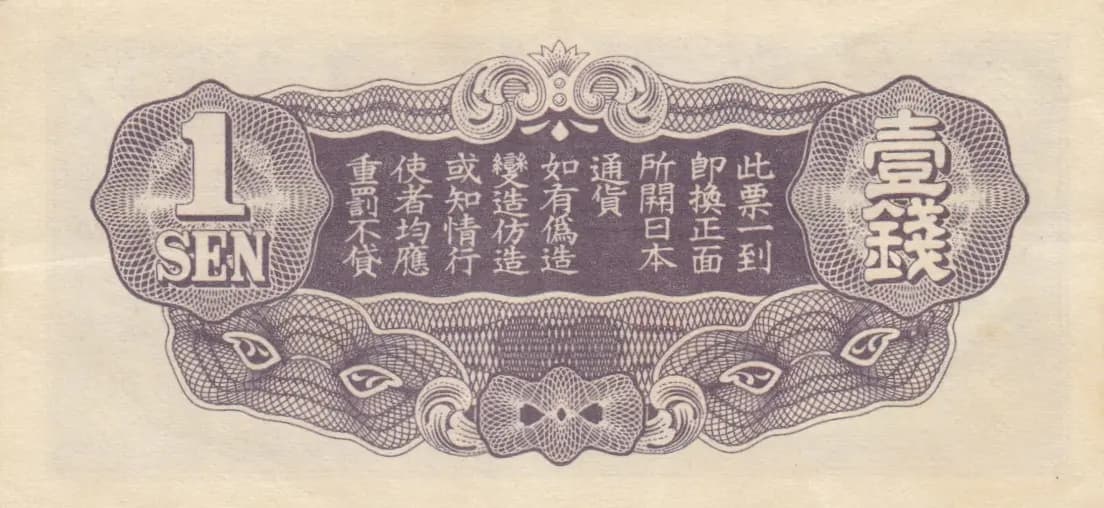
A 1 Sen Japanese Military banknote issued for use in occupied China during 1939, presented in uncirculated condition with the characteristic light aging patina expected for an 85-year-old note. The front features an ornate brown and cream design with a profile portrait in blue-green tones, a prominent red central seal, and elaborate engraved scrollwork typical of Imperial Japanese military currency. The reverse displays a symmetrical purple-maroon design with bilingual Chinese and Japanese text, including stern warnings against counterfeiting—a noteworthy feature reflecting the currency's contested use in occupied territories.
Common. Japanese military scrip from the 1939 China occupation, particularly low denominations like 1 Sen, was produced in substantial quantities to facilitate economic control across occupied regions. These notes were widely circulated and survive in reasonable numbers today. The uncirculated condition grade is more significant than the denomination itself for collector value. No evidence suggests this specific Pick number represents a short print run, recall, or special variety commanding premium pricing.
This military scrip was issued by the Imperial Japanese Army (大日本帝國陸軍) during its occupation of China in 1939, representing Japan's attempt to establish economic control in conquered territories. The dual-language inscriptions and central Bank of China reference reflect the complex monetary situation where Japanese military authorities attempted to co-opt Chinese financial institutions and legitimacy. The emphatic anti-counterfeiting warnings on the reverse underscore the instability and skepticism surrounding this imposed currency in occupied regions.
The obverse features an ornate rectangular frame with intricate brown and maroon engraved scrollwork surrounding a central composition. A profile portrait (likely representing a dignitary or symbolic figure of the occupying authority) occupies the left side rendered in light blue-green intaglio. The dominant design element is a large red circular seal or official stamp positioned centrally, flanked by a decorative fan-shaped floral motif at top center. Mythical creatures, possibly dragons, appear on the right side—elements drawn from traditional East Asian iconography repurposed for Imperial Japanese military legitimacy. The reverse presents a more restrained symmetrical design dominated by a scalloped rectangular frame in dark purple-maroon on cream stock, with a central ornamental crest featuring spiral patterns and a butterfly or similar motif. Denomination numerals (1 and SEN in English on left; 壹錢 in Chinese characters on right) frame the bilateral text warnings. Fine line engraving throughout creates depth and anti-counterfeiting complexity.
FRONT: 大日本帝國陸軍用軍票 (Great Japan Imperial Army Military Banknote) | 壹錢 (One Sen) | 中央銀行 (Central Bank) | 大日本帝國陸軍用軍票發行所 (Great Japan Imperial Army Military Banknote Issue Office). BACK: 1 | SEN | 壹錢 (One Sen) | 縣票正開即此換似何知或使者均應 (This county banknote is ready to exchange immediately for anyone who knows or uses it as such) | 造作偽造如知賞白日有所通知 (If forgery or counterfeiting is known, reward or notice will be given) | 情杵枚知或使着均應重罰不赦 (Anyone who counterfeits or uses it shall be severely punished without pardon).
Intaglio (engraved steel plate) printing, evidenced by the fine line work, intricate border patterns, and detailed scrollwork visible throughout both sides. The color separation between design elements and the crisp impression of text and portraits are characteristic of high-quality intaglio production. Japanese military scrip of this period was typically produced by the Bureau of Engraving and Printing or contracted security printers with advanced capabilities; the technical quality evident here suggests professional security printing standards.
No specific signature, date variant, or serial number prefix variations are discernible from the visual analysis provided. The note displays standard formatting for P-M8 (Japanese Military, China, 1 Sen, 1939) with bilingual Chinese-Japanese inscriptions as standard for this issue. Further research into serial number ranges or printing sequences would be required to identify any documented varieties within this Pick number.