100 pesos= 10 condores 1947
Market Prices
11 salesAbout This Note
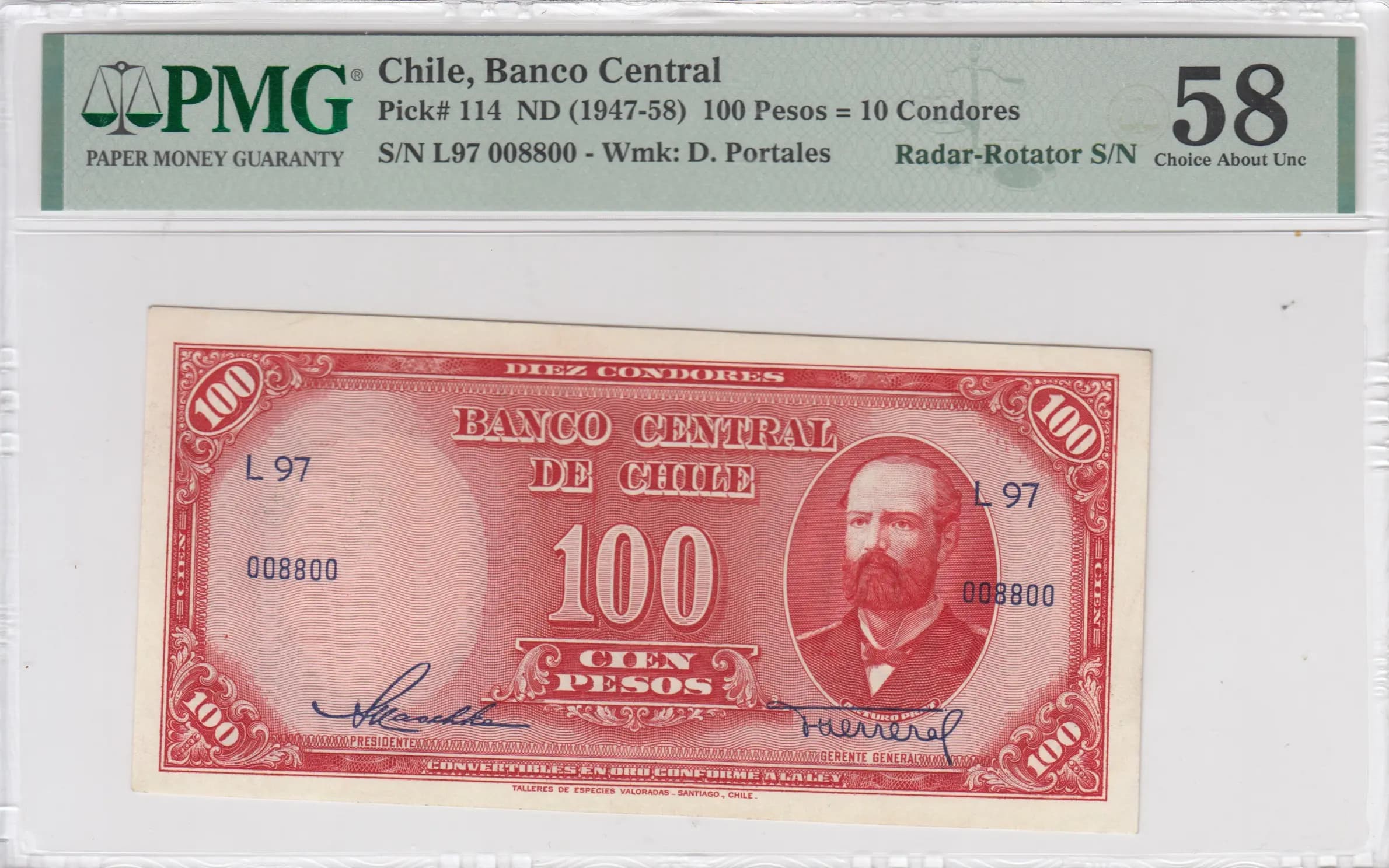
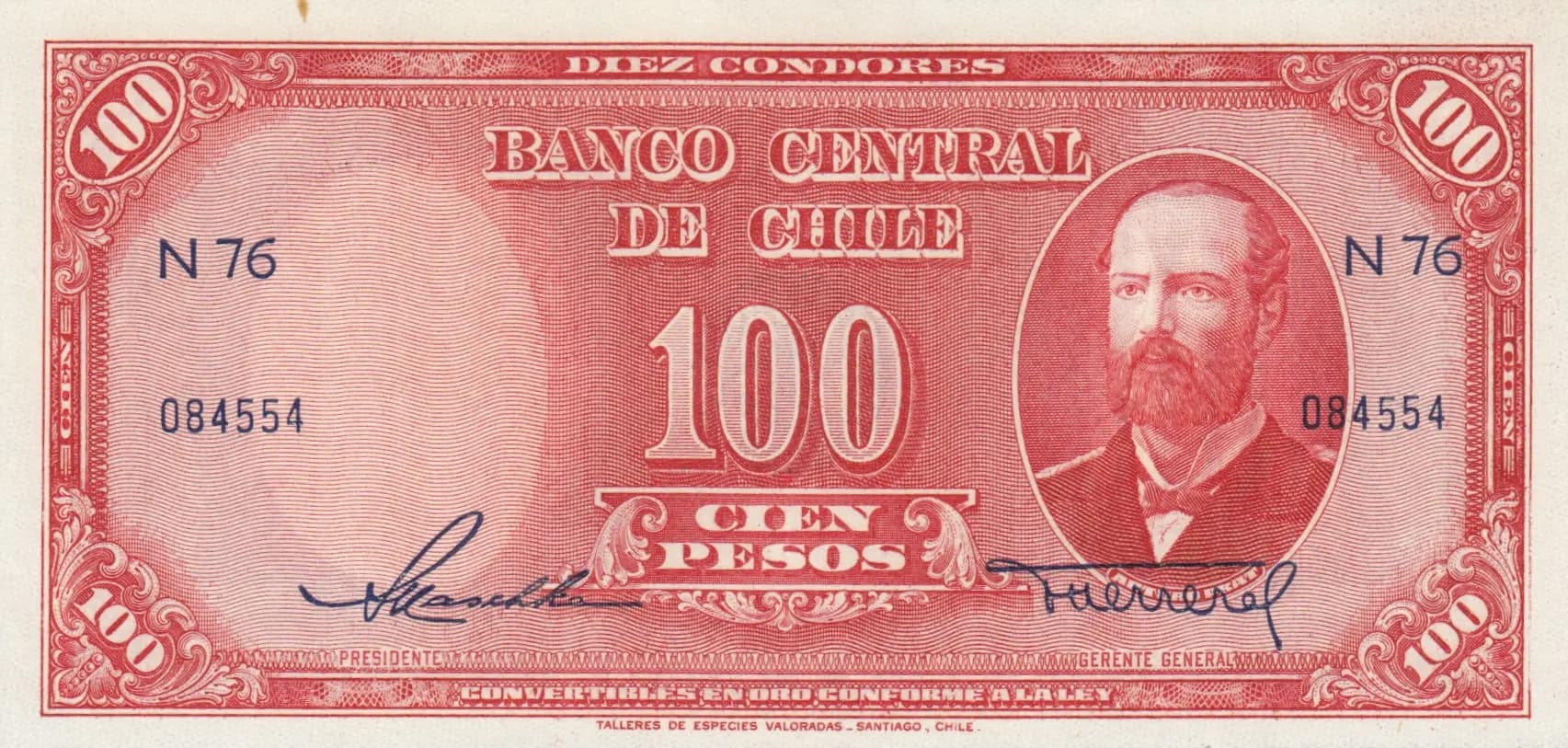
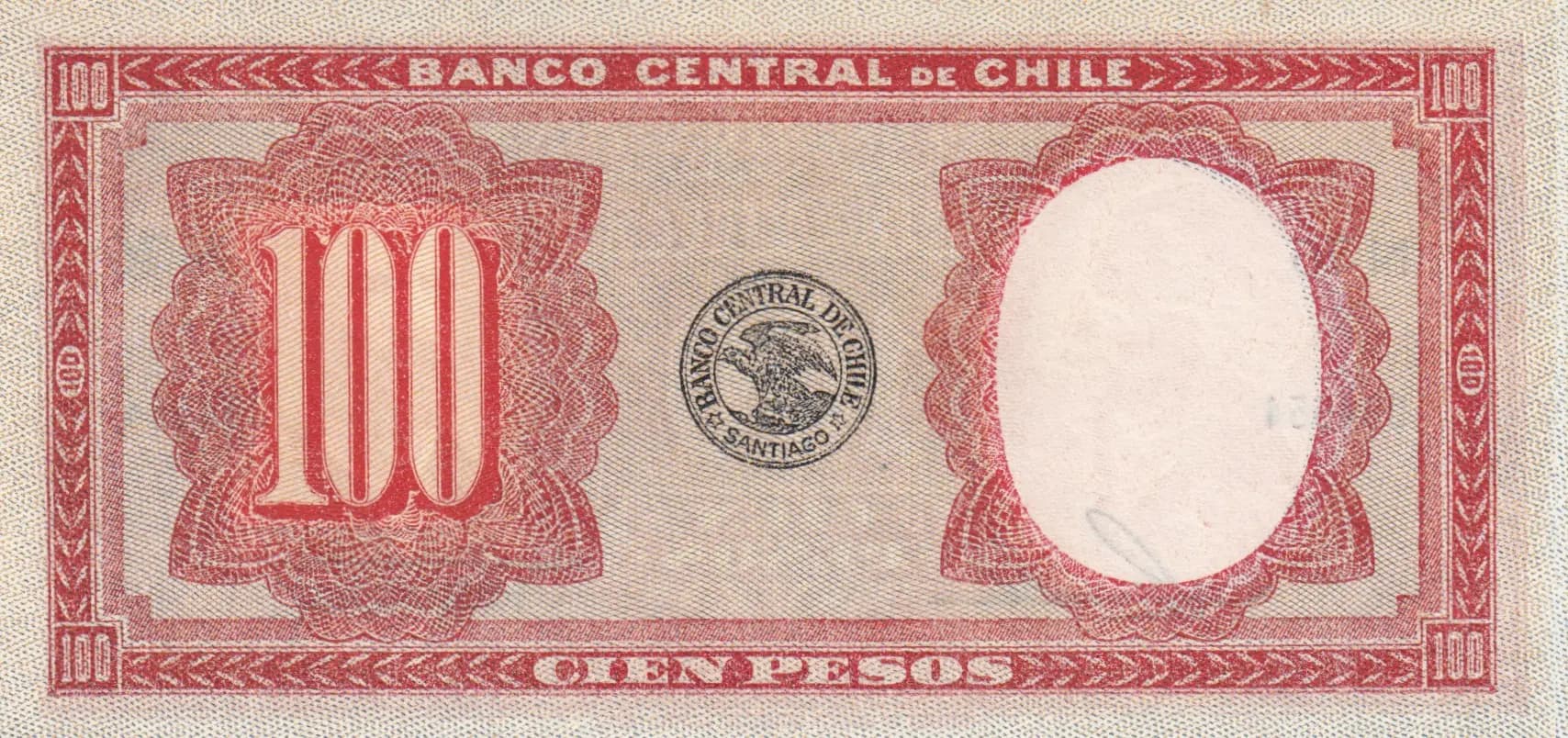
This is a Chilean 100 Pesos (10 Condores) note from 1947, issued by Banco Central de Chile and graded AU (About Uncirculated). The note features a striking red color scheme with ornate baroque-style decorative borders and fine line engraving throughout. The obverse displays a portrait of Arturo Prat on the right side within an oval frame, while the reverse showcases a large circular seal of the Banco Central de Chile. The note exhibits sharp, clear printing with no visible wear, creases, or tears, indicating exceptional preservation for its age.
Common. eBay transaction data shows this note regularly selling in the $1-15 range across various grades from 2009-2021, with the note appearing frequently enough in the market to establish consistent pricing patterns. While AU examples command higher prices (the $15.05 AUNC sale from 2017), the regular appearance of this Pick number across multiple condition grades over a 12-year period indicates a substantial original print run. The note is part of a long-lived series (1947-1958) issued by a major central bank, further supporting its common status.
This note was issued during a period when Chile maintained a gold standard, as evidenced by the inscription 'Convertible únicamente en oro al extranjero' (Convertible only in gold abroad) visible on the obverse. The portrait of Arturo Prat, a Chilean naval hero from the War of the Pacific, reflects Chile's historical commemoration of national figures. The 1947 issuance predates the 1958 series, making this an early Cold War-era Chilean currency reflecting the country's economic policies under the Central Bank's authority.
The obverse features a formal portrait of Arturo Prat, the renowned Chilean naval officer and national hero, positioned on the right side within an ornate oval frame. He is depicted as a bearded man in formal military attire, facing right in three-quarter profile. The note employs an elaborate baroque aesthetic with scrollwork, flourishes, and intricate decorative corner elements in red ink on a cream/white background. The denomination is prominently displayed in the center and left side of the note. The reverse presents a large circular seal of the Banco Central de Chile located in the center, with 'SANTIAGO' inscribed beneath it. An empty oval space on the right side of the reverse mirrors the portrait placement on the obverse. Fine line engraving creates complex geometric patterns and security printing throughout both sides, with the entire design rendered in red and pink tones.
FRONT SIDE: 'DIEZ CONDORES' (Ten Condores) | '100' and 'CIEN PESOS' (One Hundred Pesos) | 'BANCO CENTRAL DE CHILE' (Central Bank of Chile) | 'CONVERTIBLE ÚNICAMENTE EN ORO AL EXTRANJERO' (Convertible only in gold abroad) | 'PRESIDENTE' (President) and 'GERENTE GENERAL' (General Manager) | 'TALLERES DE ESPECIES VALORADAS - SANTIAGO, CHILE' (Valuable Species Workshops - Santiago, Chile) | Serial number designation 'N 76' with number '084554' | BACK SIDE: '100' and 'CIEN PESOS' (One Hundred Pesos) | 'BANCO CENTRAL DE CHILE' (Central Bank of Chile) | 'SANTIAGO' (Santiago - city of issue)
This note was produced using intaglio (engraved) printing, evidenced by the fine line work, intricate scrollwork, and multi-layered security printing visible throughout both sides. The printer was Talleres de Especies Valoradas (Valuable Species Workshops) located in Santiago, Chile, as clearly indicated on the obverse. The complexity of the baroque design elements and the precision of the line engraving are characteristic of high-security banknote production from this mid-20th century period.
The visual analysis reveals this note as part of the 1947 series with signature variety present (positions for 'PRESIDENTE' and 'GERENTE GENERAL' are visible). The catalog references note variations including small or large signature varieties, with or without security thread, and two serial number varieties. This specific example displays the serial number format 'N 76 084554'. The note appears to be from the Talleres de Especies Valoradas printing, distinguishing it from later Casa de Moneda printings of similar denominations (see P-122). The 1947 date and design with the Central Bank seal on the reverse align with the P-114 specification and distinguish it from the earlier P-95, P-96, P-105, and P-113 variants with different back designs.