5 leva 1951
Market Prices
29 salesAbout This Note
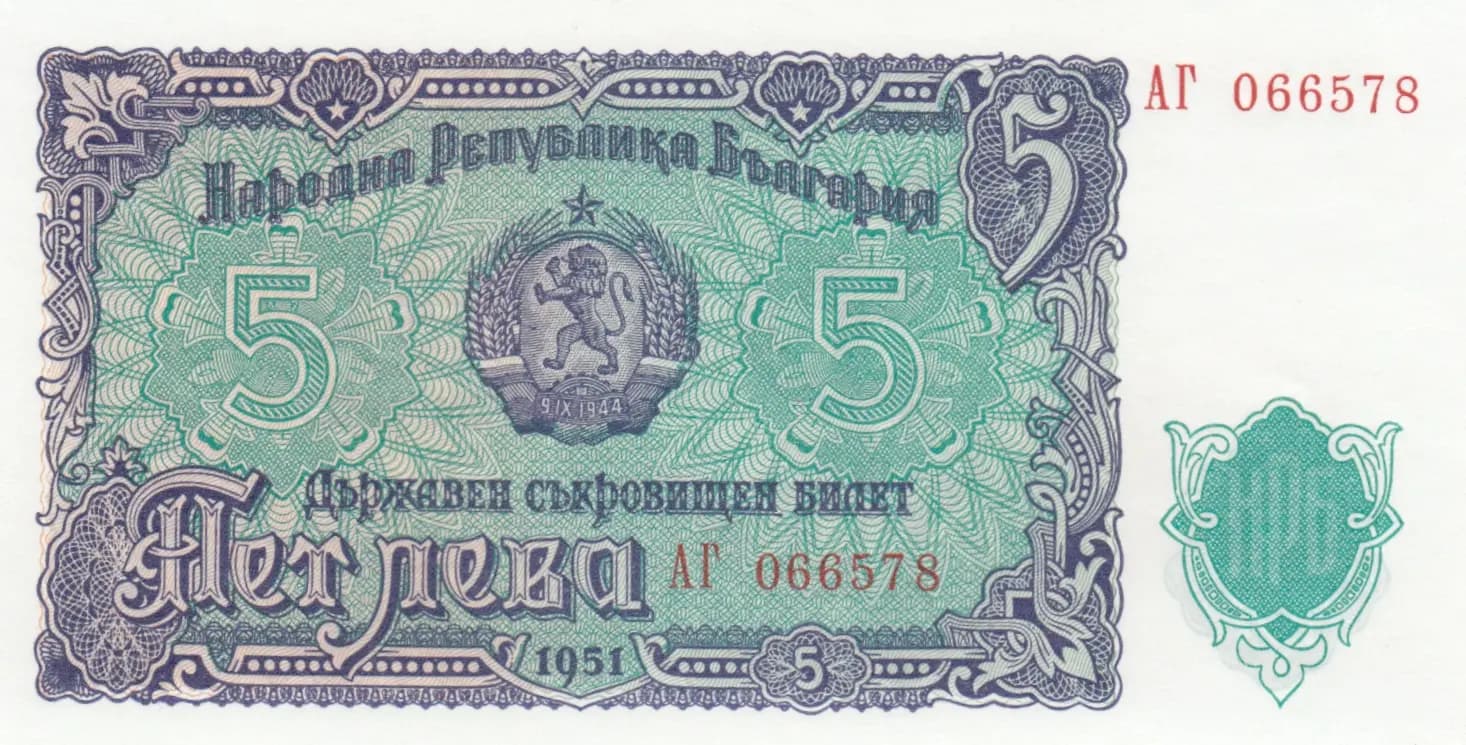
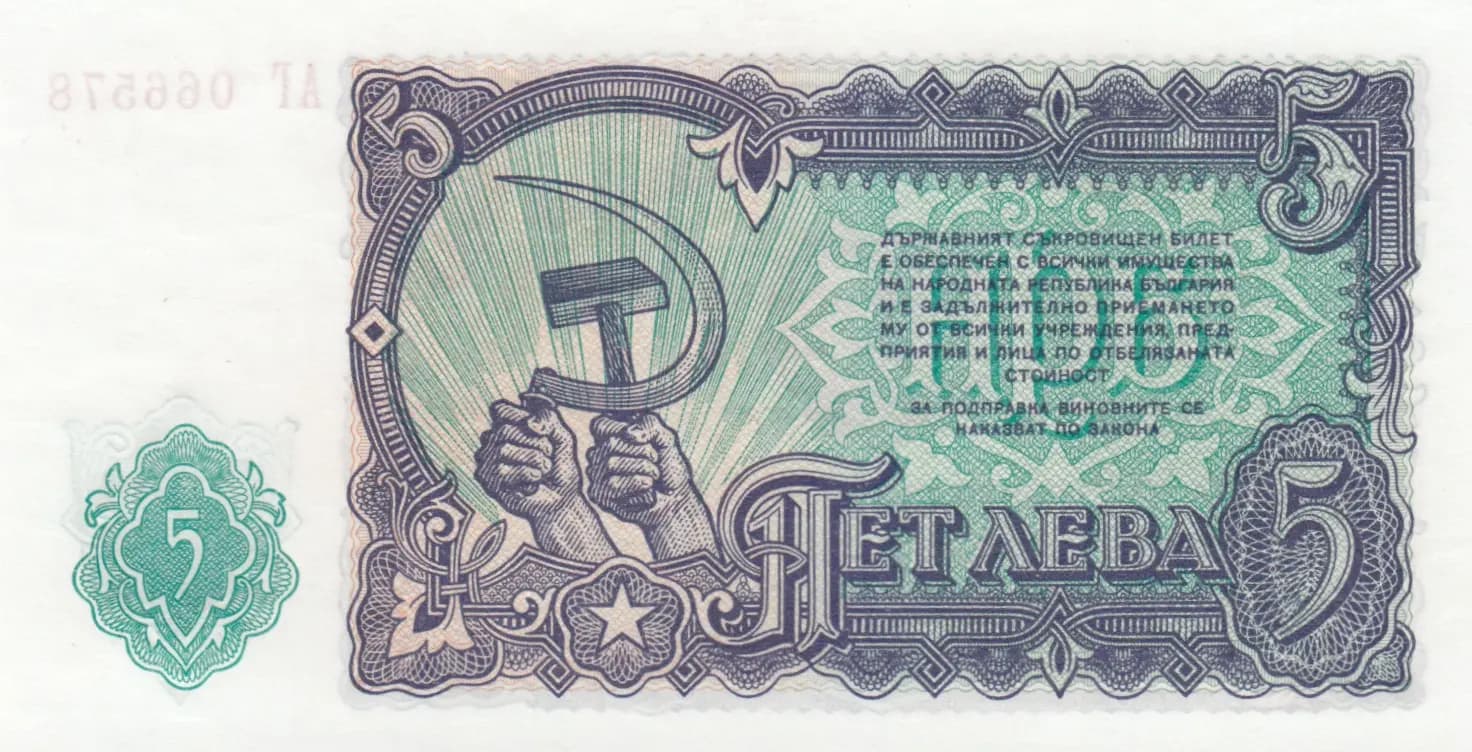
This 1951 Bulgarian 5 leva note (Pick P-82) is presented in uncirculated condition with crisp printing and no visible wear. The obverse features an ornate coat of arms with a lion dated 9.IX.1944 (commemorating Bulgaria's liberation), while the reverse displays a prominent hammer and sickle symbol with a five-pointed star, reflecting the People's Republic's communist ideology. The note exemplifies early Cold War-era Bulgarian currency design with its distinctive purple and green color scheme and intricate engraved patterns.
Common. The eBay sales data clearly indicates this is a readily available note in the market, with uncirculated examples consistently selling for $1-5 and even PMG-graded specimens (65-68) selling in the $9-115 range across multiple sales over a 10+ year period. The 2016 catalog value of $1.50 for UNC further confirms commonality. Print runs for Bulgarian currency of this era were substantial, and this denomination was in circulation for an extended period, resulting in many surviving examples.
Issued during the early years of the People's Republic of Bulgaria (1946-1990), this 1951 note reflects the Soviet-aligned communist state's iconography and propaganda. The 9.IX.1944 date commemorated on the arms represents Bulgaria's entry into World War II on the Soviet side, a defining moment for the new regime. The prominent hammer and sickle on the reverse, combined with the five-pointed star and bold legal declarations about state property backing the currency, exemplifies mid-20th century Eastern Bloc numismatic design and the Soviet Union's cultural influence over its satellite states.
The obverse features an ornate decorative border in purple and green framing a central coat of arms depicting a lion within a circular seal dated 9.IX.1944 (Bulgaria's Soviet liberation date). Large denomination numerals '5' appear in both left and right margins. The design incorporates intricate geometric and floral patterns throughout the border work, with the state designation in Cyrillic script. The reverse displays a large, centrally-positioned hammer and sickle symbol (the communist emblem) rendered in purple against a light green background, flanked by ornamental border patterns and a decorative shield bearing the numeral '5' in the lower left. A five-pointed star completes the ideological symbolism. The color palette of green and purple/dark blue is consistent across both sides, with white or cream paper providing contrast.
FRONT: 'Народна Република България' (People's Republic of Bulgaria); 'Държавен счетоводствен билет' (State accounting note/treasury note); 'Пет лева' (Five leva); Serial number 'АГ 066578' in red ink; Coat of arms date '9.IX.1944' (9 September 1944); Sequential marking '1/1051'. BACK: 'ПЕТАЕВА' (variant text); Extended legal text: 'Държавният съкровищен билет е обезпечен с всички имущества на Народната Република България и с задълженията произтичащи от деятелността на държавата преди и лица по отношаянята стойност' (The state treasury note is secured by all property of the People's Republic of Bulgaria and by obligations arising from the activities of the state before and persons regarding its value); 'За подправна виновните се наказват по закона' (For counterfeiting, the guilty are punished according to law); Serial number indicator 'аг 066580'.
Intaglio (engraved) printing, as evidenced by the fine line work, intricate geometric patterns, and precise detail visible in both the border designs and central imagery. The crisp margins, sharp definition of the hammer and sickle symbol, and the quality of the red serial number printing indicate high-quality security printing typical of state currency production. This note was produced by Goznak (the Soviet state printing facility), as documented in the PMG population report for variant P-82a.
This specimen corresponds to Pick P-82a (Goznak printer variant). The serial number АГ 066578 on the obverse and corresponding marking on the reverse are consistent with standard issue notes from this period. No overprints, date variants, or signature variations are evident in this example. The note represents the standard regular issue of 1951, with no known scarcities within the P-82 designation.