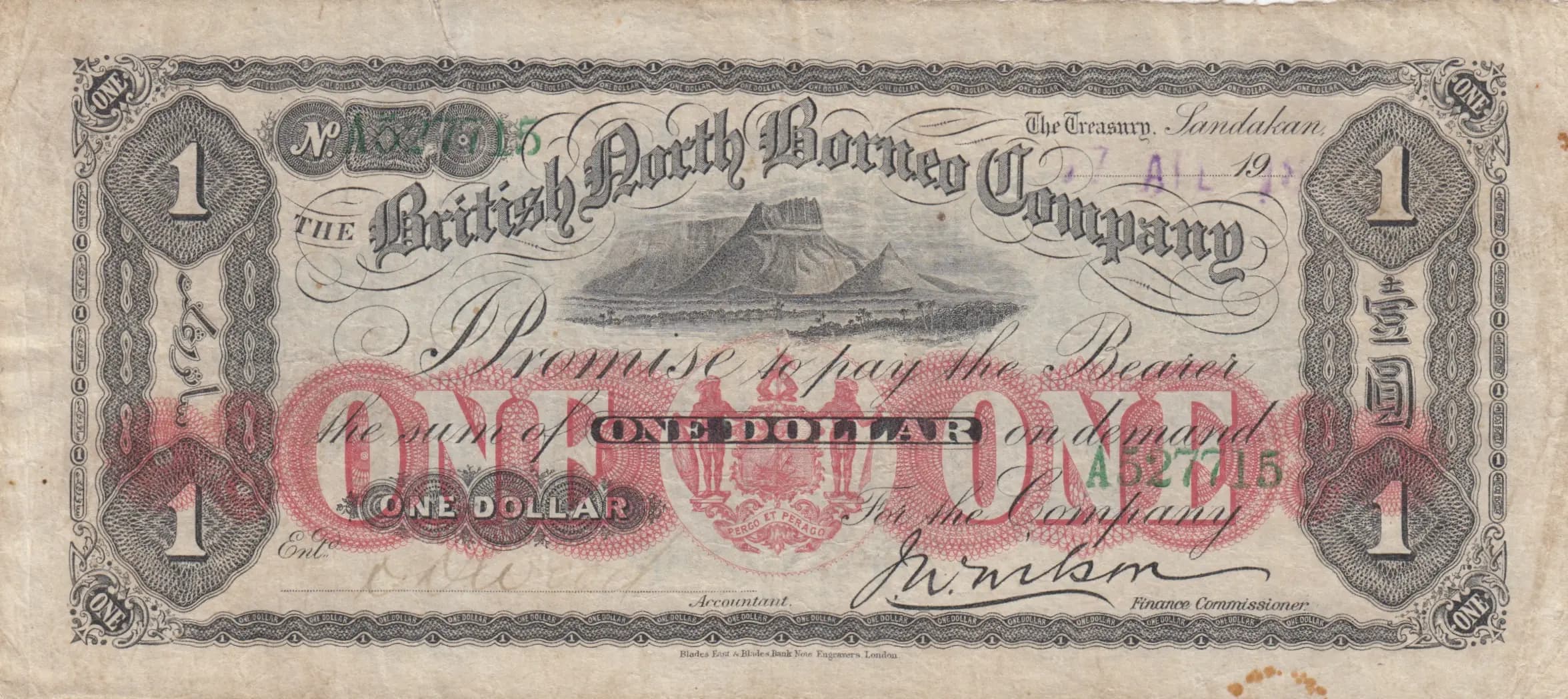
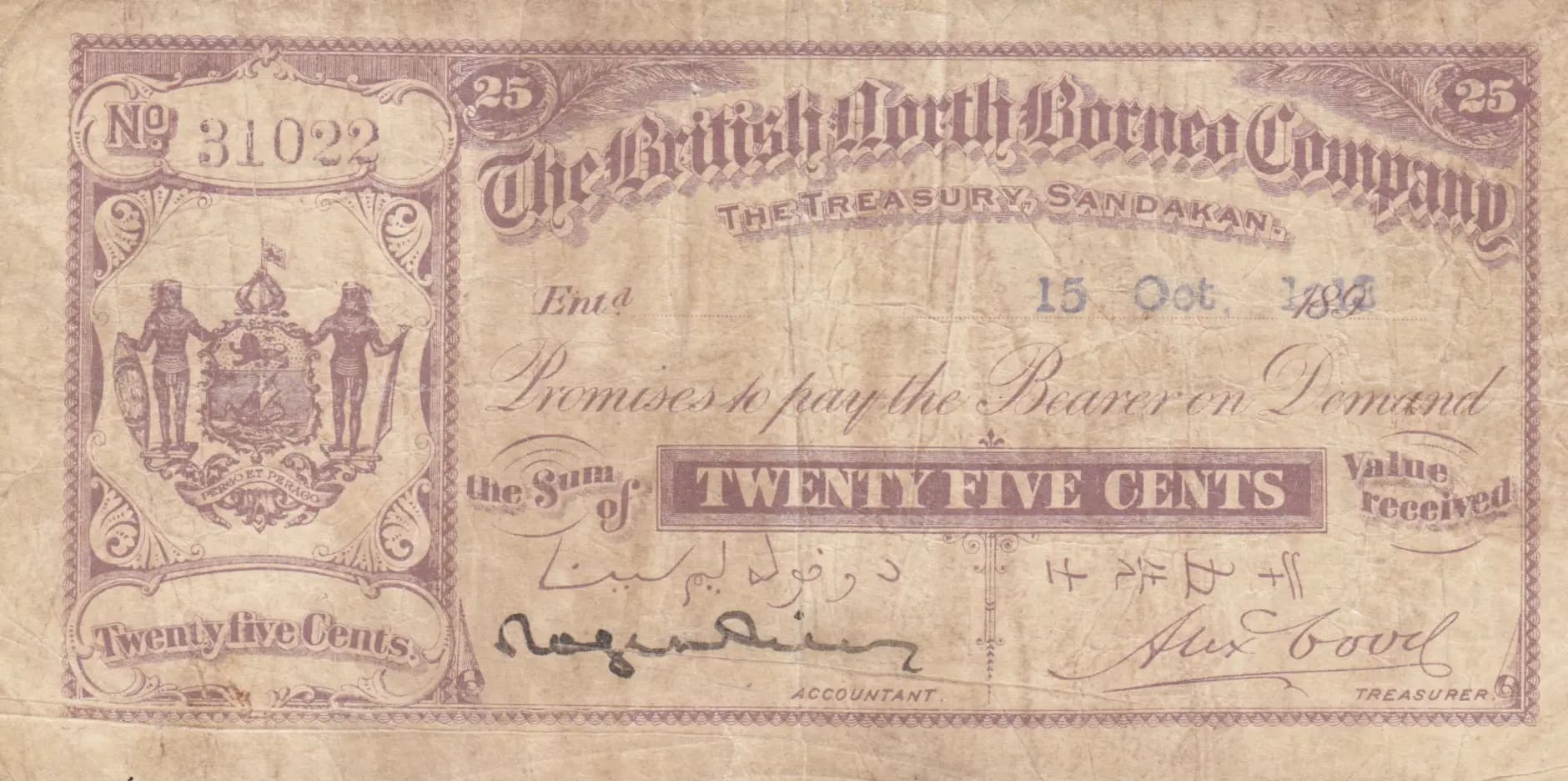
1 dollar 1936
Market Prices
10 salesAbout This Note
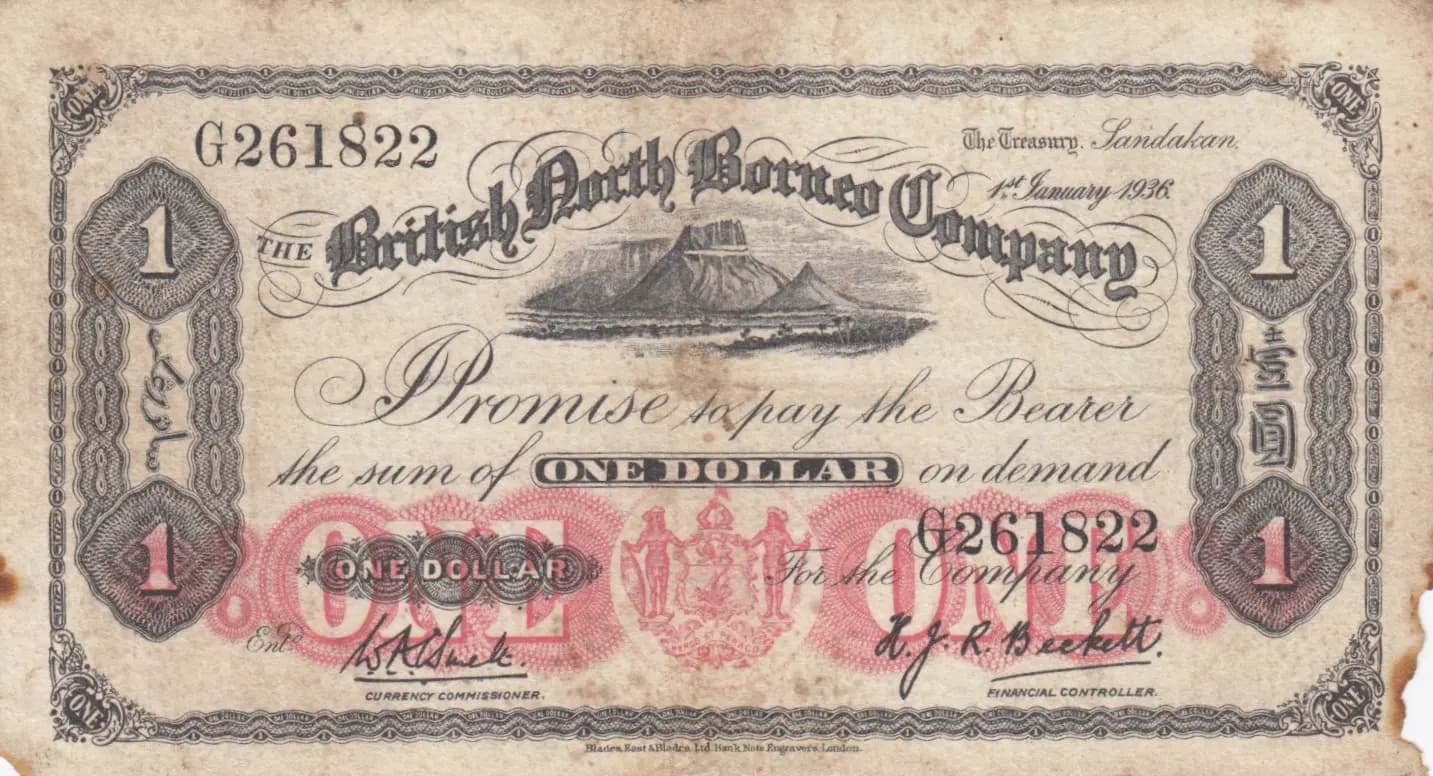
This 1936 British North Borneo Company one dollar note (Pick P-28) features the iconic Mount Kinabalu mountain landscape at center with ornate decorative borders in black and red on cream paper stock. The note displays moderate circulation wear with visible foxing and age-related discoloration throughout, consistent with a Fair grade, and represents an example from the final decade of the British North Borneo Company's currency issue before the territory's administration changed. Recent market data shows F-grade examples selling in the $69-$152 range, reflecting collector interest in early 20th-century Borneo currency.
Common. While this note is desirable to collectors of British Commonwealth and Southeast Asian currency, eBay sales data demonstrates consistent availability in the market with multiple F-grade examples selling in the $69-$152 range between 2011-2017. A more recent VF example sold for $349 in 2022, indicating strong collector demand but not scarcity. The PMG population report shows cataloging of this type, but no indication of limited print runs or recalls. The denomination and issuer span suggest adequate original circulation, with surviving examples regularly appearing in the numismatic market.
Issued on 1st January 1936 by the British North Borneo Company's Treasury at Sandakan, this note represents currency from the peak of the Company's chartered administration over the territory. The prominent depiction of Mount Kinabalu, the region's most significant natural landmark, served as a symbol of the territory's identity and natural wealth. The bilingual English and Chinese character inscriptions (壹圓 - One Dollar) reflect the multicultural commercial environment of British North Borneo during the 1930s, a period shortly before World War II would dramatically alter the geopolitical landscape of Southeast Asia.
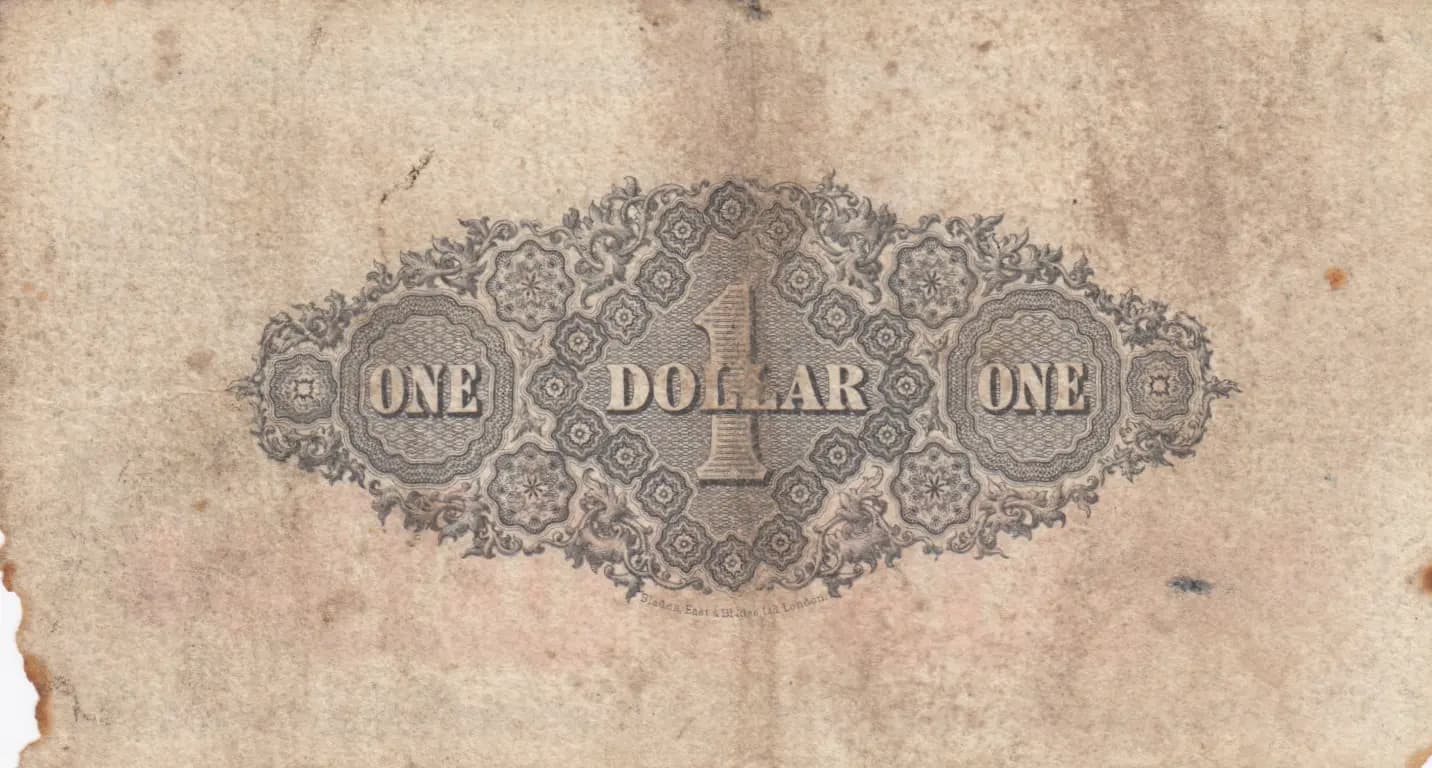
The obverse features Mount Kinabalu as a finely engraved landscape vignette positioned in the upper center of the note, serving as the dominant pictorial element. The composition employs symmetrical ornate decorative borders with intricate scrollwork and floral/geometric patterns throughout. A central ornamental emblem in red highlights the company's authority. The reverse displays a purely decorative design with radiating floral and geometric motifs arranged symmetrically, featuring circle designs with profile portraits on either side of a central vertical element. The note combines Western security printing aesthetics with acknowledgment of the territory's Chinese merchant community through Chinese character denominations. Fine line engraving throughout demonstrates the high-quality workmanship characteristic of prestigious security printers of the era.
FRONT SIDE: 'The British North Borneo Company' / 'The Treasury, Sandakan' / '1st January 1936' / 'Promise to pay the Bearer the sum of ONE DOLLAR on demand' / 'ONE DOLLAR' / 'For the Company' / 'CURRENCY COMMISSIONER' / 'FINANCIAL CONTROLLER' / '壹圓' (Chinese: One Dollar) / Serial number: G2618822 / Waterlow & Sons Limited, London (printer). BACK SIDE: 'ONE DOLLAR ONE' / Bradbury, Wilkinson & Co Ltd, London (printer).
Intaglio engraving (recess printing) executed by two of the world's premier security printers of the period: Waterlow & Sons Limited, London (front) and Bradbury, Wilkinson & Co Ltd, London (back). The visual analysis confirms the characteristic sharp detail, fine line work, and complex patterns typical of intaglio production. The deliberate use of separate printers for obverse and reverse was a security measure common among high-value Commonwealth currency of this era. The color scheme employs black and red inks on cream-toned paper stock.
Pick P-28 identifies this as the standard 1936 one dollar issue from British North Borneo Company with Blades, East & Blades Inc. (or variant designations Waterlow & Sons/Bradbury Wilkinson) as printers. The observed serial number G2618822 is a single example from what appears to be a standard series. No overprints, color variations, or other distinguishing varieties are evident in the visual analysis. PMG records one primary variant for this Pick number. The note represents the standard 1936 issue type without the modifications or emergency overprints that characterize some other notes from this issuer.