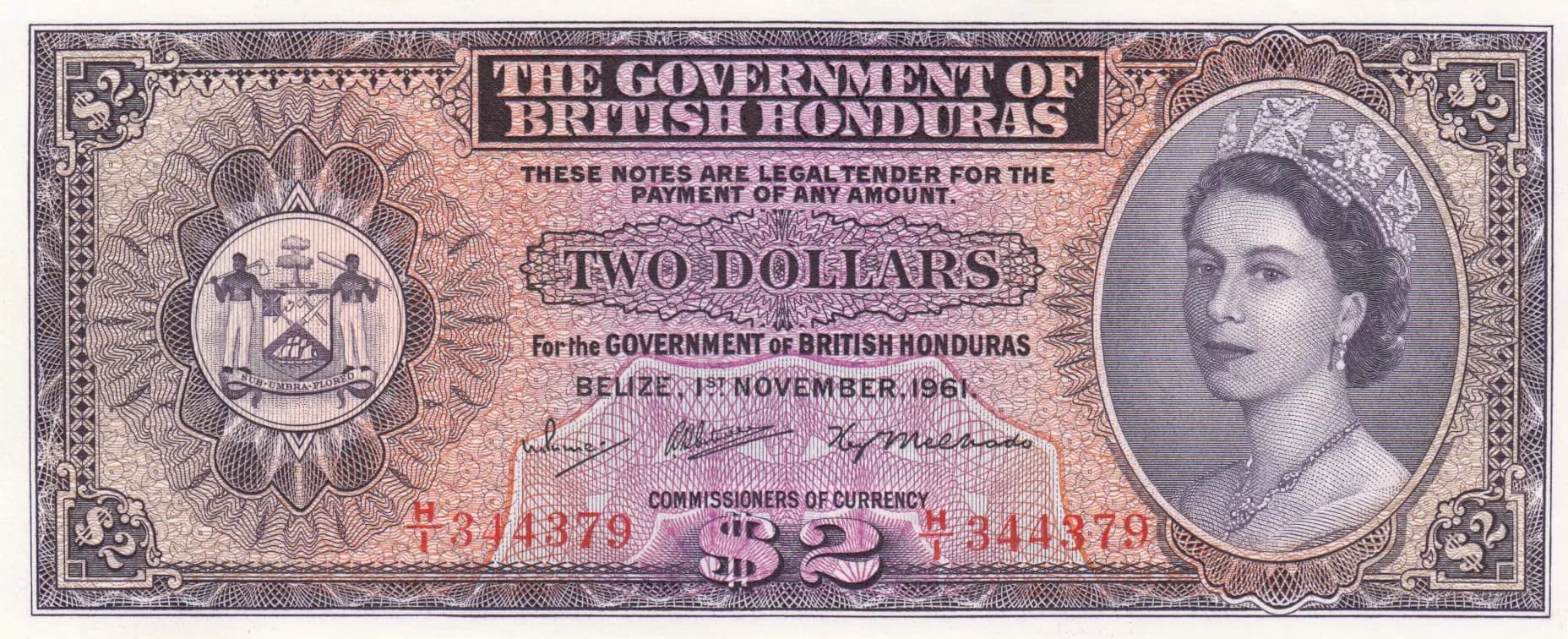
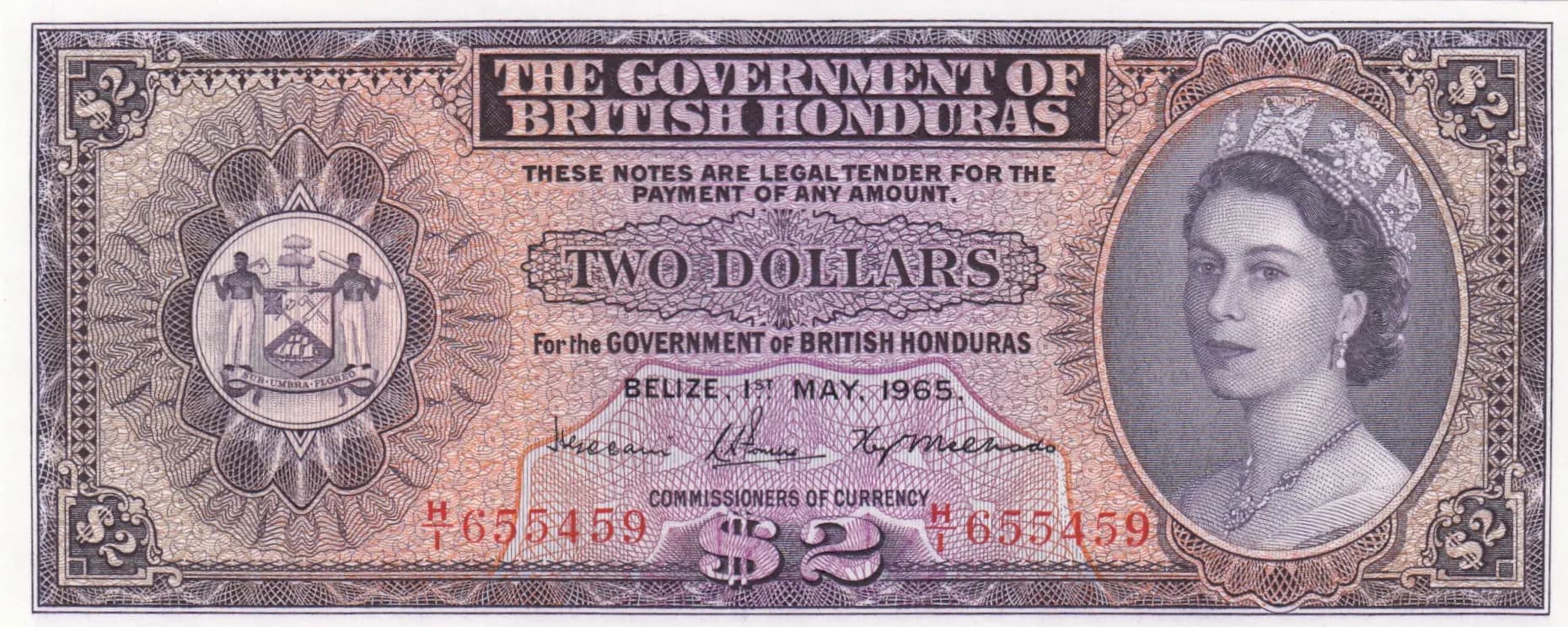
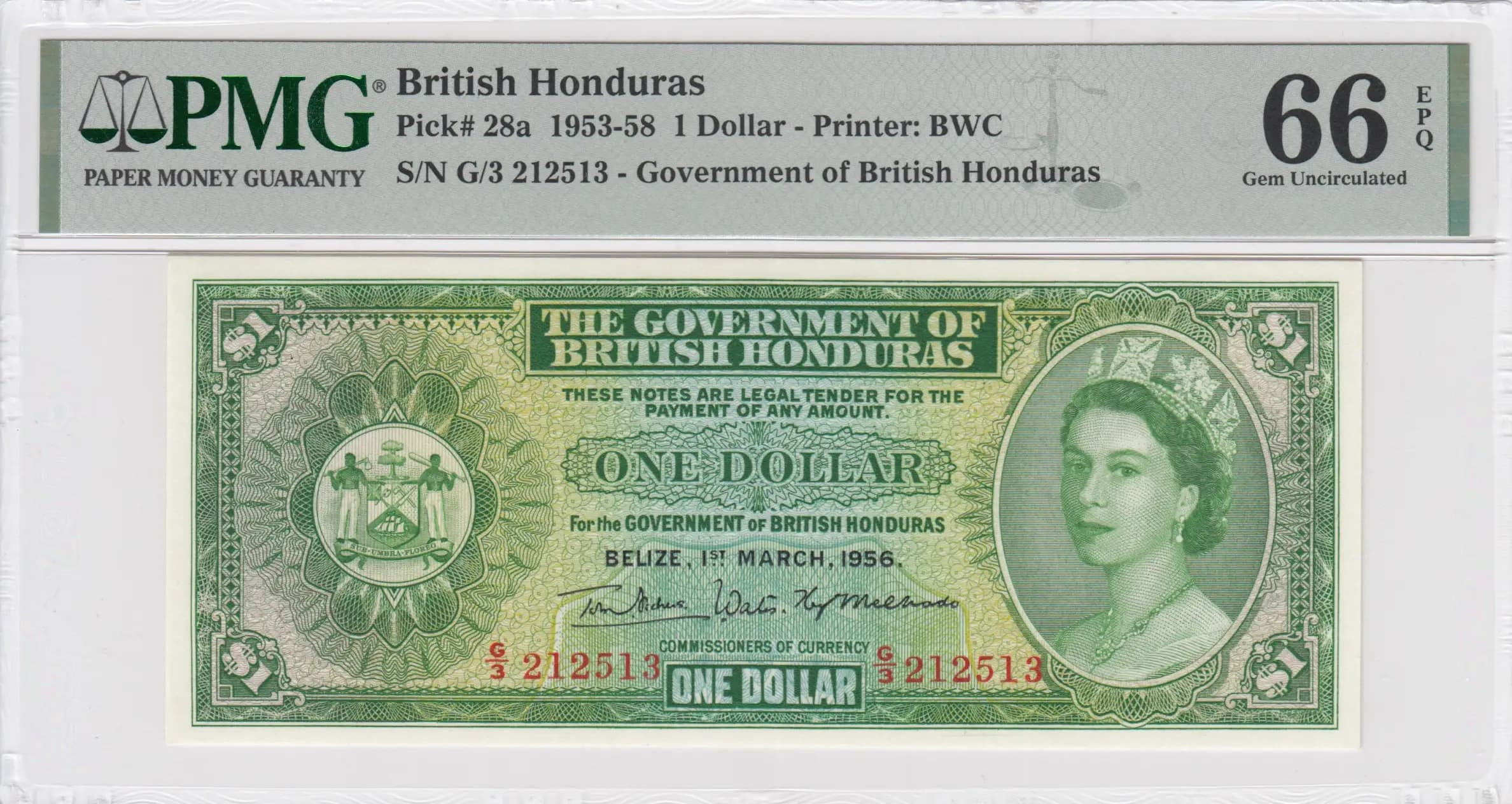
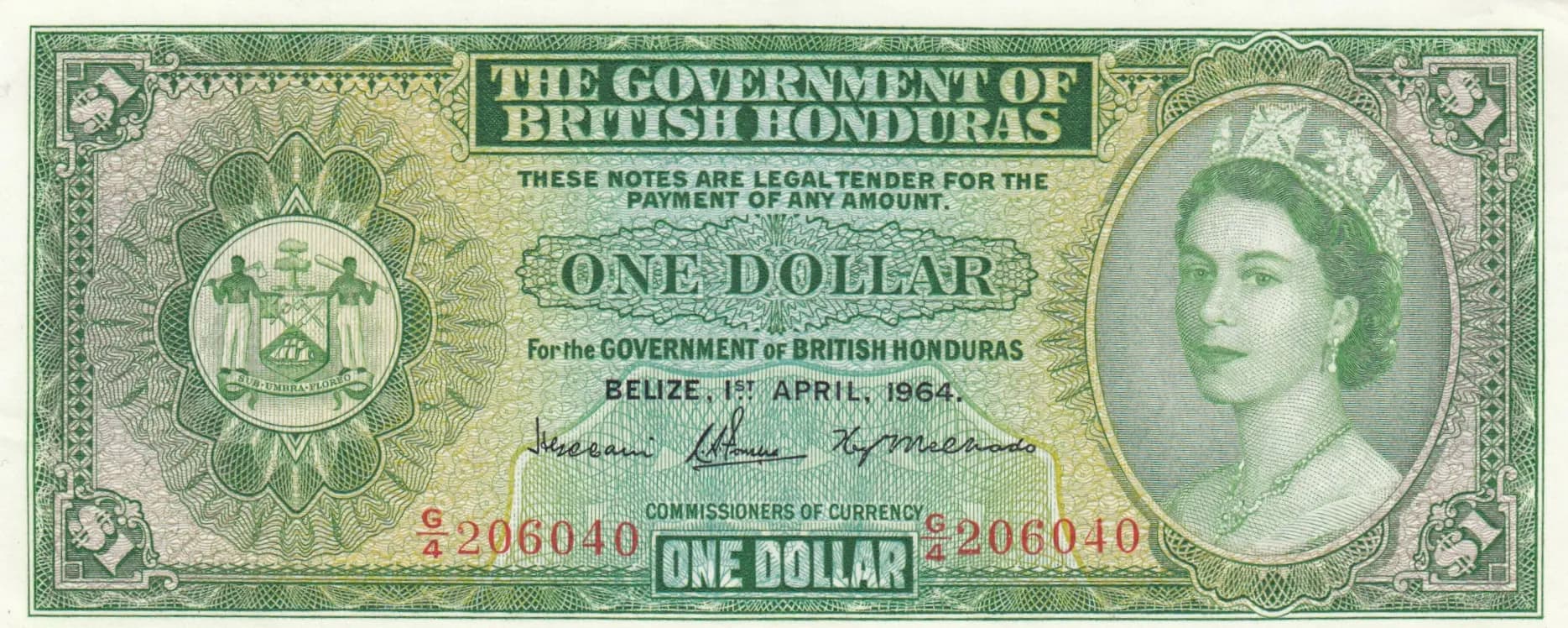
2 dollars 1973
Market Prices
7 salesAbout This Note
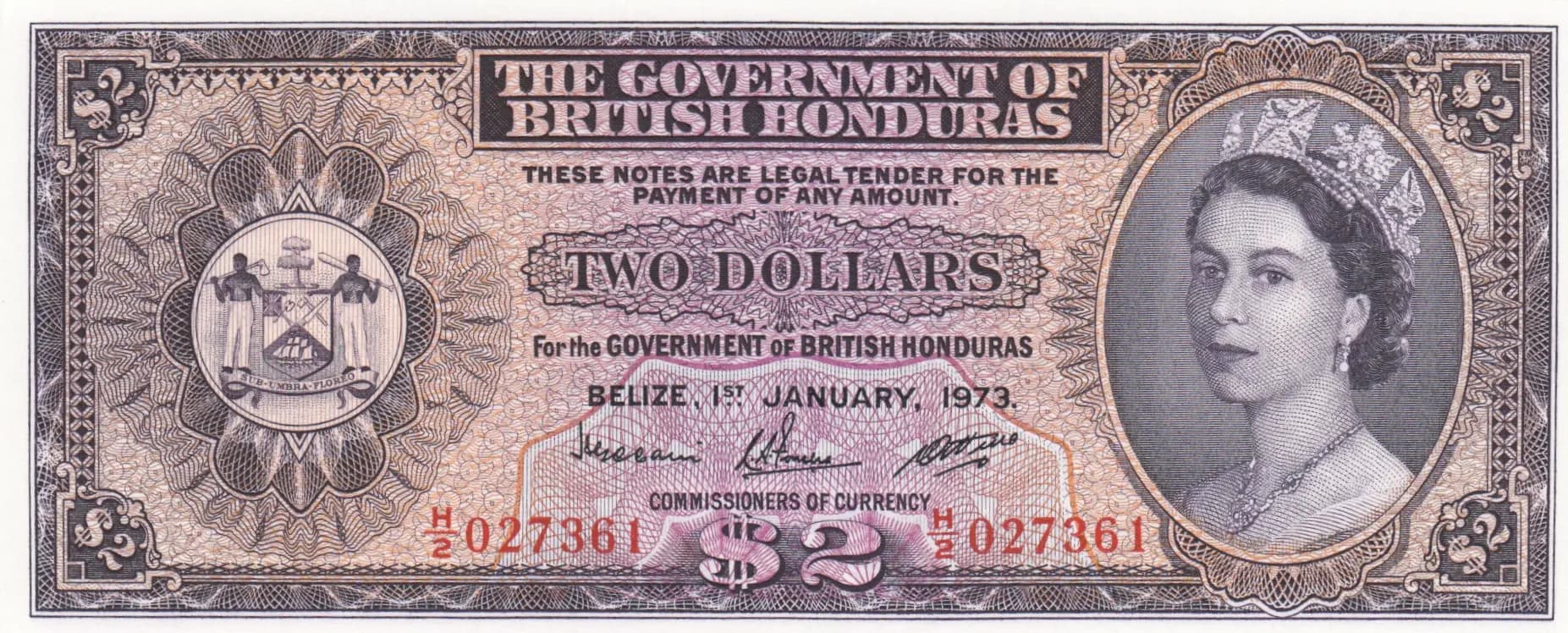
This is an uncirculated 2 Dollar banknote from The Government of British Honduras dated 1st January 1973, issued during the final years before the territory's independence as Belize. The note features exceptional engraving quality with ornate geometric borders, the British Honduras coat of arms, and a portrait of Queen Elizabeth II rendered in fine line work across brown, tan, and pink tones. In UNC condition, this note exhibits crisp detail throughout with no signs of wear, making it a desirable example of mid-20th century Commonwealth currency design.
Common. While this is a specific Pick variety (P-29c), British Honduras 2 Dollar notes from 1973 were issued in regular circulation quantities. Market data from realbanknotes.com shows UNC examples valued at $400 in 2019 catalog prices, but eBay transaction history demonstrates steady sales in the $30–$400 range depending on grade, with multiple sales recorded across two decades, indicating healthy circulation among collectors and consistent availability. The lack of rarity indicators (short print run, recall, or limited issue period) supports a common classification.
This 1973 banknote represents British Honduras at a pivotal moment in its political history, issued just months before the territory would officially change its name to Belize in June 1973, foreshadowing its independence in 1981. The coat of arms depicted on the obverse—featuring two indigenous figures flanking a shield with crossed implements—symbolizes the nation's cultural heritage and natural resources. The inclusion of Queen Elizabeth II's portrait reflects British Honduras's status as a British Crown Colony at the time of issue, maintaining formal ties to the British monarchy while asserting its own national identity.
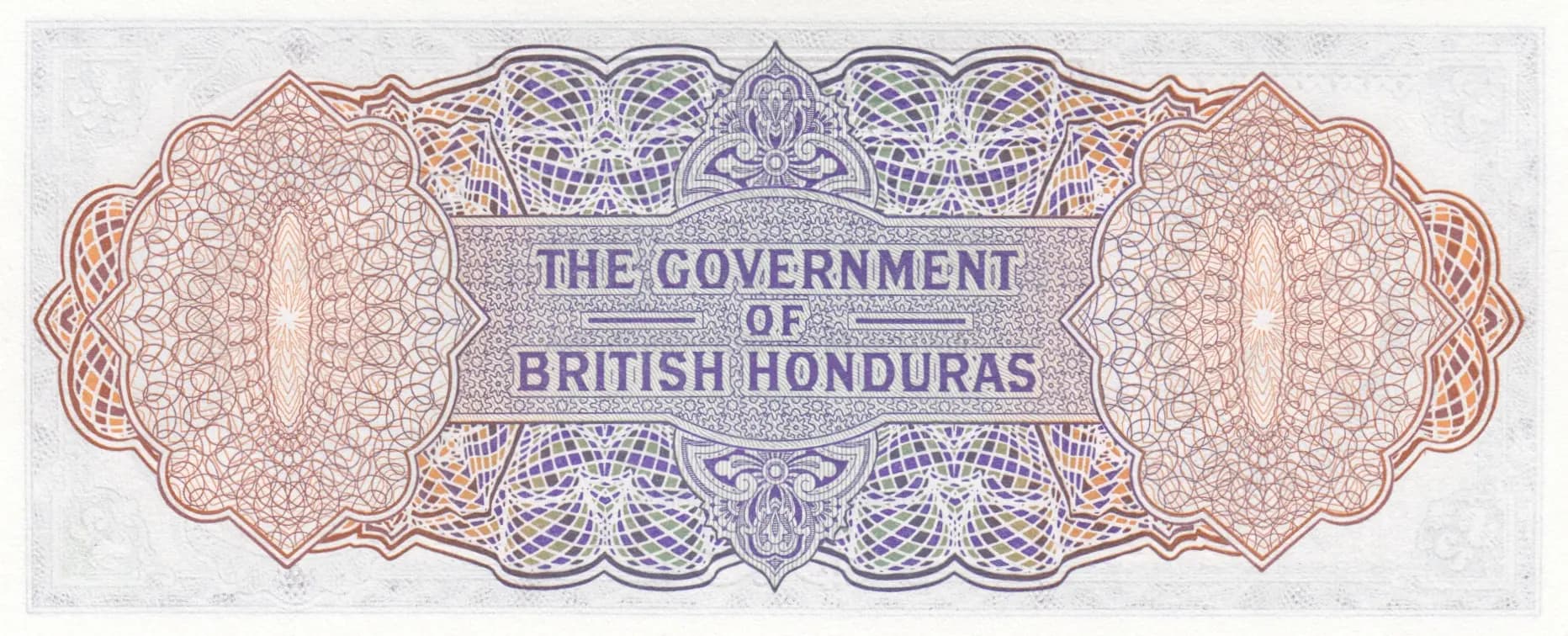
The obverse features the coat of arms of British Honduras positioned on the left in a decorative circular frame, depicting two figures (representing indigenous peoples) holding implements flanking a central shield with crossed tools below, symbolizing the nation's cultural and economic foundation. To the right is a formal portrait of Queen Elizabeth II wearing a tiara, rendered in profile within an oval frame using fine line engraving. The note is dominated by elaborate geometric border patterns and intricate line work throughout, with the denomination '2' prominently displayed in the center-bottom. The reverse displays a highly symmetrical ornamental design with purple and blue mesh/lattice patterns forming decorative motifs, scalloped edges, and tan/brown borders, creating an elegant and secure design. The color palette combines brown, tan, pink, purple, and blue tones.
FRONT: 'THE GOVERNMENT OF BRITISH HONDURAS' (header); 'BELIZE, 1ST JANUARY, 1973.' (issue date and location); 'TWO DOLLARS' (denomination); 'THESE NOTES ARE LEGAL TENDER FOR THE PAYMENT OF ANY AMOUNT.' (legal tender declaration); 'For the GOVERNMENT OF BRITISH HONDURAS' (issuing authority); 'COMMISSIONERS OF CURRENCY' (currency authority); Serial number '#027361'. BACK: 'THE GOVERNMENT OF BRITISH HONDURAS' (issuer identification). All inscriptions are in English.
Intaglio engraving (line engraving), evidenced by the fine detailed line work, intricate geometric patterns, and the crisp definition of borders and security features visible throughout both sides. The PMG population report indicates this P-29c variety was printed by BWC (Bradbury Wilkinson and Company, a renowned British security printer). The complex symmetrical patterns and fine-line security work are characteristic of high-security intaglio production standards of the era.
This note is cataloged as Pick P-29c, one of seven documented variants for the base 2 Dollar pick number. The P-29 series includes P-29a, P-29as, P-29b, P-29c, P-29cs, P-29cts, and P-29s, with variants distinguished by printer (all BWC except P-29cts) and signature combinations. The visual analysis does not provide sufficient detail to definitively identify signature variants, but the serial number 027361 and 1st January 1973 date are consistent with the cataloged issue parameters. Collectors should note that P-29 variants exist and comparative examination of signature blocks would be necessary to confirm the exact sub-variety.