1 dollar 1962
Market Prices
58 salesAbout This Note
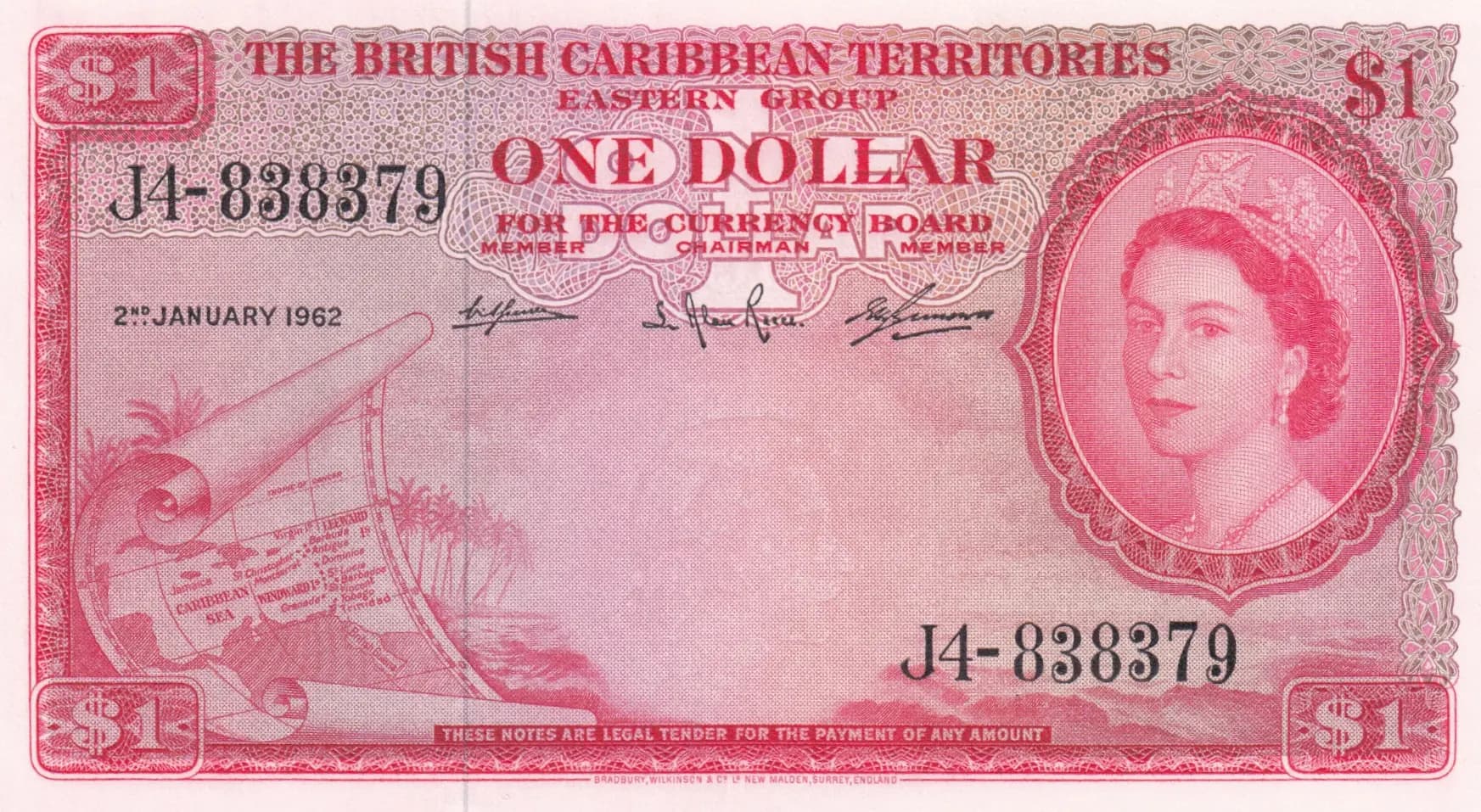
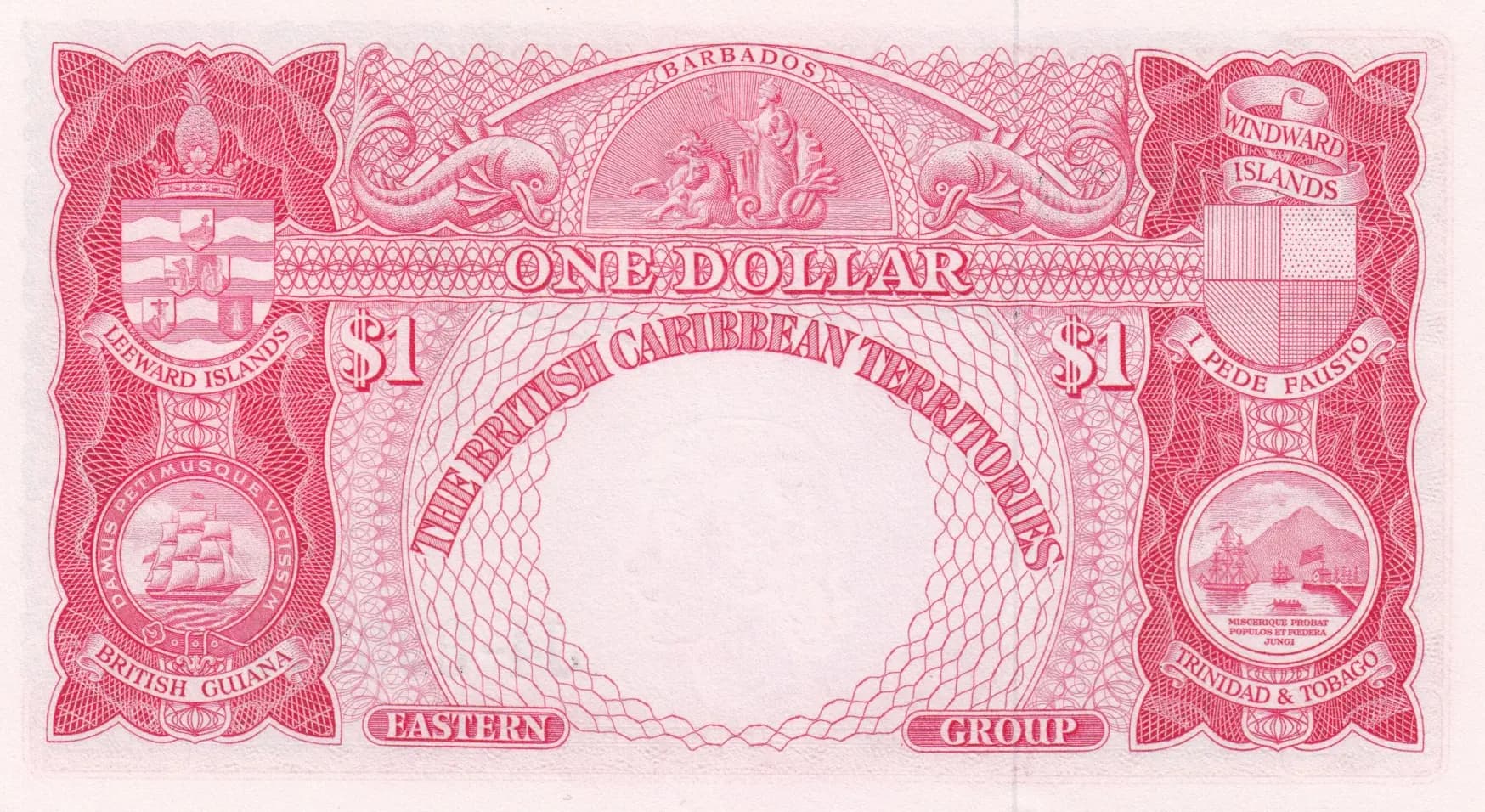
This is a well-circulated example of the 1962 British Caribbean Territories Eastern Group $1 note (Pick P-7c), featuring Queen Elizabeth II in profile on the obverse and an ornate heraldic design showcasing the four member territories on the reverse. Despite catalog grading of UNC, the visual evidence shows significant circulation wear including horizontal fold lines, creasing throughout, and age-related yellowing—characteristics more consistent with a Fine to VF grade rather than uncirculated condition. The note's intricate engraved design and historical significance as currency for multiple Caribbean colonies make it an interesting example of Commonwealth monetary history.
Common. While this is a historically significant note from the early Caribbean decolonization period, the 1958-1964 Eastern Group series had substantial print runs for circulation across six territories. eBay market data shows consistent trading activity over the past 15+ years with UNC examples typically selling in the $100-$275 range, VF examples at $20-$60, and lower grades often under $25. The denomination (one dollar) and multi-territorial circulation ensure these notes were produced in high volume. No historical evidence suggests this series was recalled or that print runs were unusually limited.
Issued on 2nd January 1962 by the British Caribbean Territory Currency Board, this note represents a pivotal moment in Caribbean monetary autonomy during the decolonization era. The obverse depicts Queen Elizabeth II as the reigning British monarch, while the reverse features coats of arms for Barbados, the Windward Islands, Leeward Islands, Trinidad & Tobago, British Guiana, and Dominica—reflecting the territorial federation that the Currency Board oversaw. The inclusion of a cannon with Caribbean landscape on the obverse symbolizes the colonial military heritage and tropical geography of these island territories.
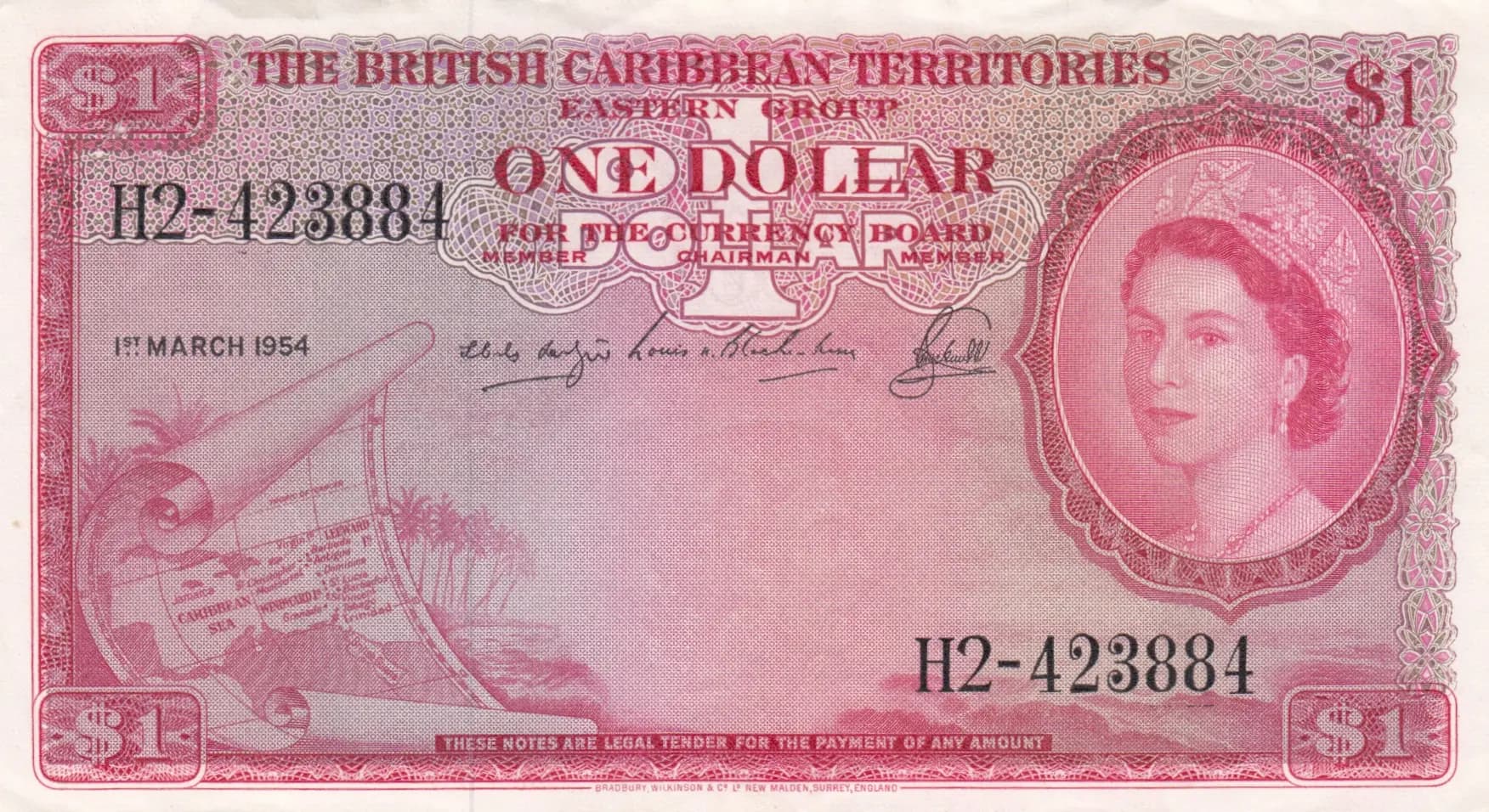
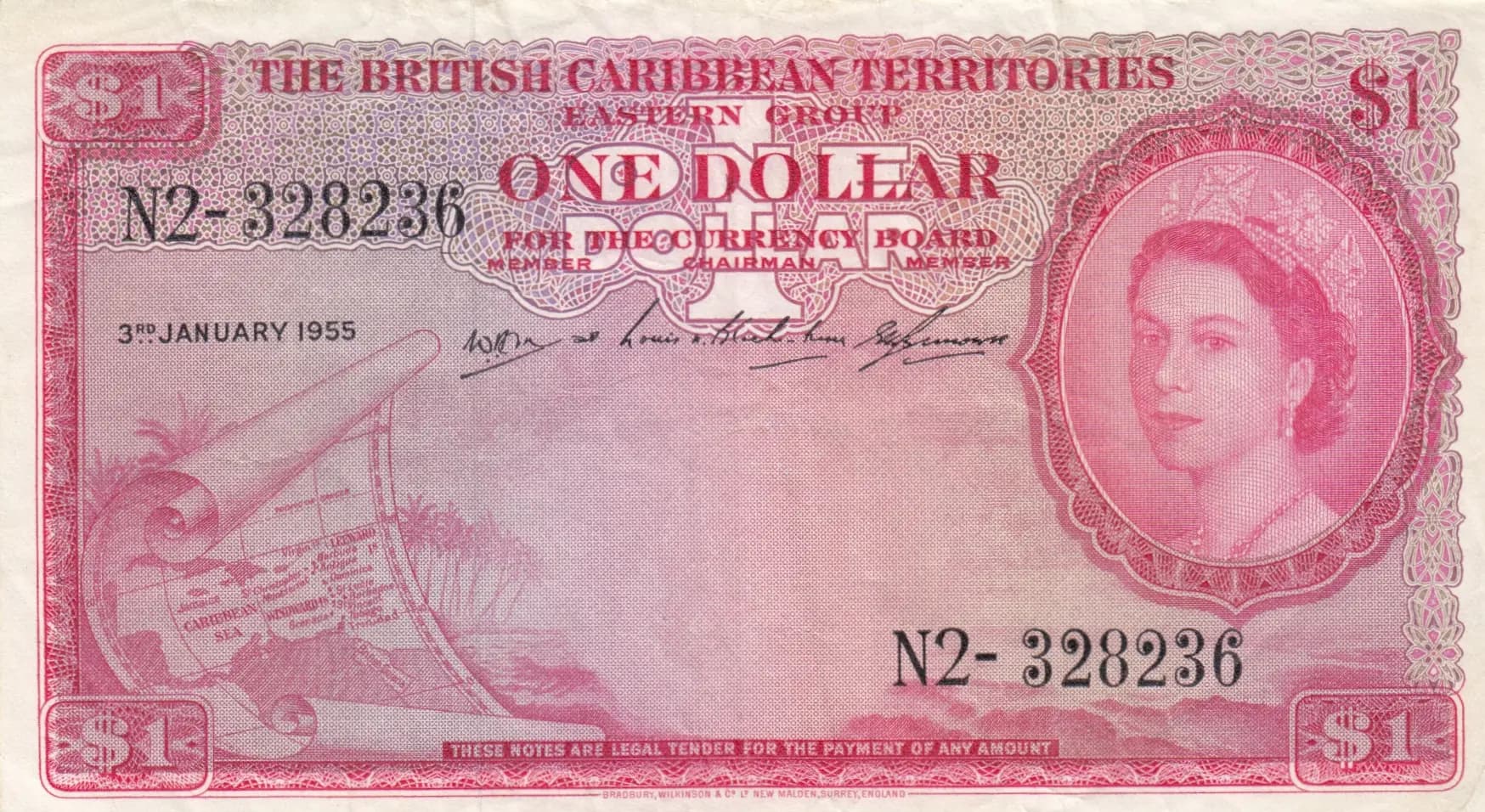
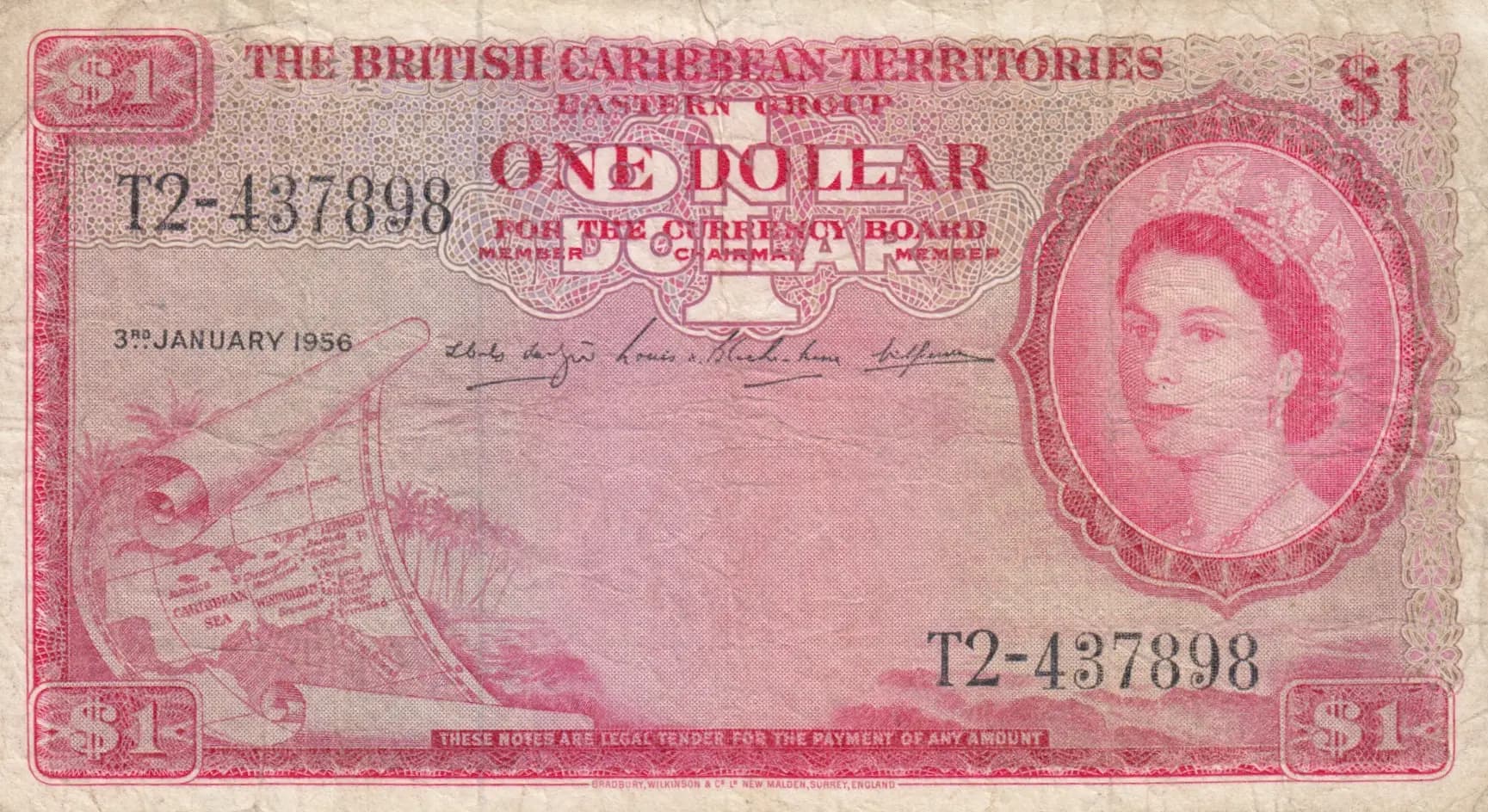
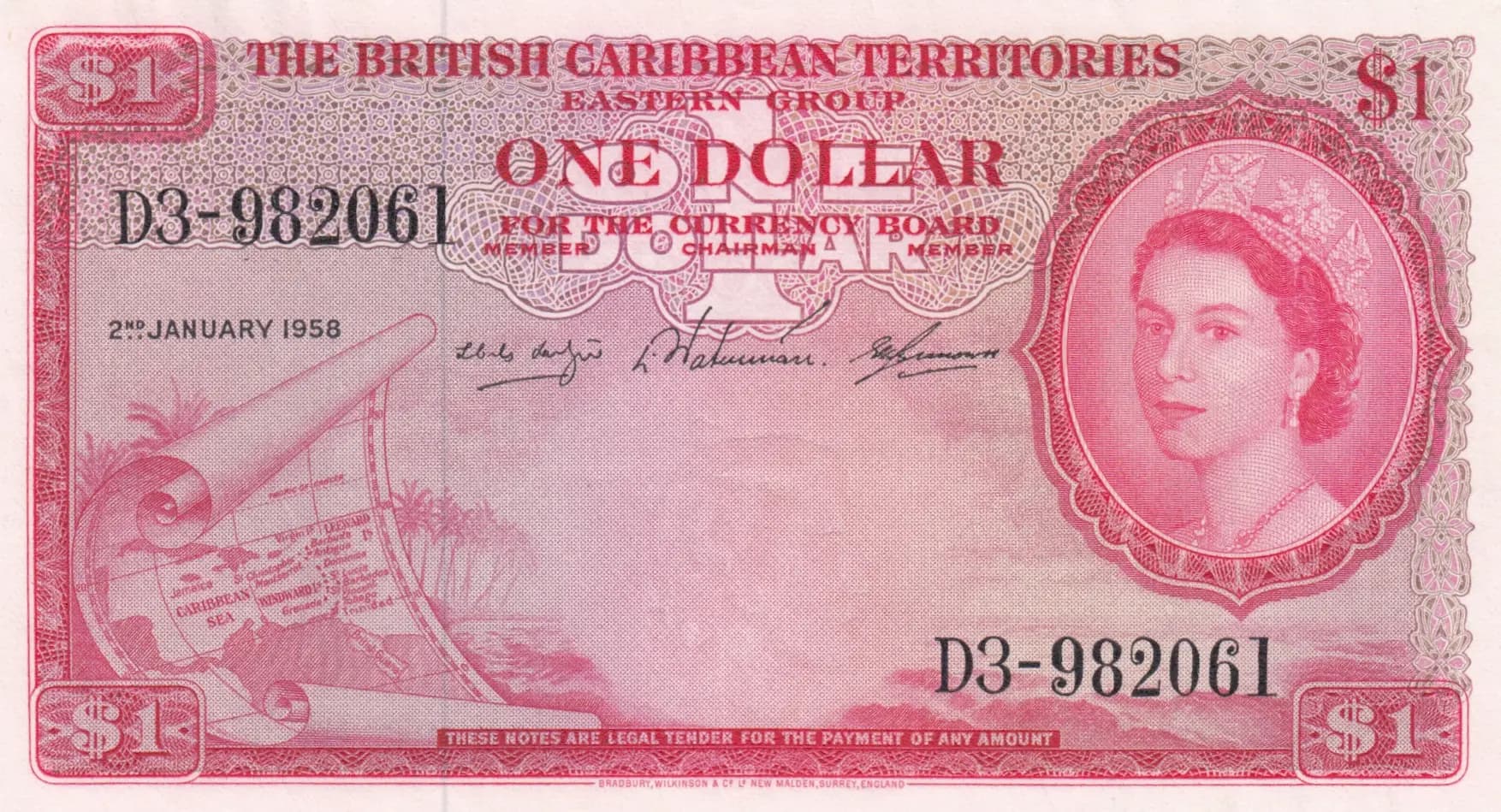
The obverse features a formal portrait of Queen Elizabeth II in profile facing right, positioned within an ornate circular oval frame on the right side of the note. To the left is an illustration of a colonial cannon with tropical Caribbean foliage and palm vegetation, representing the military and geographical heritage of the Eastern Group territories. The reverse presents a highly ornate heraldic composition with four territorial coats of arms positioned in the corners—Barbados (top left), Windward Islands (top right), Leeward Islands (bottom left), and Trinidad & Tobago (bottom right)—surrounding a central elaborate medallion featuring classical allegorical figures (including Neptune-like figures with tridents) and maritime imagery. The design incorporates lions, crowns, shields, and ships within the heraldic emblems, reflecting the colonial and maritime heritage of these Caribbean territories. The overall composition uses intricate fine-line engraving with geometric and classical architectural elements throughout, set against a light pink/mauve background.
FRONT: 'THE BRITISH CARIBBEAN TERRITORIES EASTERN GROUP' (issuing authority); 'ONE DOLLAR' (denomination); 'FOR THE CURRENCY BOARD' (issuer identification); 'CHAIRMAN' and 'MEMBER' (authorization signatures); '2ND JANUARY 1962' (issue date); 'J4-838379' (serial number); 'THESE NOTES ARE LEGAL TENDER FOR THE PAYMENT OF ANY AMOUNT' (legal tender declaration). REVERSE: 'ONE DOLLAR' (denomination); 'BRITISH CARIBBEAN TERRITORIES / EASTERN / GROUP' (issuing authority); Territory names: 'BARBADOS', 'WINDWARD ISLANDS', 'LEEWARD ISLANDS', 'TRINIDAD & TOBAGO', 'BRITISH GUIANA', 'DOMINICA'; Latin inscriptions: 'MUSOQUE FECIT' (And he made it); 'PISCIQUE PROBAT POPULUS ET PERICULA VINCIT' (The people prove by fish and overcome dangers—territorial motto).
Intaglio engraving (fine-line copperplate engraving) executed by Bradbury, Wilkinson & Company (BWC), a renowned British security printer. The visual evidence of extremely fine line work, cross-hatching, ornate decorative borders, and intricate geometric patterns throughout both sides confirms the high-security intaglio process characteristic of BWC's work during this period. The detailed heraldic emblems and portrait work show the hallmark precision and anti-counterfeiting sophistication for which BWC was known.
This note is identified as Pick P-7c (Eastern Group variant), one of nine cataloged PMG variants for this base Pick number. The variants include P-7a through P-7cs, with P-7c specifically designated for the Eastern Group. The serial number 'J4-838379' visible on the obverse and the formal date '2ND JANUARY 1962' place this within the initial issue of the 1958-1964 series. No overprints or unusual printing variations are evident in the visual analysis. The note exhibits characteristics consistent with the standard circulation issue rather than a special or limited variety.