1 dollar 1956
Market Prices
18 salesAbout This Note
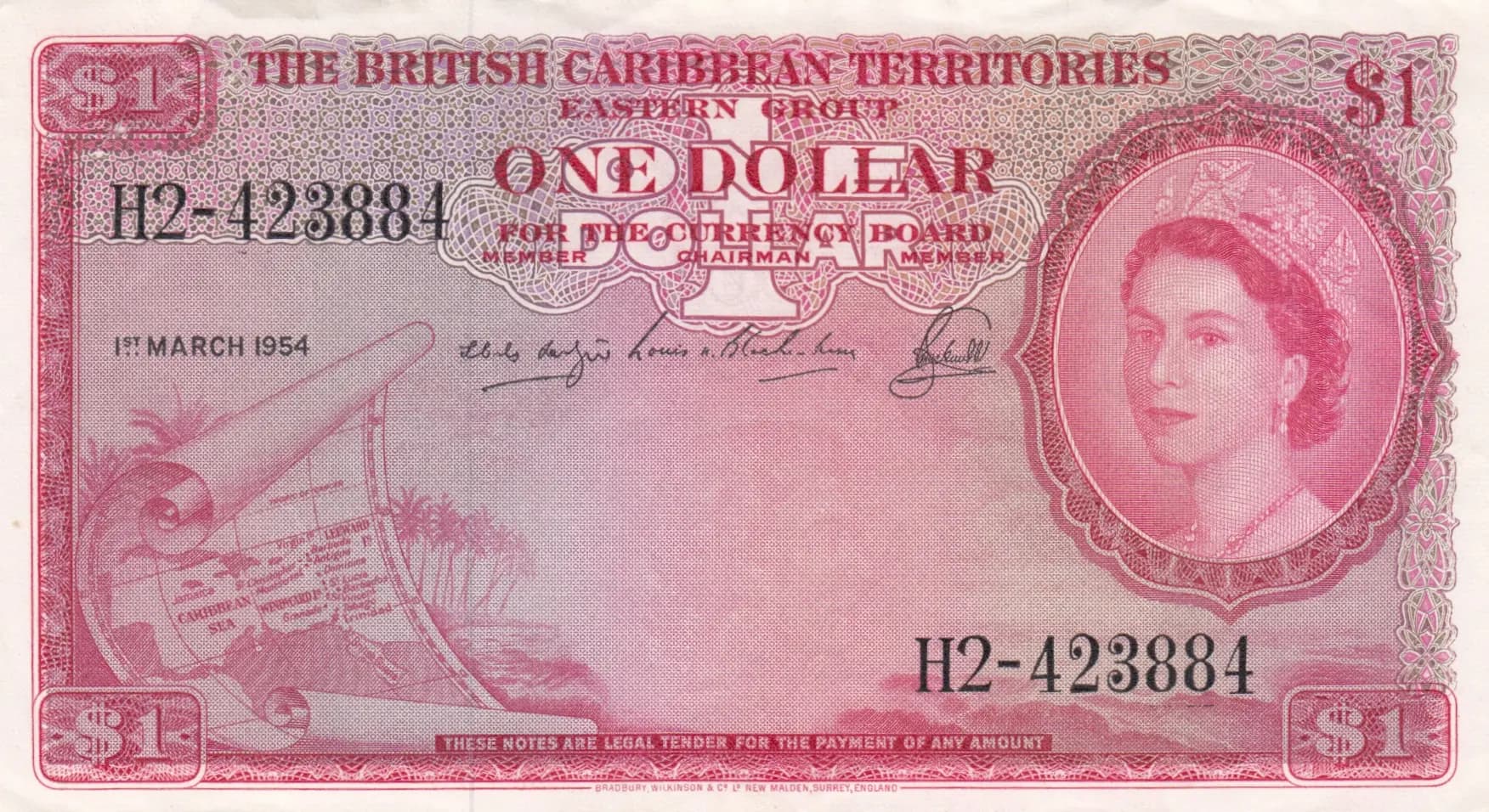
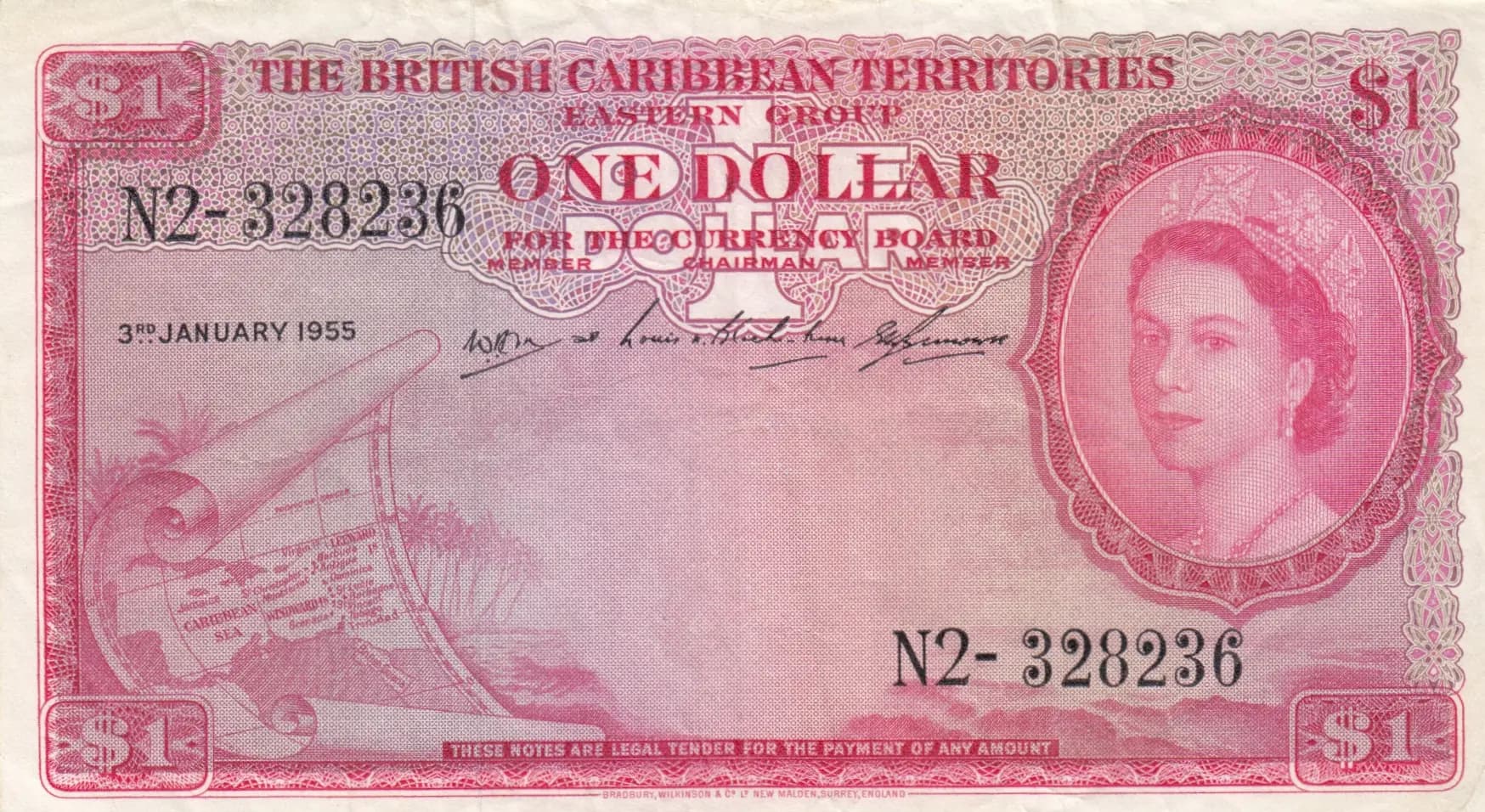
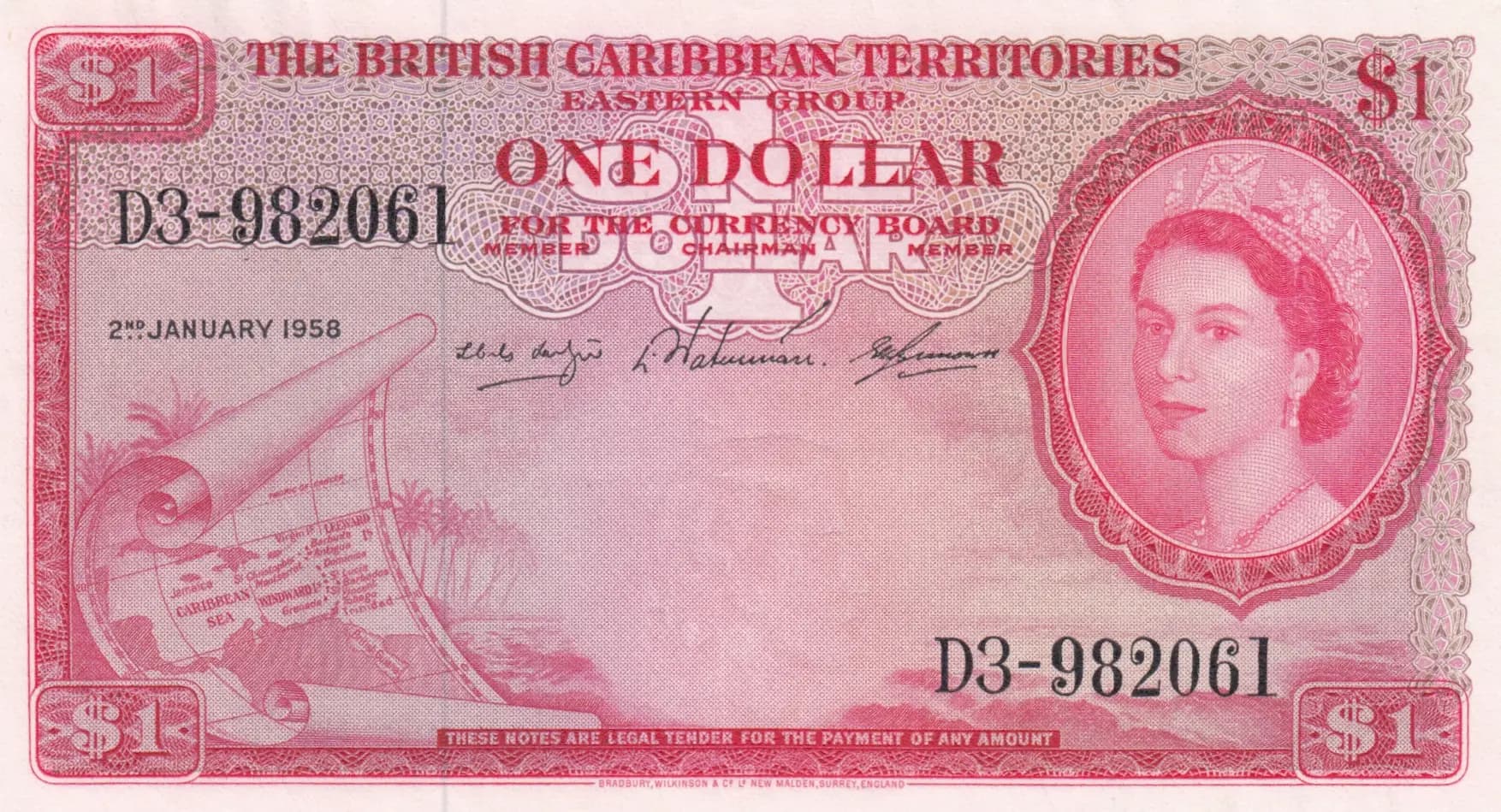
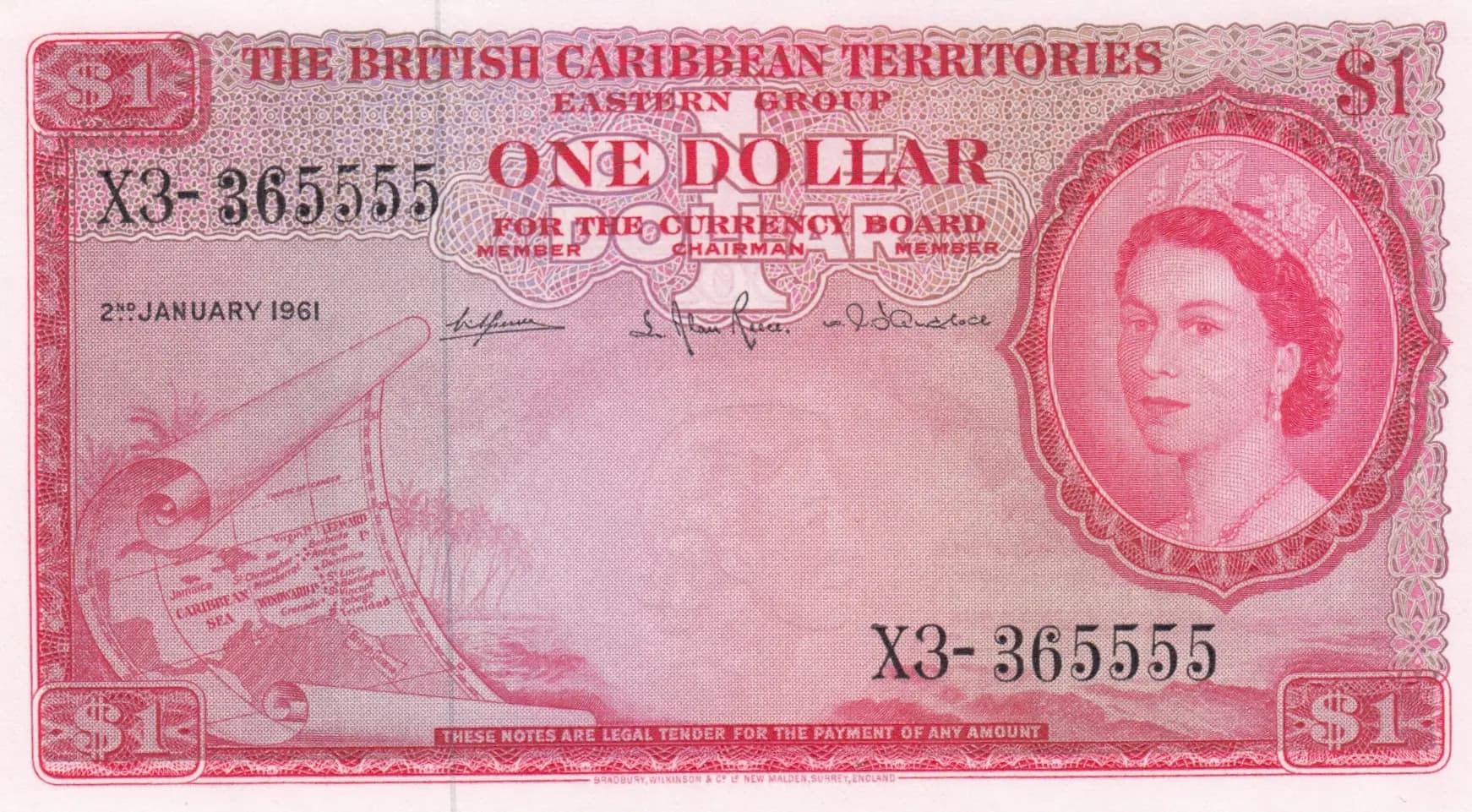
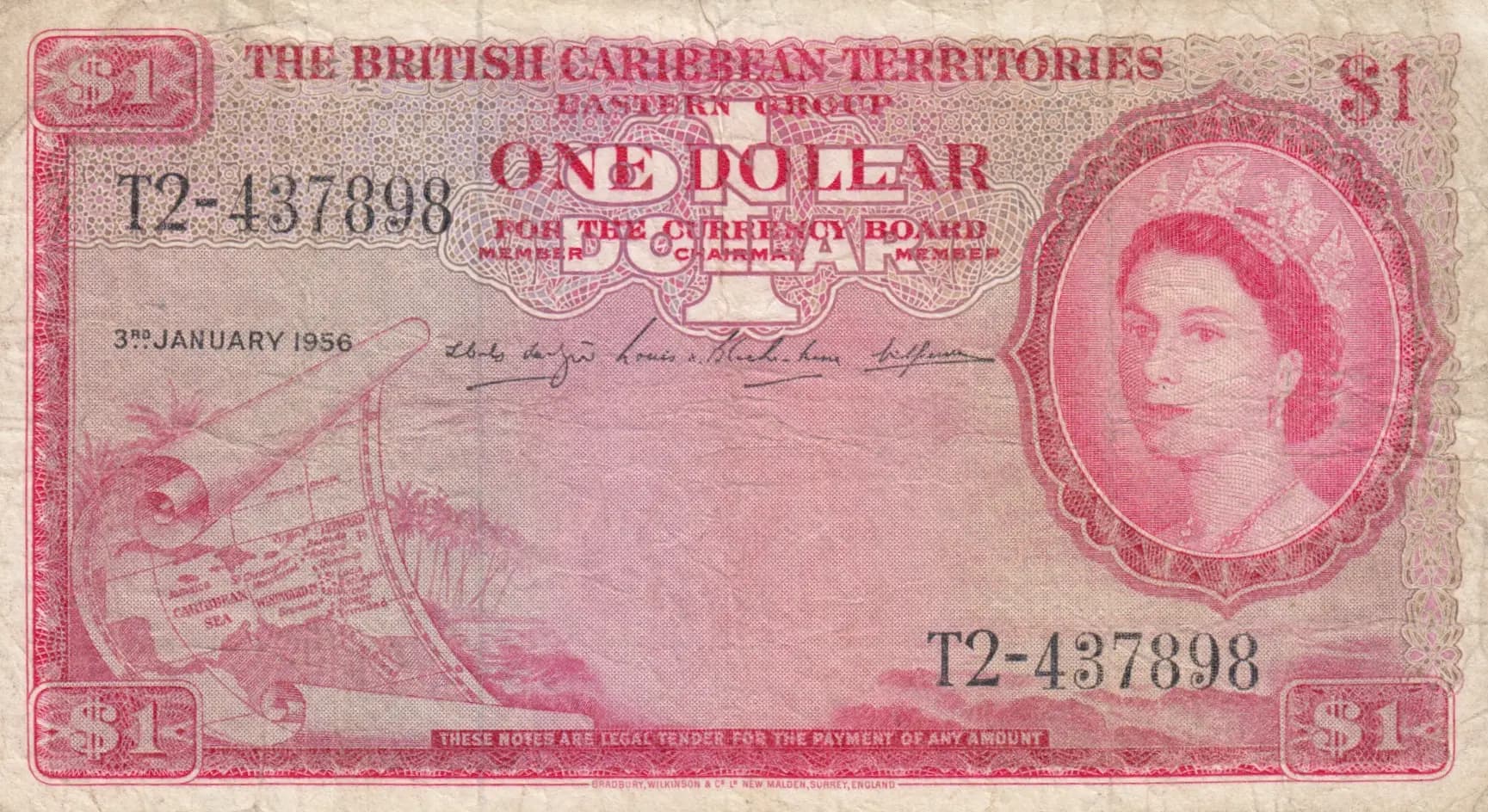
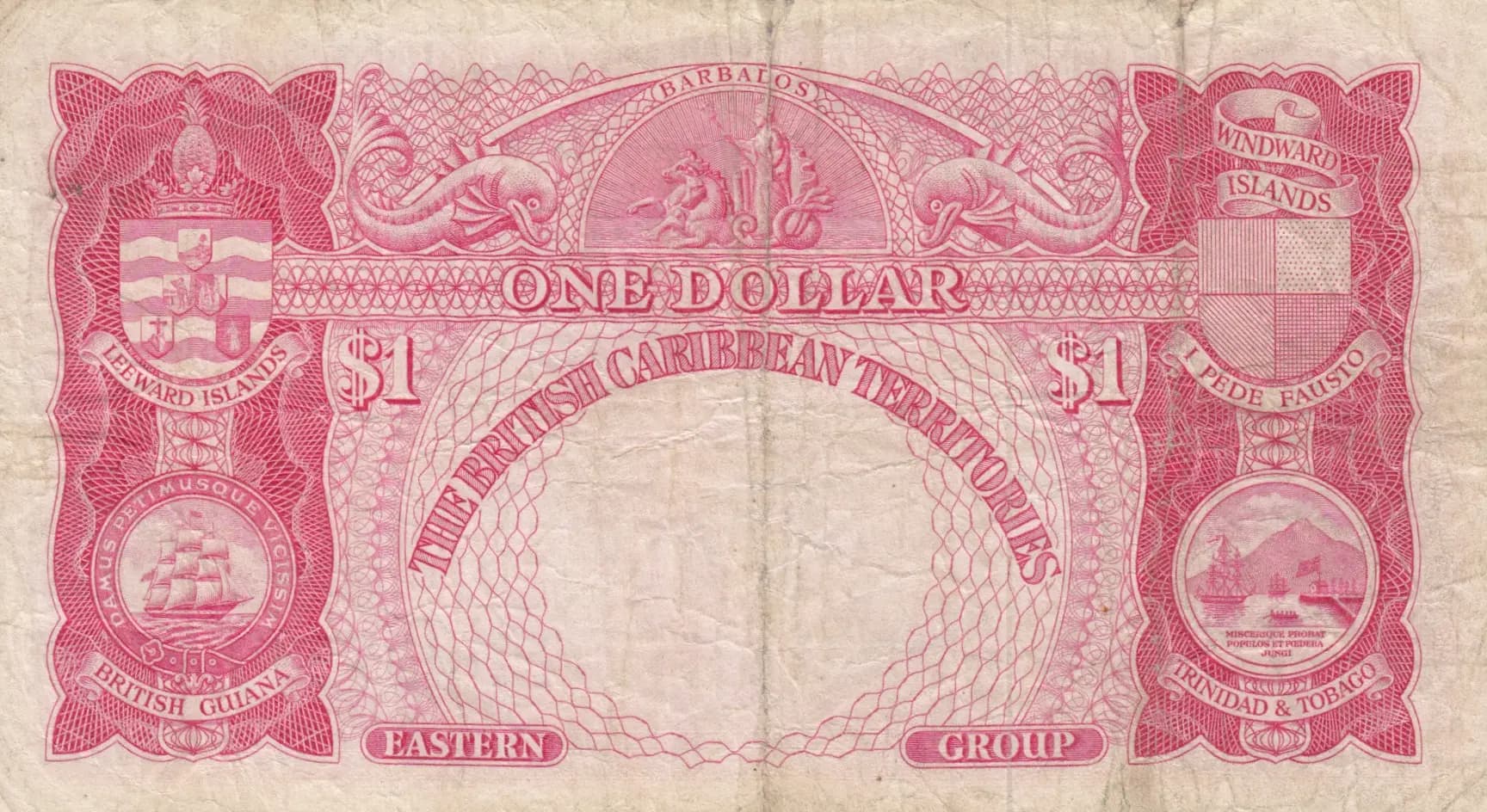
This 1956 British Caribbean Territories one dollar note (Pick 7b) features a striking pink/red color scheme with an elegant portrait of Queen Elizabeth II in an oval frame on the right obverse, accompanied by tropical foliage symbolism on the left. The reverse displays the heraldic arms of four constituent territories (Barbados, Windward Islands, British Guiana, and Trinidad & Tobago), each with detailed maritime imagery reflecting the region's seafaring heritage. In Fine condition, the note exhibits expected circulation wear including creasing, foxing, and yellowing, with a handwritten signature visible on the obverse.
Common. The eBay price history provided shows consistent market activity with F-graded examples selling in the $5.50 to $52 range, with most transactions clustering between $15-$43. The wide range of sales prices reflects normal collector market variation rather than rarity. Print run data and circulation records suggest this was a regular issue for the currency board during its operational period (1954-1957), and surviving examples in Fine condition are readily available to collectors. The denomination of one dollar as a primary circulating note suggests substantial mintage.
Issued on January 3, 1956, during the height of the British Empire's Caribbean colonial administration, this note represents a unified currency attempt for the Eastern Group territories under the British Caribbean Territory Currency Board. The four coats of arms on the reverse—featuring sailing ships and heraldic symbols—commemorate the distinct yet interconnected colonial territories that comprised this monetary union. The inclusion of 'MEMBER OF CARIFTA' on the obverse reflects early Caribbean integration efforts during the post-war decolonization period.
The obverse features Queen Elizabeth II rendered in profile facing right, positioned within an ornate oval frame characteristic of mid-20th century British Commonwealth currency design. The left side incorporates tropical palm fronds and foliage, symbolizing the Caribbean geography. Decorative geometric and floral patterns with intricate cross-hatching fill the background, providing both aesthetic appeal and security through complexity. The reverse displays a central heraldic composition with a sun motif and royal symbolism, surrounded by four corner medallions: Barbados (upper left), Windward Islands (upper right), British Guiana (lower left with a sailing vessel), and Trinidad & Tobago (lower right). Each territory's coat of arms is rendered in fine detail with maritime and heraldic elements reflecting regional identity. The color palette of pink/rose with cream and red accents creates visual distinction while maintaining the elegant formality of colonial-era currency.
FRONT: 'THE BRITISH CARIBBEAN TERRITORIES / EASTERN GROUP / ONE DOLLAR / FOR THE CURRENCY BOARD / MEMBER OF CARIFTA / 3RD JANUARY 1956 / Serial number T2-437898 / THESE NOTES ARE LEGAL TENDER FOR THE PAYMENT OF ANY AMOUNT / BRADBURY, WILKINSON & CO LTD, NEW MALDEN, SURREY, ENGLAND' — All text in English, indicating legal tender status issued by the Currency Board on the stated date, printed by the London security printer. BACK: 'ONE DOLLAR / THE BRITISH CARIBBEAN TERRITORIES / EASTERN GROUP / BARBADOS / WINDWARD ISLANDS / BEWARE ISLANDS / BRITISH GUIANA / TRINIDAD & TOBAGO / PRIDE FACIO' (Latin: 'I do with pride') — The reverse identifies the four constituent territories and their respective heraldic emblems.
Intaglio engraving (line engraving), executed by Bradbury, Wilkinson & Co Ltd (identified as 'BWC' in catalog data), a renowned British security printer located in New Malden, Surrey, England. The fine line work, cross-hatching patterns, and intricate detail visible throughout both sides—particularly in the heraldic imagery, facial features of Queen Elizabeth II, and decorative borders—are characteristic of traditional intaglio/engraving methodology. This technique provided high security against counterfeiting during the period.
This specific note is cataloged as Pick 7b (Eastern Group variant). The visual analysis confirms this is from the Eastern Group issue, as evidenced by the reverse displaying the four Eastern Group territories (Barbados, Windward Islands, British Guiana, Trinidad & Tobago) rather than other potential territorial groupings. The serial number prefix 'T2-437898' and the handwritten signature visible on the obverse are consistent with first-issue Currency Board notes from January 1956. PMG records indicate multiple variants exist for this base Pick number (P-7a through P-7cs), but the Eastern Group designation with BWC printer places this definitively within the P-7b classification. No overprints or special markings indicating a rare sub-variety are apparent.