1 mil reis 1923
Market Prices
About This Note
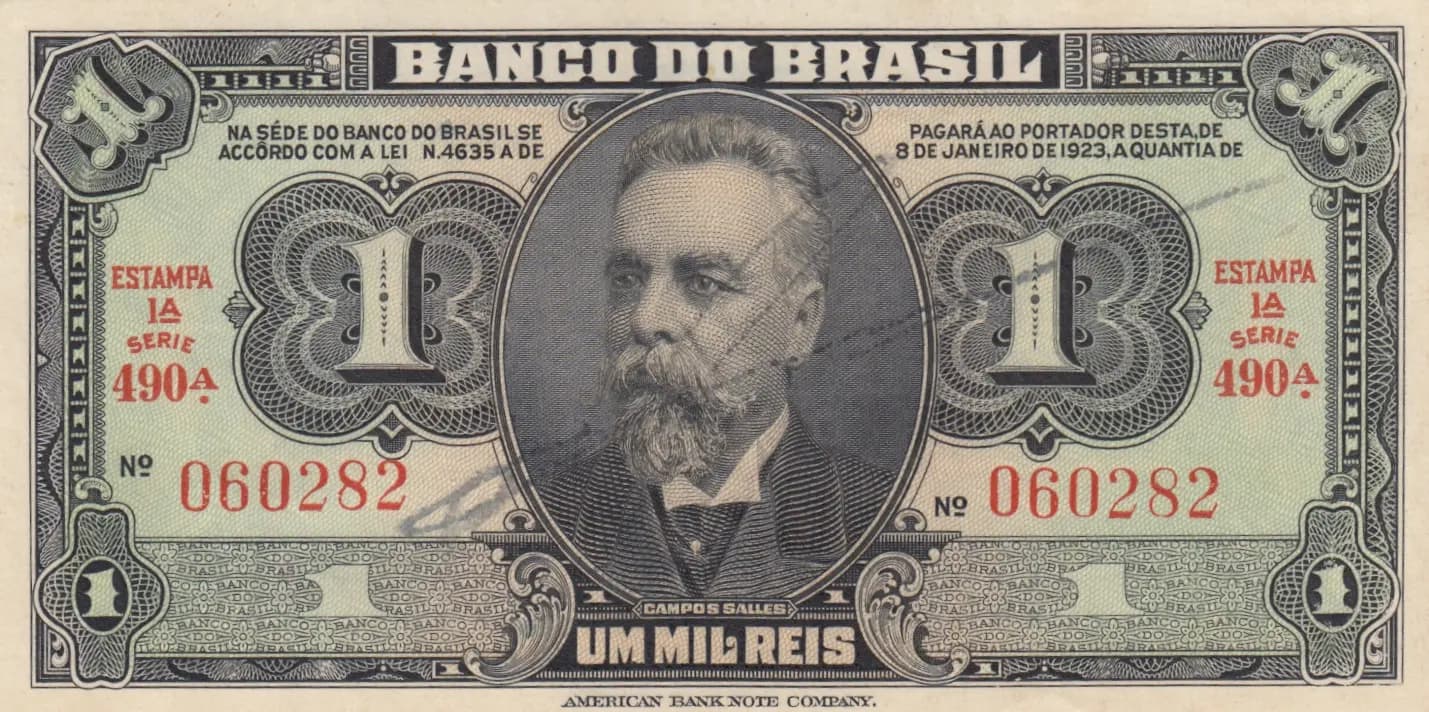
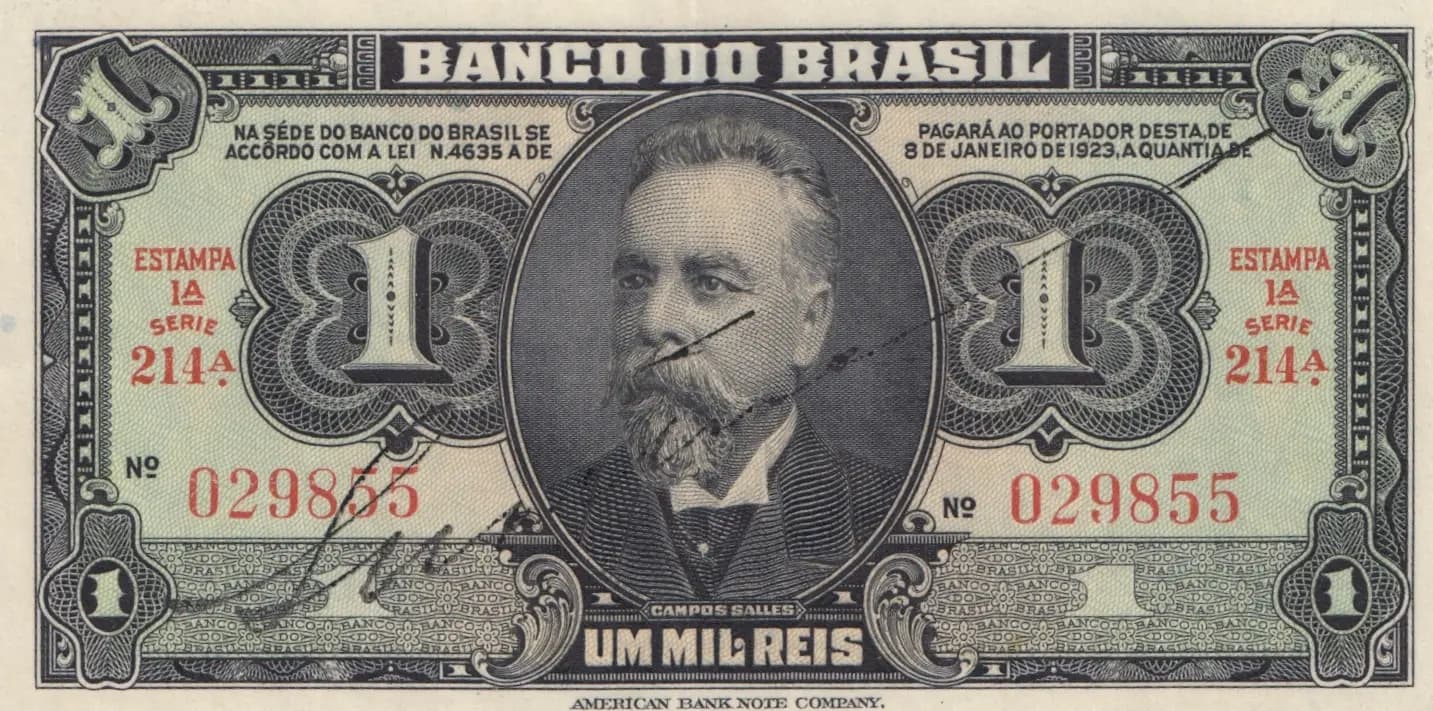
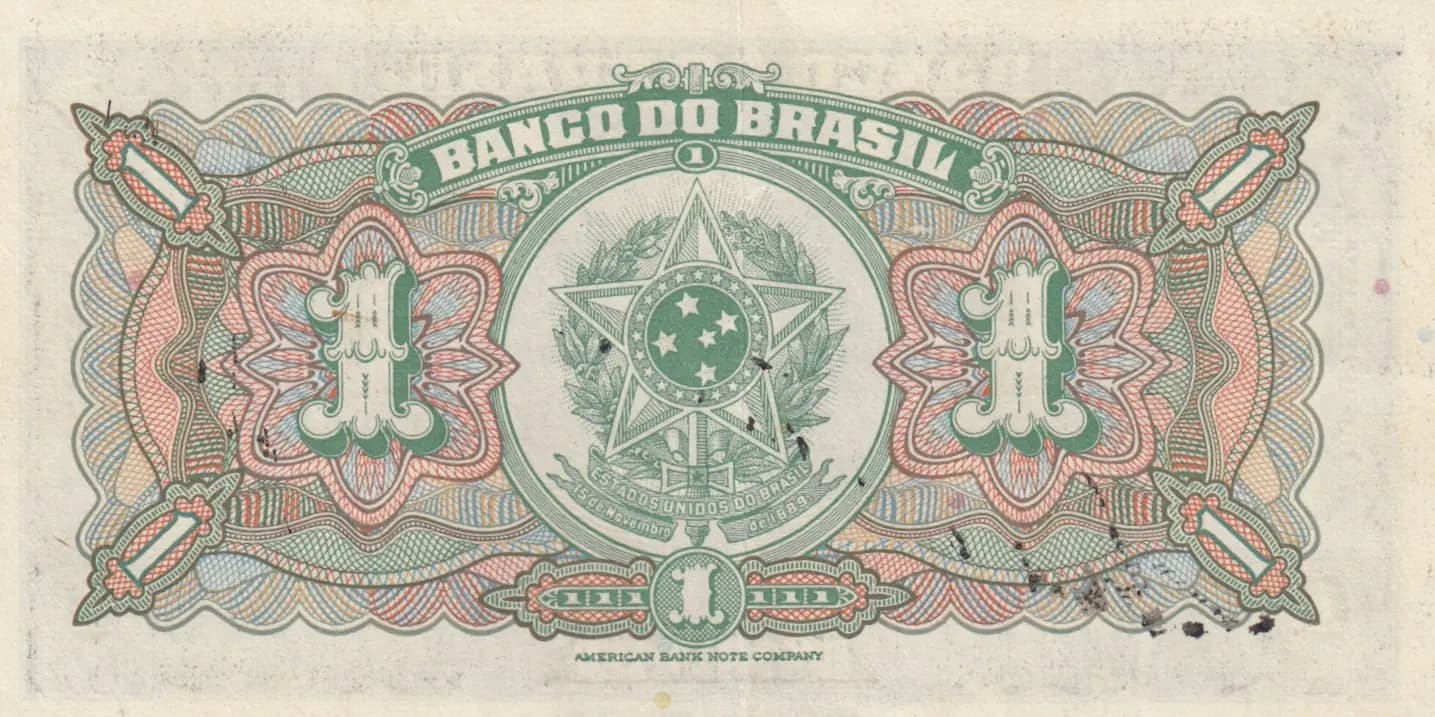
This 1 Mil Reis note from Banco do Brasil (1923) presents a handsome example of early 20th-century Brazilian currency featuring a bearded gentleman in formal dress within an ornate oval frame, complemented by the Brazilian coat of arms on the reverse. The note displays the characteristic aging of a century-old circulated specimen, with visible foxing, creases, and yellowing consistent with heavy use and storage in varied conditions. The American Bank Note Company printing and elaborate engraved security features are clearly evident, making this a representative example of the high-quality intaglio work typical of this era's premium banknote production.
Common. The eBay market data provided shows this note type trading regularly across a broad price range ($6 to $2,095), with multiple examples sold in circulated and uncirculated condition, indicating consistent availability. The PMG population report confirms this variety (P-110B) has multiple examples professionally graded. While EF-grade examples command higher prices in the $40-$800 range, the note's regular appearance in the secondary market and the substantial print run typical of Banco do Brasil 1923 issues confirm its common status. The denomination and issuer were prolific during this period.
This 1923 issue was produced during a transformative period for Brazil's financial systems, as evidenced by the denomination reflecting the country's pre-Cruzeiro currency system. The reverse's prominent display of the Brazilian coat of arms with its star, crescent moon, and eagle motif underscores national pride during the First Republic era (1889-1930), while the steam train depicted on the obverse—and the seated allegorical figure—symbolize Brazil's modernization and industrial progress in the early 20th century. The formal legal inscription referencing Law N.4635 demonstrates the regulatory framework governing currency issuance by Banco do Brasil during this period.
The obverse features a portrait of a bearded gentleman in formal attire, positioned within an ornate oval medallion frame—this represents an allegorical figure symbolizing Brazilian prosperity or commerce rather than a specific historical personage. The denomination 'UM MIL REIS' appears in elaborate numerals on either side of the portrait, with intricate geometric and floral corner ornaments providing decorative framing. The reverse displays the coat of arms of the Estados Unidos do Brasil (United Brazilian States), featuring a central shield design with a prominently positioned four-pointed star and crescent moon, enclosed within a circular frame and surrounded by a laurel wreath. The design employs classical heraldic elements with symmetrical composition, filled background patterns in red, blue, and green creating a visually complex counterfeit-deterrent design. The American Bank Note Company's engraving expertise is evident throughout in the fine line work, cross-hatching, and multi-color intaglio printing.
FRONT SIDE: 'BANCO DO BRASIL' (Bank of Brazil); 'UM MIL REIS' (One Thousand Reis); 'NA SÉDE DO BANCO DO BRASIL SE ACCÔRDO COM A LEI N.4635 A DE' (At the headquarters of Banco do Brasil in accordance with Law N.4635 of); 'PAGARÁ AO PORTADOR DESTA, DE 8 DE JANEIRO DE 1923, A QUANTIA DE' (Will pay to the bearer of this, from January 8, 1923, the amount of); 'ESTAMPA 1ª SERIE 214ª' (Print 1st Series 214th); 'Nº 029855' (Number 029855); 'CAMPOS SALLES' (Campos Salles - likely a dignitary's name); 'AMERICAN BANK NOTE COMPANY' (American Bank Note Company). BACK SIDE: 'BANCO DO BRASIL' (Bank of Brazil); 'ESTADOS UNIDOS DO BRASIL' (United States of Brazil); 'AMERICAN BANK NOTE COMPANY' (American Bank Note Company); Denomination '1' displayed in multiple ornamental locations.
Intaglio engraving with multi-color impression, executed by the American Bank Note Company (ABNC). The visual evidence of raised printed surfaces, intricate fine-line work, complex geometric patterns, and the layered color application (blue, red, green, black on cream background) are all characteristic of high-quality steel-plate intaglio printing. This premium production method was standard for Banco do Brasil notes and provided substantial security against counterfeiting through the complexity of the engraved designs and the technical difficulty of reproducing multi-color intaglio work.
This specific example is identified as Pick P-110B, confirming it as the variant cataloged by Pick and PMG with ABNC as the printer. The serial number 029855 with 'ESTAMPA 1ª SERIE 214ª' designation indicates this is from the first printing series. The note is dated January 8, 1923 (L. 08.01.1923 in catalog notation). Based on visual inspection, no overprints or unusual signature variations are apparent; this appears to be a standard circulation issue of the primary type rather than a specimen, emergency issue, or other specialized variant, consistent with its EF condition grade and regular market availability.