1 cruzeiro 1944
Market Prices
35 salesAbout This Note
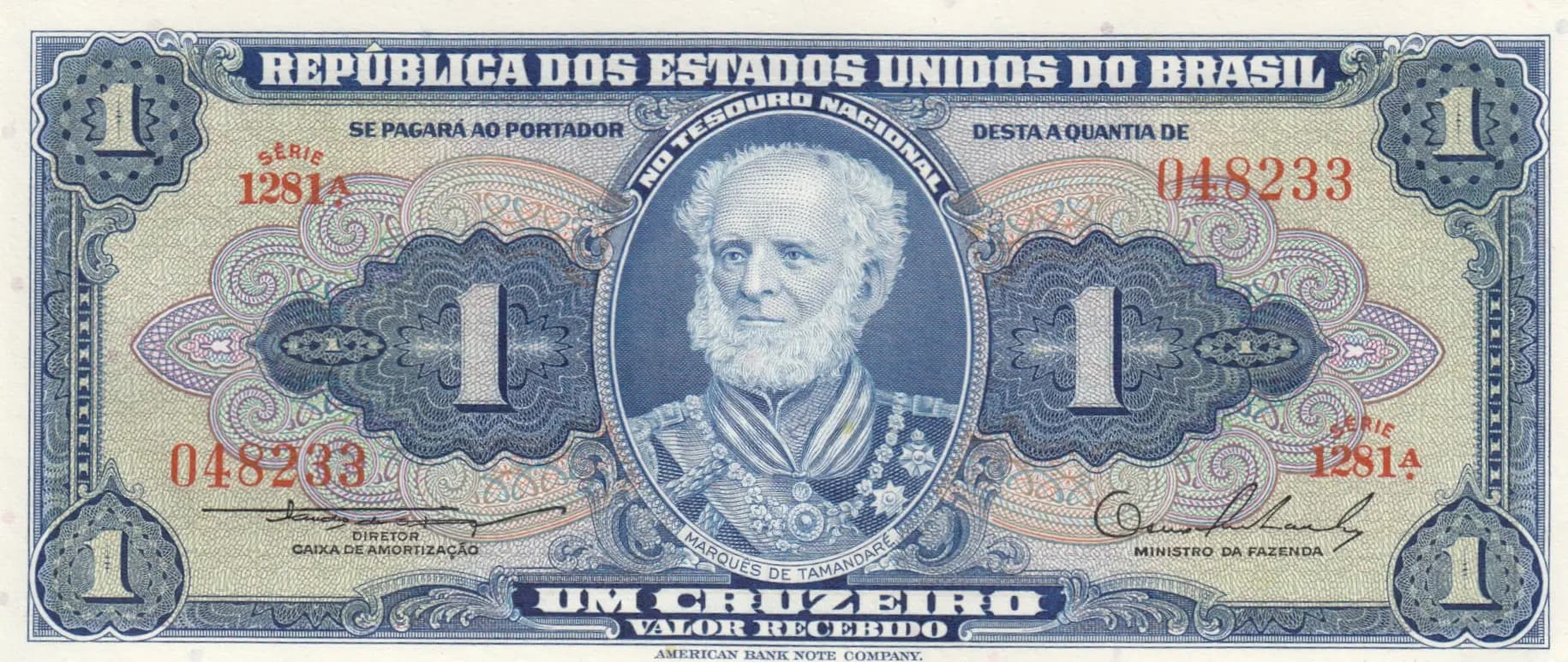
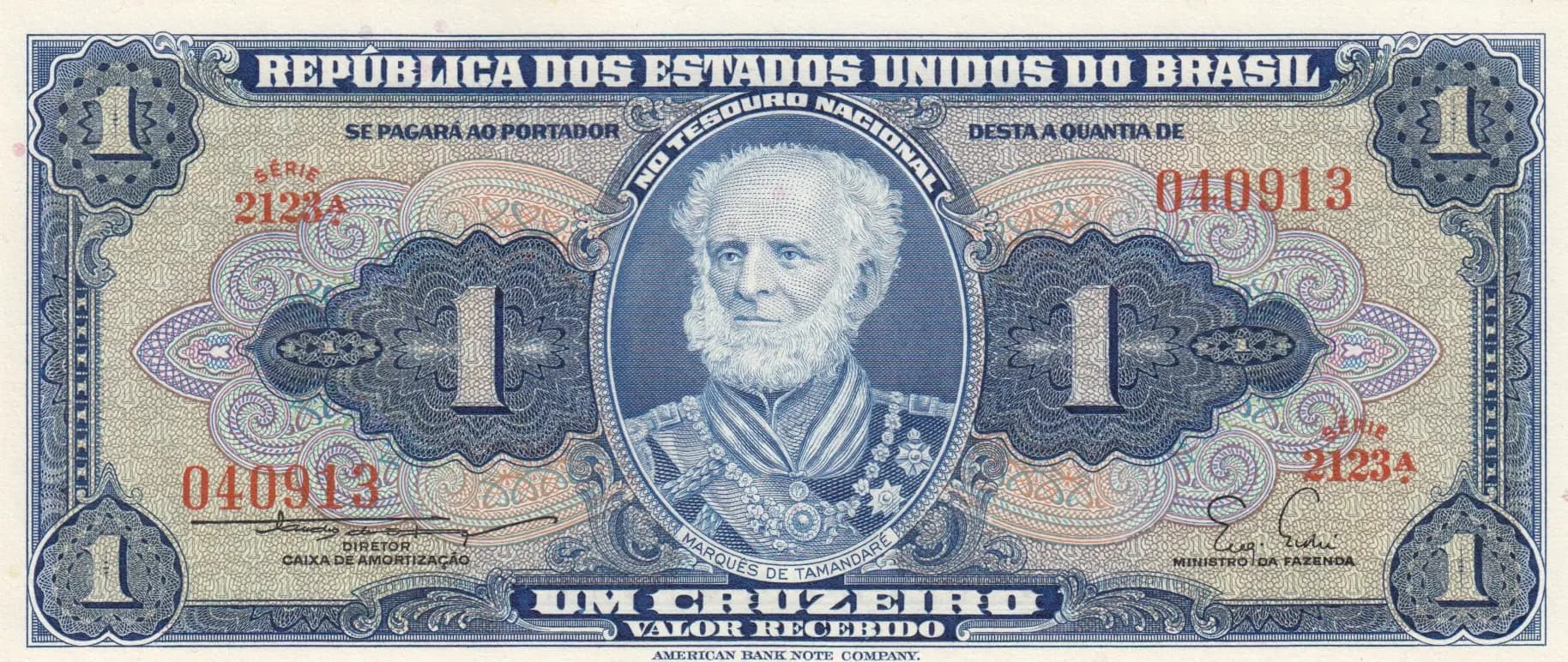
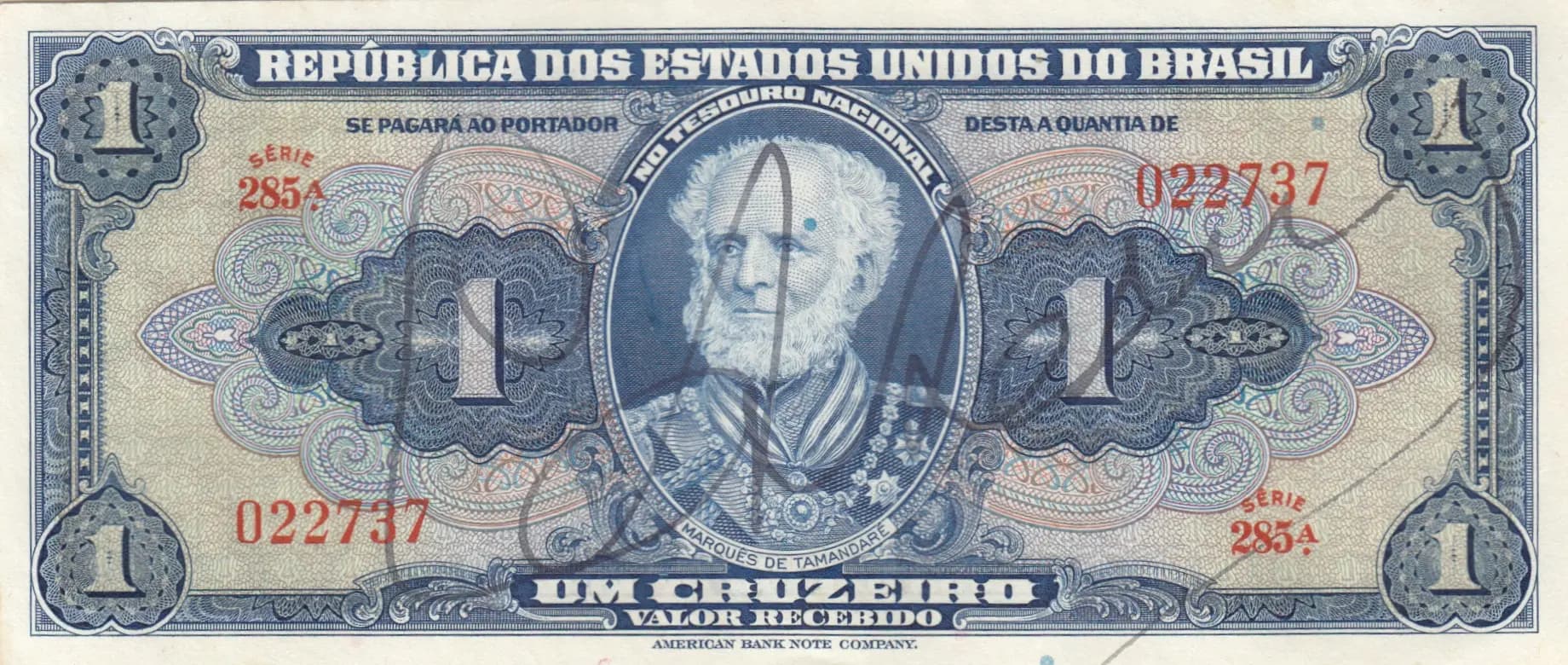
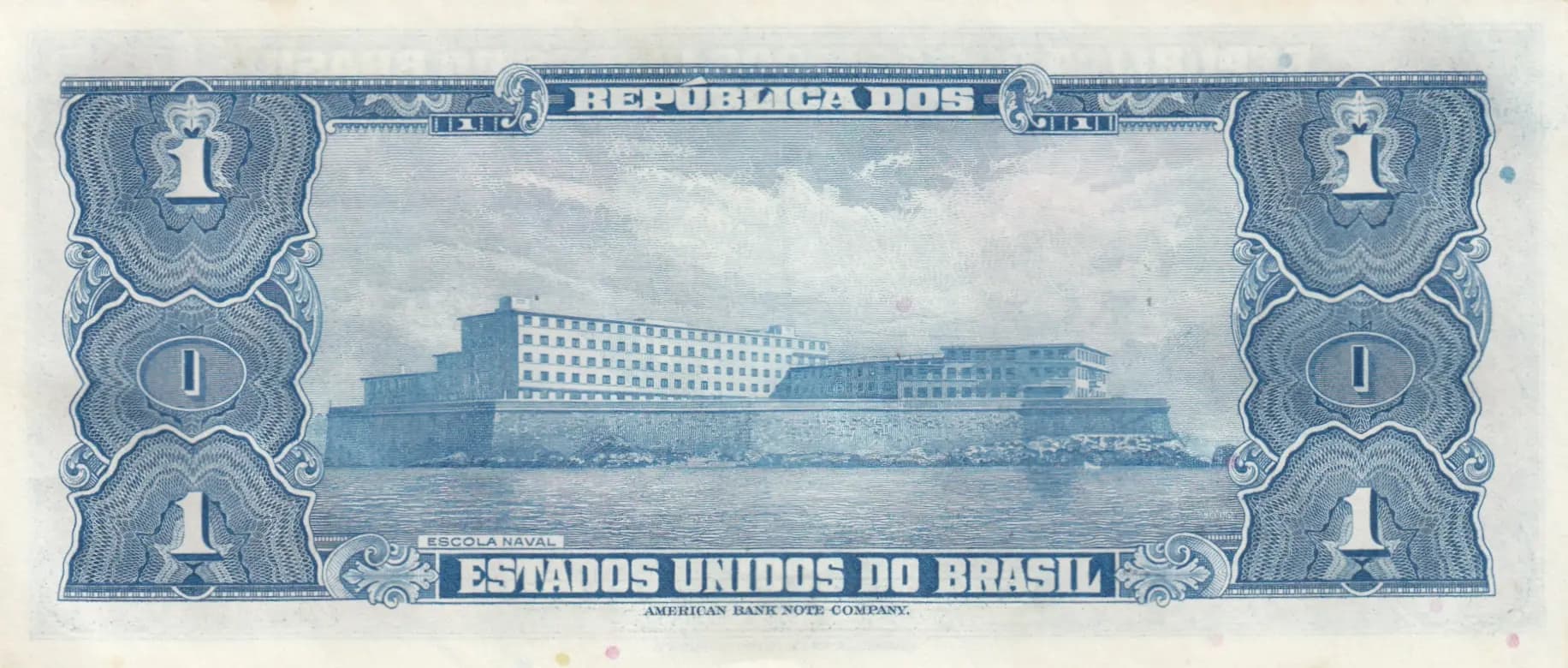
A scarce 1944 Brazilian 1 Cruzeiro banknote issued by Tesouro Nacional and printed by the American Bank Note Company. The note features a striking portrait of Marquês de Tamandaré in military regalia on the obverse and the Escola Naval (Naval School) of Rio de Janeiro on the reverse, rendered in fine blue and multicolor engraving. Despite visible age-appropriate wear including fold creases and light foxing, this UNC-graded example retains excellent visual appeal and represents an important piece of Brazil's mid-20th century currency history.
Common. Despite the note's age and historical interest, eBay market data demonstrates consistent availability with UNC examples typically selling in the $6-7 range in recent years, with 2024 sales documented at $6.39-$7.50. Earlier premium sales (2014: $13.50, 2018: $40 PMG 65) represent outliers likely driven by collector competition rather than scarcity. The 2016 catalog valuation of $3 for UNC reflects its common status. The substantial print run of this regular-issue note and its continued market availability confirm it is not scarce or rare, despite its numismatic appeal.
This 1944 note was issued during Brazil's transition to the Cruzeiro currency system, replacing the Réis. The note commemorates Marquês de Tamandaré, a celebrated Brazilian naval officer and national hero, reflecting Brazil's emphasis on maritime heritage and military institutions during the World War II era. The reverse's depiction of the Escola Naval underscores the government's commitment to naval development and national defense during this pivotal period in Brazilian history.
The obverse features an ornate baroque-style design centered on an oval medallion containing a left-facing profile portrait of Marquês de Tamandaré, a celebrated 19th-century Brazilian naval officer, depicted as an elderly bearded gentleman in formal military dress uniform with regalia. The portrait is surrounded by a circular text ring reading 'O TESOURO NACIONAL' and framed within an intricate oval guilloche border. The denomination '1' appears in four corner shields with baroque ornamental framing featuring fleur-de-lis elements. The background employs complex geometric and floral engraved patterns in light tan and beige with prominent blue decorative elements. The reverse displays an architectural rendering of the Escola Naval (Naval School) of Rio de Janeiro—a multi-story institutional waterfront building with regular window patterns and stepped design—centered within matching corner denomination shields. The color scheme transitions from the obverse's warm tones to predominantly cool blue tones on the reverse. All text is rendered in period-appropriate Portuguese, establishing the note's official governmental authority.
FRONT: 'REPUBLICA DOS ESTADOS UNIDOS DO BRASIL' (Republic of the United States of Brazil); 'SE PAGARÁ AO PORTADOR' (Will be paid to the bearer); 'DESTA A QUANTIDADE DE' (Of this the quantity of); 'UM CRUZEIRO' (One Cruzeiro); 'VALOR RECEBIDO' (Value received); 'O TESOURO NACIONAL' (The National Treasury); 'MARQUE DE TAMANDARE' (Marquis of Tamandaré); 'AMERICAN BANK NOTE COMPANY' (printer identification); 'SERIE 285A' (Series designation); Serial numbers '022737' and '022747'. BACK: 'REPUBLICA DOS ESTADOS UNIDOS DO BRASIL' (Republic of the United States of Brazil); 'ESCOLA NAVAL' (Naval School); 'AMERICAN BANK NOTE COMPANY' (printer identification).
Intaglio engraving (steel plate engraving) executed by the American Bank Note Company of New York, a premier security printer of the era. The technique is evidenced by the fine line work, cross-hatching, intricate guilloches, complex geometric patterns, and precise architectural details visible throughout both sides. The depth and clarity of the portrait engraving and the delicate guilloche borders are characteristic of high-security intaglio printing. The hand-signature capability (as noted in catalog references) further indicates traditional engraved note production methods standard to ABNC's processes in the 1940s.
Series 285A is identified on both sides of this specimen. The note exhibits the standard hand-signed format typical of Tesouro Nacional issues of this period. Serial number 022737 is visible, placing this within the lower range of the 1-1000 series number sequence noted in catalog references. No rare varieties (such as unissued remainders, printer's specimens, or significant overprint variants) are documented for this Pick number. Variations in series designation (285A appears standard for this issue) and signature combinations may exist but do not constitute major catalogued varieties.