50 dollars 1970 specimen
Market Prices
1 saleAbout This Note
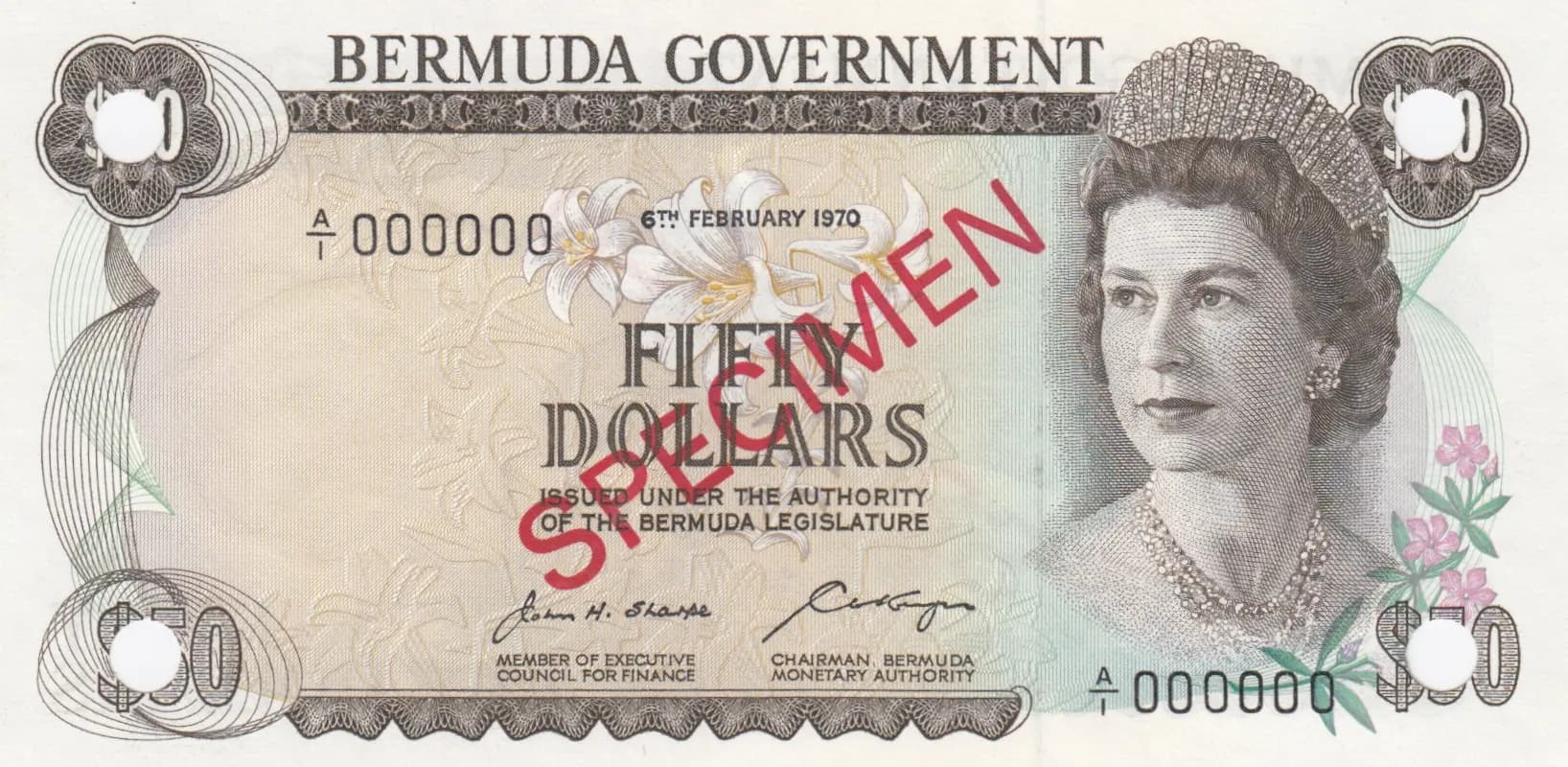
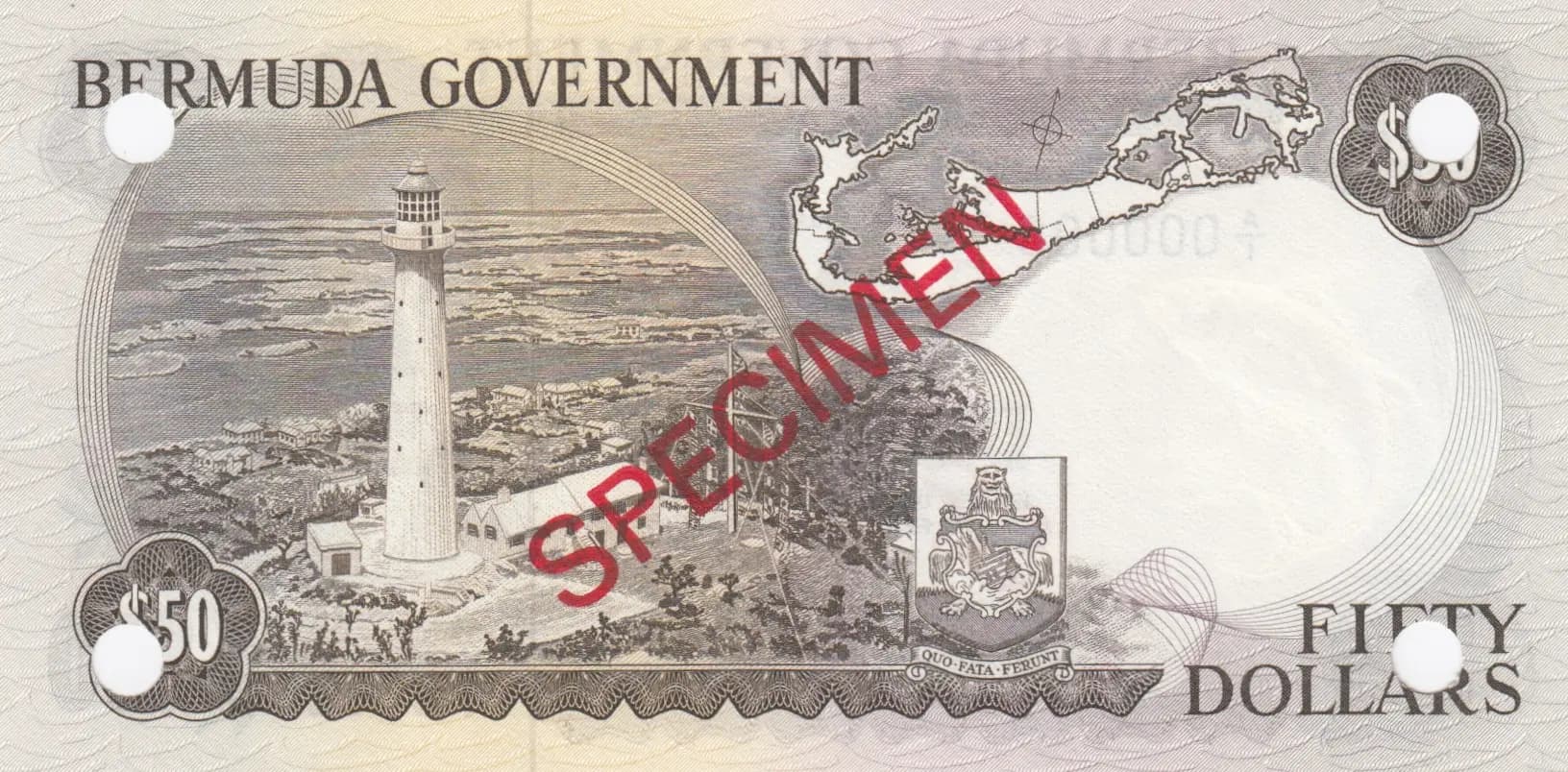
This is a Bermuda Government 50 Dollar specimen note from February 6, 1970, presented in uncirculated condition. The note features a striking portrait of Queen Elizabeth II on the obverse and Gibb's Hill Lighthouse on the reverse, both rendered in fine detail with brown, green, and beige tones. As a specimen note marked with prominent red diagonal text, this represents an official demonstration piece from the Bermuda Monetary Authority—notably scarcer than circulation examples and highly sought by collectors of Commonwealth currency and lighthouse-themed banknotes.
Uncommon. Specimen notes from the 1970 Bermuda Government series are scarcer than circulation examples due to limited production runs for demonstration and archival purposes. The eBay market data provided shows a PMG 67 example selling for $290 in 2022 with strong bidding activity, significantly above the 2019 UNC catalog value of $60, indicating collector interest and appreciation. However, these notes are not 'rare'—specimens regularly appear in the market and trading volume is sufficient for reliable pricing. The uncirculated condition and specimen designation elevate appeal relative to worn circulation notes of the same series.
This 1970 specimen commemorates Bermuda's early period of monetary independence under the Bermuda Government and Bermuda Monetary Authority. The note's imagery—Queen Elizabeth II representing the Commonwealth connection and Gibb's Hill Lighthouse symbolizing Bermuda's maritime heritage and navigation history—reflects the island's identity during a transitional period in its economic and political development. The Latin motto 'Quo Fata Ferunt' (Where the Fates carry us) on the heraldic shield underscores Bermuda's seafaring traditions.
The obverse features a formal three-quarter portrait of Queen Elizabeth II positioned at the right, rendered in refined line-work characteristic of 1970s Commonwealth banknote engraving. Her portrait is accompanied by the royal arms positioned at left-center. The design is framed by ornamental elements including white lily florals in the upper center, flower-shaped corner designs containing circular medallions, and decorative rosette patterns along the top and bottom borders. The reverse showcases Gibb's Hill Lighthouse—Bermuda's iconic 117-year-old navigational landmark—depicted with precise detail against a coastal seascape, accompanied by an inset map of Bermuda showing the island's distinctive shape. The heraldic coat of arms with the motto 'Quo Fata Ferunt' appears prominently, reinforcing official authority. Both sides employ intricate geometric line patterns and fine engraved detailing throughout.
Front: 'BERMUDA GOVERNMENT' (governmental issuer); '6TH FEBRUARY 1970' (issue date); 'FIFTY DOLLARS' (denomination); 'SPECIMEN' (specimen designation); 'ISSUED UNDER THE AUTHORITY OF THE BERMUDA LEGISLATURE' (legal authority); 'John H. Sharpe' (signature of Member of Executive Council for Finance and Chairman, Bermuda Monetary Authority); Serial numbers 'A 000000' (specimen numbering). Back: 'BERMUDA GOVERNMENT' (issuer); 'SPECIMEN' (specimen marking); 'FIFTY DOLLARS' (denomination); 'Quo Fata Ferunt' (Latin motto meaning 'Where the Fates carry us' or 'As Destiny Leads'); '50' (denomination numeral).
Intaglio engraving (line engraving and steel plate engraving), the standard security printing method for Commonwealth banknotes of this era. The fine detailed work visible on the portrait, lighthouse, map, borders, and geometric security patterns indicates professional currency engraving characteristic of British-influenced commonwealth banknote production circa 1970. The note was produced as a specimen issue, indicating official sample printing rather than circulation production.
This is a specimen note (marked 'SPECIMEN' in red diagonal overprint) from the Pick 27s series. Specimen varieties are distinguished from circulation issues (Pick 27) by this red overprint and typically have serial numbers rendered as 000000. The signature of John H. Sharpe (Member of Executive Council for Finance and Chairman, Bermuda Monetary Authority) is present on the obverse. No significant sub-varieties are documented for the 1970 specimen issue, making this a straightforward catalog type rather than a complex variety-laden series.