5 shillings 1952
Market Prices
19 salesAbout This Note
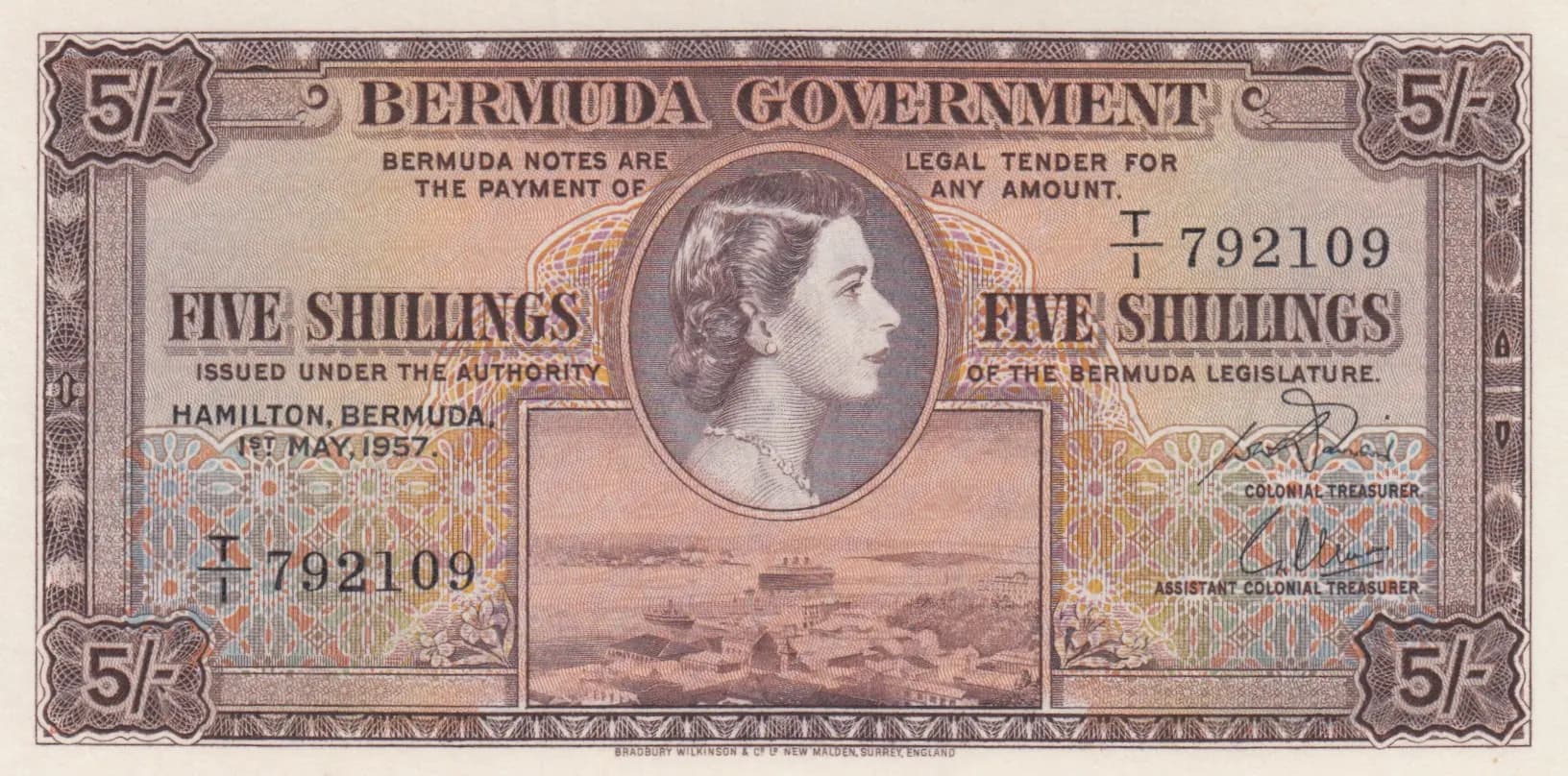
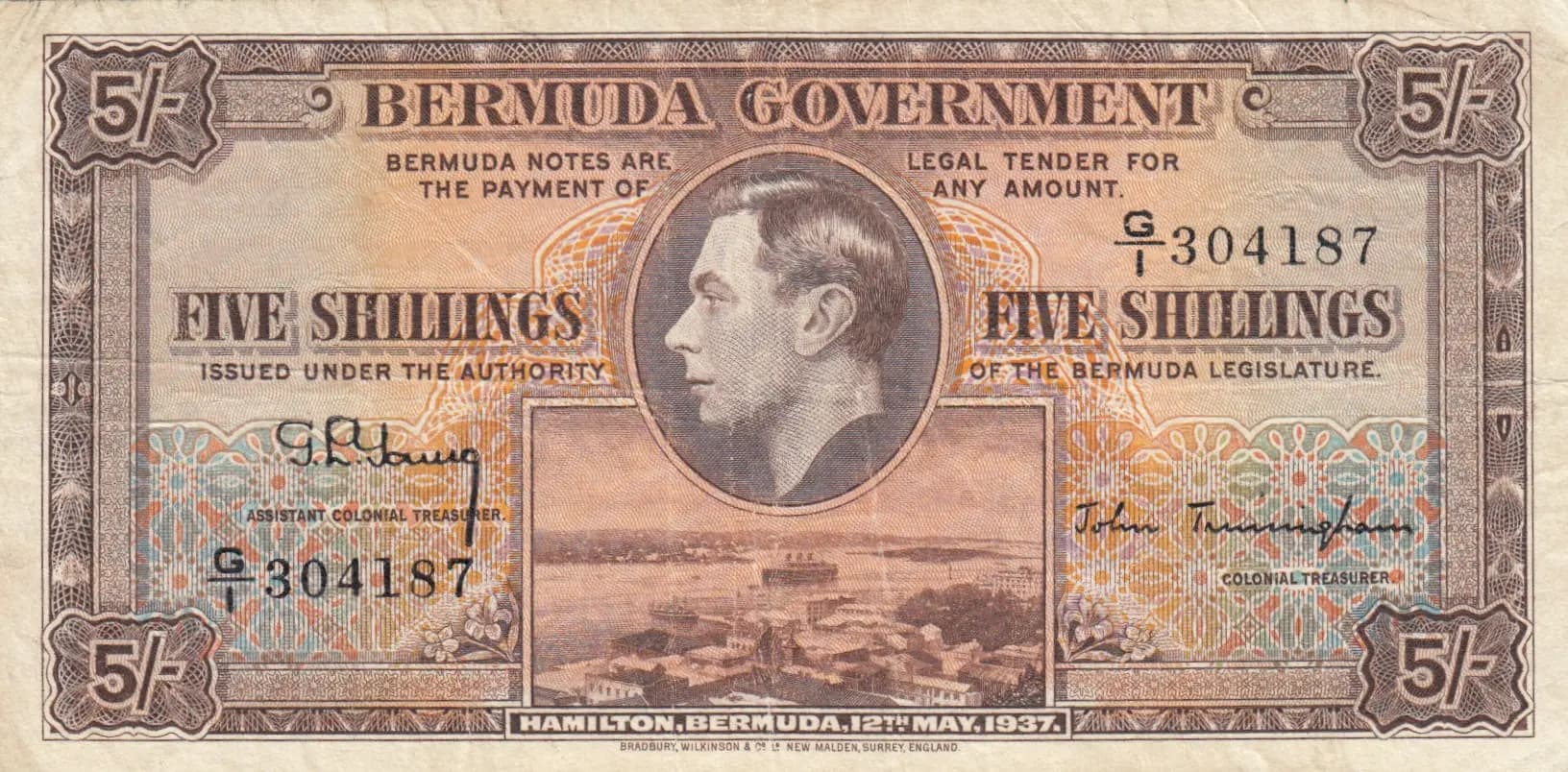
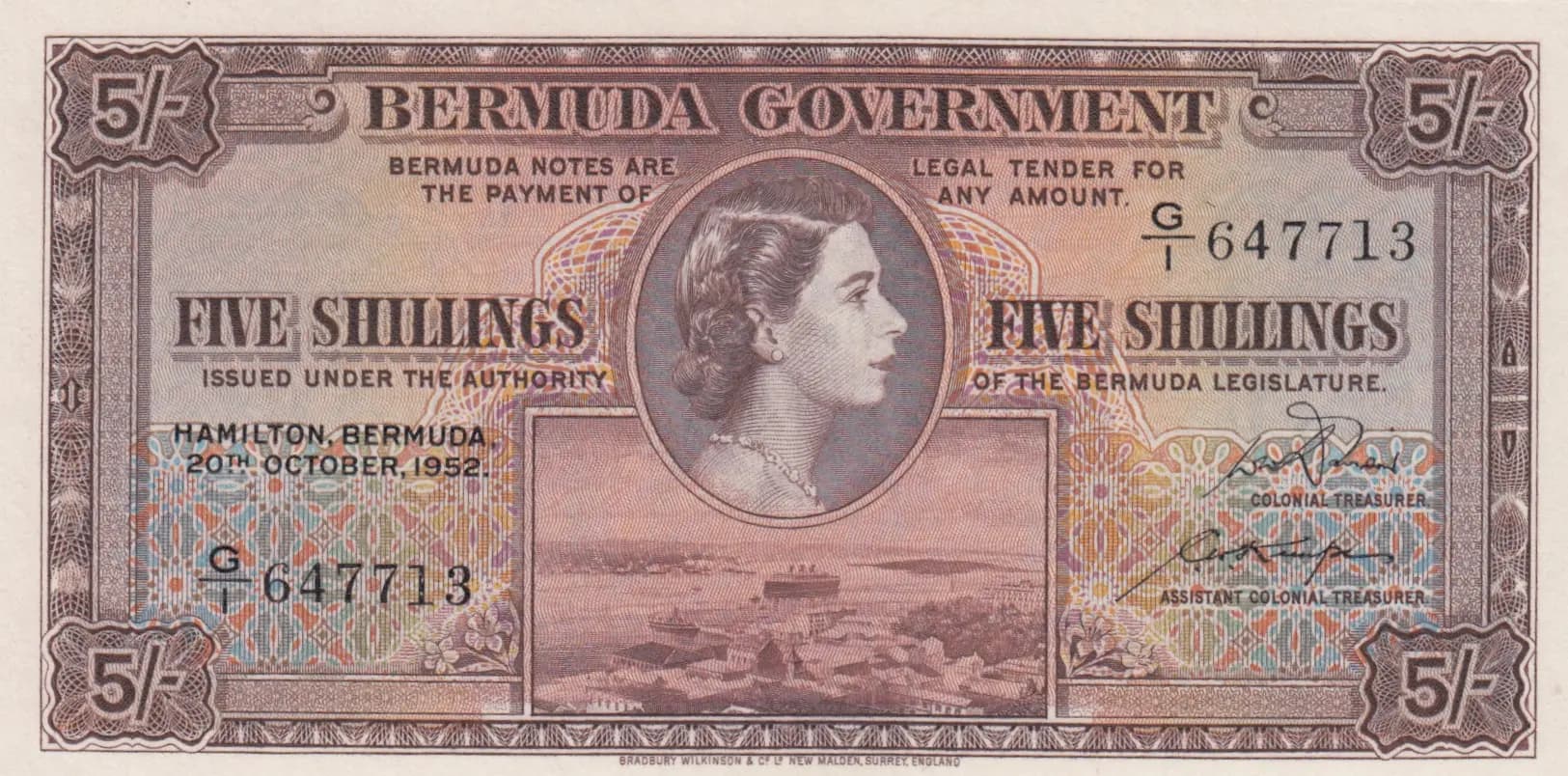
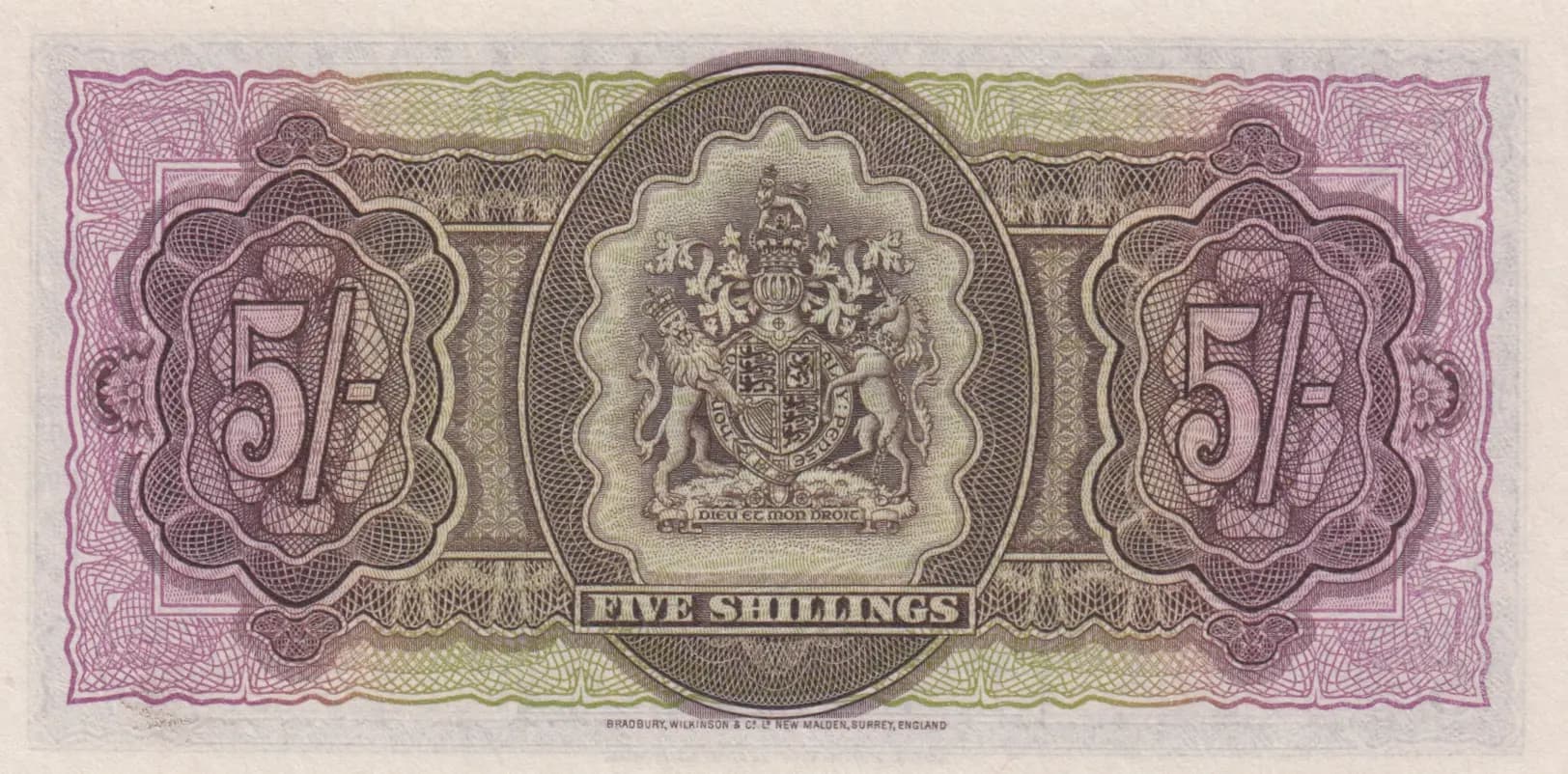
This is a striking example of the 1952 Bermuda Government 5 Shillings note (Pick P-18a), rendered in UNC condition with exceptional eye appeal. The obverse features a classical portrait of Queen Elizabeth II in profile within an ornate oval medallion, set against an intricate purple and orange color scheme with fine security engraving throughout. The reverse displays the royal coat of arms with impressive heraldic detail, making this an important early Commonwealth issue from Bermuda's post-war period.
Common. This is a regular issue from Bermuda's 1952 series with substantial print runs typical of government circulation currency. eBay market data shows consistent sales across multiple condition grades (2013-2026), with UNC examples reaching $225 catalog value but regularly realizing $75-$103 in auction. The consistent availability across multiple grading services and steady market presence indicates robust supply. This is a collectible note of interest to Commonwealth and Caribbean specialists, but not scarce in absolute terms.
Issued on 20th October 1952, just four months after Elizabeth II's accession to the throne, this note represents Bermuda's early post-war currency modernization under the Bermuda Government authority. The prominence of the young Queen's portrait and the royal coat of arms on the reverse reflect Bermuda's status as a Crown Colony and the continuity of British sovereignty during the early Cold War era. The 5 shillings denomination would remain in circulation until Bermuda's currency decimalization in 1970.
The obverse showcases a formally engraved portrait of Queen Elizabeth II in left-facing profile, positioned centrally within an ornamental oval frame. The background suggests a coastal landscape element, likely referencing Hamilton Harbour as noted in catalog references, providing geographic context to the Bermuda issuer. The reverse features the royal coat of arms of Bermuda with formal heraldic supporters (lion and dragon) beneath a crown, flanked by decorative shield-shaped ornaments bearing the denomination. The entire note is executed in a sophisticated purple/mauve and orange palette with tan/beige accents, employing the fine-line security engraving techniques characteristic of high-security banknote production.
FRONT: 'BERMUDA GOVERNMENT' (issuing authority); 'FIVE SHILLINGS' (denomination, repeated); 'BERMUDA NOTES ARE LEGAL TENDER FOR THE PAYMENT OF ANY AMOUNT.' (legal tender declaration); 'ISSUED UNDER THE AUTHORITY OF THE BERMUDA LEGISLATURE.' (issuing authorization); 'HAMILTON, BERMUDA' (place of issue); '20TH OCTOBER, 1952' (issue date); 'G/T 647713' (serial number, repeated); 'COLONIAL TREASURER' and 'ASSISTANT COLONIAL TREASURER' (signatory titles); 'BRADBURY WILKINSON & CO LTD NEW MALDEN, SURREY, ENGLAND' (printer identification). BACK: 'FIVE SHILLINGS' (denomination); 'DIEU ET MON DROIT' (French, 'God and My Right' — the royal motto); 'BRADBURY WILKINSON & CO LTD NEW MALDEN, SURREY, ENGLAND' (printer identification).
This note was produced by Bradbury Wilkinson & Co Ltd, New Malden, Surrey, England — one of the world's premier security printers of the era. The printing employs traditional intaglio (engraved) engraving techniques throughout, evidenced by the crisp, fine-line detail, complex geometric security patterns in the background, and the three-dimensional appearance of the portraits and heraldic elements. The multicolor application (brown on multicolored underprint) was achieved through sequential passes of the engraved plates, a hallmark of high-security banknote production in the mid-20th century.
This note is cataloged as Pick P-18a, with known variants including P-18b and P-18cts (likely representing different printer marks or signature combinations). The visual analysis shows this example bears the serial number prefix 'G/T 647713' and reflects the standard 20th October 1952 issue date. No overprints or exceptional signature variants are evident in the images. The Bradbury Wilkinson printer mark is standard for this issue.