100 dollars 1982 specimen
Market Prices
1 saleAbout This Note
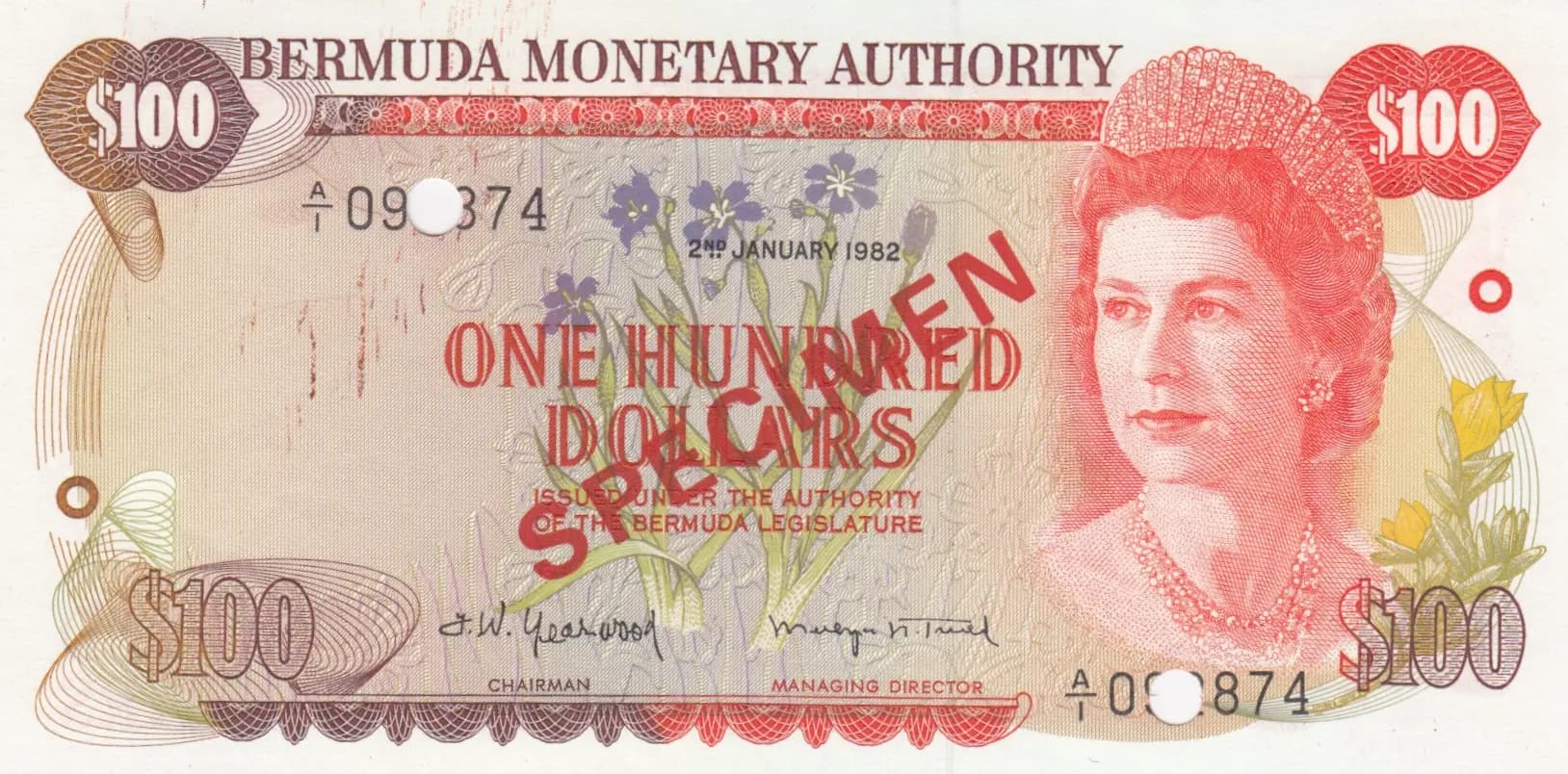
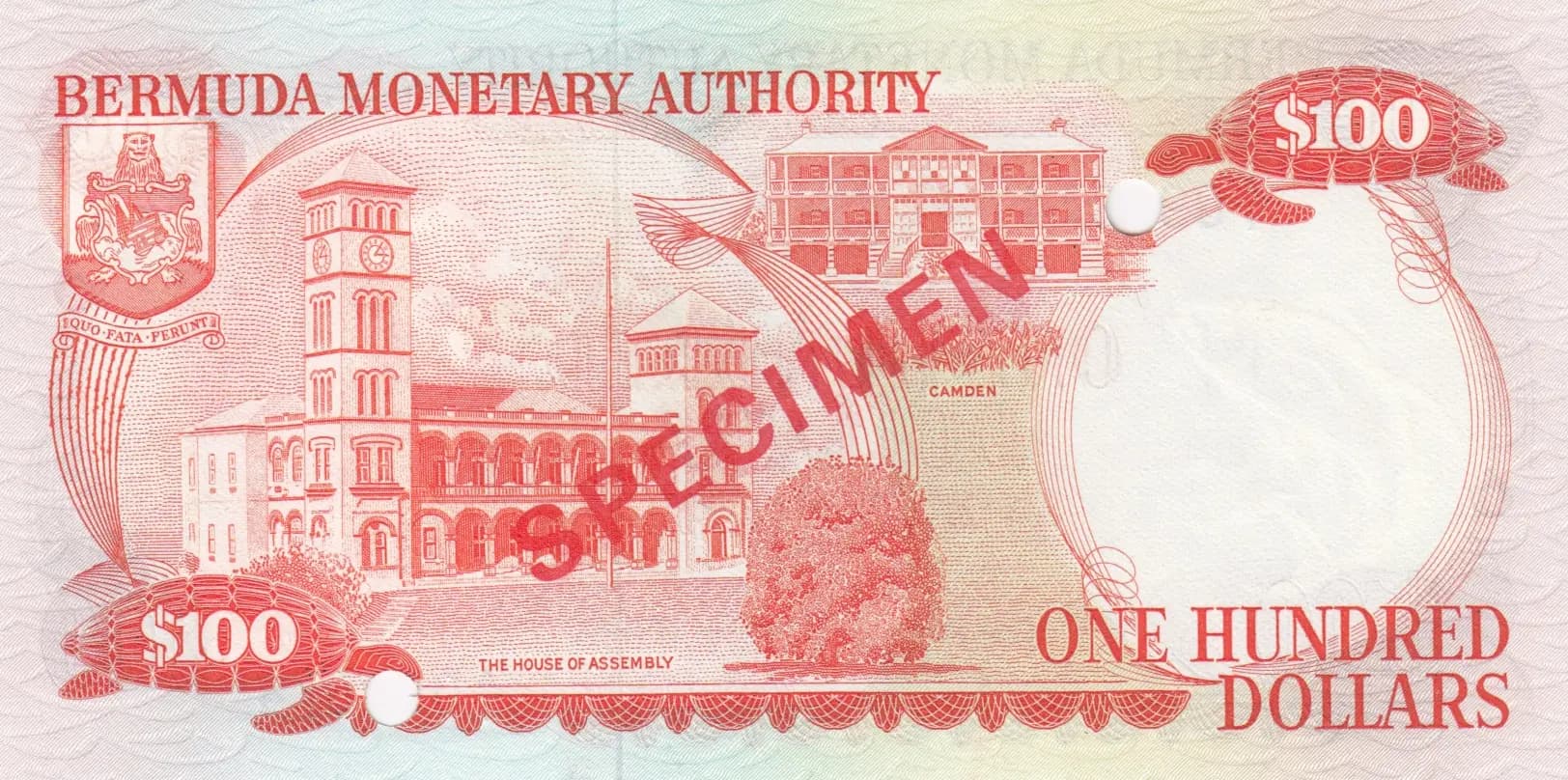
This is a Bermuda 100 Dollar specimen note from 1982, cataloged as Pick P-33as, featuring a portrait of Queen Elizabeth II on the front rendered in red/pink intaglio tones alongside decorative floral garlands. The reverse depicts significant Bermuda architectural landmarks including the House of Assembly and Camden building, with a sea turtle illustration, all in red intaglio printing on a cream background. As a specimen note bearing the red 'SPECIMEN' overprint, this note was never intended for circulation and represents an important reference example from the 1982 Bermuda currency series, with the UNC grade indicating well-preserved paper despite age-related patina.
Common. This is a specimen note from a standard currency series issued in 1982. While specimen notes are not circulated, they were produced in reasonable quantities as reference examples for banks, collectors, and official archives. The catalog value of approximately $900 UNC (per 2019 data) and the observed eBay transaction at $1,065 for a PMG 65 example indicate steady collector demand but not rarity. The 1982 Bermuda 100 Dollar note was part of a regularly-issued denomination series and lacks the characteristics (short print run, recall, or limited issuing period) that would classify it as scarce or rare.
Issued on 24th January 1982 by the Bermuda Monetary Authority under authorization of the Bermuda Legislature, this note represents the modern currency era of the island nation during the early 1980s. The reverse design emphasizes Bermuda's colonial heritage and civic institutions through depictions of the House of Assembly and Camden building, reflecting the nation's political structure, while the inclusion of the sea turtle references Bermuda's maritime natural heritage and environmental identity during this period.
The obverse features Queen Elizabeth II in right-facing profile rendered in elegant red/pink intaglio, positioned on the right side of the note. The design incorporates decorative security elements including purple and yellow floral garlands with ornamental patterns, shell or scallop designs in the corners, and complex concentric line patterns throughout. The reverse depicts two of Bermuda's most important civic and historical landmarks: the House of Assembly (the seat of Bermuda's legislature) and the Camden building, rendered in detailed architectural engraving. A sea turtle, symbolizing Bermuda's maritime heritage, appears on the right side. The Bermuda Monetary Authority coat of arms with crown and shield appears on the left of the reverse, accompanied by the Latin motto 'Qui Data Fecunt.' All elements employ fine-line intaglio work typical of high-security banknote design of this era.
Front side: 'BERMUDA MONETARY AUTHORITY' (issuing authority); '$100' and 'ONE HUNDRED DOLLARS' (denomination); '24th JANUARY 1982' (issue date); 'ISSUED BY THE AUTHORITY OF THE BERMUDA LEGISLATURE' (legal authorization); 'SPECIMEN' (indicates non-circulating specimen); Serial numbers 'A 09 374' and 'A 00 874'; Signature lines for 'CHAIRMAN' (J.W. Pearwood) and 'MANAGING DIRECTOR' (Murray H. Tread). Back side: 'BERMUDA MONETARY AUTHORITY' (issuing authority); '$100' and 'ONE HUNDRED DOLLARS' (denomination); 'THE HOUSE OF ASSEMBLY' and 'CAMDEN' (labeled landmarks); 'QUI DATA FECUNT' (Latin motto, translating to 'Who gave these' or 'Those who acted'); 'SPECIMEN' (non-circulating designation).
This note was produced using intaglio printing (engraved plate printing), the standard security printing method for banknotes. The process is evident from the fine line work, detailed portraiture, ornamental patterns, and complex background designs visible throughout both sides. The crisp detail in the architectural renderings and the dimensional quality of the portrait reflect the sophisticated craftsmanship of professional security printers. The specific printer for Bermuda's 1982 series was likely a major international security printer (British American Bank Note Company was a common contractor for Commonwealth notes during this period), though confirmation would require additional research into Bermuda Monetary Authority contracts.
This specimen is cataloged as P-33as (the 's' suffix indicating specimen status). The PMG population report identifies this as variant P-33s with watermark specification: Tuna Fish (which serves as the security watermark for this denomination). Visible signatures are by Chairman J.W. Pearwood and Managing Director Murray H. Tread. The serial numbers visible are A 09 374 and A 00 874, with the 'A' prefix indicating the series. As a specimen note, the red 'SPECIMEN' overprint is a defining characteristic, distinguishing it from regular P-33a circulation notes.