50 francs 1959
Market Prices
22 salesAbout This Note
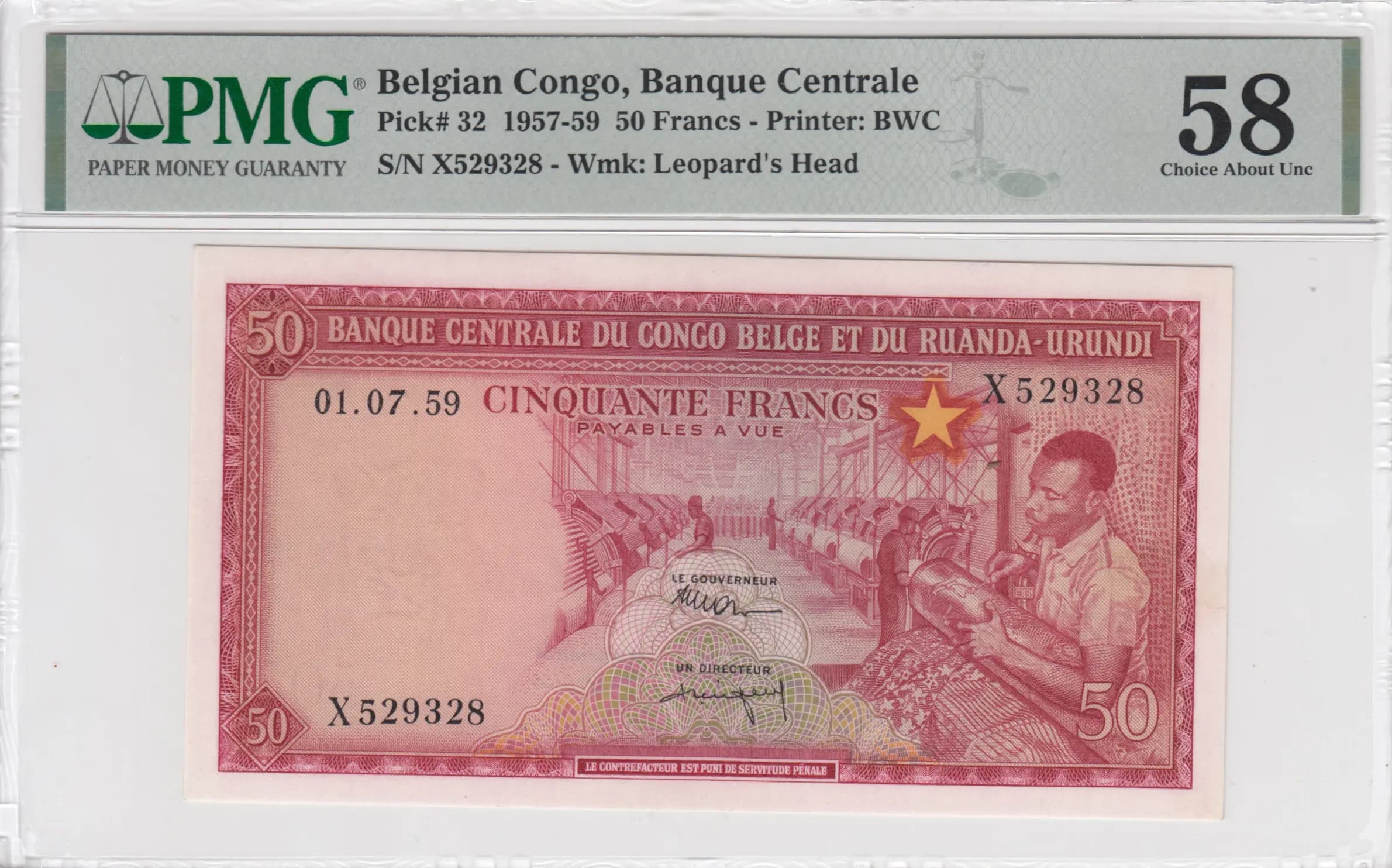
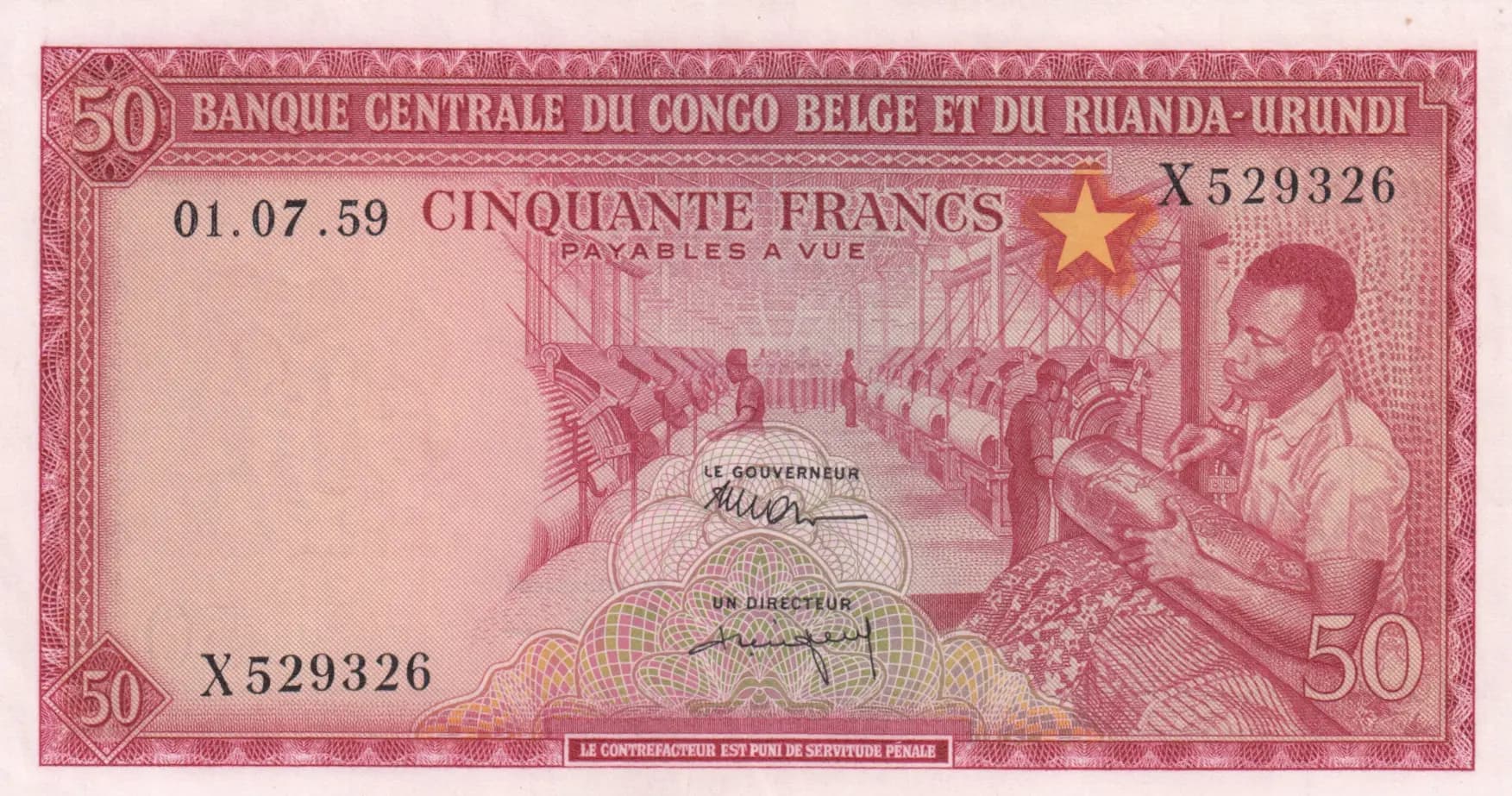
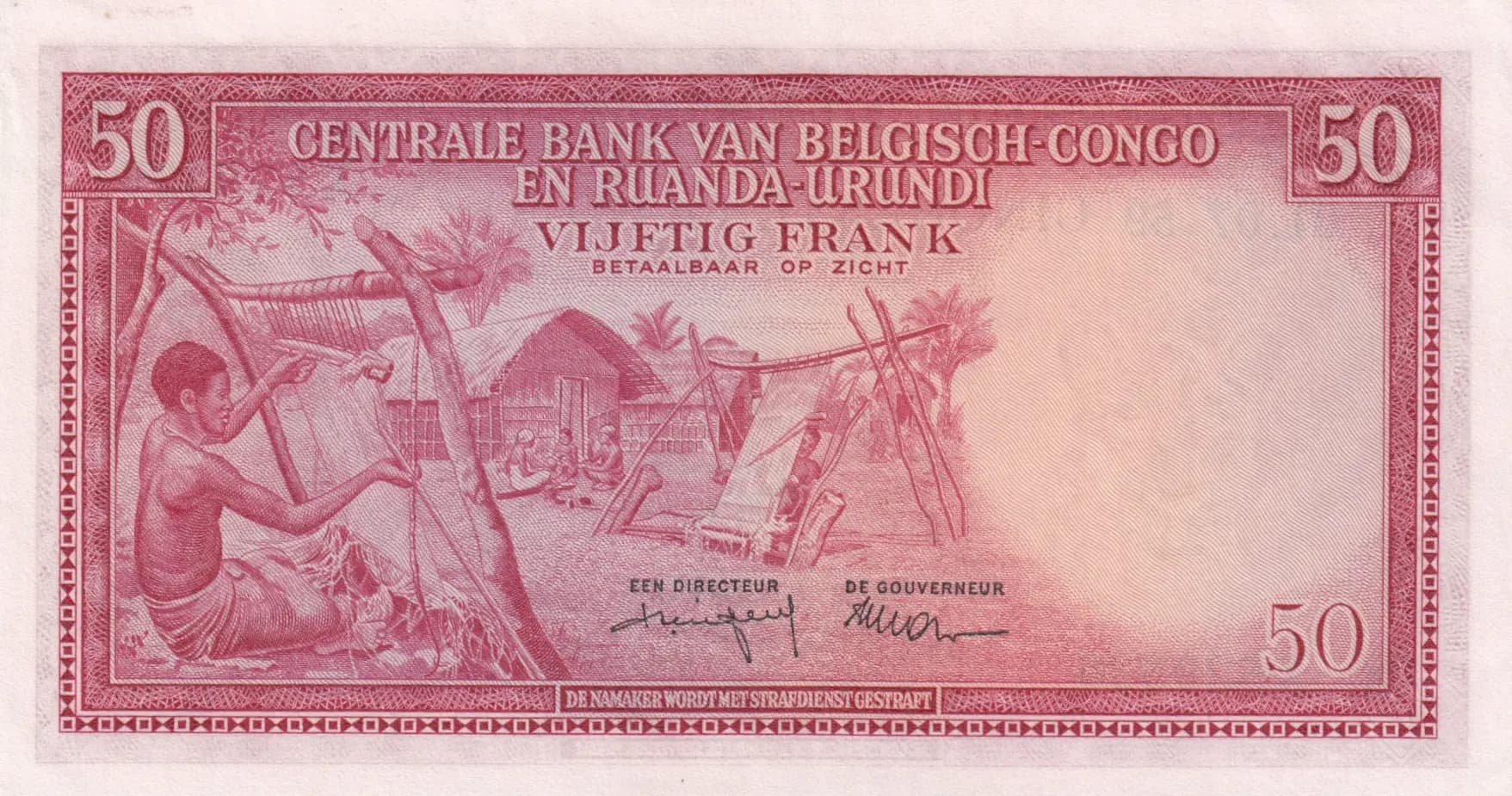
An exceptional uncirculated example of the Belgian Congo 50 Francs from 1959, graded UNC. This note exhibits crisp, clean surfaces with no visible wear, creases, or circulation marks, displaying the characteristic pink/mauve color scheme with sharp detail throughout. The obverse features an impressive industrial scene with workers at modern weaving machinery and a prominent gold star, while the reverse depicts traditional hand-weaving and rural agricultural activity, presenting a compelling visual narrative of Congo's economic development during the final years of Belgian colonial rule.
Common. Despite the historical significance of this final year of issue before Congolese independence, eBay market data shows consistent availability with regular sales in the $10-45 range for circulated and near-uncirculated examples. Even professionally graded PMG 65 specimens, while commanding premium prices ($360-391 in 2019-2020), indicate sufficient population for grading. The 2016 catalog valuation of $60 for UNC examples confirms this is a standard issue with healthy market supply. The note was produced in substantial quantities by the colonial central bank and remains relatively common in the collector market.
Issued by the Banque Centrale du Congo Belge et du Ruanda-Urundi during the final years of Belgian colonial administration (1957-1959), this 50 Francs note represents a transitional period in Central African history. The note's dual-language design (French obverse, Dutch reverse) reflects the linguistic divisions of Belgian colonial governance. The deliberate contrast between the industrial weaving machinery on the obverse and traditional hand-weaving on the reverse symbolizes the colonial power's vision of modernization alongside acknowledgment of indigenous economic practices, issued just months before Congo's independence in June 1960.
This note features a sophisticated dual-sided narrative design reflecting post-war modernization themes in colonial Belgian Congo. The obverse presents an industrial textile factory scene as its focal point, with workers operating modern weaving machinery positioned at center-right, dominated by a large golden star symbolizing economic progress and development. A male portrait appears on the right side in formal attire, likely representing a colonial administrator or governor. The reverse depicts a contrasting rural scene with traditional hand-weaving activities and huts set against a tropical agricultural landscape with palm vegetation, representing indigenous economic practices. Both sides employ ornate geometric borders and decorative medallion frames rendered in fine line engraving. The color scheme throughout is predominantly pink and mauve with red accents and white highlights, creating visual sophistication appropriate to central bank currency.
OBVERSE (French): 'BANQUE CENTRALE DU CONGO BELGE ET DU RUANDA-URUNDI' (Central Bank of Belgian Congo and Ruanda-Urundi); 'CINQUANTE FRANCS' (Fifty Francs); 'PAYABLES A VUE' (Payable on Sight); 'LE GOUVERNEUR' (The Governor); 'UN DIRECTEUR' (A Director); 'LE CONTREFACTEUR EST PUNI DE SERVITUDE PENALE' (The Counterfeiter is Punished by Penal Servitude); Date: '01.07.59' (1 July 1959); Serial: 'X529326'. REVERSE (Dutch): 'CENTRALE BANK VAN BELGISCH-CONGO EN RUANDA-URUNDI' (Central Bank of Belgian Congo and Ruanda-Urundi); 'VIJFTIG FRANK' (Fifty Francs); 'BETAALBAAR OP ZICHT' (Payable on Sight); 'DE GOUVERNEUR' (The Governor); 'EEN DIRECTEUR' (A Director); 'DE NAAMAKER WORDT MET STRAFFDIENST GESTRAFT' (The Counterfeiter is Punished by Penal Servitude).
Intaglio (engraved) printing on watermarked security paper. The fine line engraving throughout—visible in the ornate borders, geometric patterns, detailed machinery depiction, and agricultural scene—is characteristic of high-security banknote production. Printed by BWC (Banque Werke & Co. or equivalent), the printer for this Pick number, without imprint mark visible on the note. Security features include a leopard's head watermark (not visible in standard image viewing but documented in catalog references), and the complex engraved design itself serves as a security feature against counterfeiting.
Pick catalog P-32, issued 1957-1959 with observed date of 01.07.59 (July 1, 1959) on this example. PMG population report indicates two catalogued variants under this Pick number: P-32 and P-32cts (both printed by BWC without imprint). The presence of the 'X' prefix on the serial number (X529326) may indicate a specific print series. No overprints are visible on this specimen. The note represents the standard regular issue type from the final printing period of this denomination under Belgian colonial administration.