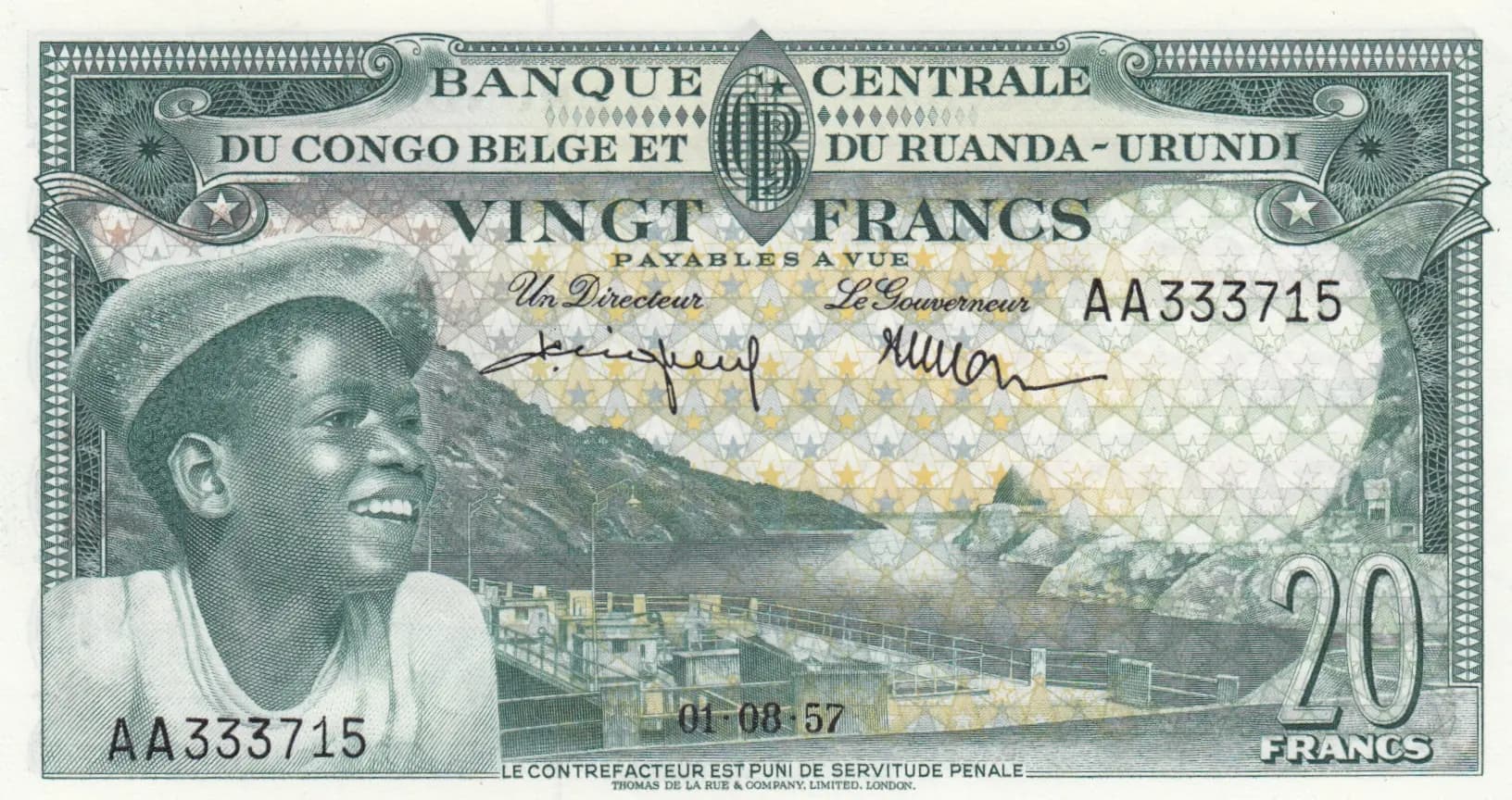
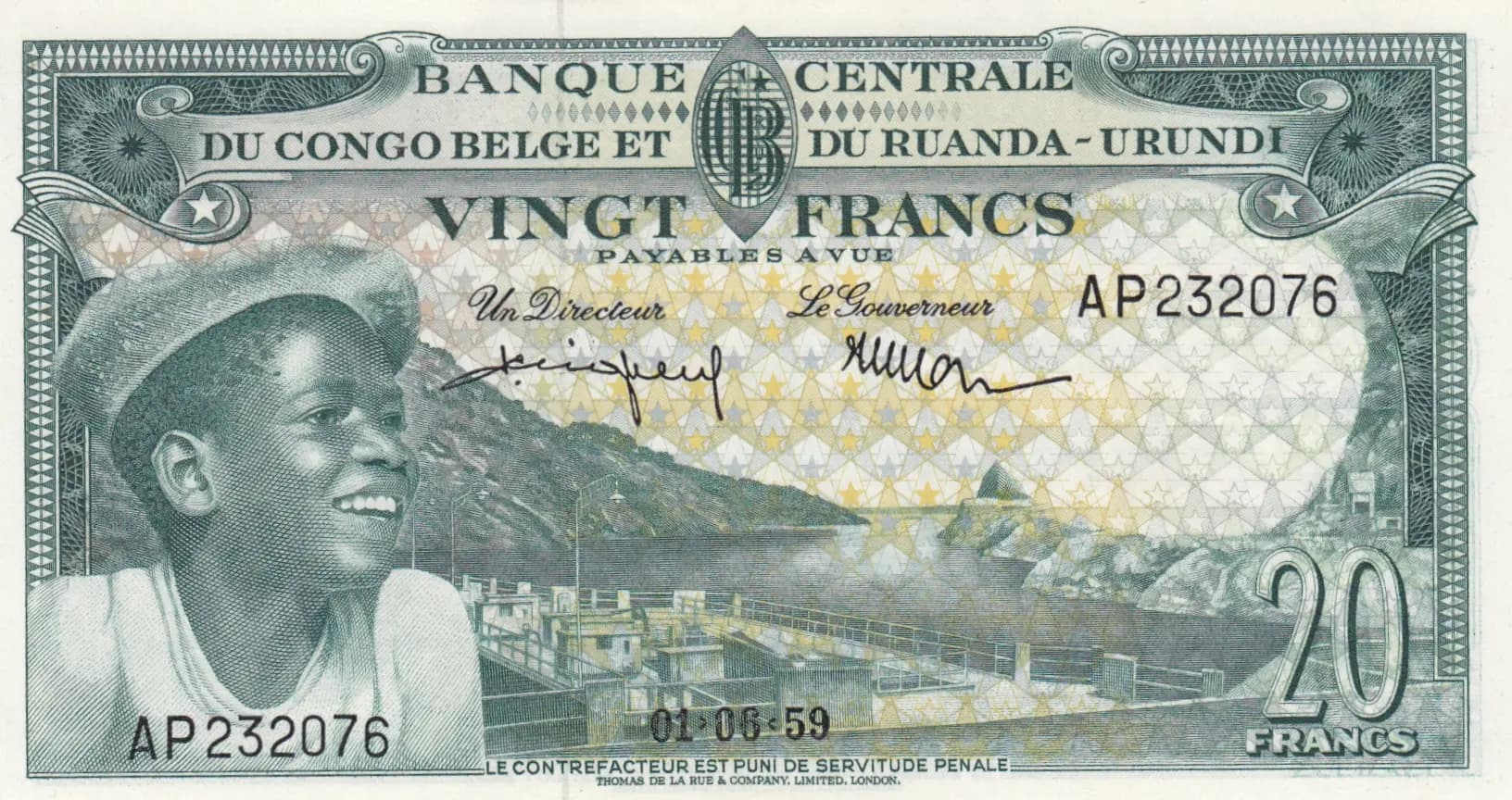
20 francs 1957
“15.04.57”
Market Prices
42 salesAbout This Note
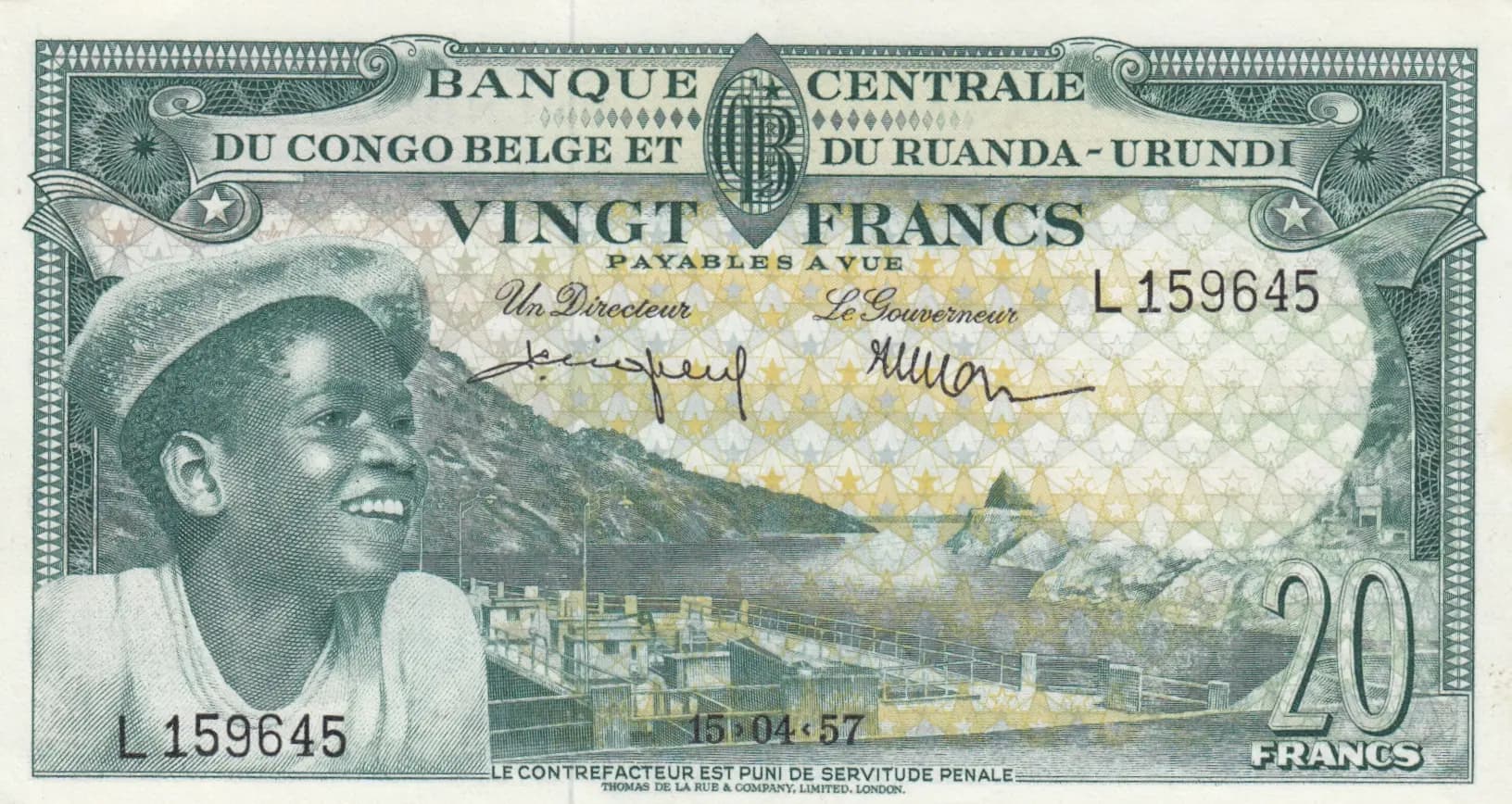
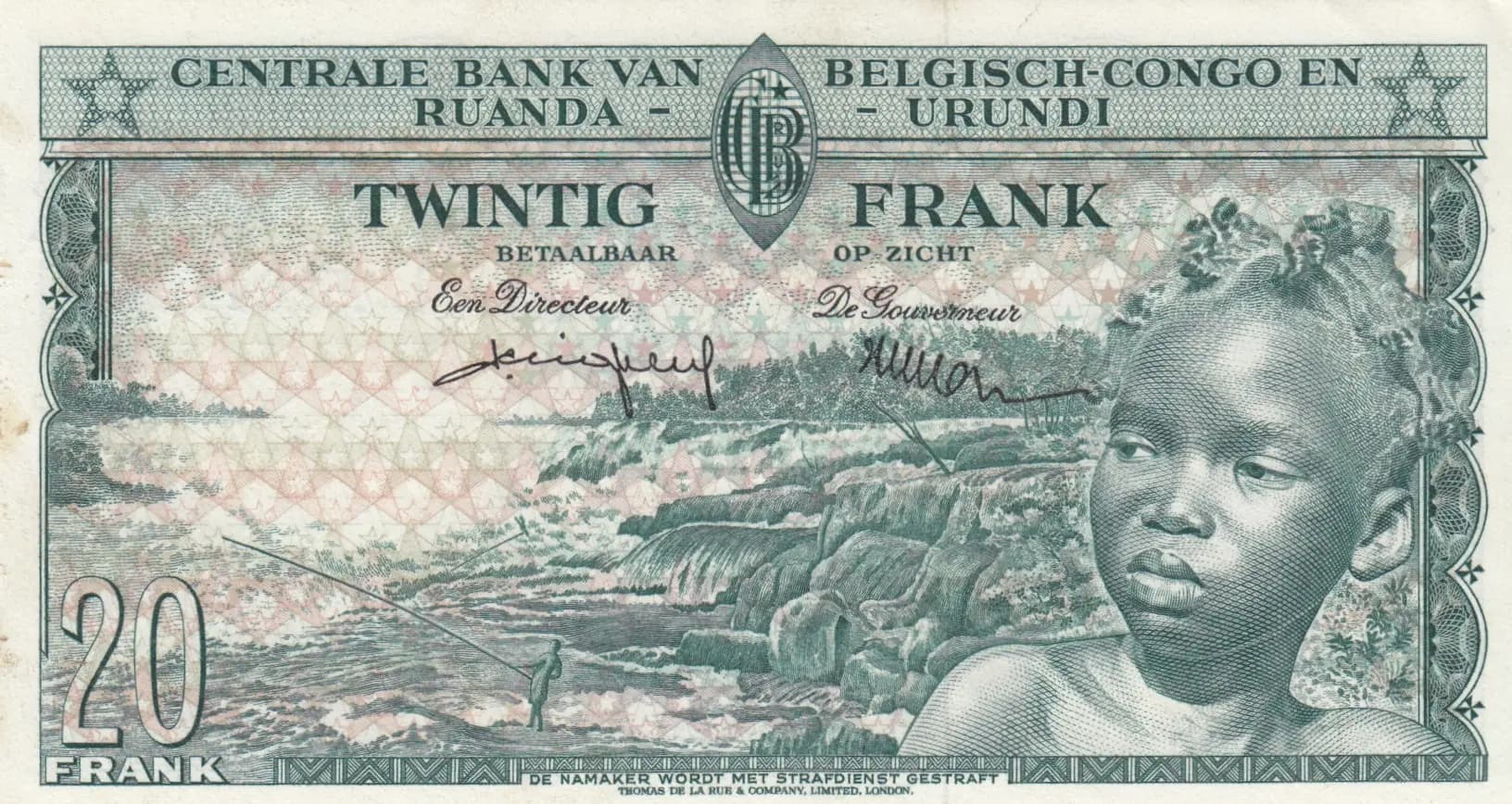
This EF-graded 20 francs note from Belgian Congo (Pick P-31, 1957) displays the characteristic bilingual design typical of the colonial period, with French text on the obverse and Dutch on the reverse. The note features excellent preservation with clear impressions of the ornate guilloche patterns and central medallion, though age-related foxing and creasing are consistent with its 66+ year age. The specific issue date of April 15, 1957, places this note near the end of the Belgian Congo's existence as a Belgian territory, making it a historically significant artifact of the final years of colonial currency.
Common. This note, despite its historical significance, was issued in substantial quantities during the 1956-1959 series and remains readily available to collectors. eBay price analysis shows consistent market presence with numerous sales ranging from $4.25 to $79.73 for EF-graded examples (with exceptional PMG-graded specimens commanding higher prices). The 2016 catalogue value for UNC ($40) and the consistent availability at modest prices indicate robust supply. This is a standard-issue colonial banknote with no evidence of scarcity, recall, or limited production.
Issued by the Banque Centrale du Congo Belge et du Ruanda-Urundi during the twilight of Belgian colonial rule, this 1957 note reflects the bilingual administrative structure (French/Dutch) of Belgium's governance in Central Africa. The depicted dam and waterfall imagery symbolize the resource wealth and industrial development that characterized colonial-era propaganda, with the Lualaba River dam representing infrastructure projects central to the Congo's economic exploitation. This note circulated during a critical period—just four years before the Congo's independence in 1960—making it a tangible record of the final colonial currency system.
The obverse features a profile portrait of a smiling man in light-colored colonial-era clothing positioned on the left side, with the centerpiece being the Alexandre Delcommune dam on the Lualaba River in Katanga province, shown with its distinctive spillway structure, surrounding landscape, and industrial buildings. The reverse depicts a natural scenic landscape dominated by a dramatic waterfall or rapids flowing through rocky terrain with vegetation, accompanied by a male portrait in profile on the right side. Both sides employ identical ornate border treatments with complex geometric guilloche patterns, decorative diamond motifs, and a central medallion featuring an intricate grid pattern characteristic of Thomas de la Rue's high-security intaglio work. The color palette transitions from green and teal tones on the obverse to green, gray, and reddish-brown accents on the reverse.
FRONT (French obverse): 'BANQUE CENTRALE DU CONGO BELGE ET DU RUANDA-URUNDI' (Central Bank of Belgian Congo and Ruanda-Urundi); 'VINGT FRANCS' (Twenty Francs); 'PAYABLES A VUE' (Payable on Demand); 'Un Directeur' (A Director); 'Le Gouverneur' (The Governor); 'LE CONTREFACTEUR EST PUNI DE SERVITUDE PENALE' (The Counterfeiter is Punished with Penal Servitude); 'THOMAS DE LA RUE & COMPANY, LIMITED, LONDON' (printer attribution); Issue date: '15 04 57' (April 15, 1957); Serial number: 'L159645'. BACK (Dutch reverse): 'CENTRALE BANK VAN BELGISCH-CONGO EN RUANDA-URUNDI' (Central Bank of Belgian Congo and Ruanda-Urundi); 'TWINTIG FRANK' (Twenty Franks); 'BETAALBAAR OP ZICHT' (Payable on Sight); 'Een Directeur' (A Director); 'De Gouverneur' (The Governor); 'DE NAMAKER WORDT NAAR MIDDEL GESTRAFT' (The Counterfeiter is Punished by Means of Punishment); 'THOMAS DE LA RUE & COMPANY, LIMITED, LONDON' (printer attribution).
Intaglio printing (engraved line work), executed by Thomas de la Rue & Company, Limited, London—the world's premier security printer of the era. The elaborate guilloche patterns, geometric borders, and fine line work visible throughout are hallmarks of intaglio production. The note exhibits the characteristic depth and precision of this technique, with security features including complex border designs and central medallion patterns designed to prevent counterfeiting. The fine detail preservation in this EF example confirms the durability of intaglio-printed currency.
Pick P-31 base number with TDLR (Thomas de la Rue) printer identification. PMG population data confirms this note exists in standard form (P-31) and specimen form (P-31s). This example, issued April 15, 1957, represents the later portion of the 1956-1959 series. Serial number L159645 suggests this is from mid-range production. No evidence of overprints or significant printing varieties observed in the visual analysis; the design is consistent with the standard bilingual obverse/reverse configuration established for this denomination and period.