20 francs 1950
Market Prices
8 salesAbout This Note
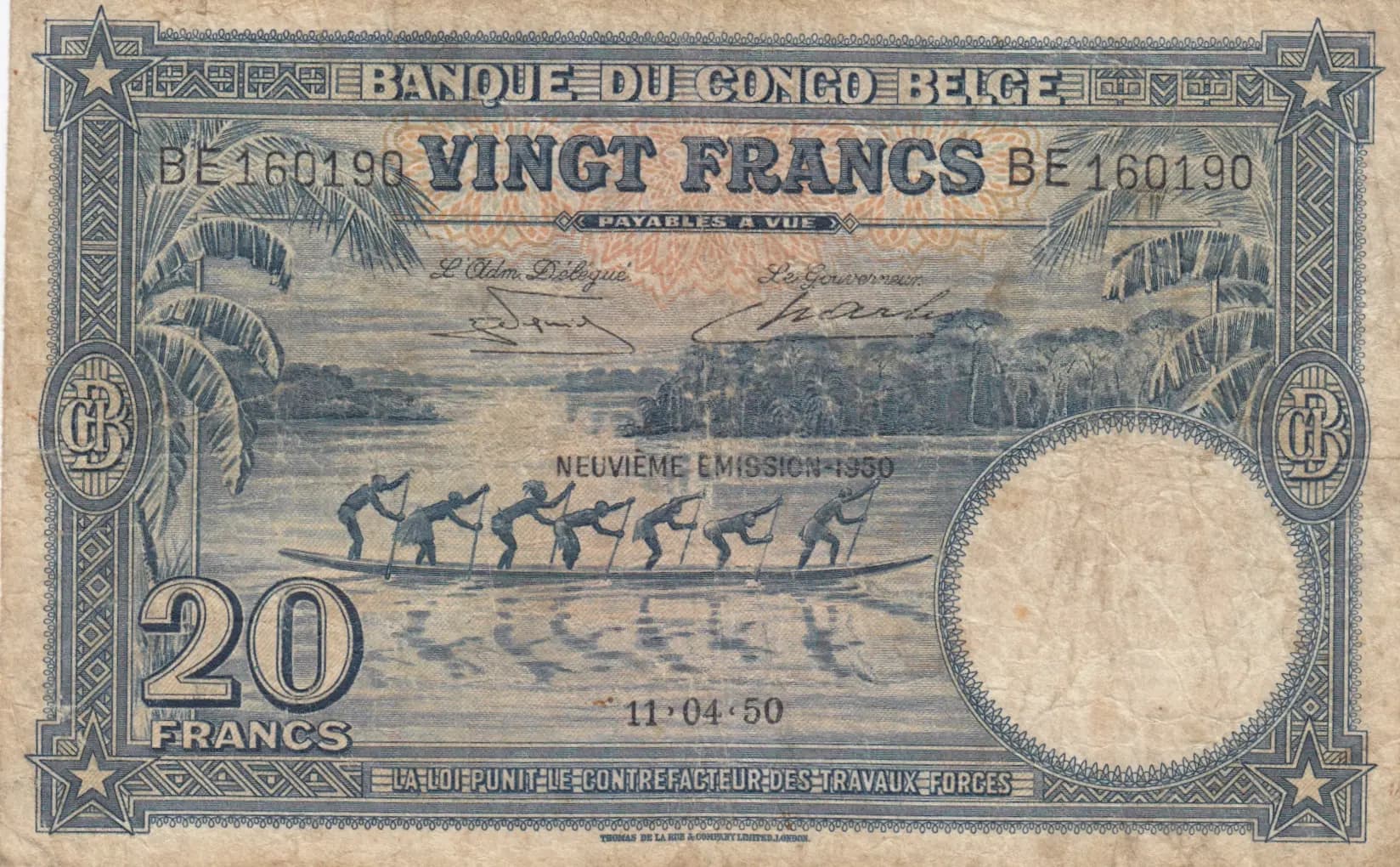
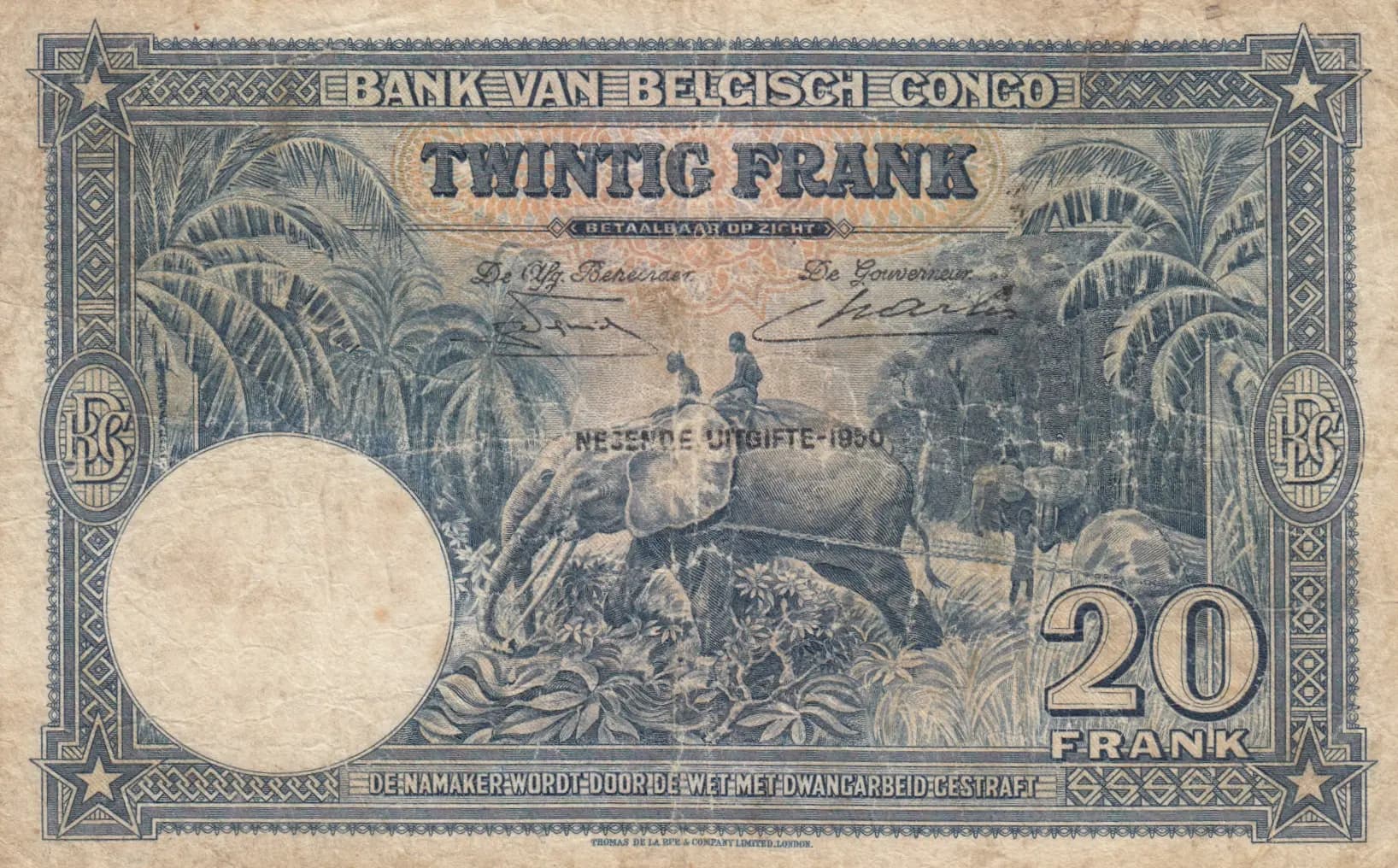
This is a Belgian Congo 20 Francs banknote from the Ninth Issue of 1950 (P-15H), featuring the characteristic pirogue (canoe) vignette on the obverse and working elephants on the reverse. The note shows significant circulation wear with creasing, foxing, and aged yellowing throughout, consistent with Fair (F) condition grading. As a colonial-era African banknote from the post-WWII period with dual French and Dutch inscriptions, this note represents an important transitional piece of Belgian Congo's monetary history.
Common. The eBay price history provided shows consistent sales activity across multiple condition grades (F-graded notes selling between $10.50 and $65 from 2011-2021, with a 2024 PMG 45 selling for $214.50), indicating healthy market liquidity typical of commonly circulated colonial issues. The 2016 catalog value for F-grade is $40, and the sustained transaction volume suggests this variety was produced in sufficient quantities to remain readily available to collectors. Belgian Congo 20 Francs notes of this period are not scarce.
This note was issued in 1950 by the Banque du Congo Belge during the final two decades of Belgian colonial rule in Congo, before independence in 1960. The imagery—depicting indigenous paddlers in a pirogue and workers with domesticated elephants—reflects the colonial era's romanticized portrayal of African labor and tropical resources. The dual-language design (French and Dutch) mirrors Belgium's bilingual governance structure imposed on its African colony, serving as a visual reminder of the administrative hierarchy during this period.
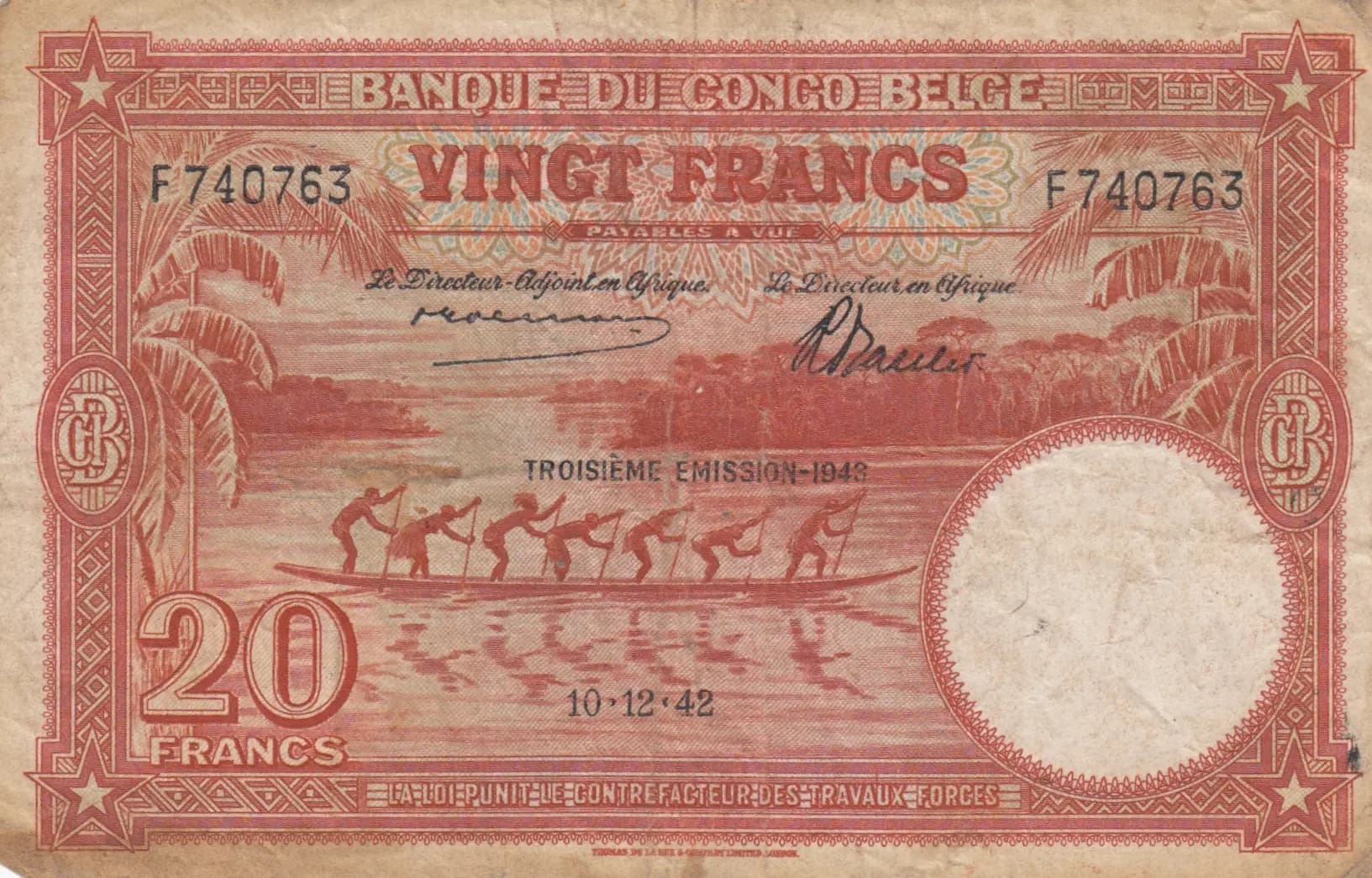
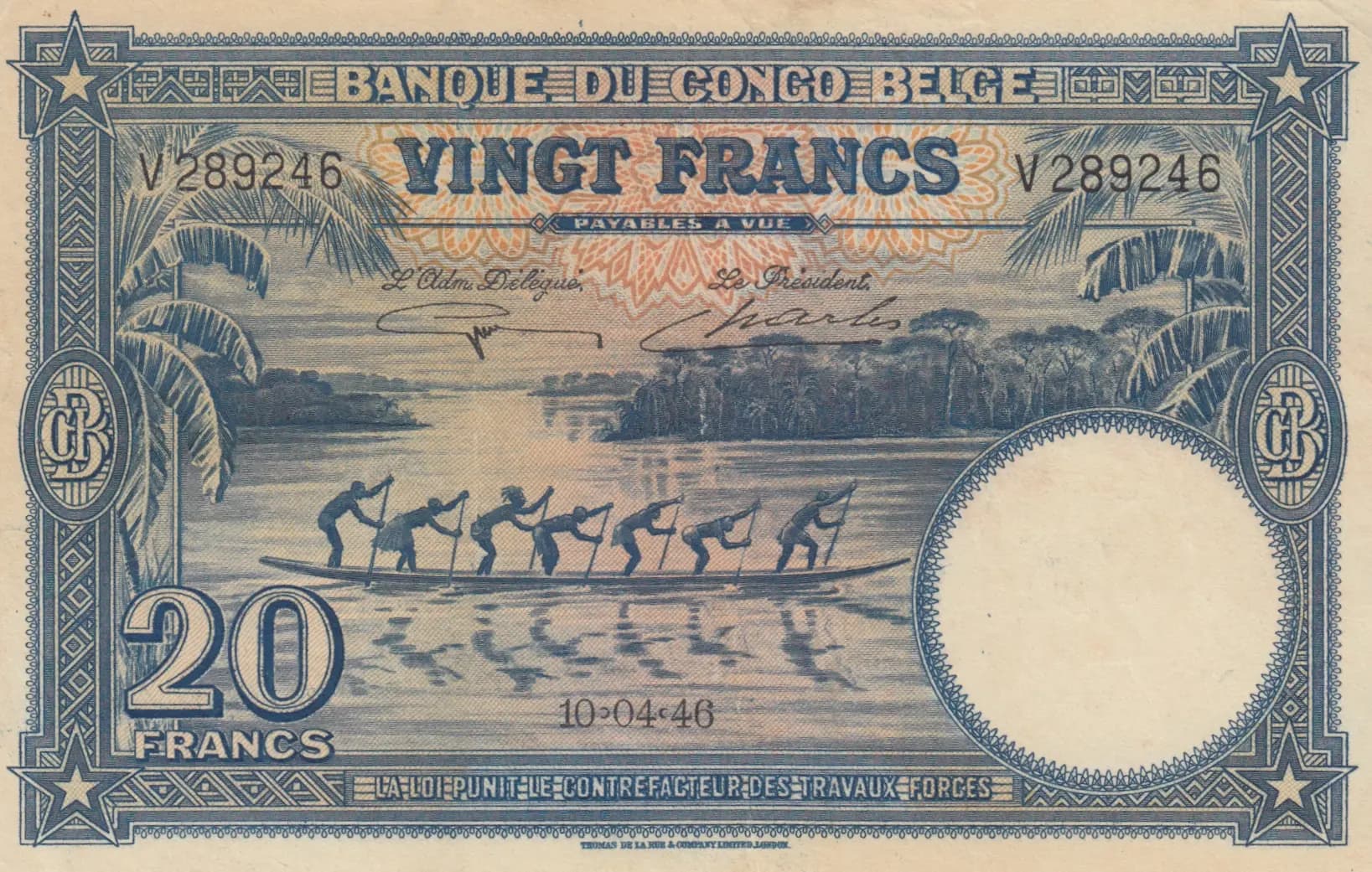
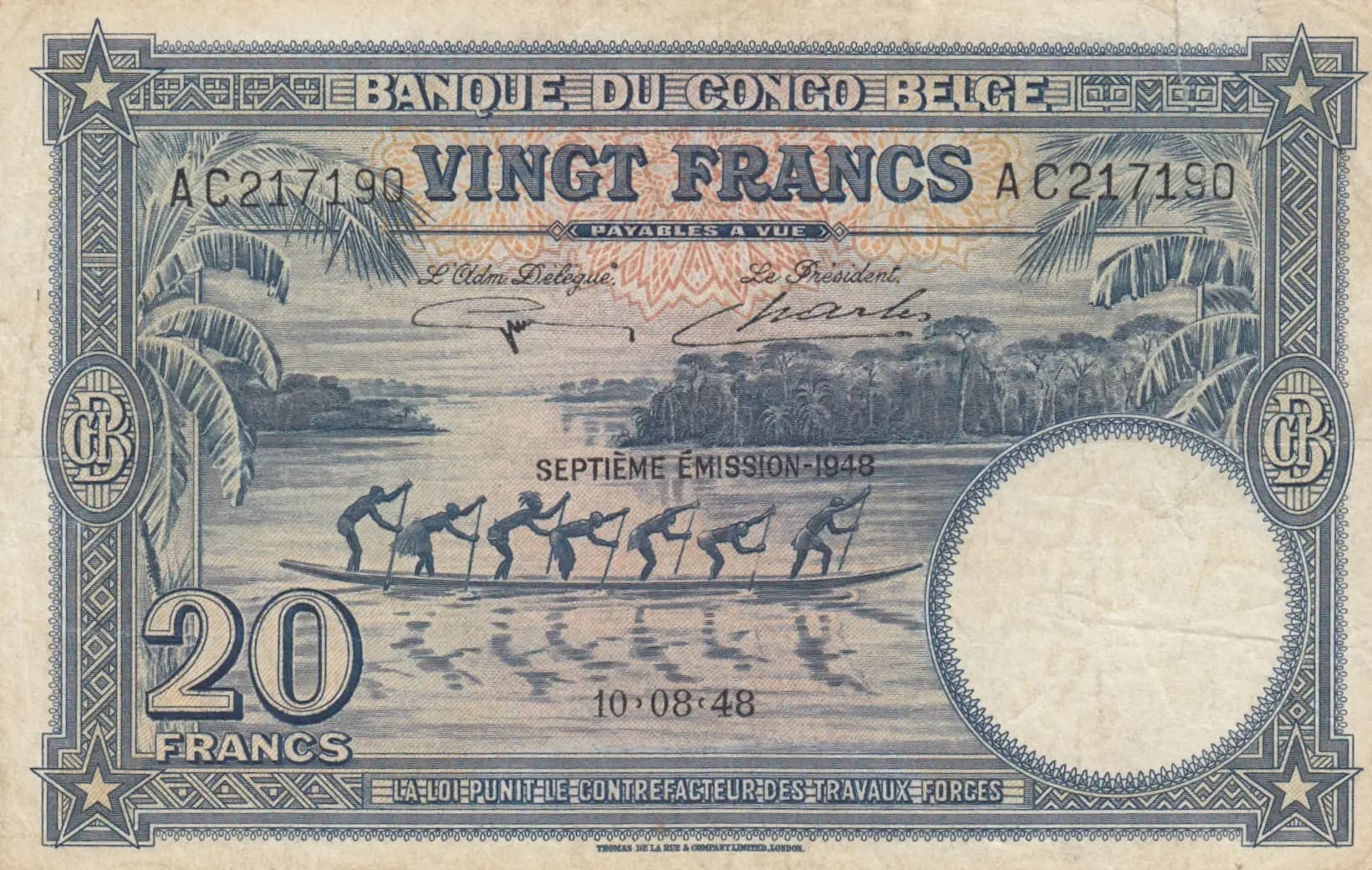
The obverse features a classical colonial vignette centered on a river scene with approximately seven African paddlers navigating a pirogue (traditional dugout canoe) through a forested waterway. Palm trees frame the composition on both sides, establishing the tropical setting. The reverse depicts working elephants in a domestic labor context, surrounded by palm vegetation and hills, reflecting the colonial economy's reliance on animal labor in resource extraction. Both sides incorporate ornamental border frameworks with geometric patterns and star symbols positioned at each corner. Oval medallions bearing monograms (CR on the obverse, likely representing colonial authority) appear symmetrically on both sides. The note employs a blue-gray and tan color palette with black line work and orange/rust accent tones, characteristic of Thomas de la Rue's colonial banknote production.
FRONT (French): Banque du Congo Belge (Bank of Belgian Congo) | Vingt Francs (Twenty Francs) | Payables à Vue (Payable on Demand) | L'Adem. Délégué (The Administrator Delegate) | Le Gouverneur (The Governor) | Neuvième Émission-1950 (Ninth Issue-1950) | 11.04.50 (Date: April 11, 1950) | La Loi Punit le Contrefacteur des Travaux Forcés (The law punishes the counterfeiter with forced labor). BACK (Dutch): Bank van Belgisch Congo (Bank of Belgian Congo) | Twintig Frank (Twenty Francs) | Betaal naar Opzicht (Payable on Sight) | De Adm. Beheerder (The Administrative Manager) | De Gouverneur (The Governor) | Negende Uitgifte-1950 (Ninth Issue-1950) | Thomas de la Rue & Company Limited, London (Printer attribution).
This note was printed by Thomas de la Rue & Company Limited, London—the pre-eminent security printer of the British Empire and its associated territories. The design demonstrates intaglio engraving techniques standard for the era, evidenced by the precise line work in the ornamental borders, fine cross-hatching in the vignette backgrounds, and sharp denomination numerals. The multi-color printing (blue-gray, tan, black, orange) required separate printing plates for each color pass. Security features include intricate border designs, corner stars, and the watermark (elephant's head) embedded in the paper stock.
This note is catalogued as Pick P-15H, representing the Ninth Issue (Neuvième Émission/Negende Uitgifte) dated April 11, 1950. The overprint 'NEUVIEME EMISSION-1950' is clearly visible on both sides. The PMG population report confirms at least 12 catalogued varieties (P-15A through P-15H and variants with 's' suffix) exist for the base Pick number, representing different printing runs and technical variations. The specific serial number visible (BE160190) and the dual-language bilingual design (French obverse/Dutch reverse) are consistent with standard 1950-era production. No exceptional printing varieties, signature variations, or rarity markers are evident in the visual analysis.