20 francs 1942
Market Prices
2 salesAbout This Note
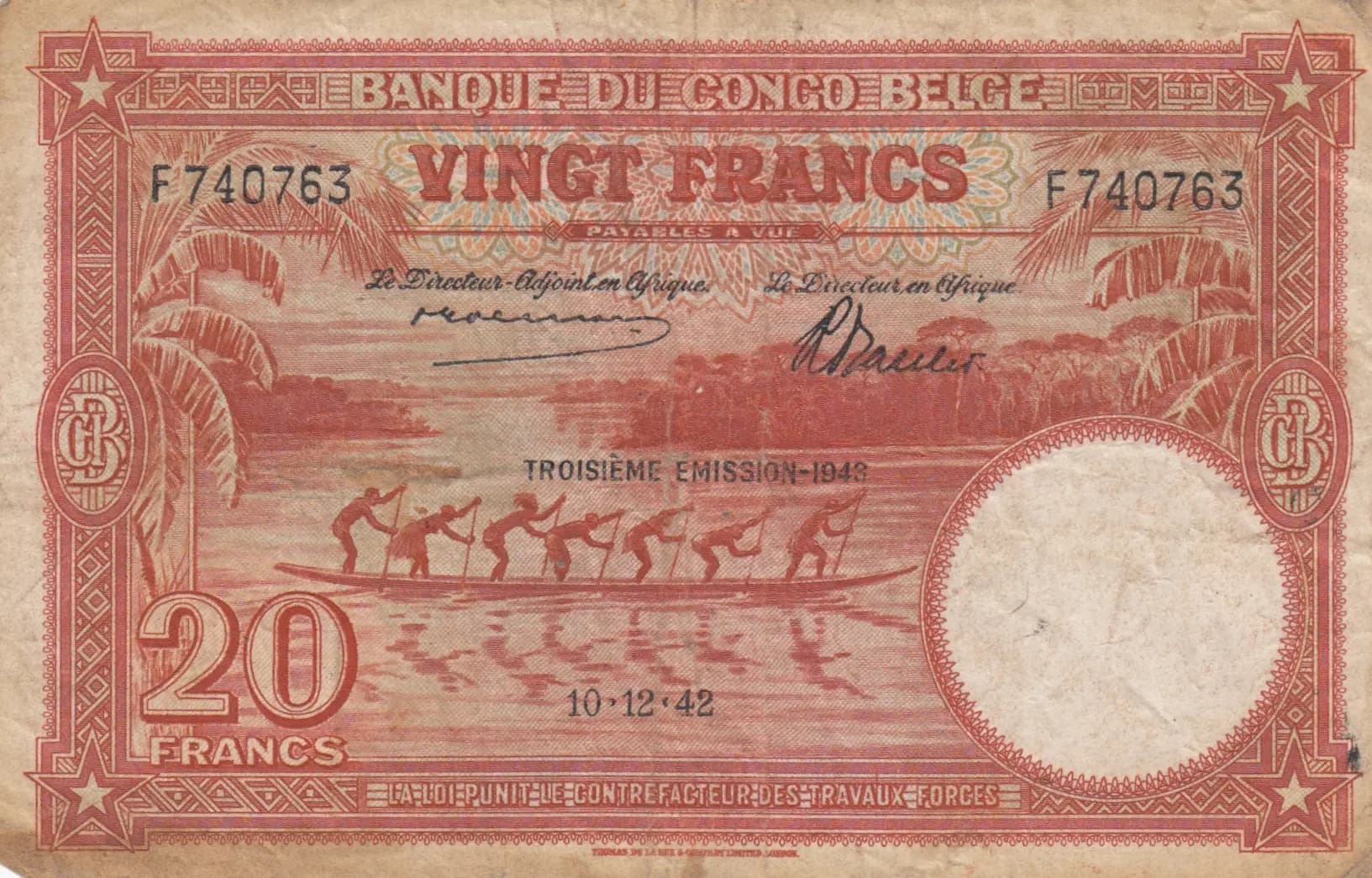
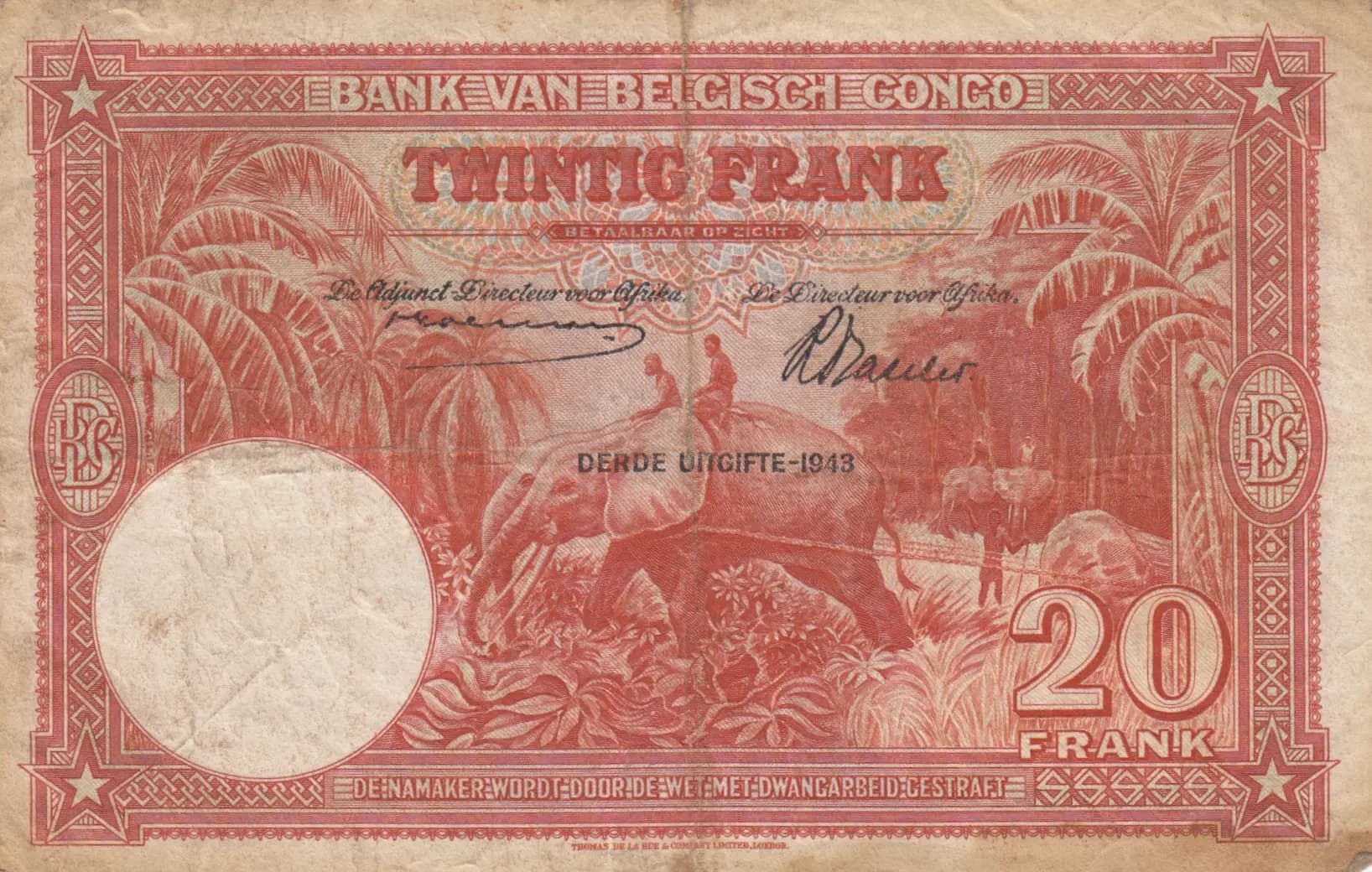
This is a Belgian Congo 20 Francs banknote from 1942, Pick P-15B, issued by Banque du Congo Belge and printed by Thomas de la Rue. The note displays the characteristic reddish-brown color scheme with fine engraved details depicting indigenous paddlers in a pirogue on the obverse and agricultural laborers on the reverse, reflecting the colonial-era economic activities of the Belgian Congo. In Fair (F) condition, the note shows substantial circulation wear including creases, folds, foxing, and discoloration typical of early 20th-century currency, with both sides bearing the "TROISIÈME ÉMISSION-1943" overprint.
Common. The catalog price data from realbanknotes.com (2016) values this note in Fair condition at $200, but eBay auction records show VF specimens selling for $56–$179.50 in the 2010–2013 period, indicating steady but modest collector demand. The Belgian Congo 20 Francs P-15 series was issued in multiple varieties (P-15A through P-15H documented) across a multi-year emission period (1942–1943), suggesting substantial print runs typical of regular-issue colonial currency. The existence of this note in Fair condition with visible circulation wear is consistent with notes that entered general circulation in the Congo, making it a common specimen among collectors. No evidence of short print runs, recalls, or scarcity applies to this Pick number.
This note was issued during World War II (dated 10 December 1942), a period when Belgium itself was under German occupation, making this African colonial currency an important financial instrument for the Belgian Congo's administration and economy. The imagery deliberately showcases the colony's economic foundation: indigenous workers engaged in paddling trade vessels and agricultural labor, reflecting Belgium's extraction-based colonial economic model. The bilingual presentation (French and Dutch) on alternating sides reinforces the Belgian Congo's dual administrative structure under Belgium's linguistic communities.
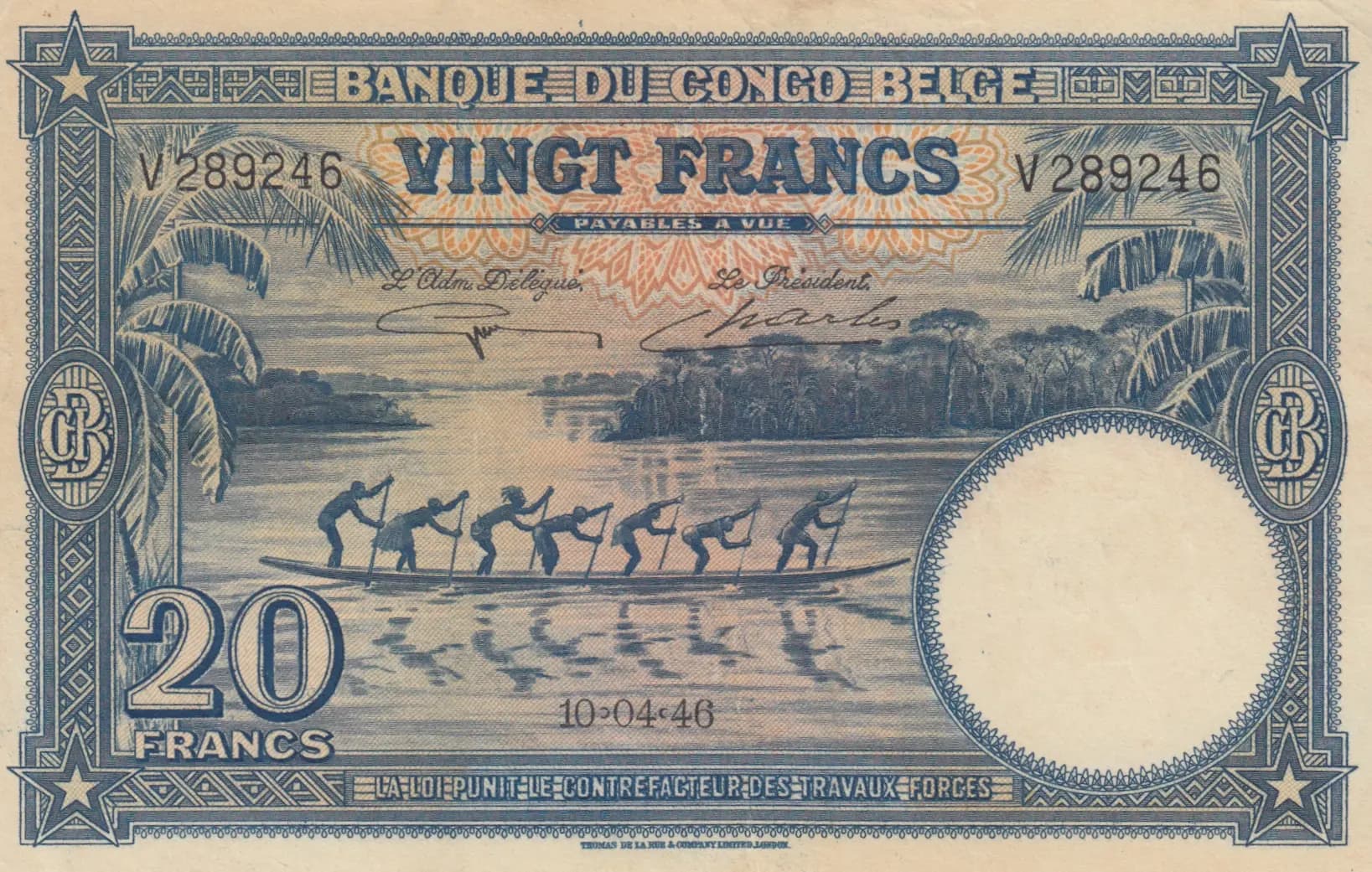
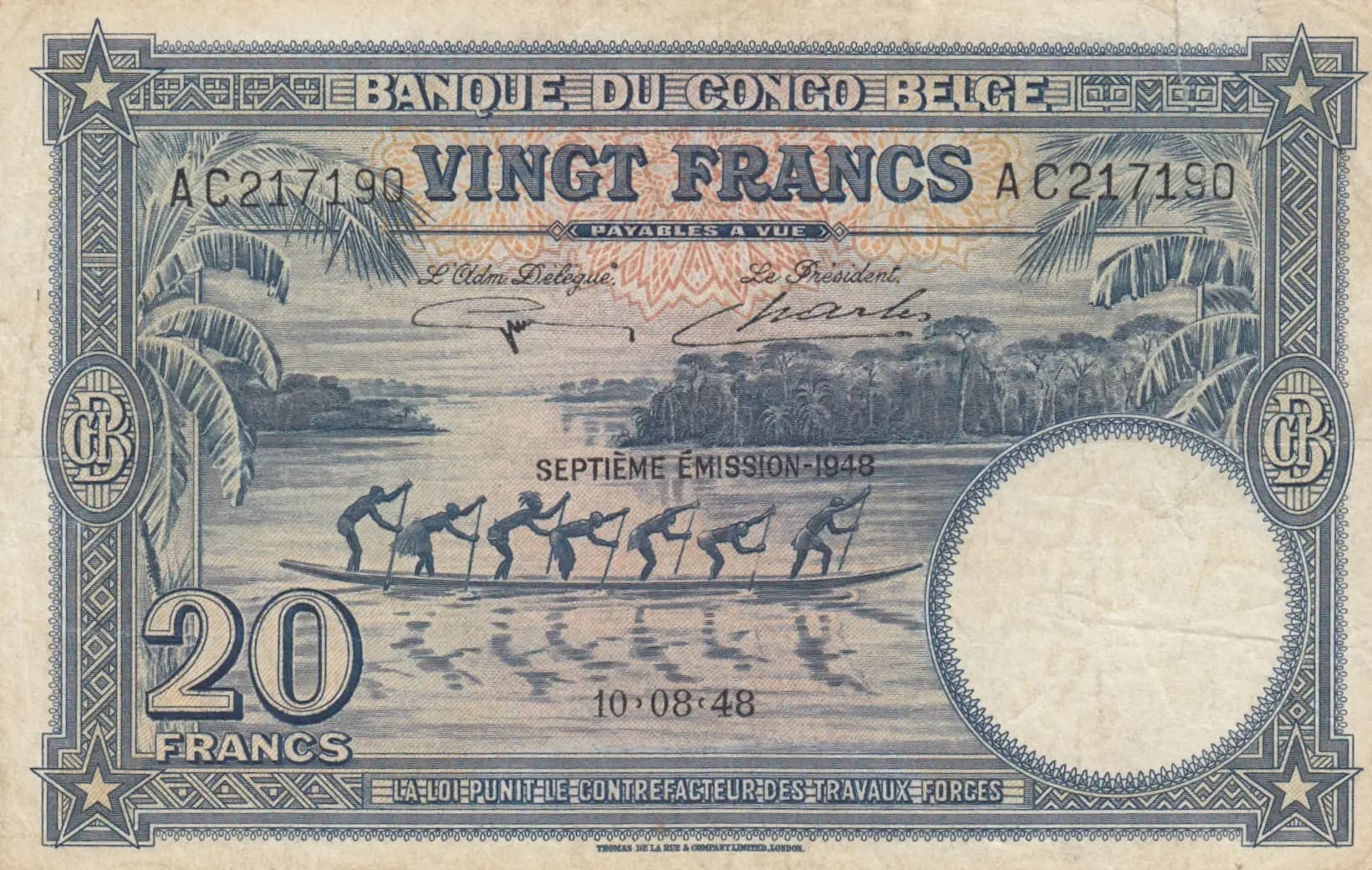
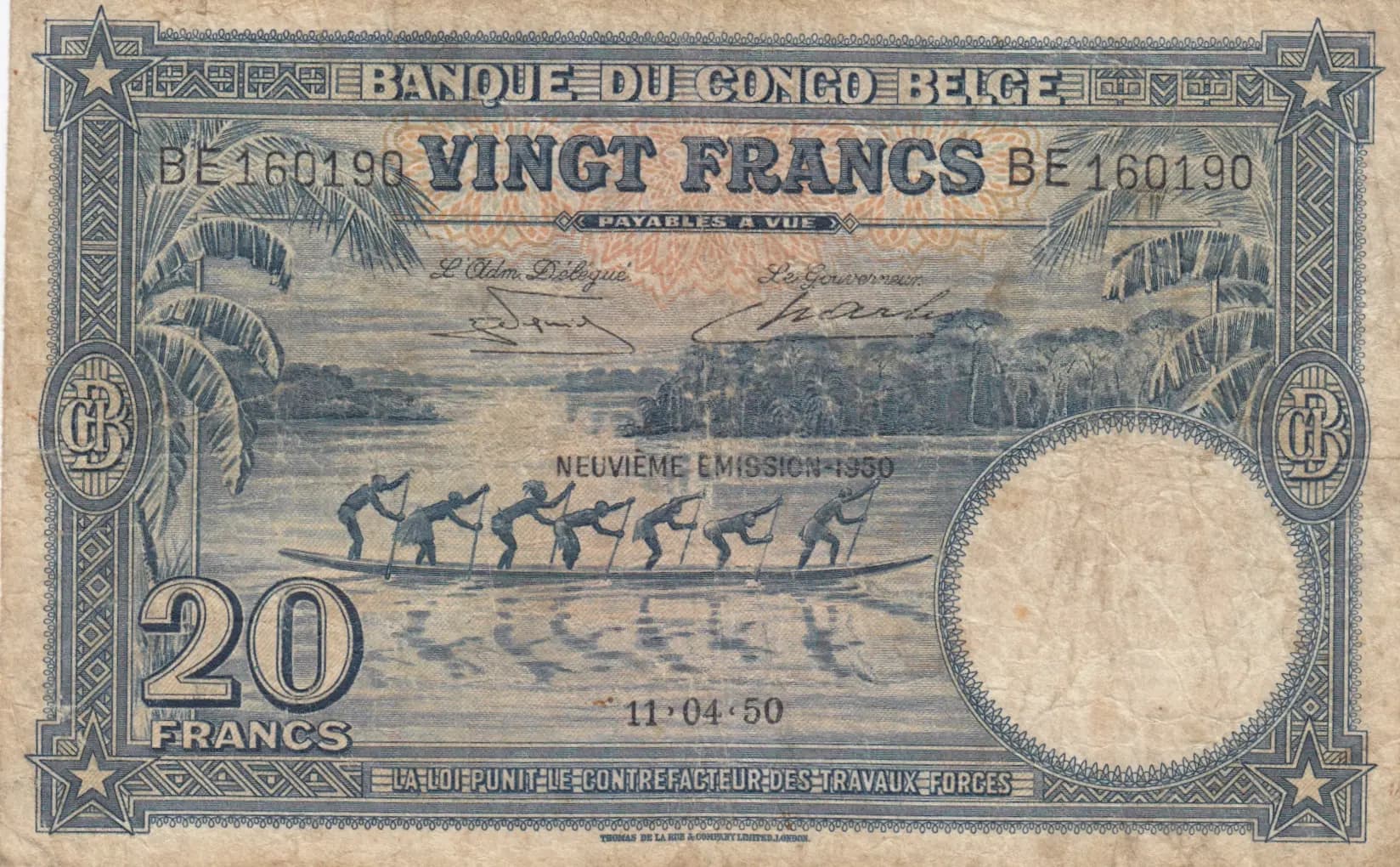
This bilingual banknote features a symmetrical layout with decorative geometric borders and corner star emblems on both sides. The obverse depicts a detailed engraved scene of indigenous paddlers manning a pirogue (traditional canoe) with multiple oarsmen navigating water, with palm trees visible in the background—symbolizing the colonial trade and transportation infrastructure. Two blank circular medallion areas appear on the right obverse, reserved for portraits or additional heraldic elements. The reverse presents an agricultural labor scene with indigenous workers engaged in field cultivation or crop tending, flanked by palm trees on both sides, with a single blank circular medallion on the left. Both sides feature the monogram cartouches (CBK for the obverse's French side, BRC for the reverse's Dutch side) representing Banque du Congo Belge / Banque van Belgisch Congo. The reddish-brown color palette is consistent throughout, with a cream/beige background providing contrast to the fine engraved details.
OBVERSE (French): 'BANQUE DU CONGO BELGE' (Belgian Congo Bank) / 'VINGT FRANCS' (Twenty Francs) / 'PAYABLES À VUE' (Payable on Sight) / 'Le Directeur-Adjoint en Afrique' (The Assistant Director in Africa) / 'Le Directeur en Afrique' (The Director in Africa) / 'TROISIÈME ÉMISSION-1943' (Third Issue-1943) / '10·12·42' (Issue date: 10 December 1942) / 'LA BOÎTE-PUNIES-CONTREFACTEUR-DES-TRAVAUX-FORCÉS' (Counterfeiter punished by forced labor) / Serial number: F740763. REVERSE (Dutch): 'BANQUE VAN BELGISCH CONGO' (Bank of Belgian Congo) / 'TWINTIG FRANK' (Twenty Francs) / 'BETAALGBAAR OP ZICHT' (Payable on Sight) / 'De Adjunct-Directeur voor Afrika' (The Assistant Director for Africa) / 'De Directeur voor Afrika' (The Director for Africa) / 'DERDE UITGIFTE-1943' (Third Issue-1943) / 'DE NAMAKER WORDT DOOR DE WET MET DWANGARBEID GESTRAFT' (The counterfeiter is punished by law with forced labor).
Intaglio engraving (line engraving), executed by Thomas de la Rue, London—the security printer noted on the banknote. The printing technique is evidenced by the fine line work, intricate border patterns with geometric designs, and the detailed representational scenes of the pirogue and agricultural labor. The precision of the engraving and the depth of the impressions typical of TDLR's work are visible despite the note's circulation wear. The multi-color printing (reddish-brown with cream background) was achieved through the traditional letterpress and intaglio combination methods employed by TDLR during this era.
This is identified as Pick P-15B based on the catalog designation and the presence of the 'TROISIÈME ÉMISSION-1943' overprint observed in the visual analysis. The visual inspection confirms this is from the Third Issue (1943 overprint) of the 1942-dated banknote series. The note bears serial number F740763 and was printed by Thomas de la Rue (TDLR abbreviation noted in the design). The bilingual layout (French obverse / Dutch reverse) is standard for all variants in the P-15 series. PMG's population report documents at least 12 distinct variants for the base P-15 number, including P-15A, P-15As, P-15B, P-15C, P-15Cs, P-15D, P-15Ds, P-15E, P-15Es, P-15F, P-15H, and an unsuffixed P-15s; this specimen's P-15B designation indicates it belongs to the second cataloged variety, though the exact differentiating characteristics between P-15A/B/C variants are not explicitly defined in the source materials.