10 francs 1959
Market Prices
35 salesAbout This Note
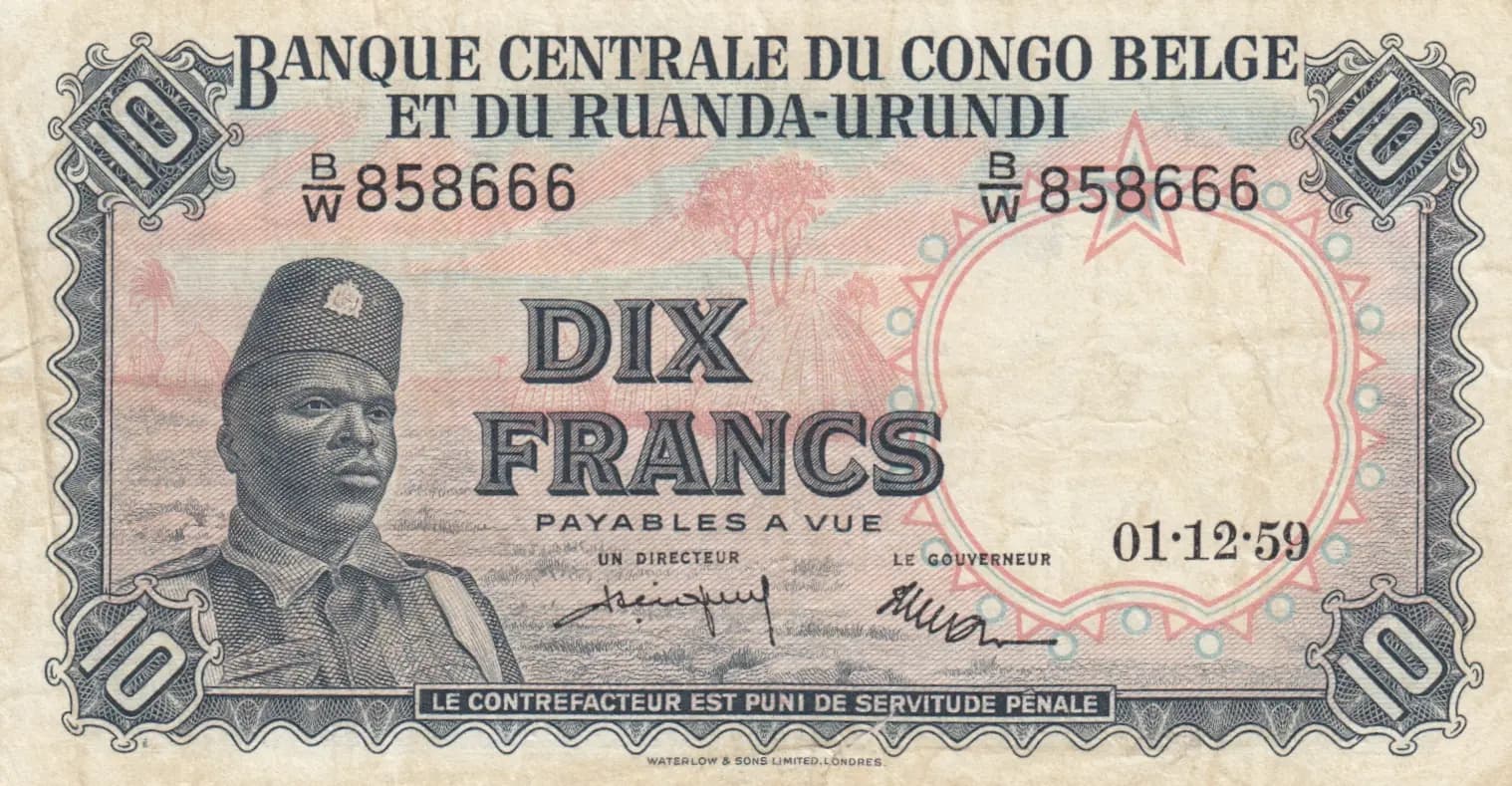
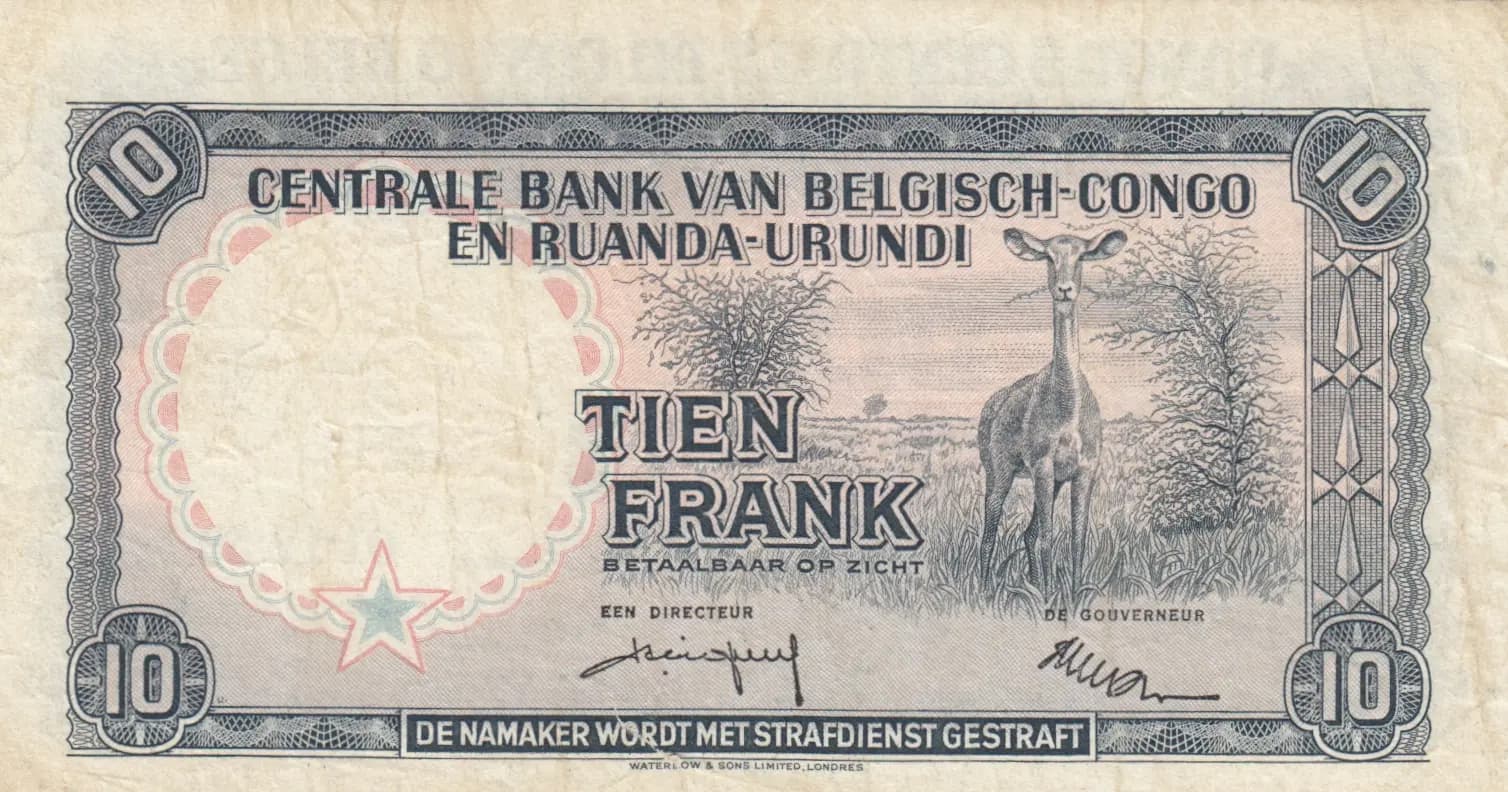
This is a Fine (F) condition 10 Francs banknote from Belgian Congo dated 1 December 1959, issued by the Banque Centrale du Congo Belge et du Ruanda-Urundi. The note exhibits typical wear for its age with visible creasing, light foxing, and general circulation handling marks throughout both obverse and reverse. The bilingual design (French/Dutch) and historical military imagery make this an interesting example of late colonial African currency, with the Force Publique soldier and savanna antelope serving as powerful cultural symbols of the period.
Common. eBay market data provided shows consistent sales activity over more than a decade (2010–2024) across all condition grades, with F-graded notes regularly selling in the $9–$33 range, indicating steady collector demand but abundant supply. The 2016 catalogue value for F-grade is $2, confirming this is not a scarce variety. While the Pick catalog distinguishes P-30a and P-30b variants (both printed by W&S), there is no evidence of significant scarcity in either variant. The note's issue spans 1956–1959 with presumably large print runs typical of regular currency circulation during colonial administration.
This note was issued during the final years of Belgian Congo's colonial period, just months before the nation's independence in June 1960. The imagery reflects colonial symbolism: the Force Publique soldier (Askari) on the obverse represents the colonial military apparatus, while the antelope on the reverse emphasizes the region's natural wealth and African heritage. The bilingual French/Dutch text reflects Belgium's linguistic communities and their administrative control over the territory, making this note a tangible artifact of the transition from colonialism to independence in Central Africa.
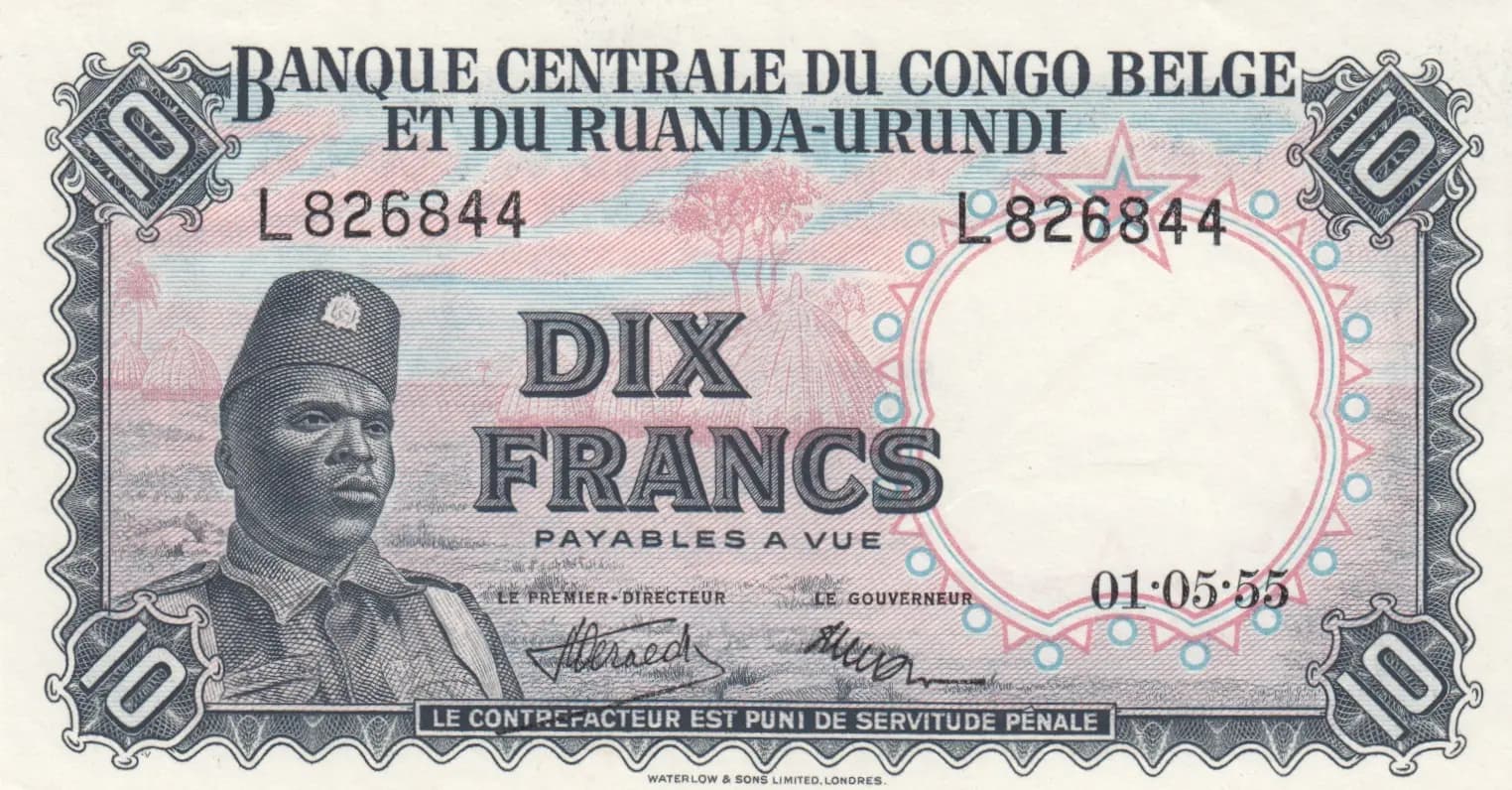
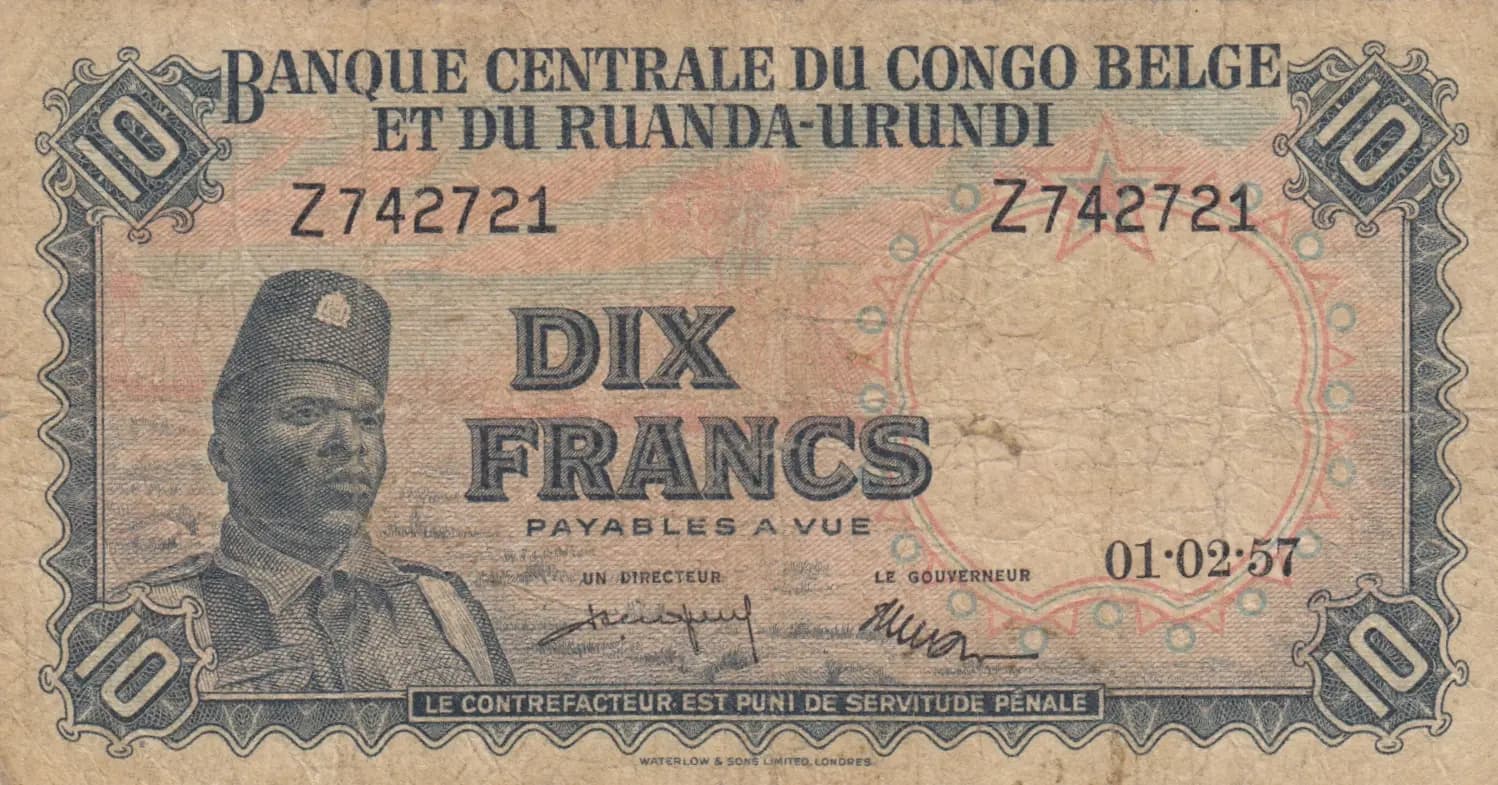
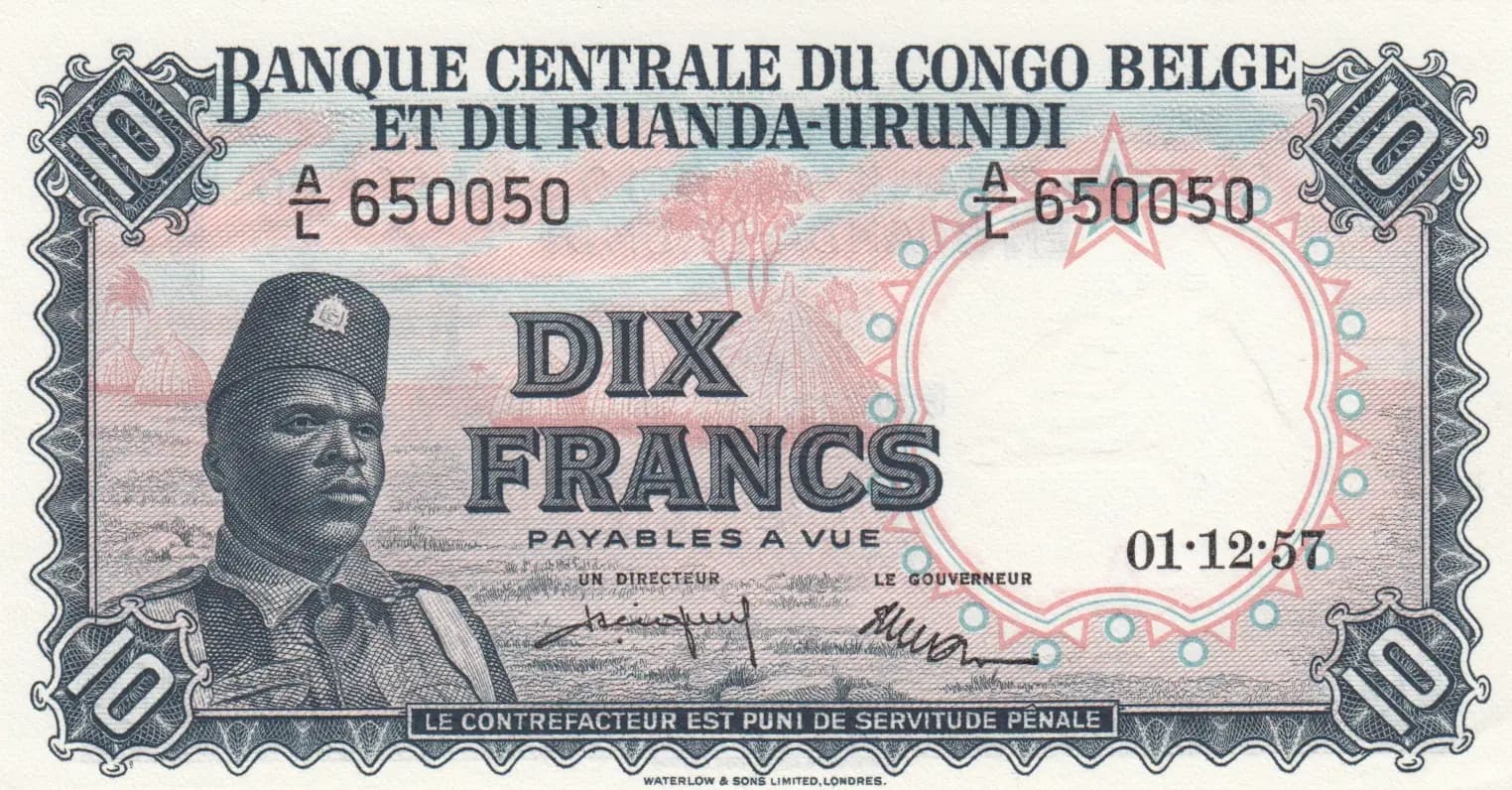
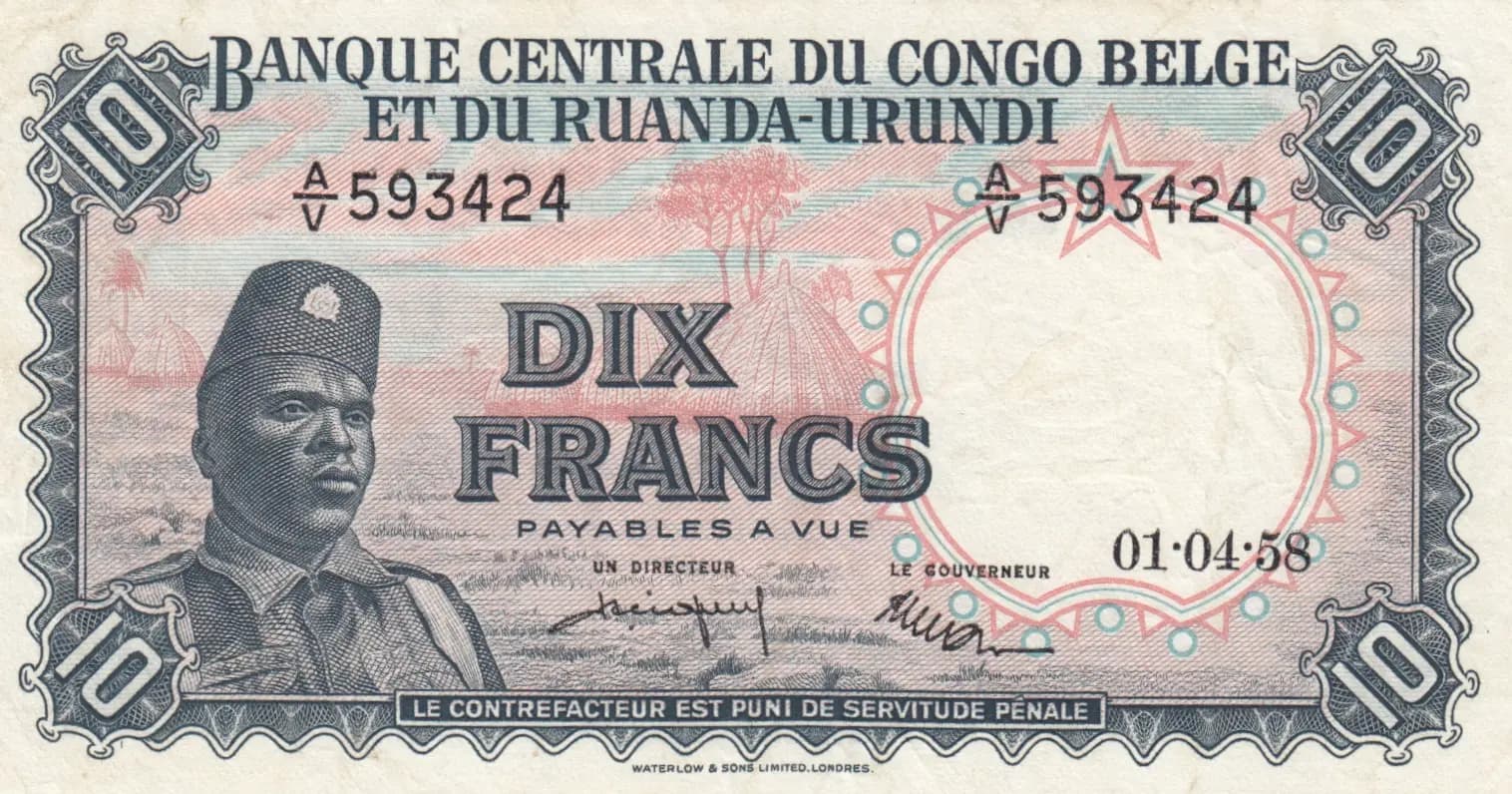
The obverse features a left-facing portrait of a soldier of the Force Publique (the colonial military force), identifiable by his fez hat and military uniform with architectural elements visible in the background. The note employs a predominantly beige and cream palette with pink tint overlays and dark blue/black accents. A large decorative circular frame with a central star ornament appears on the right side, flanked by ornate corner medallions bearing the denomination '10'. The reverse depicts an antelope (likely an antelope species native to Central Africa) standing in a savanna landscape with trees, positioned center-right. An identical circular star-framed design occupies the left side of the reverse. Both sides feature the same ornamental corner treatments with fine line work and decorative border patterns throughout. Serial numbers appear in two locations on the obverse (specimen shown: BW858666). The bilingual layout—French on obverse, Dutch on reverse—reflects the Belgian administrative structure.
FRONT (French side): 'BANQUE CENTRALE DU CONGO BELGE ET DU RUANDA-URUNDI' (Central Bank of Belgian Congo and Ruanda-Urundi) / 'DIX FRANCS' (Ten francs) / 'PAYABLES A VUE' (Payable on sight) / 'UN DIRECTEUR' (A director) / 'LE GOUVERNEUR' (The governor) / '01·12·59' (1 December 1959) / 'LE CONTREFACTEUR EST PUNI DE SERVITUDE PENALE' (Counterfeiter is punished with penal servitude) / 'WATERLOW & SONS LIMITED, LONDRES' (Waterlow & Sons Limited, London). BACK (Dutch side): 'CENTRALE BANK VAN BELGISCH-CONGO EN RUANDA-URUNDI' (Central Bank of Belgian Congo and Ruanda-Urundi) / 'TIEN FRANK' (Ten francs) / 'BETAALBAAR OP ZICHT' (Payable on sight) / 'EEN DIRECTEUR' (A director) / 'DE GOUVERNEUR' (The governor) / 'DE NAAMAKER WORDT MET STRAFDIENST GESTRAFT' (The counterfeiter is punished with penal servitude) / 'WATERLOW & SONS LIMITED, LONDRES' (Waterlow & Sons Limited, London).
Intaglio (engraved) printing, characteristic of high-security banknote production. The fine line work visible in the background, detailed portraiture, and ornamental designs are consistent with engraving. Printed by Waterlow & Sons Limited of London, a renowned security printer of the period. The printer's mark 'W&S' (Waterlow & Sons) appears on the note. Color separation and overlay techniques were employed to create the multi-colored effect (beige, cream, pink, blue, gray, black), typical of 1950s banknote production standards.
This specimen is catalogued as Pick P-30b (10 Francs, 1959, Waterlow & Sons printer). The Pick catalog identifies two variants for this base number: P-30a and P-30b, both printed by W&S. The specific distinguishing characteristics between variants are not provided in available references but may relate to signature combinations, date variations, or serial number prefix formats. The observed specimen bears the date '01·12·59' (1 December 1959) and serial number prefix 'BW'. The signature titles 'UN DIRECTEUR' and 'LE GOUVERNEUR' (French side) / 'EEN DIRECTEUR' and 'DE GOUVERNEUR' (Dutch side) are standard for this issue.