500 rublei 1920
Market Prices
56 salesAbout This Note
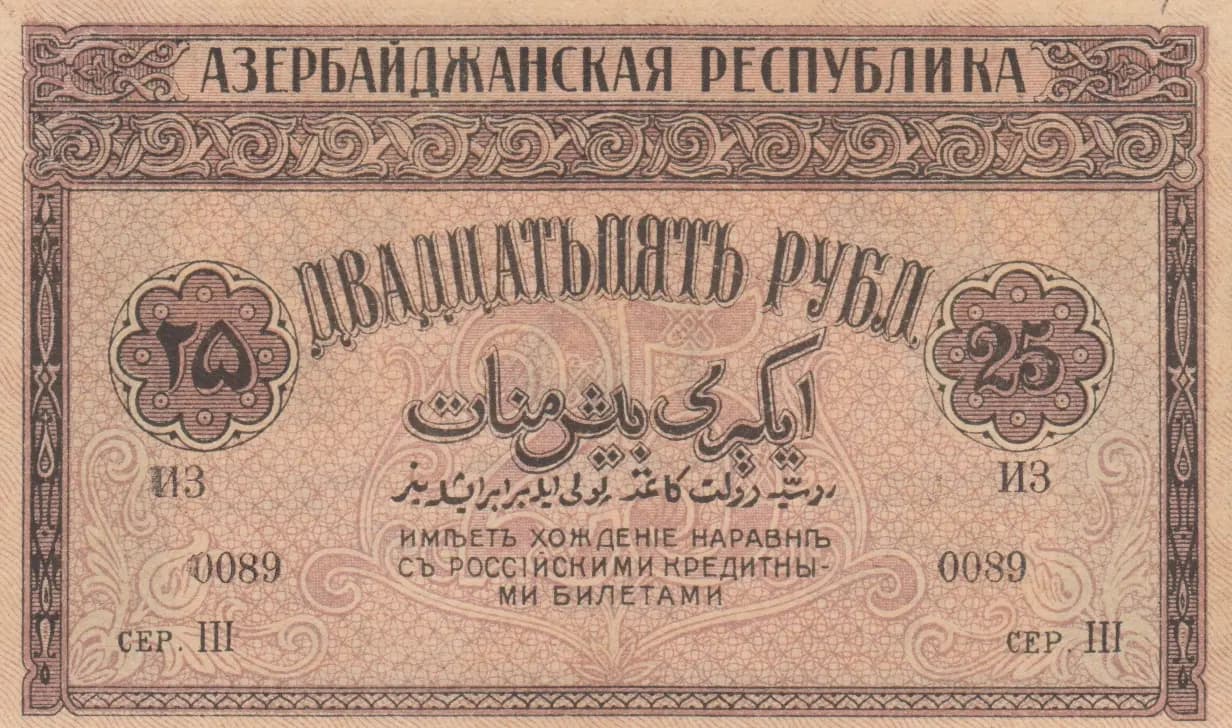
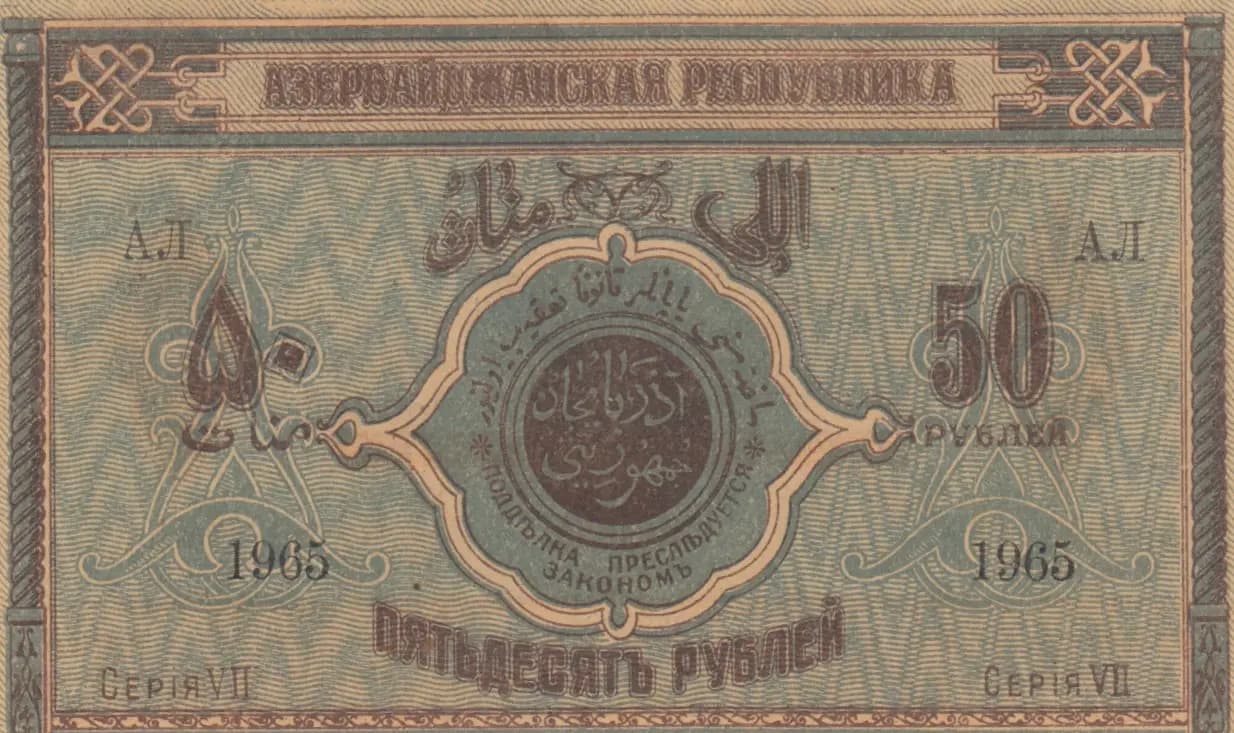
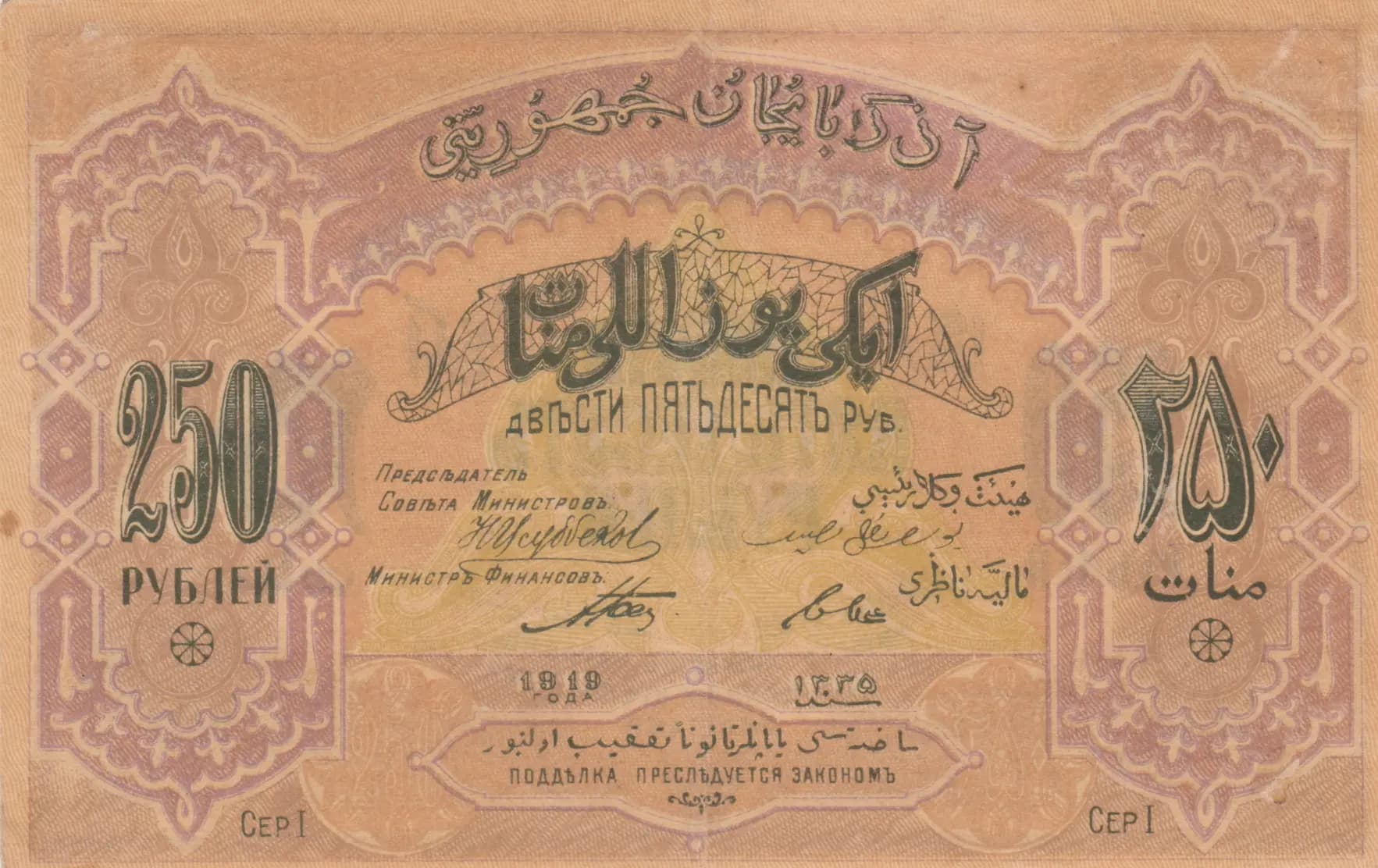
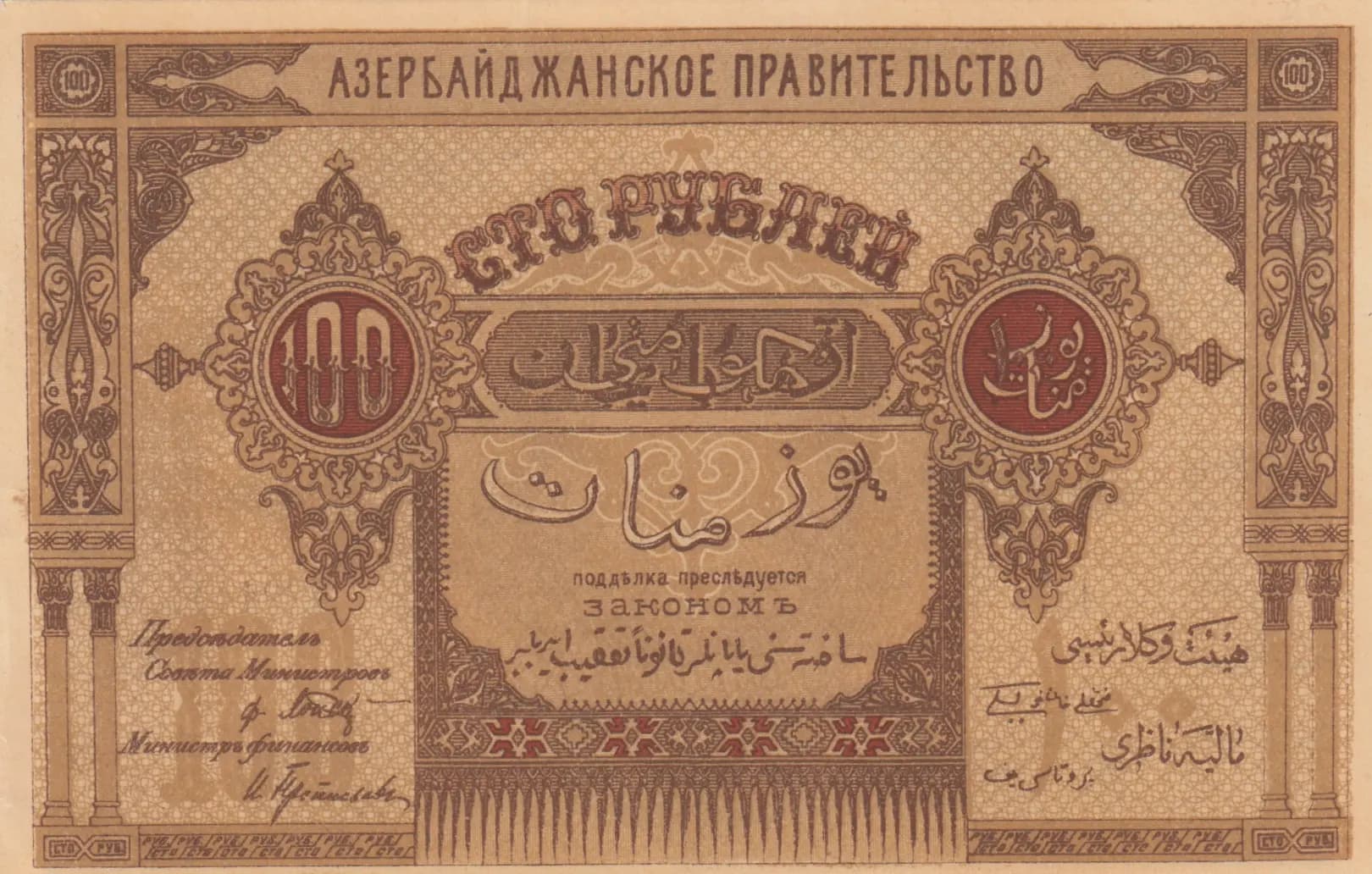
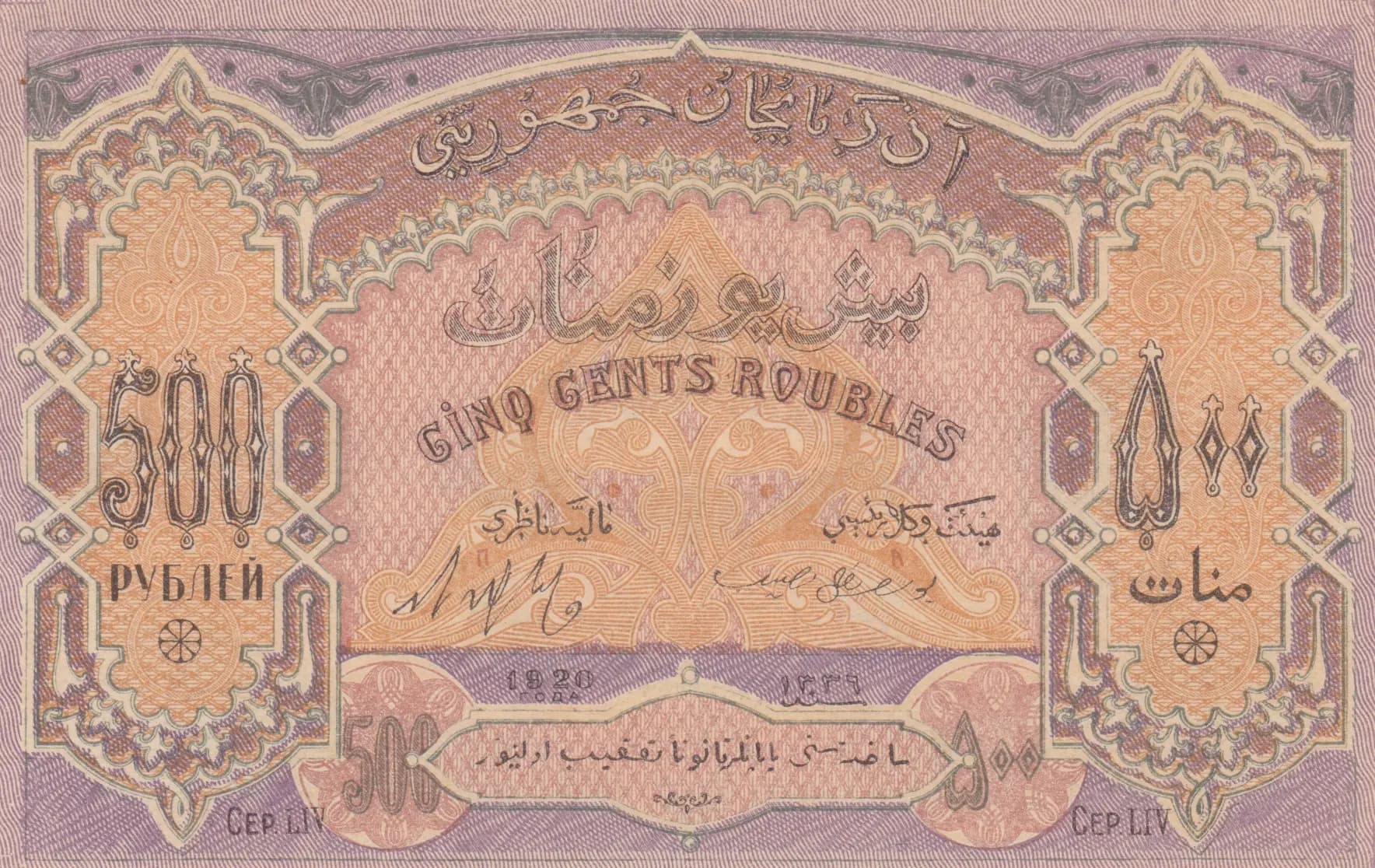
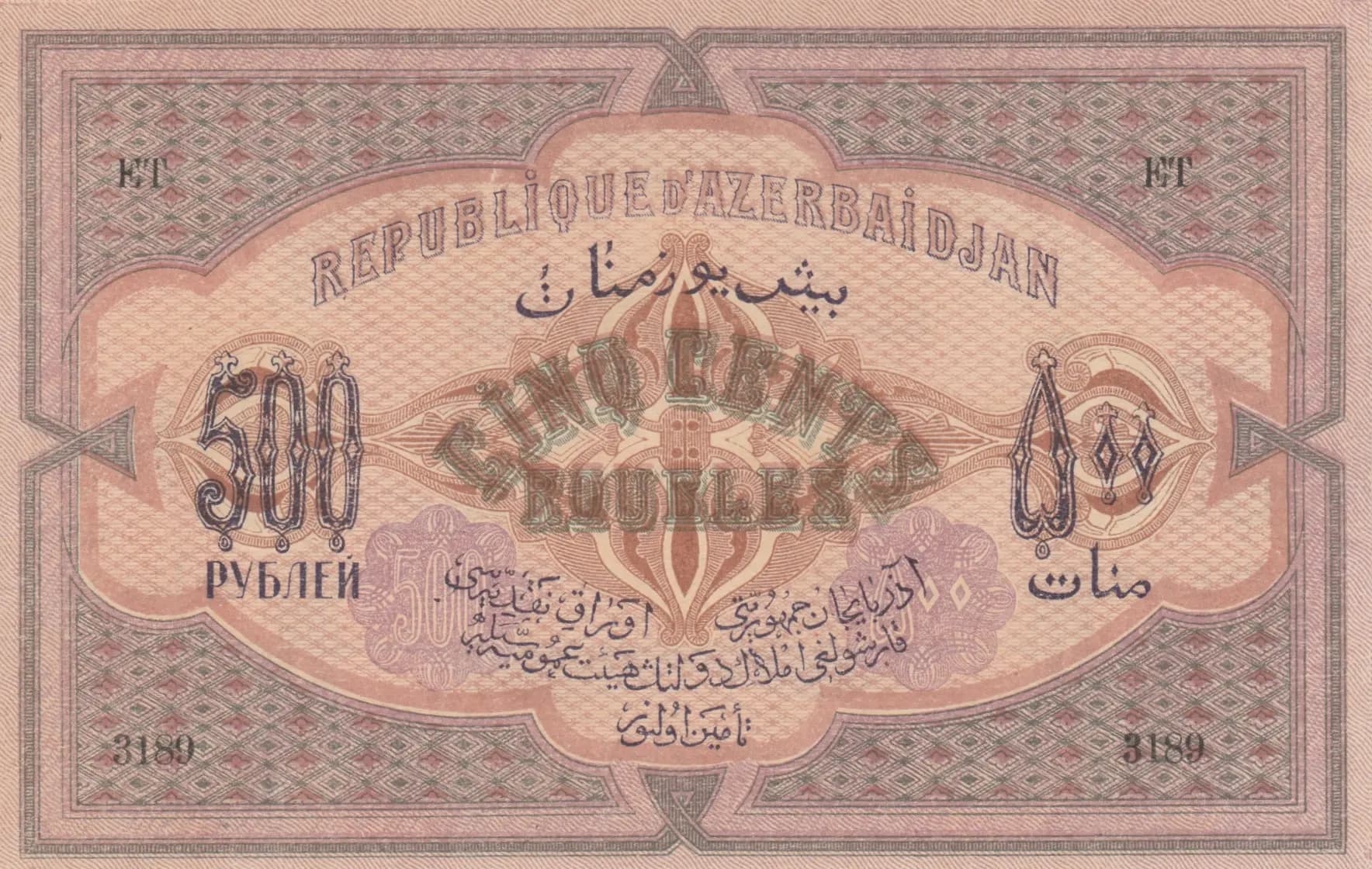
This 500 Rublei banknote from the Azerbaijan Republic (1920) presents an exceptional example of early Soviet-era Central Asian currency design, rendered in UNC condition with vibrant color preservation and no visible circulation wear. The note features a sophisticated fusion of Islamic geometric and floral ornamentation with Cyrillic and Persian/Farsi inscriptions, reflecting Azerbaijan's unique cultural and political position during the brief period of the Democratic Republic of Azerbaijan. The ornate shield-shaped cartouches, elaborate central medallions, and fine-line engraving demonstrate meticulous craftsmanship characteristic of European security printing of the period.
Common. While the Azerbaijan Democratic Republic was short-lived (1918-1920) and issues from this period carry historical significance, the 500 Rublei denomination remains relatively common in the broader numismatic market. eBay sales data demonstrates consistent availability across condition grades, with UNC examples regularly selling in the $10-$26 range historically, and only professionally graded specimens (PMG 64-65) commanding premiums of $50-$145. The lack of extreme rarity in pricing and steady supply in secondary markets indicates this is a standard issue from the brief republic period rather than a scarce variant. Condition-appropriate pricing for UNC examples currently ranges $10-$30, confirming common-grade status.
Issued during 1920 by the short-lived Azerbaijan Democratic Republic (1918-1920), this banknote represents a transitional period in Caucasian monetary history when the region briefly achieved independence before Soviet consolidation. The bilingual Cyrillic-Persian/Farsi design and trilingual inscriptions (Russian, French, and Persian) underscore Azerbaijan's position as a cultural bridge between East and West, while the Islamic geometric patterns honor the nation's Muslim heritage and artistic traditions. The use of French—a diplomatic language of the period—further evidences the young republic's engagement with international recognition and Western financial institutions.
The 500 Rublei note exemplifies the ornamental security printing aesthetic of early 20th-century European security printers serving newly independent states. The obverse features paired shield-shaped cartouches positioned left and right of center, each filled with intricate geometric Islamic patterns (hexagons, stars, and interlocking designs) rendered in brown and tan against a lavender-tinted background. A large central ornamental cartouche dominates the composition, framed by elaborate borders with floral and geometric motifs typical of Persian/Islamic artistic traditions. The reverse maintains the bilateral symmetry with a prominent central coat of arms or governmental emblem (rendered in Islamic geometric style) positioned above text-bearing cartouches, surrounded by a geometric lattice border pattern serving both decorative and anti-counterfeiting functions. The color palette—brown, cream, tan, purple/lavender, and orange—creates a sophisticated harmonic composition reflecting both European printing standards and Islamic artistic sensibilities. No figurative portraits are depicted; instead, the design celebrates abstract geometric and floral ornamentation, which was culturally appropriate for the Islamic context.
FRONT SIDE: Central numeral '500' with Russian 'РУБЛЕЙ' (Rubles), Persian 'پنجاه روبل' (Fifty Rubles—note the translation variance), English 'FIVE HUNDRED CENTS ROUBLES', year '1920', Persian 'منات' (Manat—the alternative currency name), and series markings 'СЕР III' and 'СЕР IIV' (Series III and Series IV in Cyrillic). BACK SIDE: Denomination repeated as '500 РУБЛЕЙ', Persian 'منات', French 'REPUBLIQUE D'AZERBAIDJAN' (Republic of Azerbaijan), Persian 'شتمرستان' (administrative/governmental designation), printer initials 'FT', and serial number '3189'.
This note exhibits characteristics of fine-line engraved intaglio printing, the standard security printing method of the period. The intricate geometric patterns, elaborate floral designs, and precise border work demonstrate the high-resolution capabilities of steel-plate engraving. The watermark areas visible in the border design and the consistent color reproduction across both sides suggest professional European security printing, likely produced by a Western European security printer contracted by the young Azerbaijan Republic. The detailed line work throughout and the precise registration of multi-color elements indicate sophisticated printing equipment and skilled artisanship typical of firms such as De La Rue, Bradbury Wilkinson, or similar period security printers.
This specimen exhibits Series III or Series IV designation ('СЕР III' or 'СЕР IIV'), indicating it belongs to one of the numbered series variants documented for Pick-7. The note displays series identification consistent with the catalog notation of multiple series (I-V) mentioned in external references. The back side shows printer mark 'FT' and serial number '3189', confirming individual note tracking within the series. No overprints, signature varieties, or date variants are apparent on this specimen. The Pick catalog notes two variants (P-7 and P-7s), with this being the standard P-7 issue type; distinguishing features between variants would require comparison with specimen-specific documentation, though both variants remain common.