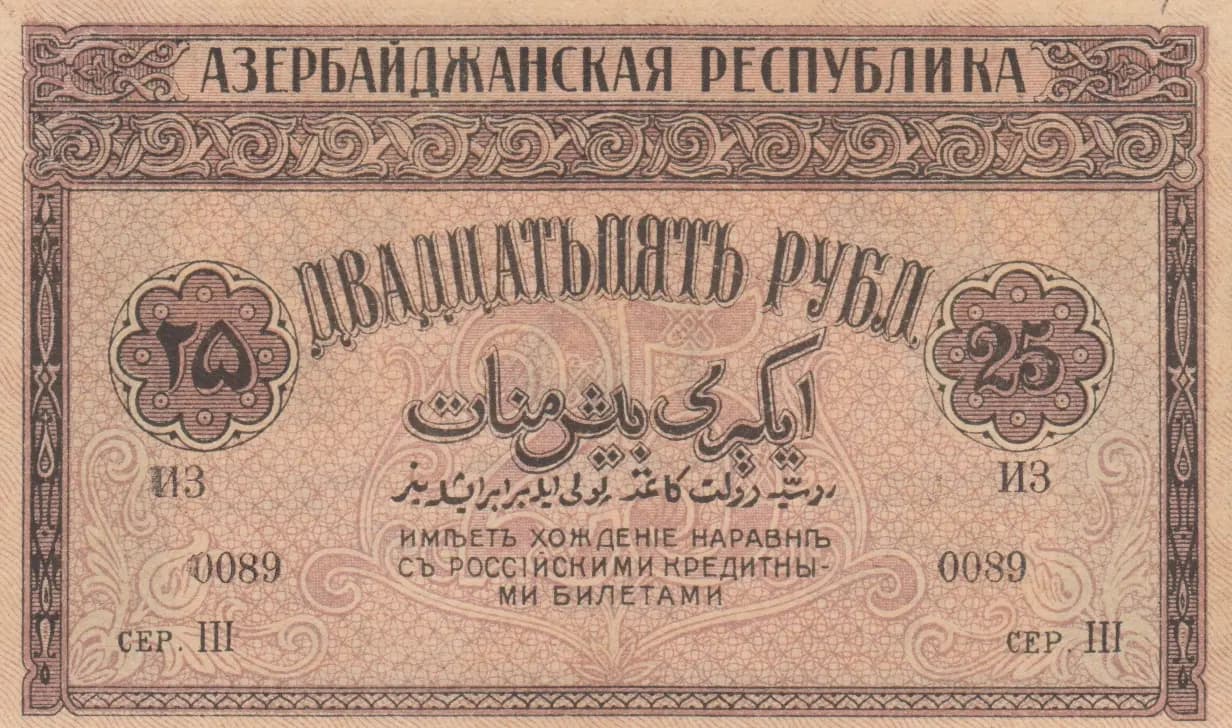
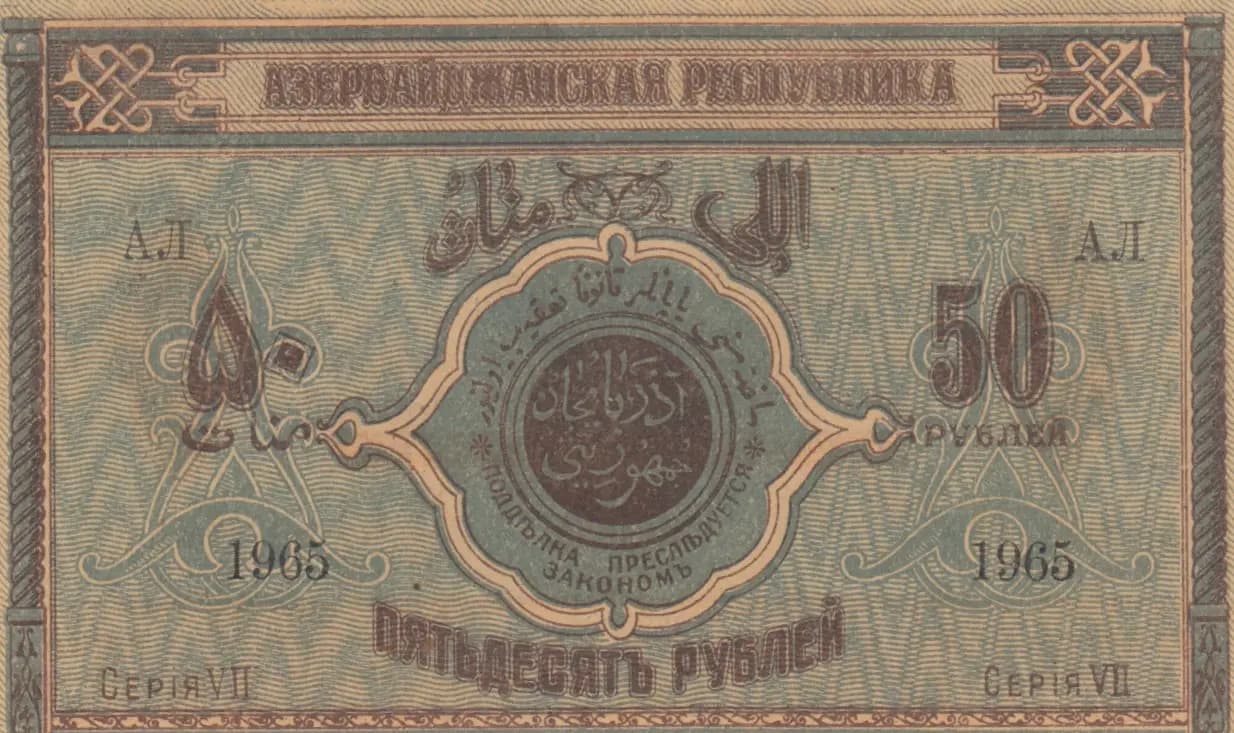
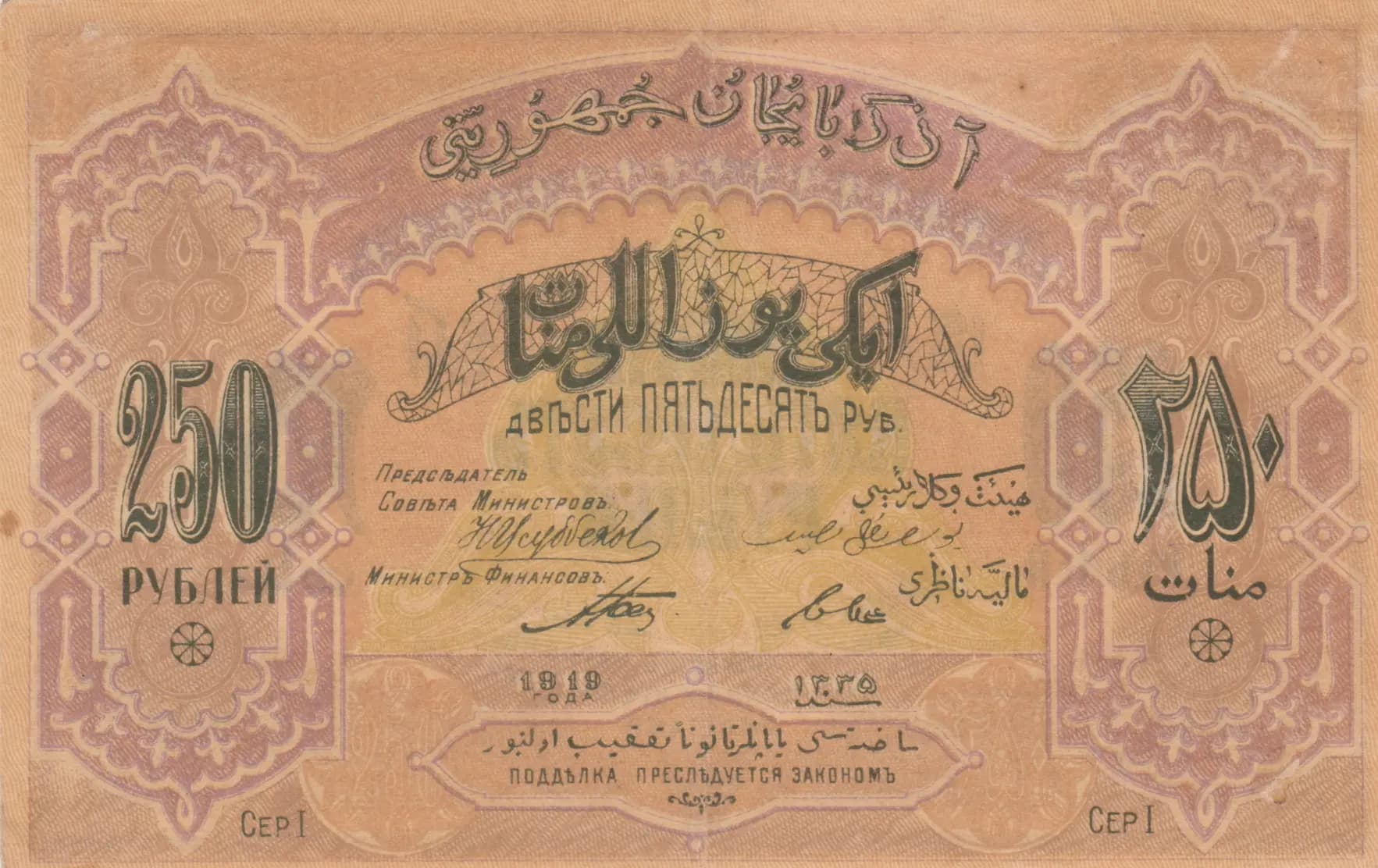
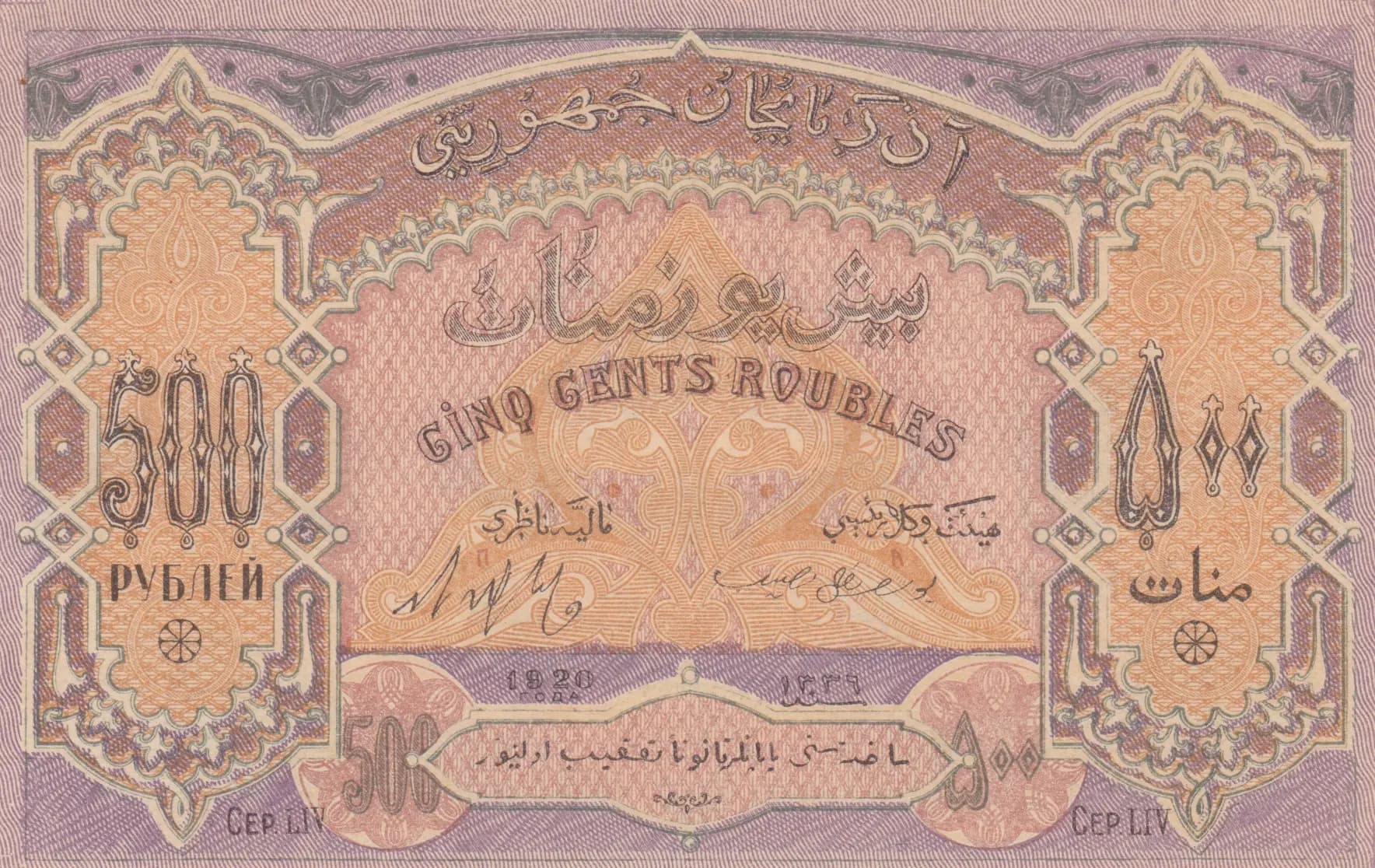
100 rublei 1919
Market Prices
1 saleAbout This Note
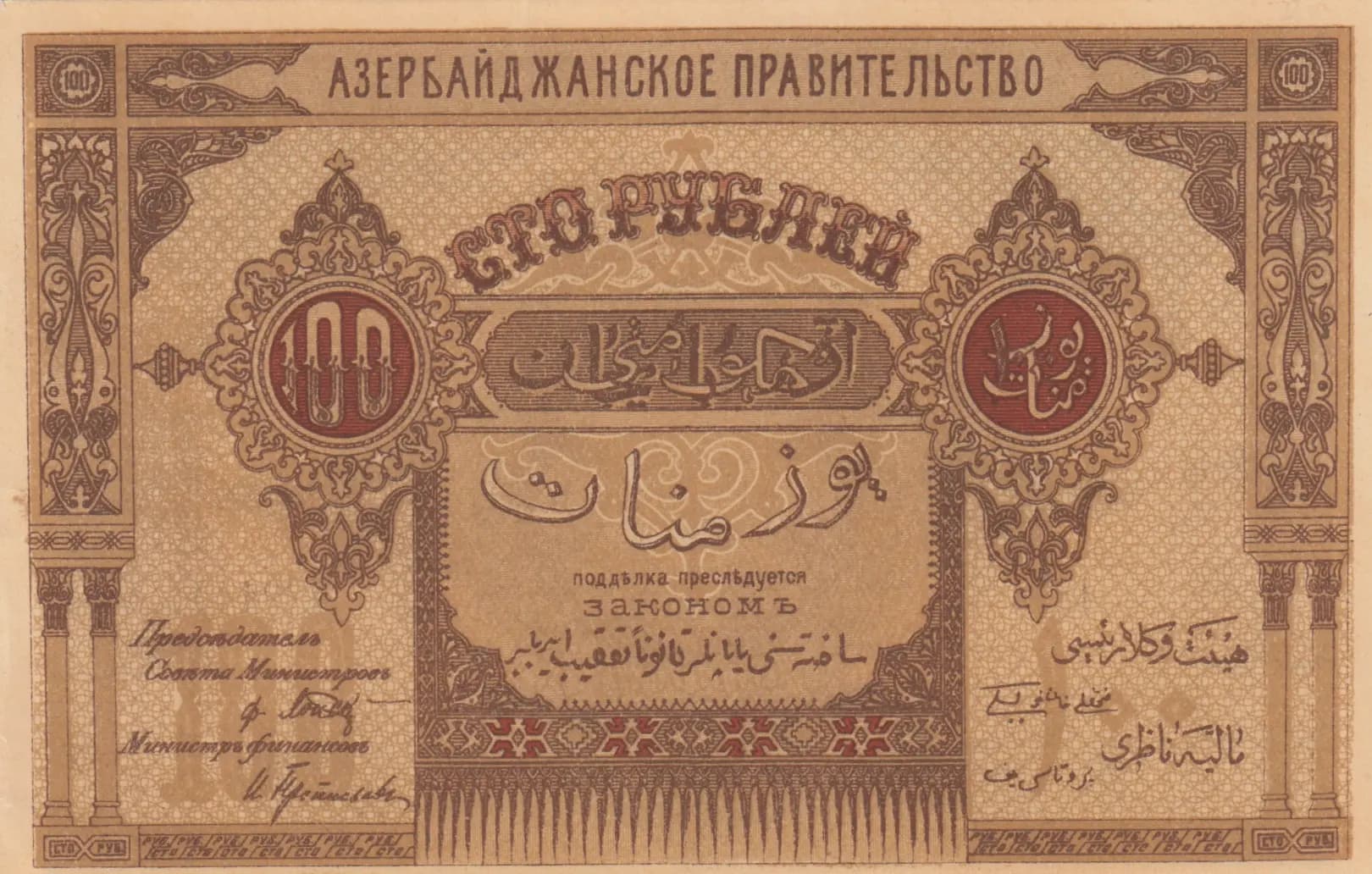
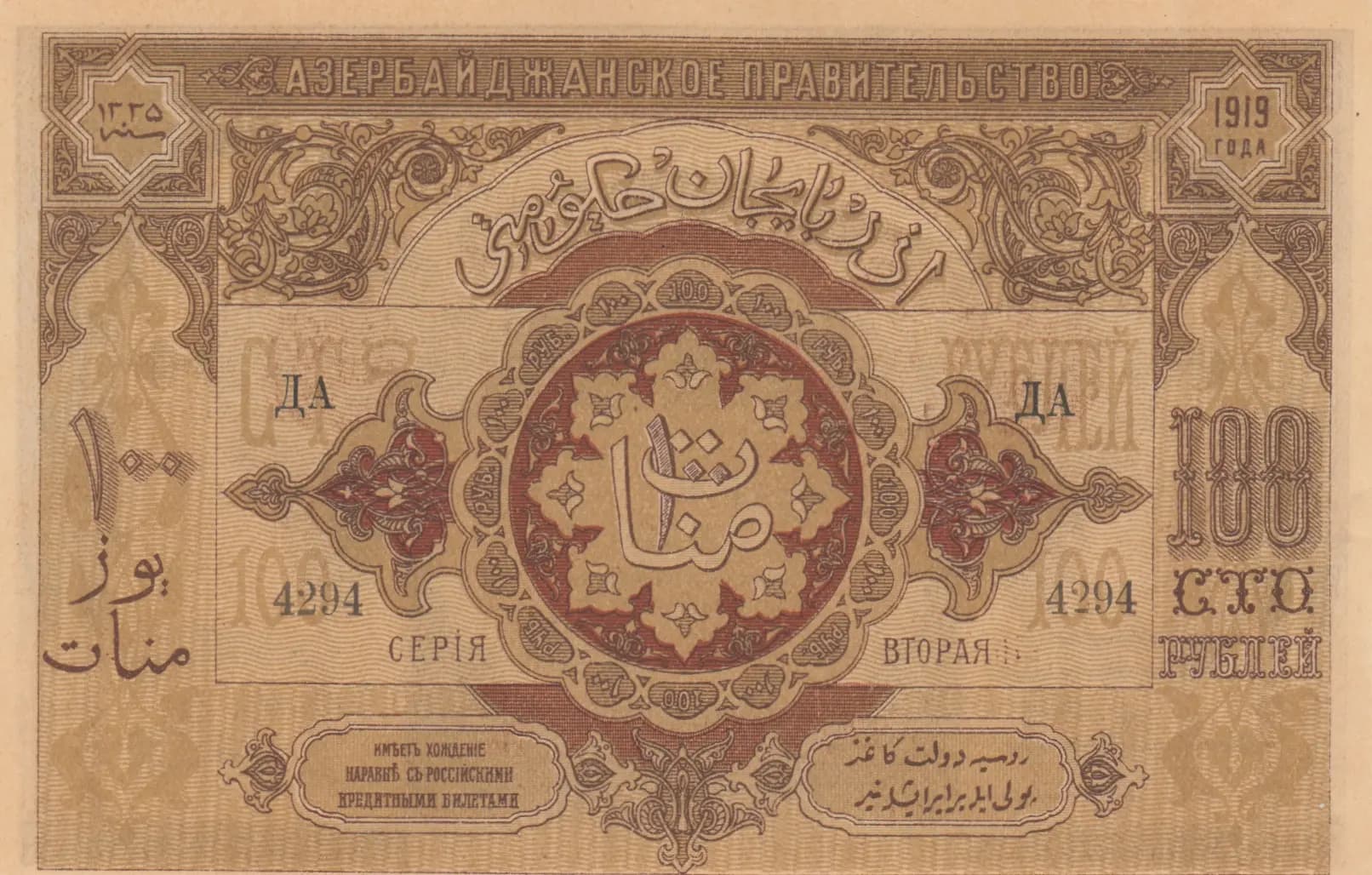
This is an AU-graded 100 Rublei note from the Azerbaijan Government (1919), displaying the characteristic ornate Islamic geometric and floral design typical of early Azerbaijani currency. The note features brown and tan tones on the obverse with dual circular medallions framing Arabic script, while the reverse showcases a striking burgundy and cream central medallion. Despite over a century of age, the note exhibits minimal wear consistent with AU condition, though age-related foxing and discoloration are visible throughout, which is expected and acceptable for notes of this era.
Common. The catalog reference data from realbanknotes.com shows eBay transactions for comparable grades in the $10–$100 range, with Fair grade notes selling for approximately $10.50 (2023). The denomination 100 Rublei was a standard circulating denomination, and no evidence suggests this Pick number had an exceptionally limited print run or was subject to recall. While these notes are historically significant and increasingly difficult to find in circulation, they appear with reasonable regularity in the numismatic market, particularly in the VF–AU grades. The AU condition grade and visible series/serial information (Series 4294) do not indicate a particularly scarce variant.
Issued during the brief existence of the Azerbaijan Democratic Republic (1918–1920), this banknote reflects the nation's attempt to establish fiscal independence and sovereignty following the Russian Revolution. The bilingual design—combining Cyrillic Russian text with Arabic script—illustrates Azerbaijan's dual cultural and linguistic heritage during a transitional period. The inscription stating the note 'has circulation equal to Russian credit notes' demonstrates the complex monetary relationships between Azerbaijan and the collapsing Russian state during this tumultuous period.
This banknote exemplifies the ornamental aesthetic of early 20th-century Caucasian currency design. The obverse features a symmetrical layout with ornate decorative borders incorporating fine Islamic geometric patterns and floral motifs in brown and tan. Two prominent circular medallions frame the denomination—the left displaying the numeral '100' and the right an ornamental design—with a central rectangular frame containing Arabic calligraphy between them. The reverse presents a dominant large circular medallion in the center filled with intricate Islamic star patterns and floral work in deep burgundy and cream, with 'ДА' abbreviations and denomination numerals positioned symmetrically on either side. The overall design reflects Azerbaijani cultural identity and Ottoman-influenced artistic traditions, eschewing portraiture in favor of geometric and calligraphic security elements. The fine line engraving throughout serves as both decorative and security purposes.
OBVERSE: 'АЗЕРБАЙДЖАНСКОЕ ПРАВИТЕЛЬСТВО' (Azerbaijani Government) — top center; 'СТО РУБЛЕЙ' (One Hundred Rubles) — denomination text; 'مائة' (One Hundred) — Arabic numeral text; 'Подделка преследуется законом' (Counterfeiting is prosecuted by law) — security warning. REVERSE: 'АЗЕРБАЙДЖАНСКОЕ ПРАВИТЕЛЬСТВО' (Azerbaijani Government); '1919 ГОД' (1919 Year) — date in upper corners; 'ДА' (Yes/Affirms) — above denomination numerals; '4294 СЕРИЯ ВТОРАЯ' (Series 4294 Second Series) — serial/series information; 'СТО РУБЛЕЙ' (One Hundred Rubles); 'ИМЕЕТ ХОЖДЕНИЕ НАРАВНЕ С РОССИЙСКИМИ КРЕДИТНЫМИ БИЛЕТАМИ' (Has circulation equal to Russian credit notes) — legal tender declaration; Arabic equivalent of the same legal tender text.
Intaglio engraving (recess/line engraving), evidenced by the fine detailed line work visible in the decorative borders, geometric patterns, and ornamental elements. The dense pattern work characteristic of security printing from this era is consistent with the printing standards of Russian and early Soviet security printers who likely produced currency for Azerbaijan during this transitional period. No specific printer attribution is definitively documented in available catalog sources, though the technical quality suggests a state-level security printing operation.
Based on the visual analysis and PMG population data, this note displays characteristics consistent with P-9b (one of two cataloged variants for this Pick number). The reverse inscription '4294 СЕРИЯ ВТОРАЯ' (Series 4294 Second Series) and the specific series designation visible on this note may correspond to identifiable varieties. The visual evidence shows handwritten notations or signatures on the obverse, which is consistent with processing marks from the period. No overprints are evident. Collectors should note that Pick distinguishes between P-9a and P-9b variants, likely based on printer marks, series numbers, or subtle design elements; detailed comparison with reference examples would be required for definitive variety attribution.